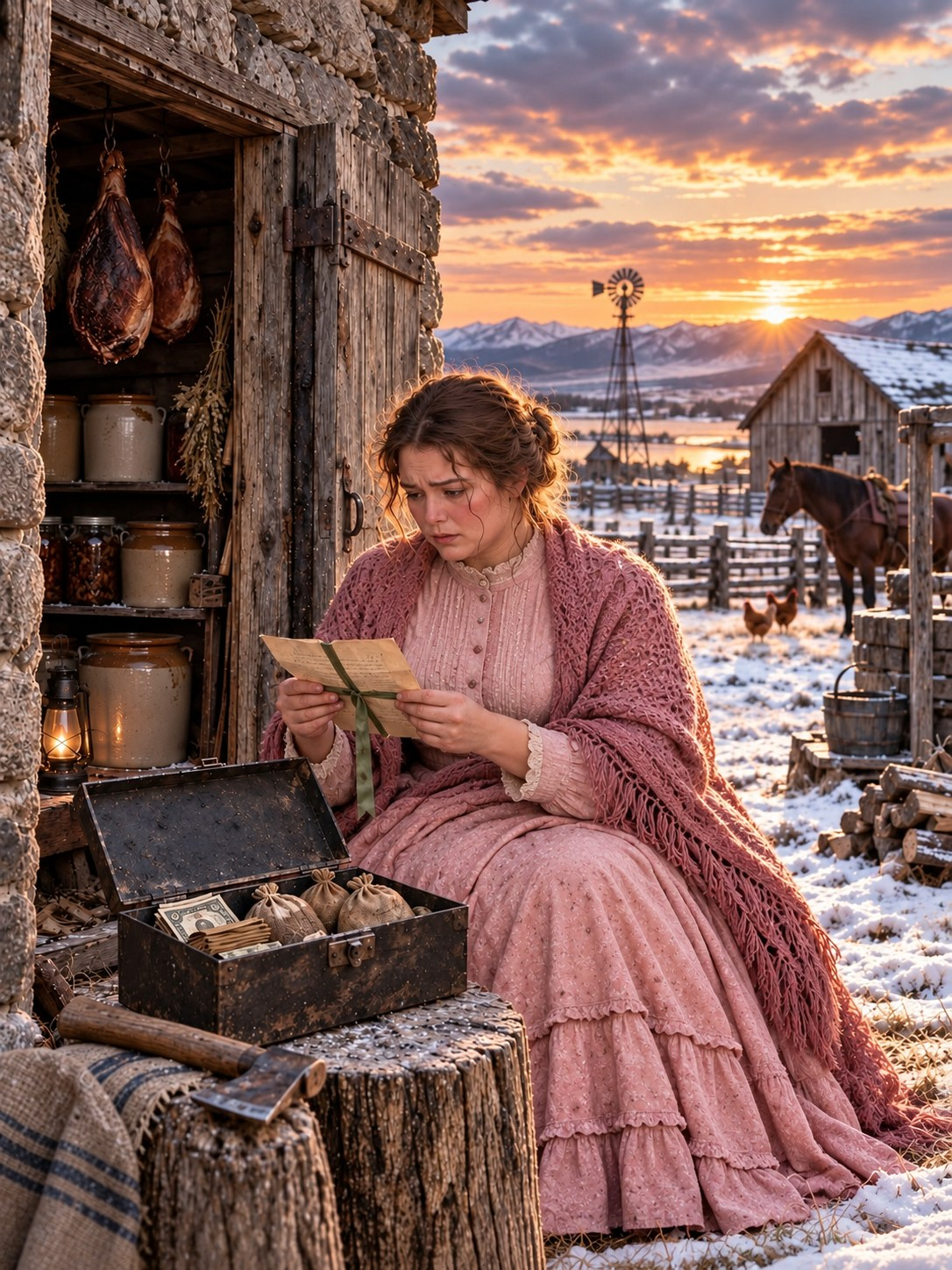
"That name shouldn't be there," Samuel Whitfield whispered.
Martha Mercer stood in the farmhouse doorway, staring at the leather-bound notebook in his hands.
The name was unmistakable.
Mercer.
Written in faded brown ink beneath a date more than thirty years old.
Samuel turned the notebook toward the afternoon light.
"Look at the handwriting," he said. "It's Hannah's. I'd recognize it anywhere."
Martha did not reach for the book.
"Mercer isn't an uncommon name."
"No."
"Then perhaps she knew someone else."
"Perhaps."
But Samuel's expression suggested he didn't believe that explanation.
Martha looked past him toward the empty road. The stranger's black horse stood near the broken fence, its reins looped loosely around a post.
An hour earlier, Silas Pritchard had threatened to seize everything she had discovered.
Now a man claiming to be Hannah Whitfield's nephew had appeared with a notebook containing her family name.
It was too much coincidence for one afternoon.
"How did you know I was here?" Martha asked.
Samuel closed the notebook.
"The county office."
"Who told you?"
"A clerk named Benjamin Hale."
Martha recognized the name. Hale had accepted her claim the previous day, speaking so quietly that she had needed to lean across the counter to hear him.
"He told you I bought the ranch?"
"He told me a young woman had filed on the Whitfield property. Then he said Pritchard had ordered the old records brought out."
"Why would that concern you?"
Samuel glanced toward the smokehouse.
"Because my aunt spent the last years of her life afraid that someone would find what she'd hidden there."
Martha felt her fingers tighten around the door.
"You knew about the box?"
"I knew there was something. I didn't know how much."
"Then why didn't you come for it?"
Samuel looked at her for a long moment.
"Because Hannah told me never to open that smokehouse."
"Why?"
"She said the person who opened it should be someone who needed what was inside more than she did."
Martha studied his face.
He was perhaps forty, with dark hair beginning to gray near his temples and a narrow scar beneath his chin. His coat was worn but well maintained. His boots showed the dust of long travel.
He did not look wealthy.
He did not look desperate.
But she had learned that appearances were poor evidence of character.
"Are you here to claim the money?" she asked.
Samuel's expression changed.
"No."
"Then what do you want?"
"To make sure you survive keeping it."
The words settled between them.
Martha stepped aside.
"Come in."
Samuel removed his hat before entering.
It was a small courtesy, but Martha noticed it.
The men who had treated her most poorly rarely bothered with courtesies unless someone important was watching.
Samuel stood just inside the kitchen, taking in the cracked plaster, crooked cupboard, and cold stove.
"You slept here last night?"
"Yes."
"Alone?"
"Yes."
His gaze moved toward the window.
"Did you hear anything?"
Martha hesitated.
"Wind. Something in the chimney."
"Nothing outside?"
She remembered the footsteps.
Or what she had thought were footsteps.
"Why?"
Samuel did not answer immediately.
Instead, he placed Hannah's notebook on the kitchen table.
"May I see the letter?"
Martha remained beside the doorway.
"Why should I trust you?"
"You shouldn't. Not yet."
The answer surprised her.
Samuel continued.
"Trust is expensive, Miss Mercer. People who have little to spare shouldn't give it away carelessly."
Martha thought of Ellery Booker.
The old woman might have said precisely the same thing.
She crossed the room, opened the tin box, and removed Hannah's letter.
Samuel took it carefully.
His expression softened when he saw the handwriting.
For several seconds, he simply held the paper.
Then he read.
Martha watched him.
His eyes moved slowly across the page. At the mention of Amos and the little boy who had died, his jaw tightened.
When he reached the final sentence, he stopped.
I hope somebody taught you kindly.
Samuel closed his eyes.
"That sounds like her," he said.
"You knew her well?"
"Better than most people did. Not as well as I should have."
He returned the letter.
Martha folded it along its original creases.
"Mr. Pritchard says the money belongs to the county."
Samuel gave a bitter laugh.
"Of course he does."
"He says there are outstanding estate debts."
"There were debts once."
"How much?"
"Less than a hundred dollars when Amos died. Hannah paid them."
"Are you certain?"
"I carried the final payment into town myself."
Martha looked toward the notebook.
"Then why is he claiming otherwise?"
Samuel pulled out a chair but did not sit until Martha nodded.
"Because Silas Pritchard has been trying to get his hands on this ranch for longer than you've been alive."
Martha sat opposite him.
"Why?"
Samuel looked toward the window.
"That's the question Hannah spent thirty years trying to answer."
The first thing Samuel explained was that the Whitfield ranch had not always been considered worthless.
Thirty years earlier, Cotton Hollow had been little more than a scattering of homesteads along a creek.
The land had been difficult.
Winters were brutal.
Summer storms could destroy a year's work in an hour.
But Amos Whitfield had discovered something valuable beneath the north pasture.
Water.
Not merely the creek that crossed the property.
A deep underground source that continued running even during the worst drought.
"He dug a second well," Samuel said. "Farther north than the one near the farmhouse."
Martha frowned.
"I didn't see another well."
"You wouldn't. Hannah covered it years ago."
"Why?"
"Because men began asking questions."
Samuel explained that the surrounding ranches had struggled through a terrible dry season. Several families abandoned their claims. Others sold for almost nothing.
Amos had refused.
He believed the water beneath his land could support livestock even when the creek ran low.
Then a group of businessmen arrived from farther east, offering to purchase the property.
Amos declined.
The offers increased.
He declined again.
Eventually, one of the businessmen threatened to have the land condemned for unpaid taxes.
"Who was he?" Martha asked.
Samuel looked at her.
"Silas Pritchard's father."
Martha felt a chill.
"Was he a county official too?"
"Not then. He was a land speculator named Edwin Pritchard. He bought struggling farms, combined them, and sold them to cattle companies."
"And he wanted Hannah's land?"
"He wanted the water."
Martha considered the broken fences and ruined buildings outside.
"Then why hasn't anyone taken it?"
"Because Hannah was very careful about what she signed."
Samuel opened the notebook.
"She kept copies of every tax payment, every deed, every letter."
He turned several pages.
There were dates.
Names.
Amounts.
Descriptions of livestock sales and purchases.
Martha recognized the habits of someone who had learned that a written record could be more useful than a loaded shotgun.
Then Samuel reached the page containing her surname.
He pointed to the entry.
"Here."
Martha leaned forward.
The writing read:
Mercer—October 14.
Beneath it were three smaller words.
Promise not forgotten.
Martha stared.
"That's all?"
"On this page."
"What does it mean?"
"I don't know."
"You came all this way because of three words?"
Samuel shook his head.
"I came because Pritchard ordered the Whitfield records reopened the moment you claimed the ranch. I brought the notebook because I thought it might help you."
Martha looked at the name again.
"My father was Nathaniel Mercer."
Samuel's eyes lifted.
"Where was he from?"
"Originally Ohio. His family moved west before I was born."
"Did he ever live in Cotton Hollow?"
"Not that I know."
"What about your grandfather?"
Martha shook her head.
"I never met him."
Samuel leaned back.
"Hannah came from Ohio."
"Half the people in Nebraska came from somewhere east."
"True."
Martha closed the notebook.
She did not want to begin imagining connections where none existed.
She had already buried too many people to make ghosts out of coincidences.
"Whatever that name means," she said, "it doesn't change the letter."
"No."
"Hannah left the money to whoever came next."
"She did."
"And I came next."
Samuel nodded.
"Then we need to make sure the county recognizes that."
By late afternoon, Martha had learned three things.
The first was that Samuel Whitfield had spent much of his adult life repairing wagons and farming a small parcel near the Kansas border.
The second was that Hannah had been his father's older sister, a woman he remembered as stubborn, generous, and almost impossible to persuade once she had made up her mind.
The third was that Silas Pritchard had no intention of letting Martha keep the money.
Samuel knew that last fact because Pritchard had already tried to take the property twice.
The first attempt had occurred after Amos died.
The second came during Hannah's final illness.
Both times, the county had produced claims of unpaid taxes.
Both times, Hannah had found receipts proving payment.
"She kept them in a wooden chest beneath her bed," Samuel said.
Martha glanced toward the narrow hallway.
"Is it still there?"
"I don't know."
The bedroom had been nearly empty when Martha arrived.
There was a bed frame, a cracked washstand, and a wardrobe missing one door.
She had not searched beneath the floorboards.
Samuel noticed her expression.
"Don't go tearing the house apart tonight."
"Why?"
"Because if Pritchard knows you've found the money, he'll be watching."
Martha thought of the footsteps outside the previous night.
"Do you believe he came here?"
"Possibly."
"Before I opened the smokehouse?"
Samuel hesitated.
"There's something else you should know."
Martha waited.
"Three months ago, someone tried to purchase this property directly from the county."
"Who?"
"A company called Western Prairie Holdings."
"Who owns it?"
"Nobody seems willing to say."
Martha frowned.
"How can a company buy land without anyone knowing who owns it?"
"With enough lawyers and enough money."
"Was Pritchard involved?"
Samuel gave her a tired look.
"I've never been able to prove it."
The kitchen grew quiet.
Outside, the afternoon light had begun to fade.
Martha considered what Samuel had told her.
The land contained a reliable underground water source.
A powerful family had tried to acquire it.
Hannah had resisted.
Now the ranch had passed into Martha's hands, and the same family wanted it again.
She looked at the tin box.
Four hundred eighty-two dollars.
Enough to repair a farm.
Not enough to fight a powerful man with county officials at his disposal.
"What would you do?" she asked.
Samuel seemed surprised.
"In your position?"
"Yes."
"I'd take the money and leave."
The answer struck her harder than she expected.
"You think I should abandon the ranch?"
"I think a young woman with no family nearby and no legal experience should be careful about fighting men who can afford to ruin her."
Martha looked down.
She had spent twenty-seven miles walking toward this place.
She had signed her name to the claim with a hand that trembled from hunger and exhaustion.
She had slept on the floor and woken believing that, for the first time, she might belong somewhere.
And now another man was telling her to leave.
Samuel seemed to understand.
"I'm not saying it's fair."
"Fairness has never fed me."
"No."
"Neither has running."
He studied her.
Martha continued.
"Mrs. Booker taught me how to repair a roof, plant a field, and keep animals alive through winter. She didn't teach me how to surrender land because someone richer wants it."
Samuel looked at Hannah's letter.
Then he nodded slowly.
"She would have liked you."
Martha felt an unexpected tightness in her throat.
"Who?"
"Hannah."
She said nothing.
Samuel stood.
"Then we do this properly."
"How?"
"First, we establish that the money was a gift, not an estate asset subject to seizure. Second, we examine the county records. Third, we find out who is behind Western Prairie Holdings."
"And if Pritchard refuses?"
Samuel looked toward the road.
"Then we find someone with more authority than he has."
Before leaving, Samuel helped Martha inspect the front door.
The latch was weak.
The lower hinge had begun pulling away from the frame.
He found two usable nails in her pocket and hammered them into place.
Martha watched him work.
"You don't have to do that."
"I know."
"Then why are you?"
Samuel drove the final nail.
"Because Hannah would have been furious if I left you here with a door a determined child could kick open."
Martha almost smiled.
Almost.
He straightened.
"I'll return tomorrow morning. We'll go into town together."
"I can go alone."
"I know you can."
He picked up his hat.
"But there are times when having a witness is useful."
At the doorway, he paused.
"One more thing."
Martha waited.
"If Pritchard comes back tonight, don't open the door."
"What if he has a warrant?"
"Ask to see it through the window."
"And if he insists?"
"Tell him Samuel Whitfield is coming with you to the county office in the morning."
Martha nodded.
Samuel stepped onto the porch.
Then he turned.
"Miss Mercer?"
"Yes?"
"Keep Hannah's letter somewhere separate from the money."
"Why?"
"Because money can disappear."
He glanced at the folded paper in her hand.
"But a dead woman's intentions are harder to explain away when they're written in her own handwriting."
Martha watched him ride away.
Only when his horse disappeared beyond the bend did she return to the kitchen.
She placed the money beneath a loose floorboard near the stove.
The letter went inside her Bible.
The notebook Samuel had left for her to examine remained on the table.
Then she barred the door.
Darkness arrived quickly.
Martha lit the oil lamp and ate a supper of boiled potatoes and the last of her dried apples.
The food was plain.
But she ate slowly, thinking about the money hidden beneath the floor.
Four hundred eighty-two dollars.
She had counted it three times.
The amount remained the same.
It seemed impossible that so much money could belong to someone who had arrived with eleven dollars and forty cents.
She thought of Ellery Booker's nephew.
He had sold the cows within days of the funeral.
He had counted every spoon.
He had given Martha three weeks to leave.
Not once had he asked whether she had enough money to survive.
She wondered what he would say if he knew she now possessed a ranch and more money than she had ever seen.
Probably that she had no business owning either.
Martha pushed the thought away.
She opened Hannah's notebook.
The pages smelled faintly of old leather and dust.
Most entries concerned ordinary ranch matters.
Hay purchased.
Fence repaired.
Calf born.
Winter provisions stored.
But scattered among them were unusual notes.
Pritchard came again.
Amos refused the offer.
The north well must remain covered.
No papers signed.
Martha turned another page.
There was a date.
Then a single sentence.
The boy heard everything.
She stopped.
What boy?
Hannah's son had died young.
Samuel would have been a child when some of these entries were written.
Perhaps the note referred to him.
She turned the page.
Another entry appeared.
Edwin says he has proof. I asked to see it. He refused.
Martha frowned.
Proof of what?
She read farther.
The Mercer matter cannot be settled until the original papers are found.
Her heart began beating faster.
Mercer.
Again.
She moved the lamp closer.
The ink had faded, but the words were clear.
I will not let Edwin take what does not belong to him.
Martha sat back.
The notebook had changed.
It was no longer merely a record of ranch expenses and family memories.
It was evidence of a dispute.
A dispute involving the Pritchards.
And someone named Mercer.
She turned several more pages.
Then she found a folded piece of paper tucked into the binding.
It was smaller than the notebook pages.
The edges had yellowed.
Across the top were the words:
Private memorandum.
Below them was a date.
And beneath that, a list of names.
Amos Whitfield.
Edwin Pritchard.
Nathaniel Mercer.
Martha stopped breathing.
Her father's name.
Not merely her surname.
Nathaniel Mercer.
She read it again.
There could be another man with the same name.
But the possibility felt increasingly unlikely.
Her father had died when she was seventeen.
He had worked as a carpenter, repaired wagons, and occasionally traveled to neighboring counties for seasonal jobs.
He had rarely spoken about his younger years.
When Martha asked why they had moved so often, he usually said that work was easier to find somewhere else.
She had believed him.
Why wouldn't she?
Now his name appeared in a dead woman's notebook, connected to a ranch he had never mentioned and a man who had threatened Martha that very afternoon.
She examined the memorandum.
The lower half was missing.
Someone had torn it away.
Only a few lines remained.
Concerning the agreement made at the north well...
Witnessed by the undersigned...
To be held until such time as...
The sentence ended where the paper had been torn.
Martha turned it over.
Nothing.
She held it toward the lamp.
Still nothing.
Then she noticed a small mark near the bottom.
A number.
17.
She searched the notebook for a corresponding page.
Page seventeen contained a record of livestock purchases.
Nothing unusual.
But the page after it had been removed.
The binding showed a narrow strip of torn paper.
Martha touched it.
Someone had deliberately taken the page.
She thought of Samuel.
He had possessed the notebook for years.
Had he known about the memorandum?
Had he removed the missing page?
Or had Hannah done it herself?
Martha closed the book.
She wanted answers.
But she also wanted to survive until morning.
She checked the door.
Then the windows.
Then the small kitchen knife lying beside the stove.
Outside, the wind had risen.
The barn creaked.
A loose board tapped against the chicken house.
Martha extinguished the lamp and carried her quilt into the kitchen.
She intended to sleep near the stove.
Instead, she remained awake.
Listening.
The first sound came shortly after midnight.
A horse.
Martha sat upright.
The sound was faint, but unmistakable.
Hooves on frozen ground.
Then silence.
She waited.
Perhaps a traveler had passed along the road.
Perhaps Samuel had returned.
Perhaps it was nothing.
Then she heard a metal latch move.
Not the farmhouse door.
The smokehouse.
Martha rose quietly.
She crossed to the window and moved the curtain aside.
Moonlight lay across the yard.
The smokehouse door stood open.
She had closed it before supper.
She was certain.
A dark figure moved near the entrance.
A man.
He carried a lantern covered on three sides, allowing only a narrow strip of light to escape.
Martha watched him enter the smokehouse.
Her heart began pounding.
He was searching for the box.
Pritchard.
Or someone working for him.
She stepped away from the window.
The money was hidden beneath the floor.
The letter was inside her Bible.
The notebook lay on the table.
She had no intention of confronting a stranger in the dark.
But she could not simply stand there while he searched her property.
She moved toward the kitchen door.
Then stopped.
Ellery's voice seemed to rise from memory.
Never walk toward a man in the dark when you don't know what he's carrying.
Martha returned to the window.
The figure emerged from the smokehouse.
He was holding something.
Not the tin box.
Something long and narrow.
A wooden case.
Martha frowned.
She had searched the smokehouse carefully.
She had seen no wooden case.
The man looked toward the farmhouse.
Martha stepped back.
A moment later, the covered lantern went dark.
She heard footsteps.
Then the faint creak of the porch boards.
Someone was outside her door.
Martha held her breath.
The latch moved.
Once.
Twice.
Then a low voice spoke.
"She's inside."
Martha felt the blood drain from her face.
A second voice answered from somewhere beyond the porch.
"Then do it quietly."
She backed away.
There were two men.
Perhaps more.
The latch moved again.
Martha reached for the kitchen knife.
Her hand trembled.
She forced herself to breathe.
She had no firearm.
No dog.
No neighbor close enough to hear her shout.
Only a weak door and a small knife.
Then someone struck the door.
Not hard.
Just enough to test it.
The new nails held.
A man's voice cursed softly.
"She's barred it."
"Then leave it."
"We need the papers."
"Not tonight."
The voices faded.
Martha remained motionless.
She heard footsteps cross the porch.
Then the sound of horses moving away.
Only when the yard fell silent did she lower the knife.
Her legs felt weak.
She sat at the table.
For a long time, she stared at Hannah's notebook.
The men had not asked for the money.
They had asked for the papers.
At dawn, Martha went outside.
The smokehouse door hung open.
The crocks had been moved.
Several shelves were empty.
Someone had scraped the stone wall behind the lowest shelf.
Near the threshold lay a broken piece of wood.
Martha picked it up.
It was part of a small wooden case.
The edges were freshly splintered.
She searched the ground.
Two sets of boot prints crossed the frost.
One was large.
The other narrower.
Both led toward the road.
Near the chopping block, she found something else.
A brass button.
It bore a tiny engraved letter.
P.
Martha turned it over.
The back was scratched.
She slipped it into her pocket.
Then she returned to the farmhouse and opened Hannah's notebook again.
The memorandum remained tucked inside.
The torn page was still missing.
She thought about the words she had heard.
We need the papers.
Not the money.
The papers.
Perhaps Pritchard's threats had never been about four hundred eighty-two dollars.
Perhaps the money was simply what he hoped to use as an excuse to search the ranch.
Martha looked toward the north pasture.
Somewhere beneath the frozen ground lay a covered well.
A well connected to an old agreement.
An agreement bearing her father's name.
She had just decided to search for it when she heard a wagon approaching.
Martha stepped onto the porch.
A county wagon came around the bend.
Two horses pulled it.
Three men sat on the front bench.
Silas Pritchard held the reins.
Beside him sat a uniformed deputy.
The third man carried a leather document case.
Martha watched them stop near the broken gate.
Pritchard climbed down.
His expression was almost cheerful.
"Good morning, Miss Mercer."
Martha said nothing.
The deputy approached the porch.
Pritchard removed a folded paper from his coat.
"I gave you an opportunity to cooperate yesterday."
Martha looked at the document.
"What is that?"
"A lawful order."
"Signed by whom?"
"The district magistrate."
She held out her hand.
Pritchard hesitated.
Then he gave her the paper.
Martha read slowly.
The order authorized the seizure of disputed estate assets.
It also authorized an inspection of the farmhouse, smokehouse, and surrounding outbuildings.
Her stomach tightened.
"You had this prepared before you came yesterday."
Pritchard smiled.
"I anticipated difficulties."
Martha looked at the deputy.
"Does this allow them to take my personal belongings?"
"No, ma'am," the deputy answered. "Only property specifically connected to the Whitfield estate."
Pritchard's smile faded slightly.
Martha folded the paper.
"Then I want an inventory of everything removed."
"You'll receive one."
"And I want the names of everyone entering my house."
Pritchard stared at her.
The deputy nodded.
"That's reasonable."
For the first time, Martha saw irritation flash across Pritchard's face.
He had expected fear.
Perhaps tears.
Perhaps pleading.
Instead, she was asking questions.
The third man stepped down from the wagon.
He was younger than Pritchard, with pale hair and an expensive coat.
He opened his document case.
"Miss Mercer, my name is Charles Vane. I represent Western Prairie Holdings."
Martha felt her pulse quicken.
The company Samuel had mentioned.
The company that had tried to purchase the ranch.
Vane smiled politely.
"My employers are prepared to offer you a generous settlement."
"I haven't asked to sell."
"No. But circumstances have changed."
"What circumstances?"
"The discovery of assets that may complicate your claim."
Martha looked at Pritchard.
Then at Vane.
"How much?"
Vane seemed pleased.
"Two hundred dollars."
Martha stared.
"For the ranch?"
"Cash. Today."
"One hundred sixty acres?"
"With the understanding that the property requires substantial repairs."
"And the water?"
Vane's smile disappeared.
"What water?"
"The north well."
Silence.
Pritchard turned sharply toward her.
"Who told you about that?"
Martha looked at him.
"Why does it matter?"
Vane closed his document case.
The deputy glanced between them.
For several seconds, nobody spoke.
Then Pritchard stepped forward.
"Miss Mercer, I suggest you accept the offer."
"No."
"Think carefully."
"I have."
"You don't understand what you're refusing."
Martha looked toward the distant pasture.
"Then perhaps you should explain it."
Pritchard's face darkened.
Vane placed a hand on his arm.
"Silas."
The name was spoken quietly.
But it carried authority.
Pritchard stopped.
Vane turned back to Martha.
"Perhaps we should discuss this privately."
"There's nothing private about a land sale."
He smiled again.
"Very well."
He opened the document case.
Removed a folded sheet.
And placed it on the chopping block.
"This is the original purchase agreement."
Martha looked down.
The paper was old.
Older than the county notice.
Older than the document Pritchard had shown her yesterday.
Across the top were the words:
Agreement for Transfer of Water Rights.
Below them were several names.
Amos Whitfield.
Edwin Pritchard.
And Nathaniel Mercer.
Martha felt the world narrow.
Her father's name.
Again.
Vane watched her carefully.
"Now perhaps you understand why your claim is complicated."
Martha reached for the document.
Pritchard moved to stop her.
But the deputy stepped between them.
"Let her read it."
Martha unfolded the paper.
Her eyes moved down the page.
There were legal phrases she barely understood.
References to water access.
Land boundaries.
Future transfers.
Then she reached the final paragraph.
The signature at the bottom was unmistakable.
Nathaniel Mercer.
Her father.
But beside it was a notation written in darker ink.
Witness deceased before execution.
Martha stared at the words.
Her father had signed a document after someone had recorded him as dead.
She looked up at Vane.
"Where did you get this?"
He did not answer.
Pritchard stepped closer.
"Miss Mercer, I believe it's time you came with us."
The deputy frowned.
"On what charge?"
Pritchard reached into his coat.
"Fraudulent acquisition of disputed property."
Martha looked at the paper again.
Then at the three men.
She suddenly understood why they had arrived together.
The offer had never been an offer.
It was a warning.
And if she refused, they intended to remove her.
The deputy reached for the warrant.
"Let me see that."
Pritchard hesitated.
At that moment, another horse approached from the road.
Samuel Whitfield.
He rode hard, his coat flapping behind him.
He stopped beside the wagon and dismounted before the horse had fully settled.
"Don't sign anything!" he shouted.
Vane turned.
Pritchard's face went white.
Samuel crossed the yard.
He saw the document in Martha's hands.
Then he saw the signature.
For a moment, he looked genuinely frightened.
"Where did you get that?" he demanded.
Vane closed his case.
"That is none of your concern."
Samuel ignored him.
He looked directly at Martha.
"Listen to me. Whatever they told you, don't believe it."
Martha held up the paper.
"My father's name is on this."
Samuel stopped.
His eyes moved to the bottom of the document.
Then to the notation beside the signature.
His face changed.
He looked at Pritchard.
"You forged it."
Pritchard stepped backward.
Samuel's voice rose.
"You used a dead man's name!"
The deputy reached for the paper.
Vane suddenly moved.
He grabbed the document from Martha's hand.
Samuel seized his wrist.
The two men struggled.
The leather case fell.
Papers scattered across the frozen ground.
Martha stepped back.
Then she saw something slide from beneath the fallen documents.
A small envelope.
Yellowed.
Sealed with dark green wax.
Across the front, in handwriting she recognized from Hannah's letter, were four words.
For Nathaniel Mercer's daughter.
Martha bent to pick it up.
Vane lunged toward her.
Samuel shouted her name.
But Martha had already broken the seal.
Inside was a single folded page.
She opened it.
The first sentence made her stop breathing.
If you are reading this, Martha, then the man who murdered your father has finally come for the ranch.






Comments 0