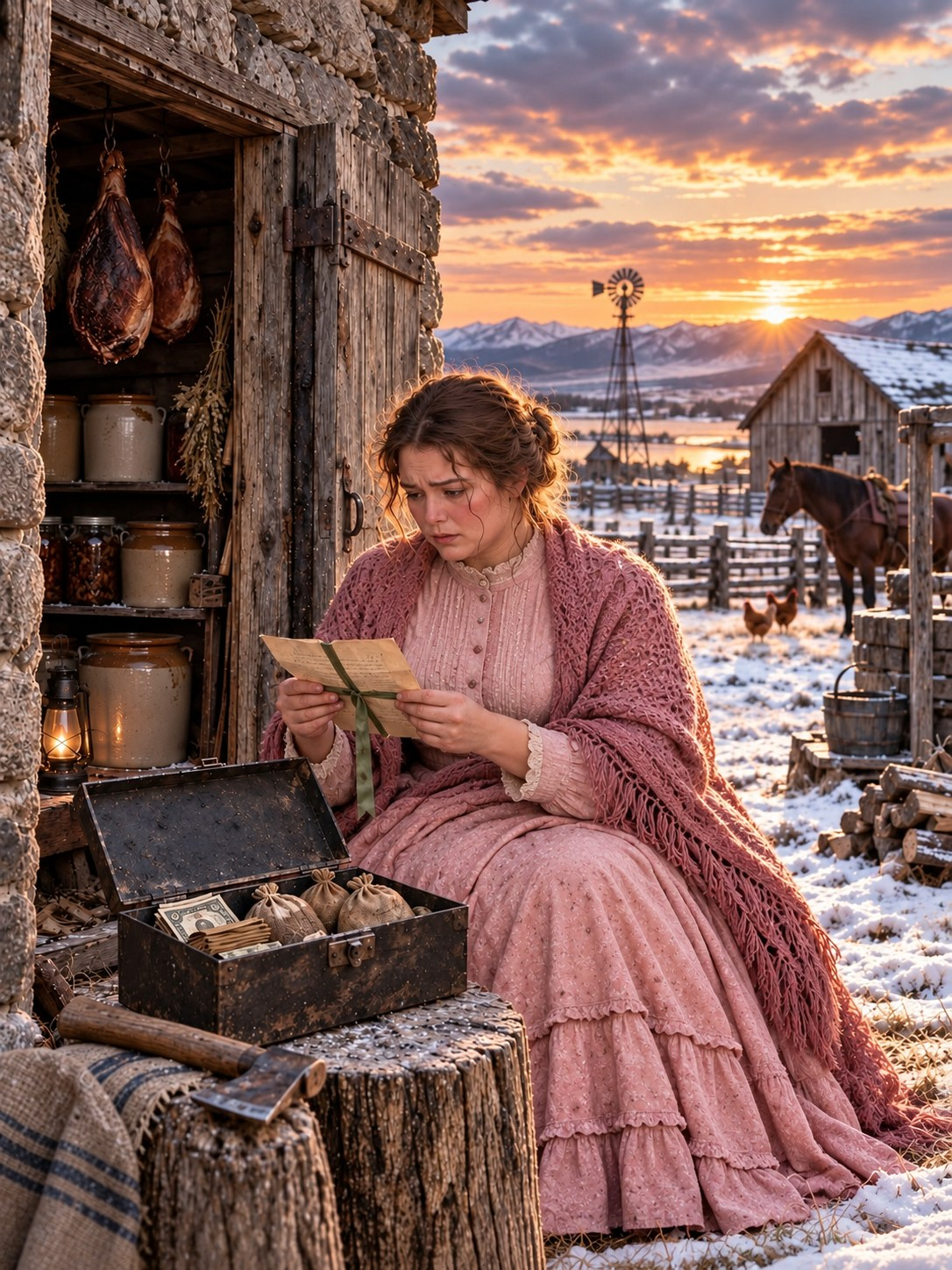
"Don't touch that box!" a man shouted from the other side of the fence.
Martha Mercer stopped with her father's folding knife against the rusted lock of a black tin chest.
The stranger wore a fine wool coat and carried a county ledger stamped with an official seal.
On the bottom of the page facing her, someone had written three words in red ink.
WHITFIELD PROPERTY—DISPUTED.
Martha looked from the ledger to the sealed smokehouse behind her.
The ranch was not abandoned after all.
At least, someone had a powerful reason to pretend it wasn't.
Twenty-four hours earlier, Martha Mercer had possessed eleven dollars and forty cents, two dresses, a Bible, and no place in Nebraska where anyone was required to let her sleep.
Now she owned one hundred sixty acres.
Or so the county clerk had assured her.
The land lay beyond Cotton Hollow, where the road deteriorated into two wagon ruts and the prairie seemed to swallow every sound except the wind.
The farmhouse leaned slightly east.
The barn had a sliding door that hung from one hinge.
The chicken house had lost half its roof.
The corral would not have held a stubborn goat.
And the stone smokehouse beside the kitchen garden had been sealed with enough black pitch and ironwork to discourage anyone without considerable patience.
Martha had plenty of patience.
It was money she lacked.
She had arrived the previous afternoon carrying everything she owned in a canvas sack. She had spent her first night on the farmhouse floor beneath a quilt that smelled faintly of cedar and dust.
She had not slept much.
The wind found every crack in the walls.
Something scratched inside the chimney.
Twice, she thought she heard footsteps outside.
But when morning arrived, the property was still standing, and no one had come to tell her to leave.
That alone felt like an improvement.
Before sunrise, she had eaten the last piece of bread from her sack, sharpened her borrowed hatchet, and walked toward the smokehouse.
She intended to learn whether the little stone building contained anything worth saving.
Perhaps a sound shelf.
Perhaps an iron hook.
Perhaps a crock that could hold drinking water.
She had not expected to find a fortune.
And she certainly had not expected a stranger to arrive before she had even opened the box.
"Did you hear me, miss?"
Martha looked up.
The man stood outside the broken corral, one gloved hand resting on the top rail.
He was perhaps fifty, with a narrow face, carefully trimmed mustache, and polished boots that looked entirely unsuited to the road leading here.
His horse was a handsome chestnut gelding.
Its saddle cost more than everything Martha owned.
"I heard you," she answered.
"Then put that knife down."
Martha glanced at the blade.
It was small, worn, and currently wedged beneath a rusted lock plate.
"I'm opening a box."
"I can see that."
"Then I don't believe we have a misunderstanding."
The man's expression hardened.
"Young lady, I represent the county."
Martha waited.
He seemed accustomed to that declaration producing immediate obedience.
When it did not, he opened the ledger.
"My name is Silas Pritchard. I oversee delinquent property accounts and disputed tax forfeitures in this district."
Martha remembered the name.
The clerk who had processed her claim had mentioned him.
Not kindly.
"Mr. Pritchard," she said, "I filed my claim yesterday. I have the receipt."
"That is precisely why I'm here."
He stepped through the opening where a gate should have been.
Martha watched his boots sink into the frozen mud.
"You see," he continued, "there have been irregularities concerning this parcel."
"What kind?"
"Ownership irregularities."
"The county sold it."
"The county accepted an application."
"The clerk said the land was mine."
"Clerks make mistakes."
Martha placed the folding knife beside the box.
"Then I suggest you speak to the clerk."
Pritchard's mouth tightened.
"You are not in a position to be difficult."
It was a familiar sentence.
She had heard variations of it throughout her life.
From men who believed a young woman without money should be grateful for whatever she was offered.
From Ellery Booker's nephew, who had stood in the kitchen after his aunt's funeral and explained that Martha had three weeks to find another place to live.
From a shopkeeper who once suggested that a girl who couldn't pay cash ought to learn how to smile more pleasantly.
Martha had learned something from every one of them.
The people most eager to remind her of her position were usually afraid she might discover she had a better one.
"What do you want?" she asked.
Pritchard looked at the black tin box.
"That depends on what you've found."
Martha said nothing.
His gaze moved to the open smokehouse.
"How did you get inside?"
"I opened the door."
"It was sealed."
"Yes."
"By whom?"
"I wasn't here when it happened."
He did not appreciate that answer.
Martha could tell.
He approached the chopping block and examined the scattered strips of tin, square-cut nails, and pieces of hardened pitch.
"You shouldn't have disturbed this building."
"Why?"
"It may contain estate property."
"Whose estate?"
He hesitated.
Only briefly.
But Martha noticed.
"Hannah Whitfield," he said.
The name meant nothing to her.
Yet something in his voice made it sound as though it should.
"Was she the previous owner?"
"Among other things."
"Is she alive?"
"No."
"Does she have family?"
Pritchard closed the ledger.
"That is not your concern."
Martha looked at the box again.
She had found it behind the lowest crock, hidden so carefully that only someone searching every shelf would have discovered it.
The smokehouse had been sealed from the outside.
Whoever placed the box there had intended it to remain hidden.
But hidden from whom?
"I haven't opened it yet," Martha said.
Pritchard's eyes sharpened.
"Then give it to me."
"Why?"
"Because it may contain documents belonging to an unsettled estate."
"Then we should find out what it contains."
"I'll handle that."
Martha picked up her knife.
Pritchard took one step forward.
"Miss Mercer."
She looked at him.
"I would strongly advise against testing my patience."
Martha remembered Ellery Booker standing over a slaughtered hog with a bloody knife in her hand.
Never let a man hurry you when he's the one who wants something.
Ellery had been seventy-one then.
Her back had been bent.
Her hands had been swollen with arthritis.
But she could still look a grown man in the eye until he remembered his manners.
Martha slid the knife beneath the lock plate.
"Then you may want to return to town," she said. "This could take a while."
The lock gave way with three careful taps.
The lid lifted.
Pritchard stopped breathing.
Martha saw it happen.
Not because he gasped.
Not because he spoke.
Because his eyes moved immediately to the folded paper tied with green ribbon.
He had not yet seen the money.
He had not seen the cloth pouches.
But he recognized the ribbon.
That was the first thing that frightened her.
Inside the box lay three small cloth bags, a worn leather wallet, and the folded letter.
Martha touched the nearest pouch.
Coins shifted.
She opened the wallet.
Banknotes.
Old, carefully folded banknotes.
More money than she had ever held.
For a moment, the ranch around her seemed to disappear.
She saw roof shingles.
Fence wire.
Seed potatoes.
A milk cow.
Flour.
A proper stove.
A winter without wondering whether she would have enough food to reach spring.
Then Pritchard spoke.
"Close it."
Martha looked up.
His face had changed.
The arrogance remained, but something else had appeared beneath it.
Fear.
"How much is there?" he demanded.
"I haven't counted."
"Give me the box."
Martha reached for the letter.
"Not until I know who it belongs to."
Pritchard extended his hand.
"Miss Mercer, I am giving you a direct instruction."
"And I'm asking a reasonable question."
He glanced toward the empty road.
Then toward the farmhouse.
Then back at the box.
"That money is subject to county seizure."
"On what grounds?"
"Outstanding obligations."
"What obligations?"
"Taxes. Estate debts. Legal costs."
"How much?"
"That has yet to be determined."
Martha studied him.
It was strange, she thought, how a man could know that money must be seized without knowing how much was owed.
She untied the ribbon.
Pritchard moved quickly.
"Don't read that."
Martha looked at him.
"Why?"
"Because private estate correspondence is not your property."
"Then you can explain that to a judge."
His eyes narrowed.
"You're making a serious mistake."
Martha unfolded the paper.
The handwriting was steady and deliberate.
For whoever finds this.
She read the first paragraph.
Then the second.
Then the third.
Hannah Whitfield had come west from Ohio with her husband, Amos.
They had built the ranch together.
They had raised a son.
They had buried that son when he was nine years old.
Years later, fever had taken Amos.
Hannah had remained.
Alone.
She had worked the land, repaired what she could, and saved what little remained after each harvest.
When her heart began failing, she had prepared the smokehouse.
She had sealed food in crocks.
She had hidden her savings.
And she had written a letter to the person who might someday arrive with enough courage to stay.
Martha's fingers tightened around the paper.
The money amounted to four hundred eighty-two dollars.
Every cent was intended for the next person willing to make a home on the land.
Not a relative.
Not a creditor.
Not a county official.
Whoever came next.
Martha read those words twice.
Pritchard held out his hand again.
"Give me the letter."
She ignored him.
Hannah had written about the apple grafts in the north corner.
The good well.
The creek that never ran dry.
The importance of curing meat before the first hard frost.
Then came the final sentence.
I hope somebody taught you kindly.
Martha could no longer see the page clearly.
She blinked.
Once.
Twice.
She thought of Ellery Booker.
The woman who had taken her in at thirteen after her mother died.
Ellery had never been soft.
She had never called Martha her daughter.
She had taught her how to sharpen a blade, mend a harness, preserve fruit, and tell whether a horse was favoring one leg.
She had pushed a bowl of soup across the table when Martha was too grief-stricken to eat.
She had left a quilt outside Martha's bedroom during the first winter.
She had taught her to survive.
And she had done it kindly, even when kindness wore the face of stern instruction.
Martha lowered the letter.
For a moment, she forgot Pritchard was there.
Then he said something that brought her back.
"That woman had no right."
Martha looked up.
"What?"
Pritchard's face was pale.
"Nothing."
"You said she had no right."
"I said the document has no legal authority."
"That's not what you said."
He stepped closer.
"Miss Mercer, I am prepared to overlook your interference if you surrender the contents immediately."
Martha folded the letter.
"Who was Hannah Whitfield to you?"
His expression went blank.
"A deceased taxpayer."
"Then why did you know about the ribbon?"
Silence.
A gust of wind lifted the corner of the paper.
Pritchard stared at her.
Martha felt the cold settling into her hands.
She was twenty-four.
She was alone.
She had no family to defend her.
And she was standing beside a box of money while a county official demanded that she hand it over.
She knew how such disagreements usually ended.
Not in favor of the girl with eleven dollars.
Pritchard reached inside his coat.
Martha stiffened.
But he withdrew a folded document.
"This," he said, "is notice that the Whitfield property remains subject to outstanding claims. Until those claims are resolved, all movable assets must be surrendered."
He held it out.
Martha accepted the paper.
It bore an official stamp.
Several signatures.
A date.
She read slowly.
Her schooling had been interrupted too many times for her to consider herself an educated woman, but Ellery had insisted she learn to read contracts before she ever signed one.
"Why is this dated last month?" Martha asked.
"Because the investigation began last month."
"Then why did the county sell the land yesterday?"
"Administrative delay."
"Does the clerk know?"
"Of course."
"Then why didn't he tell me?"
Pritchard's voice sharpened.
"Because you are not entitled to explanations concerning county procedure."
Martha looked at the document again.
The bottom line carried a handwritten notation.
Whitfield Property—Disputed.
Beneath it was a smaller entry.
Claimant to be notified upon recovery of personal effects.
Martha frowned.
"Claimant?"
Pritchard said nothing.
"Who is the claimant?"
"That information is confidential."
"Is it you?"
He gave a short, humorless laugh.
"Don't be ridiculous."
Martha folded the notice.
"Then I won't be giving you anything today."
Pritchard's face darkened.
"You don't understand the seriousness of this."
"I understand that you came here before I opened a box nobody was supposed to know existed."
"I knew the smokehouse contained estate property."
"How?"
He said nothing.
Martha continued.
"You recognized the ribbon. You knew the name of the woman who wrote the letter. You knew the box might contain money."
"Enough."
"And you haven't once asked whether I found anything else."
Pritchard stared at her.
For the first time, Martha saw him without the protection of his polished boots, fine coat, and county ledger.
He was simply a frightened man trying to take something from someone he believed too weak to refuse.
"Listen carefully," he said.
His voice had become quiet.
"You're new to Cotton Hollow. You don't know how things work here. People who challenge the county often discover that life becomes unnecessarily difficult."
Martha thought of the broken barn.
The empty pantry.
The farmhouse with its leaking roof.
Life was already difficult.
She wasn't sure what more he intended to do.
"I'll come to town tomorrow," she said. "I'll speak to the clerk who accepted my claim."
Pritchard shook his head.
"You'll bring the box to my office before sundown."
"No."
The word surprised both of them.
Martha had not raised her voice.
She had not intended to sound defiant.
But the refusal stood between them as firmly as a locked door.
Pritchard studied her for several seconds.
Then he smiled.
It was not a pleasant smile.
"You remind me of Hannah."
Martha felt something tighten in her stomach.
"You knew her?"
"Everybody knew Hannah Whitfield."
"Was she a good woman?"
His smile disappeared.
"She was a stubborn woman."
"Those aren't the same thing."
"Sometimes they are."
He returned the ledger to his saddlebag.
"Before sundown, Miss Mercer."
He mounted his horse.
Then he looked back.
"One more thing."
Martha waited.
"Don't trust every word you read in that letter."
"Why?"
Pritchard adjusted his reins.
"Because Hannah Whitfield was not the woman you think she was."
He rode away before Martha could ask what he meant.
Martha stood beside the chopping block until the horse disappeared beyond the bend.
Only then did she realize her hands were shaking.
She placed the letter inside the box and shut the lid.
For several minutes, she simply breathed.
She had faced hardship before.
Hunger.
Grief.
Cold.
Loneliness.
But those were troubles she understood.
This was different.
A man with official authority had arrived at an abandoned ranch, recognized a letter he should never have seen, and demanded money that a dead woman had deliberately hidden.
And he had been afraid.
Not of Martha.
Of what she might discover.
She carried the box into the farmhouse.
The kitchen was barely usable.
One cupboard door hung crookedly.
The stove needed cleaning.
A broken chair lay beside the fireplace.
But the table was sound.
Martha set the box on it and examined the contents again.
Three cloth pouches.
One wallet.
One letter.
Four hundred eighty-two dollars.
She counted the money twice.
The total matched Hannah's handwriting exactly.
Then she read the letter a second time.
Hannah's story was plain and unadorned.
There were no grand declarations.
No promises of wealth.
Only a tired woman explaining what she had saved and why she wanted someone else to have it.
Martha understood that kind of woman.
Ellery Booker had been one.
She had never wasted words telling Martha she loved her.
But she had taught her everything she knew.
And when she died, Martha discovered that every tool in the shed had been sharpened.
Even the ones nobody had used in years.
Martha had wondered then whether Ellery had known death was coming.
Now she wondered whether Hannah Whitfield had felt the same need to prepare something for the person left behind.
She looked toward the window.
The ranch lay silent.
The barn leaned.
The fence sagged.
The land was poor in places and overgrown in others.
But it was land.
Her land.
If the county had told the truth.
She unfolded Pritchard's notice beside Hannah's letter.
The official seal looked genuine.
The signature was difficult to read.
The date was recent.
She examined the bottom notation again.
Claimant to be notified upon recovery of personal effects.
Whoever had written it expected something to be recovered.
Perhaps the box.
Perhaps the letter.
Perhaps something else.
Martha remembered the smokehouse shelves.
Eleven crocks.
Two hanging hams.
A small hidden space behind the lowest crock.
She had searched only one corner.
What if Hannah had left more?
She dismissed the thought.
Greed was dangerous.
Ellery had warned her about that too.
But curiosity was not greed.
And someone had tried very hard to keep her from reading the letter.
Martha folded the notice.
Then she noticed something strange.
The county seal had been pressed through the paper so firmly that it left an impression on the back.
But beneath the seal was another mark.
Faint.
Almost invisible.
She carried the document to the window.
Held it against the light.
And saw that the paper had been used before.
Someone had written on the reverse side, then scraped away the ink.
Martha tilted it.
Three letters became visible.
Then a number.
Then part of a name.
She reached for the small bottle of lamp oil on the shelf, remembering an old trick Ellery had once shown her for reading faint marks on paper.
But before she could try it, she heard a horse outside.
Martha froze.
Pritchard had been gone less than an hour.
She moved toward the window.
A rider was approaching the farmhouse.
Not Pritchard.
This horse was black.
The rider wore a dark coat and a broad-brimmed hat pulled low.
He stopped beside the broken gate.
Dismounted.
Then stood perfectly still, studying the smokehouse.
Martha's hand moved toward her father's folding knife.
The stranger approached the porch.
He did not knock immediately.
Instead, he looked toward the kitchen window.
Martha stepped back.
A moment later, three slow knocks sounded against the front door.
She waited.
Then a man's voice spoke from outside.
"Miss Mercer?"
Martha said nothing.
"I know you found Hannah Whitfield's letter."
Her breath caught.
The man continued.
"And if Silas Pritchard has already been here, you need to listen very carefully."
Martha approached the door.
"Who are you?"
There was a pause.
Then the stranger answered.
"My name is Samuel Whitfield."
Martha stared at the wood.
Whitfield.
The same name as the dead woman.
The stranger spoke again.
"Hannah was my aunt."
Martha gripped the door handle.
Then he said something that made her blood turn cold.
"She left that money for you. But she didn't tell you what happened to the last woman who tried to claim this ranch."
Martha pulled the door open.
The stranger stood on the porch holding a small leather-bound notebook.
Its cover was cracked.
Its corners were worn.
And across the front, in faded gold lettering, were two words.
HANNAH WHITFIELD.
Samuel opened the notebook to a page marked with a strip of green ribbon.
"Before you decide whether to trust me," he said, "there's something you need to see."
Martha looked down.
Beneath a date written thirty years earlier was a list of names.
The final name had been crossed out so violently that the pen had torn through the paper.
Samuel turned the page.
And Martha saw her own surname written in Hannah Whitfield's handwriting.
Mercer.
Samuel's face went pale.
"That's impossible," he whispered. "Hannah wrote that before you were born."






Comments 0