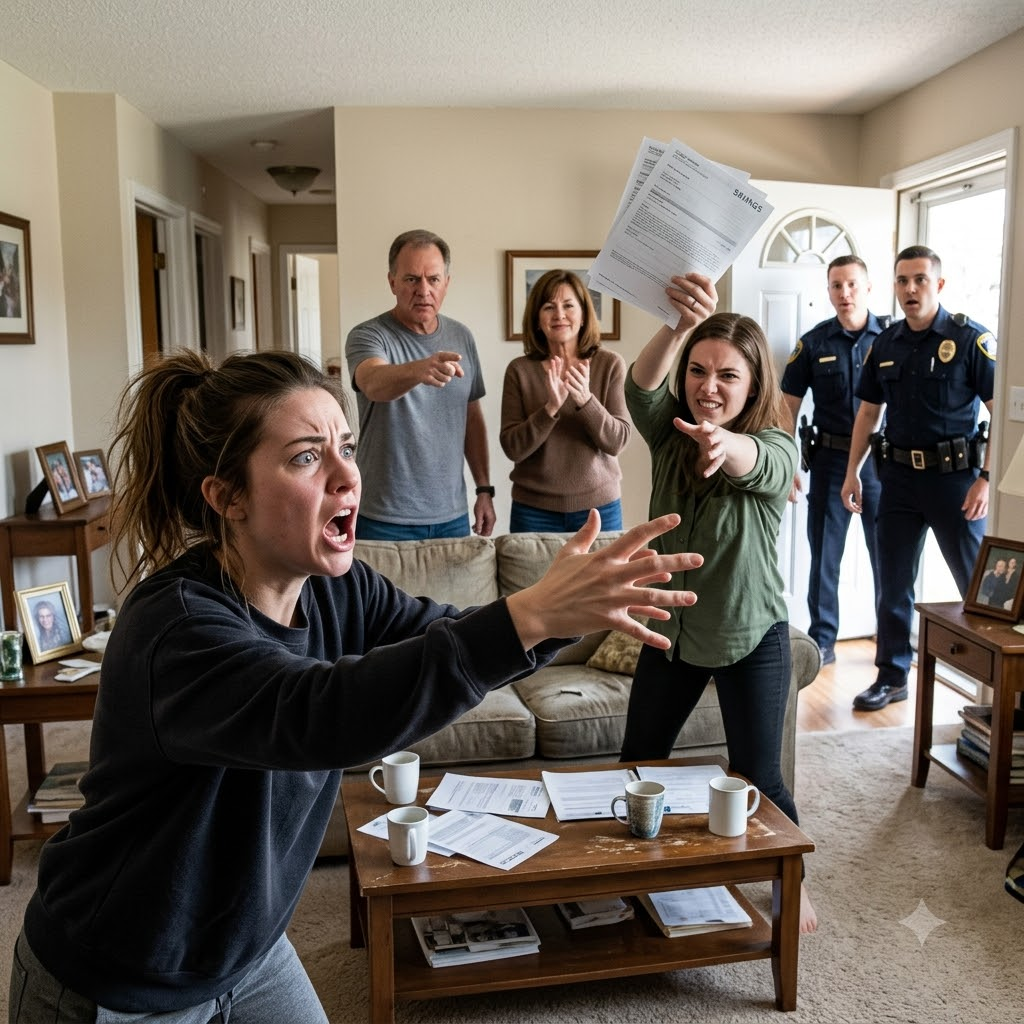
"Don't open that door!"
Officer Bennett grabbed my arm as I moved closer to the screen.
The man standing outside my apartment was holding a white envelope.
I recognized his face.
His name was Martin Keene.
And he was the last person I expected to see connected to my family's attempt to steal my savings.
Martin was sixty-one years old. He had worked as a financial consultant for years and had been my father's personal accountant for as long as I could remember.
He had attended family birthday parties.
He had sat at our Thanksgiving table.
He had once given me a book about managing money when I graduated from college.
I had always thought of him as a family friend.
But there was something I had never known.
He had been involved in my finances long before Rachel opened her boutique.
"Do you know this man?" Officer Bennett asked.
I nodded.
"His name is Martin Keene. He's my father's accountant."
"Has he ever had access to your apartment?"
"Not that I'm aware of."
"Has he ever handled your bank accounts?"
"No."
Officer Harris looked at the recording again.
The timestamp showed 8:42 a.m.
Martin stood outside my apartment door, looking down the hallway before taking something from his coat pocket.
He didn't have a key.
He had a white envelope.
He knocked twice.
Then he looked directly toward the doorbell camera.
He waited.
Nobody answered.
He knocked again.
Finally, he slipped the envelope beneath my door.
Then he walked away.
I replayed the footage.
"Why would he come here?"
Officer Bennett didn't speculate.
"Do you remember receiving anything that morning?"
I shook my head.
"I was at work."
"Did you check your mailbox?"
"Probably that evening."
"Could the envelope still be inside?"
I thought about it.
My mail was delivered to a locked mailbox in the building lobby.
I hadn't checked it in several days.
But Martin hadn't put the envelope there.
He had delivered it directly to my apartment.
"Maybe," I said.
Officer Harris asked whether I was comfortable checking the hallway and mailbox with them.
I nodded.
We left the office and walked toward the front door.
Before opening it, Bennett checked the camera recording again.
The hallway was empty.
He opened the door.
I stepped outside.
And there, near the bottom of the doorframe, was a small folded piece of white paper.
It had been pushed against the wall and partially hidden by the entrance mat.
I bent down.
Bennett stopped me.
"Let me examine it first."
He carefully picked it up.
The paper had been folded twice.
There was no envelope.
No stamp.
No return address.
Just my name written across the front.
MEGAN CARTER.
I recognized the handwriting.
Martin's.
Officer Bennett photographed the paper before opening it.
Inside was a single printed sheet.
It contained a short message.
Ms. Carter,
Your father asked me to review some financial paperwork concerning your savings account. I believe there has been a misunderstanding about the authorization process. Please call me before speaking with anyone else about this matter.
Martin Keene.
At the bottom was a telephone number.
I stared at it.
"He's trying to contact me."
Officer Harris looked at the note.
"Did you ask him to review your financial paperwork?"
"No."
"Did you give him permission to discuss your account?"
"No."
Officer Bennett placed the note with the other evidence.
"Then don't call him yet."
I nodded.
But I couldn't stop thinking about the message.
My father had asked Martin to review my financial paperwork.
How much had he shown him?
My account statements?
My identification?
My savings history?
My signature?
And why had Martin waited outside my apartment rather than contacting me directly?
Back inside, Officer Bennett asked me to sit at my desk.
He wanted to understand the history of my savings account.
I opened the banking application and showed him the account details.
The account had been established eleven years earlier.
I was twenty-two at the time.
My first full-time engineering job paid enough to cover rent, utilities, transportation, and groceries, but not enough to make saving easy.
I had opened the account after receiving my first performance bonus.
It was only $1,200.
I remembered the day clearly.
I had walked into a branch downtown during my lunch break, carrying a folder of employment documents.
I wanted a separate account for one reason.
I didn't want to spend the money.
Every month, I transferred a portion of my paycheck into it.
Sometimes it was $500.
Sometimes $800.
Whenever I received overtime pay, I moved more.
When I received a promotion, I increased the automatic transfer.
My coworkers bought new cars.
I kept my old Honda.
My friends went on vacations.
I stayed home.
I didn't consider myself unusually disciplined.
I simply had a goal.
I wanted to own a house before I turned thirty-five.
For years, that goal had seemed distant.
Then the balance crossed $50,000.
A few years later, it passed $100,000.
I remember checking the account that morning and taking a screenshot because I couldn't believe I had reached that number.
When it finally reached $186,000, I felt something I had rarely experienced.
Security.
I could walk into a bank and know that I had enough money for a substantial down payment.
I could choose a home based on what I wanted rather than what I could barely afford.
I could finally stop feeling as though one unexpected bill would destroy everything I had built.
And now my family was trying to take it.
Officer Harris listened while I explained the history.
"Have you ever discussed this account with your father?"
"Yes. He knew I was saving."
"Did you tell him the exact balance?"
I thought about it.
"Not recently."
"Did you ever give him statements?"
"No."
"Did you ever ask him for financial advice?"
"When I was younger, maybe. But not about this account."
Officer Bennett looked at the screen.
"Who was the original financial consultant when you opened it?"
I paused.
Then I remembered Martin.
"Actually, Martin helped my father with some paperwork when I first started working. I think he introduced me to someone at the bank."
Bennett looked up.
"Did he help you open the account?"
"I don't remember signing anything with him. I remember my father saying Martin knew someone at the branch."
"Could Martin have received copies of your documents?"
"I suppose it's possible."
That possibility made me uncomfortable.
I had spent years protecting my savings from strangers.
Yet someone who had been invited into our family home might have had access to information I had never intended to share.
Officer Harris asked whether I still had the original account-opening paperwork.
I looked toward the empty space in the filing cabinet.
"That was in the white envelope my mother took."
Bennett nodded.
"Then we'll need to establish exactly what was inside it."
I described the contents.
There had been the original account agreement, an identification verification receipt, and a letter explaining the account's ownership structure.
Nothing complicated.
But the envelope also contained the original signature card.
My signature.
The one I had written eleven years earlier.
I looked at Officer Bennett.
"Could someone use that to copy my signature?"
He considered the question.
"A genuine signature can potentially be used as a reference when someone attempts to imitate another person's handwriting. Whether that happened here is something investigators would need to establish."
I looked at the forged authorization.
The resemblance was suddenly more disturbing.
Someone hadn't simply guessed what my signature looked like.
They might have had the original in front of them.
Officer Bennett asked me to open my email and search for messages from the bank.
I typed the bank's name into the search bar.
Several old messages appeared.
Monthly statements.
Security notifications.
Account updates.
Then I found an email from Thursday morning.
It had arrived at 9:16 a.m.
The subject line read:
REQUEST FOR ACCOUNT REPRESENTATIVE VERIFICATION.
I opened it.
The message explained that someone had submitted a request to establish an additional authorized representative on my account.
The request had been placed on hold pending identity verification.
There was a reference number.
I showed it to Bennett.
He compared it with the number on the appointment confirmation.
They matched.
"That's the same request," I said.
He nodded.
"Do you remember receiving any phone calls from the bank?"
"No."
"Any messages asking you to verify the request?"
I searched my phone.
There was one missed call from an unfamiliar number on Thursday afternoon.
I had ignored it because I was in a meeting.
I showed him.
Officer Bennett wrote down the number.
Then he asked me to check my voicemail.
I found the message.
A woman's voice spoke calmly.
"Hello, Ms. Carter. This is Jennifer calling from the account services department. We're following up on a request involving authorized account access. Please contact us using the number on the back of your bank card. Thank you."
I replayed it.
The woman had never said the request was suspicious.
She had simply asked me to contact the bank.
I had forgotten about it.
Bennett looked at me.
"Did you return the call?"
"No."
"That's fortunate. You should contact the bank using its official number and explain that you did not submit the request."
I nodded.
I immediately called the number printed on my debit card.
After several minutes, a representative answered.
I explained that I was reporting an unauthorized attempt to change the access arrangements on my savings account.
The representative asked security questions.
Then she placed me on hold.
I stared at the wall while the music played.
My savings account.
Eleven years.
One hundred and eighty-six thousand dollars.
I had never imagined that I would have to fight to prove that my own money belonged to me.
Finally, the representative returned.
"Ms. Carter, thank you for waiting."
"Can you tell me what happened?"
"We received a request to add an authorized representative to your account on Thursday morning."
"Who submitted it?"
"We can confirm that the request was submitted through an assisted service channel."
"What does that mean?"
"It means the request was presented to a representative rather than submitted through your online banking application."
"Was it submitted by me?"
There was a pause.
"The request identifies you as the account holder."
"That's not what I asked. Did I submit it?"
"According to our records, the person who presented the request claimed to be acting with your authorization."
I closed my eyes.
"Did you approve it?"
"No. The request remains under review."
I felt a small wave of relief.
"Can you block it?"
"We can place a temporary security restriction while the matter is investigated."
"Please do that."
The representative explained the next steps.
She also advised me to change my online banking password, review recent activity, and establish additional security protections.
I followed her instructions while Officer Bennett took notes.
Then I asked one more question.
"Did the person provide identification?"
Another pause.
"Yes."
"What identification?"
"I'm unable to provide all the details over this call, but I can confirm that the request included supporting identification documents."
My throat tightened.
"Whose identification?"
"One moment, please."
She placed me on hold again.
When she returned, her voice had become more cautious.
"Ms. Carter, I can confirm that the supporting documents included a copy of your identification."
I looked at Officer Bennett.
He nodded.
I asked the representative to preserve the records associated with the request.
She confirmed that the bank would document my dispute.
Before ending the call, she gave me a reference number.
I wrote it down.
Then I looked at the folder.
My father had entered my apartment.
My mother had taken my original signature card.
Rachel had carried the transfer authorization.
And Martin had apparently been asked to review the paperwork.
The pieces were beginning to fit together.
But I still didn't know who had actually created the forged signature.
My phone rang again.
This time, the caller ID displayed my father's name.
I looked at Officer Harris.
He nodded toward the phone.
"You don't have to answer."
I hesitated.
Then I accepted the call and placed it on speaker.
"Megan."
Dad sounded angry.
"What?"
"Why are you involving the bank?"
I stared at the phone.
"Because someone tried to change the access arrangements on my savings account."
He sighed.
"That's what we've been trying to explain."
"What exactly are you explaining?"
"Martin was helping us organize everything."
"Why?"
"Because Rachel needs the money."
I felt my jaw tighten.
"That doesn't answer my question."
Dad lowered his voice.
"You don't understand how difficult things have become for your sister."
"Then tell me."
"Her business is drowning. She has suppliers demanding payment. The landlord is threatening legal action. She's got employees depending on her."
"That still doesn't explain why you tried to access my account."
"We were going to repay you."
"When?"
"When things improved."
I laughed once.
Not because anything was funny.
Because I couldn't believe he was saying this.
"Did you even calculate how much I would lose if Rachel's business failed completely?"
"Her business isn't going to fail."
"You don't know that."
"Neither do you."
I leaned back in my chair.
"Then why are you gambling with my savings?"
There was silence.
Then he said something that made my stomach turn.
"Because you were the only one who could afford to help."
I closed my eyes.
There it was.
Not love.
Not fairness.
Not family responsibility.
Convenience.
I was the one who had worked hard.
I was the one who had saved.
I was the one who had gone without.
And that made me the easiest person to sacrifice.
"Did you take my original signature card?"
Dad didn't answer.
"Did you give it to Martin?"
He exhaled sharply.
"Your mother was trying to help."
"That's not an answer."
"Megan, listen to me. If you keep pushing this, you're going to hurt everyone."
I looked toward Officer Bennett.
He was listening carefully.
"Someone already tried to hurt me."
"Nobody hurt you."
"My wrist is bruised."
"That was an accident."
"You entered my apartment without permission."
"I had a key."
"You didn't have permission."
He became quiet.
Then his voice changed.
"Your mother is upset. Rachel is crying. You need to stop making this worse."
I stared at the phone.
"Did you tell Rachel I had agreed to transfer the money?"
"She knew what we were planning."
"Did you tell her I had signed the authorization?"
Another silence.
Then he said:
"You'll understand when you know everything."
I sat forward.
"What does that mean?"
But he had already ended the call.
I lowered the phone.
Officer Harris asked whether I wanted to add the conversation to my statement.
"Yes."
Bennett wrote down the details.
Then he looked toward the video recording.
"There's another issue we should consider."
"What?"
"The man in the footage."
"Martin?"
"Yes. We need to understand what he knew and when he knew it."
I nodded.
I looked again at the note he had left.
Please call me before speaking with anyone else about this matter.
Why had he wanted to speak to me privately?
Why had he come to my apartment?
And why had my mother asked me not to let the police see the other recordings?
I couldn't stop thinking about those questions.
At approximately 9:40 p.m., the officers finished documenting the apartment.
Before leaving, Officer Bennett reminded me to secure the property, change the locks, and preserve every recording and communication related to the incident.
I immediately contacted the building manager.
He agreed to arrange an emergency lock replacement the following morning.
I also changed my banking passwords and activated additional account protections.
For the first time that night, I felt slightly safer.
Then I opened my email.
There was a new message.
It had arrived less than two minutes earlier.
The sender was Martin Keene.
The subject line read:
WE NEED TO TALK ABOUT YOUR FATHER.
I opened it.
Dear Megan,
I understand that the situation has become more serious than anyone anticipated.
Your father asked me to assist with a financial arrangement involving your savings. I initially believed you had agreed to the proposed transfer.
However, after reviewing the paperwork, I became concerned about the authorization.
There is something important you need to know.
The signature on the transfer document was not the only signature I was asked to prepare.
I stopped reading.
My hands went cold.
I scrolled down.
The final paragraph was short.
I have a copy of the original document, including the name of the person who instructed me to prepare the second authorization.
I read it twice.
Then I looked at Officer Bennett.
He noticed my expression.
"What happened?"
I turned the laptop toward him.
He read the email.
His face became serious.
"Did he attach the document?"
I checked.
There was one attachment.
A PDF.
Its filename was:
CARTER_ACCOUNT_AUTHORIZATION_FINAL.pdf
I clicked it.
The document opened.
At the top was my full name.
Beneath it was the account number.
Then came the transfer instructions.
And at the bottom were two signature lines.
The first was mine.
The second belonged to someone I knew.
Someone who had been sitting at my parents' dining table that evening.
Someone who had applauded when my father announced that my money would be transferred.
I stared at the signature.
Then I zoomed in.
It was my mother's name.
DIANE CARTER.
But beneath her signature was a handwritten instruction that made Officer Bennett immediately reach for his phone.
It read:
"If Megan refuses, use the original signature card and proceed without her."
And beside that instruction was a date.
A date that was three weeks earlier than the day my father entered my apartment.






Comments 0