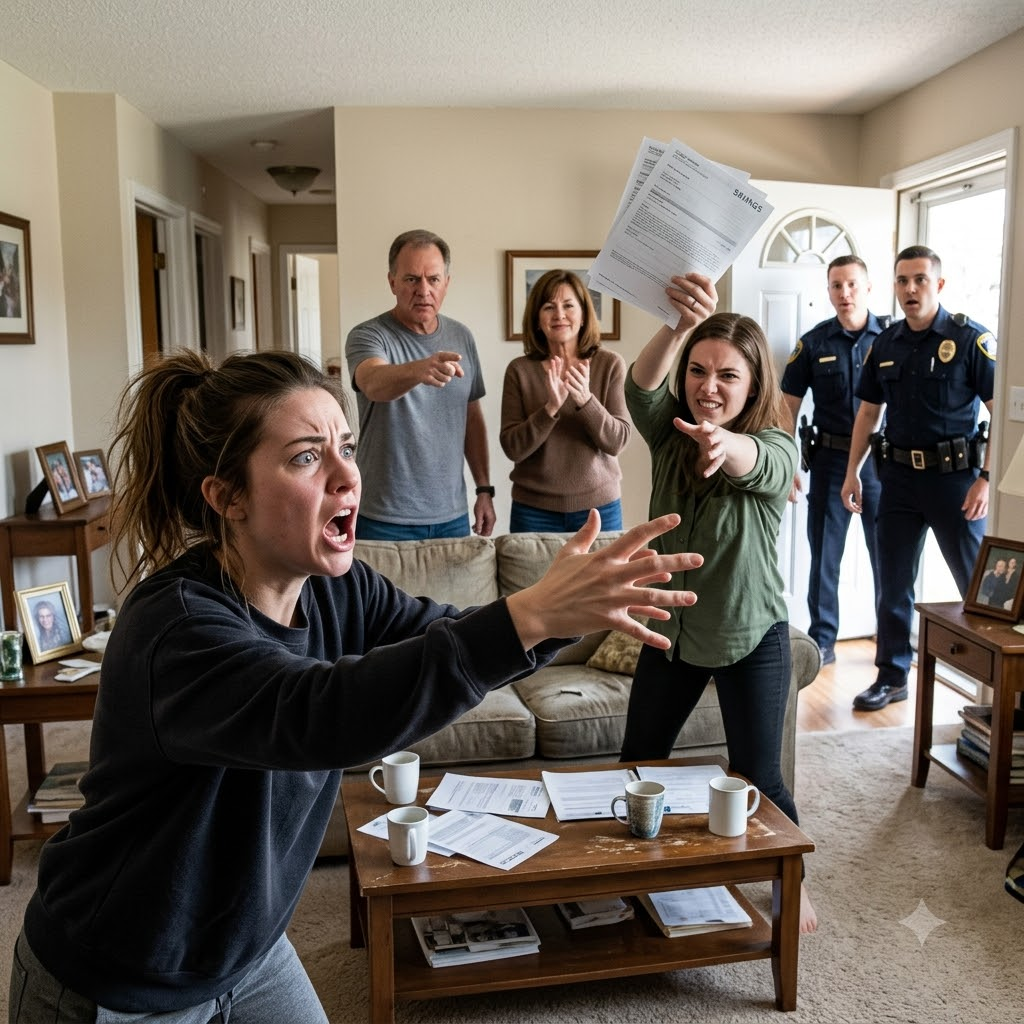
The woman standing outside my apartment held my driver's license between two fingers.
For several seconds, neither of us moved.
She looked older than me, perhaps by two years, with dark brown hair falling just below her shoulders. A narrow scar crossed the skin above her left eyebrow. Her expression was serious, almost exhausted.
She looked enough like me to make my stomach turn.
"I'm Elizabeth," she said.
I didn't open the door.
"I know who you are."
Her eyes moved toward the hallway.
"Is someone inside with you?"
"Yes. The police know you're here."
She swallowed.
"I expected that."
"Why are you holding my identification?"
She looked down at the card.
"Because I think it's time you got it back."
I stared at her.
For eleven years, someone had used my name to open financial accounts, submit documents, and establish an insurance policy without my knowledge.
Now that person was standing outside my apartment, holding the original identification card that had helped make it possible.
"Put it on the floor," I said.
She obeyed.
Then she stepped backward.
I opened the door only after Officer Bennett approached.
Elizabeth entered slowly.
She looked at the laptop, the documents, and the bank statements spread across my desk.
Her eyes stopped at the photograph of the family asset distribution agreement.
"Your father showed you that?"
"Yes."
She nodded.
"Then he finally admitted that I existed."
I didn't answer.
Bennett introduced himself and explained that Elizabeth would need to provide a formal statement.
She agreed.
Then she looked directly at me.
"I know you hate me."
I crossed my arms.
"You used my identity."
"Yes."
"You signed documents in my name."
"Yes."
"You were listed on an insurance application I never authorized."
She lowered her eyes.
"Yes."
I felt anger rising.
"Then what exactly did you expect me to say?"
"Nothing. I just wanted you to know I didn't start this."
I almost laughed.
"That doesn't make you innocent."
"I know."
For the first time, she looked genuinely ashamed.
She placed a thick envelope on the desk.
"These are the original documents I kept."
I looked at Bennett.
He examined the envelope without opening it until the appropriate evidence-preservation steps were followed.
Inside were copies of the original account agreement, the insurance application, several bank statements, and a handwritten letter from my father.
There was also a small memory card.
Elizabeth pointed toward it.
"The recording."
I looked at her.
"Another recording?"
"The original one from the day you opened your account. Your mother made a copy. I made another."
I felt my heartbeat quicken.
"Why did you keep it?"
"Because I knew Robert would eventually try to deny everything."
Bennett asked whether she would allow the recording to be preserved and examined.
She agreed.
Then Elizabeth sat down.
And for the first time, she began telling me everything.
Eleven years earlier, Elizabeth had been thirty-four.
She had known my father since childhood, although he had never publicly acknowledged her as his daughter.
Her mother had raised her alone.
Robert had provided occasional financial assistance, but he had kept his relationship with Elizabeth separate from his marriage to Diane.
When Elizabeth's mother died, she approached him for help.
He promised her money.
He promised her security.
He promised that she would eventually receive a share of the family assets.
But he had one condition.
She would have to cooperate with a financial arrangement.
My father told her that he was establishing investment accounts for his daughters.
He said the accounts would be managed centrally and distributed fairly when the time came.
Elizabeth believed him.
She was struggling financially and had few people she could rely on.
My father introduced her to Martin Keene and Thomas Bell.
He explained that the paperwork would be complicated but legitimate.
Then he asked Elizabeth to help with something unusual.
She was to attend the bank using identification information connected to me.
My father had provided her with copies of my personal documents.
He told her that I had already agreed to the arrangement.
He also claimed that my mother knew everything.
Elizabeth said she had hesitated.
But my father showed her a document bearing what appeared to be my signature.
She believed him.
She went to the bank.
She signed the insurance application.
She helped submit the amendment.
And she allowed my identity to become part of an arrangement she didn't fully understand.
"Why didn't you stop when you realized it was wrong?" I asked.
Elizabeth looked at me.
"Because I was already involved. And because Robert told me he had evidence that could make me look like the person responsible."
"What evidence?"
She opened the envelope.
There were several documents showing payments my father had made to her over the years.
Some were legitimate family assistance.
Others had been transferred through accounts connected to the financial arrangement.
He had kept records of everything.
"He told me that if I ever exposed him, he would say I had stolen your identity without his knowledge."
I stared at her.
"And you believed him?"
"I knew he could prove that I had signed the documents. I didn't know how to prove the rest."
I looked away.
Her situation explained her fear.
It didn't excuse what she had done.
"Why did you contact me now?"
"Because Robert moved the money."
She pointed to the bank statement.
"He had been telling me for years that the second account was mine to inherit. But when I discovered the distribution agreement, I realized he was using your identity to make the entire arrangement look legitimate."
"And the insurance policy?"
Elizabeth lowered her eyes.
"Robert wanted the policy to remain active because he believed it would provide additional financial security."
"Security for whom?"
"For himself."
I stared at her.
She continued.
"After I discovered that the beneficiary had been changed, I tried to have my name added. I thought the policy was part of the money Robert had promised me."
I felt sick.
"You tried to become the beneficiary of a policy on my life."
"Yes."
"Without telling me."
"Yes."
I stood up.
"Do you understand how terrible that is?"
She nodded.
"I do."
For several seconds, neither of us spoke.
Then she said something that made my anger momentarily give way to shock.
"Your father also lied to me about Daniel."
I turned.
"My uncle?"
She nodded.
"Daniel was the first person who discovered the identity arrangement."
Elizabeth explained that my uncle Daniel had been suspicious of my father's financial activities.
He had been present at the bank on the day the accounts were established.
He had heard my father discussing the documents with Thomas.
At first, Daniel believed the arrangement was simply a way to manage family investments.
But when he discovered that my signature had been copied, he confronted Robert.
My father insisted that everything had been approved.
Daniel didn't believe him.
He contacted Martin and requested the original documents.
He also spoke privately with my mother.
That was when he learned about the second page of the agreement.
The page that required my personal acknowledgment in front of two witnesses.
Without that acknowledgment, the arrangement granting my father control was incomplete.
Daniel wanted to tell me.
My father begged him to wait.
He promised to correct the records.
He promised to remove my identity from the financial arrangement.
He promised that the money would be transferred into legitimate accounts.
Daniel agreed to give him a short period to fix the problem.
But nothing changed.
Instead, my father began moving money.
Daniel discovered that the insurance policy had also been submitted using my identity.
He threatened to report everything.
Three days later, he died in a car accident.
For eleven years, my family had described it as an ordinary accident.
Elizabeth opened another document.
It was a copy of an email Daniel had sent to Thomas.
The message was dated the day before his death.
It read:
If Robert refuses to correct the records tomorrow, I'm taking the entire file to the authorities. Megan deserves to know what was done using her name.
I stared at the screen.
My uncle had been trying to protect me.
He had been preparing to expose my father.
And then he had died.
"Do you think Dad caused the accident?" I asked.
Elizabeth shook her head.
"I don't know. I never saw evidence that he did."
Officer Bennett intervened.
"That's an important distinction. We shouldn't turn suspicion into an accusation without evidence."
Elizabeth nodded.
She explained that the original accident investigation had found no evidence of criminal activity.
Daniel had lost control of his vehicle during heavy rain.
There had been no confirmed mechanical failure or evidence of interference.
The documents did establish that he had intended to report the financial misconduct.
His death had prevented him from doing so.
I felt tears pressing behind my eyes.
Not because I was ready to forgive my father.
But because I had spent eleven years believing my uncle had simply died without ever knowing what had happened.
Now I knew he had tried to help me.
And I finally understood why my mother had kept the recording.
She had been afraid of losing her marriage.
Daniel had been afraid of losing his family.
Thomas had been afraid of losing his career.
Elizabeth had been afraid of being exposed.
Everyone had been afraid.
And I had been the only person who didn't even know there was something to fear.
At 11:30 p.m., Officer Bennett arranged for the recording to be preserved and reviewed.
The original audio was eleven years old.
The quality wasn't perfect, but the voices were recognizable.
I sat beside the laptop.
My mother was on the recording.
So was my father.
Thomas Bell.
And Daniel.
The first few minutes contained ordinary conversation.
My mother asked whether I had arrived.
My father complained about the bank's paperwork.
Thomas explained that the account could be opened in my name.
Then I heard my younger voice.
"Why does Dad need to be listed as an authorized representative?"
I froze.
I sounded so young.
But my answer was clear.
"I want to manage my own money. I don't want anyone else controlling it."
My father laughed.
"You're making this more complicated than it needs to be."
I remembered that moment.
I had been sitting at the kitchen table with my mother.
My father had been standing near the counter.
I had refused to sign the family agreement.
On the recording, I heard myself say:
"If I save the money, I want to decide what happens to it."
There was a pause.
Then Daniel spoke.
"She's right, Robert. The account should belong to her."
I closed my eyes.
My uncle had defended me.
My father replied:
"Nobody is taking anything from her."
Daniel answered:
"Then why are you asking her to sign a control agreement?"
The room became silent.
My mother finally spoke.
"Robert, just leave it. Megan has already said no."
My father became irritated.
He told everyone to stop arguing.
Then I heard footsteps.
A door opened.
I apparently left the room.
The conversation continued.
My father said:
"She doesn't need to understand every detail. We can establish the account now and correct the paperwork later."
Daniel refused.
Thomas asked whether the documents could be processed without my signature.
My father answered:
"There's another way."
Then the recording captured something that made Officer Bennett pause.
My father's voice became quieter.
"Elizabeth can complete the identification part. She already has Megan's documents."
I felt my stomach drop.
My mother asked whether that was legal.
My father replied:
"Nobody will lose anything. It's temporary."
Daniel said:
"No. You're putting your daughter's name on something she never agreed to."
My father answered:
"She's my daughter. I know what's best for her."
Then Daniel said:
"That's exactly why you shouldn't be doing this."
The recording continued for another minute.
My father instructed Thomas to prepare the amendment.
He told my mother to keep the original papers.
And then he said the sentence I would remember for the rest of my life.
"If Megan ever asks, we tell her it's a family investment. She doesn't need to know who controls it."
I stopped the recording.
I couldn't listen anymore.
My father hadn't misunderstood my wishes.
He hadn't made an innocent administrative mistake.
He had heard me refuse.
He had heard Daniel defend me.
He had heard my mother question him.
And he had gone ahead anyway.
The investigation continued over the following weeks.
The bank provided the historical account records.
The insurance company supplied the original policy application.
The receiving institution documented the $417,862.19 transfer.
Martin surrendered additional financial files after investigators confronted him with the records.
His cooperation revealed that he had prepared several of the documents and had knowingly helped maintain the false account arrangement.
Thomas admitted that he had approved an amendment without witnessing my signature.
He also provided evidence showing that the second-page acknowledgment had never been completed.
Elizabeth gave a full statement and surrendered the identification documents she had used.
She accepted responsibility for her participation in the identity misuse.
My mother provided the original recording, the missing second page, and a detailed account of what she had witnessed.
She also admitted that she had entered my apartment with my father and taken my financial records.
Rachel provided copies of the boutique's financial documents.
She admitted that she had knowingly presented inaccurate debt figures to justify the proposed transfer.
Her cooperation helped investigators establish that several supplier invoices had already been paid.
The financial picture was finally becoming clear.
My father had used my identity to establish and control the hidden account.
He had redirected employment-related payments and managed investment funds without my knowledge.
He had arranged an insurance policy using false identification information.
He had attempted to distribute money through the family asset agreement.
And when the arrangement began falling apart, he had tried to move the entire hidden balance into his personal account.
The attempted transfers to Rachel and Martin had been rejected.
The bank's security restriction prevented the $186,000 transfer from my original savings account.
My father's personal account was subsequently frozen through the appropriate legal process.
The money was traced and recovered through the financial investigation, including the funds that had been transferred out.
It took months.
There were legal proceedings, interviews, and difficult meetings.
But the records were clear.
I had never authorized the agreement.
I had never approved the insurance policy.
I had never consented to my father managing my money.
The legal process eventually resulted in financial restitution and criminal consequences for those responsible.
My father was held accountable for his role in the fraudulent financial arrangements and unauthorized use of my identity.
Martin faced consequences for preparing and processing false documents.
Thomas was investigated for his participation in the improper account amendments and lost his professional standing.
Elizabeth accepted responsibility for the identity documents she had signed and cooperated with the investigation.
My mother faced consequences for her own participation, but her cooperation and the evidence she provided were considered during the proceedings.
Rachel closed her boutique.
She had to deal with the consequences of the false financial records and the debts she had tried to conceal.
For the first time in her adult life, she had to manage her own financial decisions without expecting our parents to rescue her.
I didn't celebrate anyone's downfall.
I simply wanted my life back.
Eight months after the first police officers knocked on our family home, I received a letter from the bank.
The disputed accounts had been reviewed.
The funds recovered through the investigation had been returned according to the legal settlement and verified ownership records.
My original savings account was restored.
The hidden account was closed.
The unauthorized insurance policy was permanently canceled.
All representative permissions associated with my father's identity were revoked.
My personal information was secured through new banking and identity-protection measures.
I sat at my kitchen table and read the final confirmation.
For the first time in months, the numbers on the page didn't frighten me.
They represented something I had fought to recover.
My savings.
My identity.
My future.
The $186,000 I had worked eleven years to accumulate remained mine.
The additional funds that had been wrongfully diverted were accounted for through the restitution process.
I finally had enough financial security to purchase the house I had once been afraid I would never afford.
I chose a modest two-story home with a bright kitchen, a small backyard, and large windows overlooking a quiet street.
It wasn't the most expensive house in Columbus.
It didn't need to be.
Every dollar I used toward the purchase was mine.
I signed the closing documents without anyone standing beside me telling me what was best for my future.
When the attorney handed me the keys, I held them for several seconds.
Then I smiled.
Not because I had won a battle against my family.
Because I had finally reached a place where nobody else could decide what my money, my name, or my life belonged to.
Rachel contacted me three months later.
Her message was short.
I know I don't deserve your forgiveness. I just wanted to tell you I'm working again. I got a job at a small clothing store. I'm paying my own bills. I haven't asked Mom or Dad for anything.
I read it twice.
Then I replied.
I'm glad you're taking responsibility for your life. That doesn't mean everything is repaired between us.
She answered:
I understand.
For a while, that was all.
Eventually, we met for coffee.
Rachel looked different.
Her hair was shorter.
She wore ordinary jeans and a simple sweater.
There was no expensive handbag, no talk about business opportunities, and no complaint about people failing to support her.
She apologized.
Not once.
Several times.
She admitted that she had envied my savings because she believed everything had come easily to me.
She had watched me buy my first house, maintain a steady career, and refuse to spend beyond my means.
Instead of respecting the work behind those choices, she had convinced herself that I had more than enough to share.
She had allowed our father to turn that resentment into an excuse.
I listened.
I didn't promise that we would return to being the sisters we had once been.
Trust couldn't be transferred back into an account with a single signature.
But I agreed to let her earn it slowly.
We started with occasional conversations.
Then lunch.
Eventually, we were able to talk without discussing money.
It wasn't a perfect reconciliation.
It was an honest beginning.
And that was enough.
My mother and I met separately.
She had sent me a handwritten letter acknowledging what she had done.
She admitted that she had known the agreement was improper.
She admitted that she had taken my documents.
She admitted that she had applauded my father's announcement because she was afraid of challenging him.
She didn't ask me to forgive her.
She simply said she was sorry.
When we finally sat across from each other, she looked older than I remembered.
"Megan, I should have protected you."
I looked at her.
"Yes. You should have."
She nodded.
"I know."
I told her that I wasn't ready to restore our old relationship.
I needed time.
I needed boundaries.
And I needed to know that if I ever said no, she would accept it.
She agreed.
We began with occasional phone calls.
No discussions about my savings.
No requests for financial help.
No pressure to visit my father.
Just conversations.
Slowly, I began to believe that she understood the difference between being a mother and expecting unconditional obedience from a daughter.
Thomas Bell also contacted me.
He sent a letter explaining his role and accepting responsibility.
He didn't make excuses about my father's influence.
He acknowledged that he had processed documents he should have questioned.
He apologized for allowing his professional judgment to be compromised by a personal relationship.
I didn't immediately respond.
But I eventually wrote back.
I told him that I appreciated his cooperation with the investigation, but that his apology couldn't erase eleven years of silence.
He understood.
As for Elizabeth, she moved away from Columbus.
She returned the remaining identification materials and completed the required legal process.
She also provided a statement about my uncle Daniel.
Before leaving, she sent me a copy of the final email he had written to Thomas.
I kept it.
Not because I wanted to remember the scandal.
Because I wanted to remember that someone had tried to protect me before I even knew I needed protection.
Daniel had been right.
My money should have belonged to me.
My choices should have been mine.
And my family should never have treated my identity as something they could borrow.
One year after the first dinner confrontation, I invited Rachel and my mother to my new home.
It was a small gathering.
Nothing extravagant.
There was homemade pasta, roasted vegetables, and a simple cake.
Rachel brought flowers.
My mother brought a framed photograph of Daniel.
I placed it on the living room shelf.
For years, I had remembered him only through the stories my parents told about his accident.
Now I knew something more important.
He had stood up for me when I wasn't in the room.
He had refused to accept a lie simply because it was convenient.
And he had tried to make sure I knew the truth.
After dinner, I walked into the kitchen.
My new bank statement sat on the counter.
I had opened a fresh savings account under my own control.
There were no representatives.
No family agreements.
No hidden beneficiaries.
No one else had access.
I looked at the balance and thought about the young woman I had been eleven years earlier.
She had wanted to save enough money to buy a house.
She had wanted independence.
She had wanted to build something that belonged to her.
She hadn't been wrong to trust her family.
They had been wrong to exploit that trust.
Rachel appeared in the doorway.
"Are you okay?"
I turned toward her.
"Yes."
She looked at the statement.
"Still saving?"
I nodded.
"Always."
She smiled faintly.
"That sounds like you."
I looked around my kitchen.
The cabinets were exactly the color I had chosen.
The table was mine.
The house was mine.
The future was mine.
For the first time in my life, I didn't feel that I had to defend those things.
I had recovered more than money.
I had recovered the right to decide what happened next.
And when I finally turned off the kitchen light that evening, I knew there was nothing left hidden in my family's financial records that could take that away from me.
I had my name back.
I had my savings back.
I had my home.
And, most importantly, I had my freedom.






Comments 0