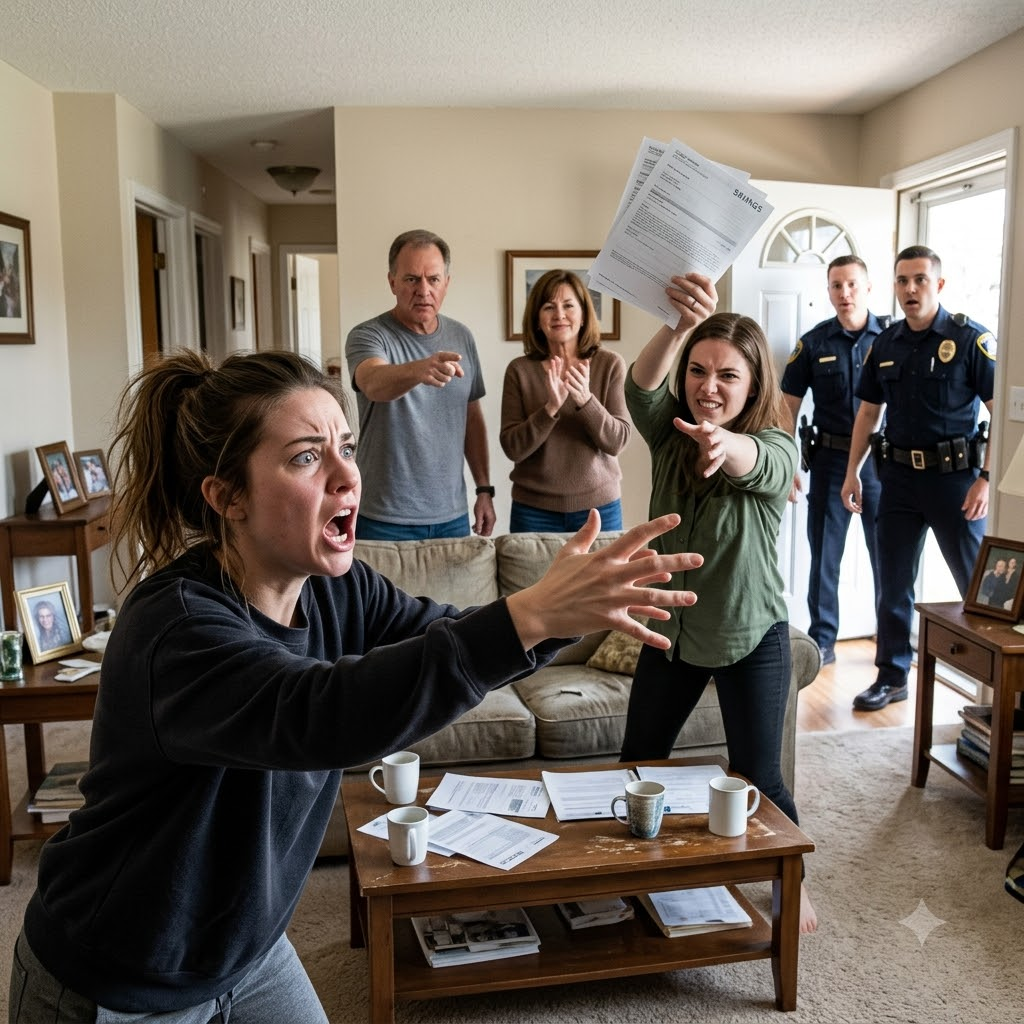
"Four hundred seventeen thousand dollars?"
I stared at the bank statement on my phone.
My father had withdrawn $417,862.19 from an account bearing my name.
The transaction had happened on Friday.
One day before he stood at the dinner table and announced that my $186,000 savings account would be transferred to Rachel.
I looked at Officer Bennett.
He was already calling Officer Harris.
"Ms. Carter, don't contact your father about this transaction yet," he said. "We need to establish whether this account actually belongs to you and how the withdrawal was authorized."
I nodded.
But my mind was racing.
I had never opened a second savings account.
I had never deposited money into one.
I had never received statements for an account with that balance.
And yet my name appeared at the top of the document.
I enlarged the photograph.
The account number was partially visible.
The bank's name was printed beneath it.
The balance was listed as $417,862.19.
At the bottom, the withdrawal was described as a transfer to an external account.
The recipient was Robert Carter.
My father.
I looked at the transaction date again.
Friday.
The same day I had been working late at the engineering office.
The same day I had stopped for groceries.
The same day I had returned home without knowing that someone had moved more than four hundred thousand dollars from an account supposedly belonging to me.
"Where did this photograph come from?" Bennett asked.
"An unknown number."
"Did the sender identify themselves?"
"No."
He examined the image.
"Do you recognize the bank?"
I nodded.
It was the same institution where I had opened my original savings account.
That made the situation even more confusing.
"Could this be a retirement account?" I asked.
"Possibly. We need the bank to verify it."
I looked at the name.
Megan Carter.
Then I noticed something else.
The account had been opened eleven years earlier.
November 14.
The exact same day I had opened my first savings account.
I felt a chill.
Someone had created a second financial arrangement on the day I began saving for my future.
And my father had apparently known about it all along.
Officer Harris returned my call at 12:38 p.m.
He had received the information about the second account and wanted to know whether I had any records of it.
I told him I didn't.
He asked whether I had ever received a statement from the bank that I hadn't recognized.
I searched my email.
Nothing.
I checked my old paperwork.
Nothing.
I checked the online banking application.
Only my original savings account appeared.
There was no second account.
Harris listened carefully.
"Have you ever authorized your father to open financial accounts in your name?"
"No."
"Have you ever given him your Social Security number for banking purposes?"
"When I was younger, yes. But only for routine family paperwork."
"Did you understand what he was doing?"
"I assumed he was helping me with ordinary financial arrangements."
"Did you sign any additional account applications?"
"Not that I remember."
He nodded.
"We'll need to establish the account's ownership and opening records."
I looked at the photograph.
"Officer, what if the account was opened using my information without my knowledge?"
"Then that would be an important part of the investigation."
I swallowed.
The possibility was becoming harder to ignore.
My father might have used my identity to establish a financial account.
An account that had accumulated more than $400,000.
An account he had apparently controlled for eleven years.
And now the entire balance had been transferred into his own name.
I looked at Bennett.
"Can the bank tell us who opened it?"
He nodded.
"With the appropriate investigation and records request, that information may be available."
I stared at the screen.
For eleven years, I had believed I was building my financial future one deposit at a time.
Meanwhile, someone might have been building another financial arrangement in my name.
At 1:10 p.m., I received another message from Rachel.
Please don't assume Dad stole that money.
I read it twice.
Then I replied.
How could I assume anything else?
She called immediately.
I answered.
"Explain."
Rachel sounded exhausted.
"That account was supposed to be yours."
"Then why didn't I know about it?"
"Dad said it was being managed separately."
"By whom?"
"Martin."
I looked toward Officer Bennett.
He motioned for me to put the call on speaker.
Rachel continued.
"Dad told me it was part of a family investment arrangement."
"What investment?"
"I don't know all the details."
"Rachel, you just told me you knew about a $417,000 account."
"I saw the statements."
"When?"
"At Dad's office."
"How long have you known?"
"About two years."
I felt my jaw tighten.
"Two years?"
She began crying.
"He said he was keeping it safe."
"Why was your name listed as the beneficiary?"
"Because Dad said he wanted me to receive it if something happened to him."
I closed my eyes.
"So my money was being held for you?"
"I didn't know it was your money."
"Whose name was on the account?"
"Yours."
"Then how did you not know?"
She became defensive.
"I never saw the original application. Dad told me it was an account he had established for the family."
I stared at the transaction.
"Did he tell you where the money came from?"
Rachel hesitated.
"Some of it was from investments."
"Whose investments?"
"I don't know."
"Did he tell you that he had withdrawn it?"
"No."
"Did you know he was transferring it to his own account?"
"No."
Her answer sounded genuine.
But I had learned not to confuse sincerity with innocence.
"Rachel, why did you suddenly tell me about it?"
She took a breath.
"Because I heard Dad talking to Martin."
"When?"
"Last night."
"What did they say?"
Rachel lowered her voice.
"They were arguing about the transfer."
"Which transfer?"
"The $417,000."
I looked at Bennett.
He leaned closer.
Rachel continued.
"Martin said the money couldn't be moved without explaining where it came from."
I felt my stomach tighten.
"What did Dad say?"
"He told Martin that he had already explained everything."
"Then what?"
"Martin said there was a problem with the original account documents."
I asked:
"What problem?"
Rachel was silent.
Then she whispered:
"Martin said the original beneficiary form had been changed."
I stared at the screen.
"Changed by whom?"
She didn't answer.
"Rachel?"
"I don't know."
"Did Dad change it?"
She began crying again.
"That's what Martin accused him of."
I looked at the bank statement.
The beneficiary was Rachel.
The recipient of the withdrawal was Robert.
The original account belonged to me.
At least, that was what the document appeared to say.
I asked Rachel whether she had a copy of the original beneficiary form.
"No."
"Did you ever see it?"
"Yes."
"When?"
"Last year."
"Who was listed?"
She hesitated.
Then she whispered:
"Your name."
My heart began pounding.
"Was I the beneficiary?"
"Yes."
I sat completely still.
Rachel continued.
"Then Dad showed me another form. He said the beneficiary had been updated."
"Did you sign it?"
"No."
"Did Mom?"
"I don't know."
"Did Martin?"
"I don't know."
I took a breath.
"Then who changed it?"
Rachel answered quietly.
"Dad."
At 2:05 p.m., the bank's fraud department called.
Laura recognized my case.
"Ms. Carter, we've received your request concerning the additional account."
I sat down.
"Can you confirm whether it exists?"
"Yes. We located an account opened eleven years ago under your name."
My fingers tightened around the phone.
"Is it still active?"
"It was active until Friday."
"Who closed it?"
"The account was not closed. The balance was transferred through an external transaction."
"To my father?"
There was a pause.
"The receiving account is registered to Robert Carter."
I looked at Officer Bennett.
He immediately began taking notes.
I asked:
"Who opened the account?"
Laura explained that the bank could not disclose all historical records through the initial phone verification process.
But she confirmed that the application had been submitted through an assisted banking service.
I felt sick.
"Was I present?"
"That information is part of the historical application record."
"Can you preserve it?"
"Yes."
"Please preserve everything connected to that account."
She confirmed.
Then I asked:
"Why didn't I receive statements?"
Laura paused.
"According to the account profile, correspondence was directed to a different mailing address."
I closed my eyes.
"What address?"
She gave me an address.
My parents' house.
I looked at Bennett.
For eleven years, the statements had been going to my father's home.
I had never received one.
"Was my father listed as an authorized representative?"
"Yes."
I felt my stomach drop.
"Since when?"
"According to the account profile, from the opening date."
I stared at the wall.
The original agreement.
The second account.
The hidden statements.
My father's authority.
The missing documents.
It was all connected.
But I still didn't know how he had obtained the authority.
"Laura, was I listed as the sole owner?"
She paused.
"Your name appears as the primary account holder."
"What does that mean?"
"There are additional ownership and authorization details in the historical file that would need to be reviewed."
I looked at Bennett.
He nodded for me to continue.
"Was my father a joint owner?"
"I can't confirm that without the full file."
"Then please send the records through the formal dispute process."
Laura agreed.
Before ending the call, she told me that the bank had placed a hold on any further disputed transactions.
I thanked her.
Then I put the phone down.
Officer Bennett looked at me.
"Your father had access to the account from the beginning."
"Yes."
"And the statements went to his address."
"Yes."
He paused.
"Did you ever receive any money from that account?"
"No."
"Did you know it existed?"
"No."
He nodded.
"Then we need to establish who funded it, who controlled it, and under what authority."
I looked at the bank statement.
There was a transaction history.
I hadn't noticed it before.
I opened the photograph again.
The first deposit was $18,000.
Then $24,500.
Then $31,000.
The deposits continued over the years.
Some were labeled as investment returns.
Others were marked as transfers from an external brokerage account.
The total had grown steadily.
I looked at the first deposit date.
November 20.
Six days after I opened my original savings account.
I whispered:
"Someone started putting money into this account almost immediately."
Bennett nodded.
"That's what the statement indicates."
I looked at the transaction descriptions.
One caught my attention.
EMPLOYER BENEFIT DISTRIBUTION.
I frowned.
"What is that?"
"Do you recognize the employer?"
I checked.
It listed the name of an engineering company.
Not my current employer.
My first employer.
The company I had worked for immediately after college.
I remembered receiving a signing bonus when I started.
It had been $8,000.
I had deposited it into my original savings account.
But the statement suggested that another payment had been made through the same employer.
A payment of $18,000.
I stared at the screen.
I had never received $18,000 from that company.
I searched my old employment records.
The first company I had worked for was called Meridian Electrical Systems.
I had joined them as a junior engineer at twenty-two.
I had stayed for three years before moving to a larger consulting firm.
I opened an old folder containing my employment contract.
The original offer letter was still there.
I found the compensation section.
My starting salary was $58,000.
There was a signing bonus of $8,000.
And there was a performance incentive program.
I remembered the details.
Employees could receive additional compensation for completing certain projects.
I had qualified for one incentive during my second year.
But the payment had been delayed.
My father had helped me review the paperwork because I was confused about the tax deductions.
I remembered signing a form at our kitchen table.
He had told me he would take care of the rest.
I had assumed the money would arrive in my account.
I searched my old bank statements.
The $8,000 signing bonus was there.
The regular salary payments were there.
The annual performance incentive was there.
But the $18,000 deposit was nowhere to be found.
I turned toward Bennett.
"My father might have received money that was supposed to go to me."
He looked at the document.
"Do you have the original incentive paperwork?"
"I'll have to find it."
I searched my email.
There were several messages from Meridian.
One contained a compensation statement.
I opened it.
The document showed my annual performance incentive.
The amount was $18,000.
I stared at it.
The payment date matched the deposit into the second savings account.
I read the recipient information.
It was my name.
But the payment destination was not my original savings account.
It was the account my father had controlled.
I felt my throat tighten.
For eleven years, I had believed that I had received everything I had earned.
Apparently, I hadn't.
My father had redirected an $18,000 payment into an account I didn't know existed.
And that might only have been the beginning.
I continued searching.
Another payment appeared two years later.
$22,500.
Another appeared the following year.
$31,000.
All from investment or employment-related sources.
Some might have been legitimate family investments.
Others appeared to be compensation connected to my work.
I didn't know.
But I knew I had never authorized those deposits.
I looked at the total.
More than four hundred thousand dollars.
The number suddenly felt less mysterious.
My father hadn't necessarily created the money himself.
He might have accumulated it through funds that were supposed to belong to me.
At 3:30 p.m., Officer Bennett received a call.
He listened carefully.
Then he looked at me.
"Ms. Carter, we have an update."
I sat forward.
"What happened?"
"Your mother has agreed to provide a formal statement."
I nodded.
"About the recording?"
"Yes. And about the original account."
My heart began beating faster.
"Did she say anything about the second account?"
Bennett glanced at his notes.
"She confirmed that your father managed it."
I felt cold.
"Did she know about the $417,000 withdrawal?"
"She says she learned about it yesterday."
"Does she know where the money went?"
He paused.
"She says she has an idea."
I leaned forward.
"What idea?"
Bennett looked at me.
"She believes the money was transferred to an account connected to your sister's business."
I stared at him.
Rachel had told me she knew nothing about the withdrawal.
But if the money had gone to her business, the situation was even more complicated.
"Did Mom say Rachel knew?"
"Not yet."
I looked down.
The boutique's debts.
The private settlement.
The $74,500 payment to Martin.
The $417,862 withdrawal.
The numbers were beginning to connect.
My father might have transferred the hidden account's entire balance to cover debts.
But why had the receiving account been registered in his name?
And why was Rachel listed as the beneficiary?
I asked Bennett whether the bank could trace the receiving funds.
He said the appropriate investigators would need to obtain the records.
Then he added:
"Your mother also mentioned another person."
I looked up.
"Who?"
"Someone who helped your father establish the second account."
My heart tightened.
"Thomas Bell?"
Bennett nodded.
"Yes."
I thought about the conversation with Thomas.
He had admitted witnessing a document without seeing me sign it.
But now there was another question.
Had he helped my father establish a separate account using my identity?
And had he known where the money came from?
I asked whether Thomas had been contacted.
Bennett said that investigators were working to establish the relevant records.
Then he looked at me.
"There's something else."
"What?"
"Your mother says Thomas wasn't the only person who knew about the second account."
I stared at him.
"Who else?"
He checked his notes.
"Martin Keene."
I almost laughed.
Of course.
Martin had been involved from the beginning.
But then Bennett added another name.
A name I hadn't expected.
"She also mentioned a woman who worked at the bank."
I frowned.
"Who?"
He turned the page.
"Her name is Laura Bennett."
I froze.
The same name as the woman from the bank's fraud department?
I looked at him.
"Are you sure?"
He checked his notes.
"That's the name your mother provided."
I felt a chill.
"Is she connected to the original account?"
"Apparently."
I looked at my phone.
Laura had been the representative who helped me secure my account.
She had been the person who explained the disputed authorization.
And now my mother was saying that someone with the same name had been involved eleven years earlier.
I asked whether they were the same person.
Bennett didn't know.
But he said the name would be checked.
At 4:10 p.m., I received an email from the bank.
The subject line read:
HISTORICAL ACCOUNT RECORDS — ADDITIONAL INFORMATION REQUIRED.
I opened it.
The message explained that the bank had located the original application and several supporting documents.
They were being reviewed as part of the fraud investigation.
There was one document attached.
A scanned account-opening form.
I clicked it.
The first page contained my name, address, date of birth, and identification information.
The account had been opened on November 14.
The same day I remembered.
But the signature section was different from what I expected.
There were three lines.
Primary account holder.
Authorized representative.
Witness.
My signature appeared on the first line.
My father's signature appeared on the second.
Thomas Bell's appeared on the third.
I stared at the form.
The document looked official.
It contained a bank stamp.
A branch reference number.
And a date.
I enlarged the signature section.
My signature looked similar to the one on my driver's license.
But the capital M was wrong.
The final stroke was too short.
I knew I hadn't signed it.
I looked at the second line.
My father's signature was clear.
He had been designated as an authorized representative from the very beginning.
But there was another section beneath it.
A box marked:
ACCOUNT OWNER'S ACKNOWLEDGMENT OF THIRD-PARTY CONTROL.
It had been checked.
Beside it was a short handwritten note.
Owner agrees representative may manage and redirect funds under family financial arrangement.
I felt sick.
I looked at Officer Bennett.
"That's not my handwriting."
He examined it.
"Do you recognize who wrote it?"
I shook my head.
Then I noticed the date beside the handwritten note.
November 14.
The same day.
I scrolled to the bottom.
There was a second page.
The page Thomas had mentioned.
The condition that my mother had apparently kept hidden.
I opened it.
The first paragraph explained that the authorized representative's control would only become effective if the account holder personally acknowledged the arrangement in the presence of two witnesses.
I read it twice.
There was no evidence that I had done that.
The witness section contained only one name.
Thomas Bell.
The second witness line was blank.
And beneath the paragraph was a handwritten instruction.
"Second witness to be added after customer confirmation."
I stared at it.
The document had never been completed.
My father had possessed an agreement that appeared to grant him authority.
But the second page contained a condition that had not been satisfied.
I looked at Bennett.
"Does that mean he had no authority?"
He was careful.
"That's for the bank and legal authorities to determine. But the missing acknowledgment is significant."
I nodded.
Then I noticed something at the bottom of the scanned document.
A small stamp.
It had been partially cut off.
I enlarged it.
The stamp contained the words:
REVISED ACCOUNT AUTHORITY — APPROVED.
I frowned.
"What is that?"
Bennett leaned closer.
He examined the stamp.
Then he asked me to open the original file information.
I did.
There was a reference number beneath the stamp.
It didn't match the original application.
It belonged to a later amendment.
I checked the date.
The amendment had been processed eleven years earlier.
Only three days after I opened the account.
And the person who approved it was listed at the bottom.
BRANCH OPERATIONS MANAGER: THOMAS BELL.
I stared at the name.
Thomas had told me he hadn't witnessed my signature.
He had told me my father had signed the agreement afterward.
But the bank's own records suggested that Thomas had approved a revised authorization.
I looked at Bennett.
"Why would he do that?"
Before he could answer, my phone rang.
It was an unfamiliar number.
I answered.
A woman's voice spoke.
"Ms. Carter, my name is Laura Bennett. I work in the bank's historical records department."
I sat up.
"How can I help you?"
"We've located an additional document connected to the account you disputed."
"What document?"
She hesitated.
"An amendment dated three days after the account was opened."
I looked at the scanned page.
"I already have a copy."
There was silence.
Then she said:
"That's not the document I'm referring to."
My stomach tightened.
"What do you mean?"
"The amendment we located contains a second account holder designation."
I gripped the phone.
"Who?"
Laura lowered her voice.
"Ms. Carter, the original record lists you as the primary account holder."
I waited.
"But the amendment lists another person as the beneficial owner of the funds."
I looked at Officer Bennett.
He moved closer.
I asked:
"Who is it?"
Laura took a breath.
Then she read the name.
"Robert Carter."
I stared at the phone.
My father had been listed as the beneficial owner of money held in an account bearing my name.
But before I could ask another question, Laura continued.
"There's one more thing. The amendment was approved using a second identification document."
"What identification document?"
She paused.
"Your father's driver's license."
I felt my blood run cold.
"Why would he use his own identification on my account?"
Laura didn't answer immediately.
Then she said:
"Because the application states that you were not present when the amendment was signed."
I looked at Bennett.
He was already reaching for his phone.
And then Laura delivered the final detail.
"The signature on that amendment isn't yours, Ms. Carter."
I swallowed.
"Whose is it?"
Her answer was barely audible.
"It belongs to someone who claimed to be you."






Comments 0