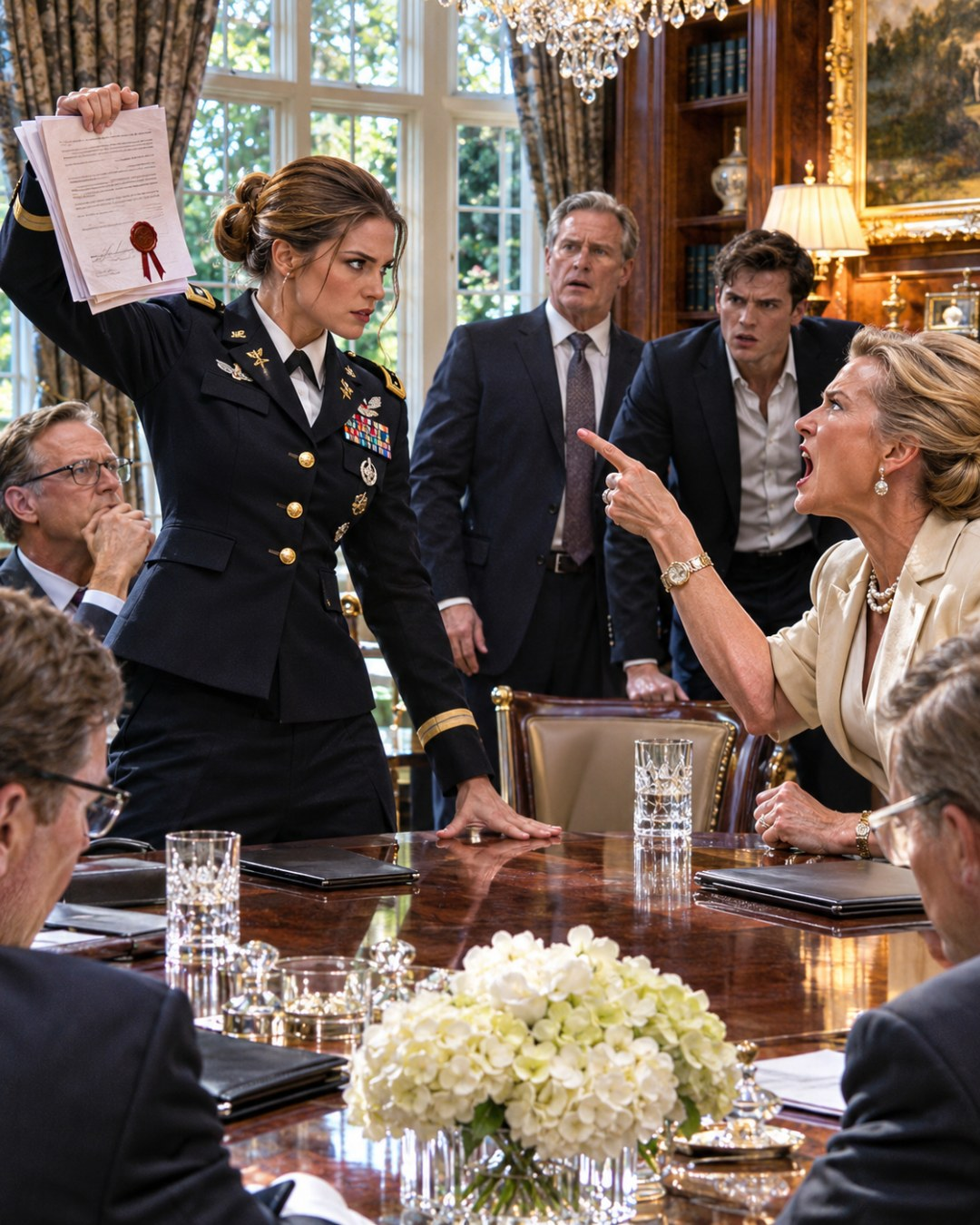
"Sign it, Sienna!" my mother shouted, slamming her palm against the mahogany table.
Five attorneys stared at the inheritance waiver between us.
At the bottom of the document, beneath my father's name, someone had written a date.
It was three days after his death.
My mother had made a mistake.
And she had no idea I had already noticed.
"Did you hear me?" Victoria Sterling demanded.
I looked up from the document.
"I heard you."
"Then pick up the pen."
I didn't move.
My mother had always mistaken silence for surrender. When I was seventeen, silence meant I was hiding my anger. At twenty-two, it meant I was too stubborn to admit she was right. At thirty-eight, apparently, it still meant she could push hard enough to make me obey.
She had never considered another possibility.
Sometimes silence meant I was paying attention.
"Is there a reason you're refusing?" she asked.
"Several."
Julian, my younger half-brother, gave a short laugh from the far side of the room.
"Oh, here we go."
He stood behind the attorneys, dressed in an expensive brown blazer that probably cost more than the monthly rent on my first apartment. His sandy blond hair was neatly styled, his watch was unmistakably expensive, and his expression carried the same familiar mixture of entitlement and irritation I had known since childhood.
Julian was thirty-one.
He had never worked for anyone who couldn't be persuaded to give him another chance.
My father had financed his first restaurant.
Then his second.
Then a third location that had closed after eleven months.
According to Julian, every failure had been caused by someone else.
The economy.
His partners.
His employees.
The landlord.
Never Julian.
Now, three weeks after my father's funeral, he wanted the money my father had left me.
And my mother had apparently hired five attorneys to help him get it.
"Let's maintain a professional atmosphere," one of the lawyers said.
He was the oldest of the group, a silver-haired man wearing rectangular glasses and a dark navy suit.
His name, according to the folder in front of him, was Charles Whitmore.
He looked about sixty-five, with the measured expression of someone accustomed to expensive disagreements.
"Colonel Sterling," he continued, "perhaps we should begin by reviewing the purpose of today's meeting."
My mother turned sharply.
"She isn't here as a colonel."
Whitmore paused.
"Excuse me?"
"She's here as my daughter."
I watched him carefully.
His expression barely changed, but his pen stopped moving.
"Of course," he said.
My mother folded her arms.
"Whatever title she uses at work has absolutely nothing to do with this family."
I almost smiled.
There it was.
The same argument she had been making for sixteen years.
My career was acceptable when it provided something she could mention at charity dinners.
It was inconvenient whenever it reminded her that I had built a life beyond her control.
To my mother, I was a government employee who wore a uniform, received a steady paycheck, and had inexplicably refused every opportunity to marry someone with a recognizable surname.
She knew I had served overseas.
She knew I worked in intelligence.
She knew I had been promoted.
But she had never asked what my responsibilities involved.
She certainly didn't know that I commanded a specialized military intelligence unit.
And she didn't know that the Pentagon briefing I had attended that morning had nothing to do with the family meeting she had arranged.
My professional responsibilities were separate from my father's estate.
I intended to keep them that way.
But years of examining complicated information had taught me something useful.
People who were hiding things often revealed more through their arrangements than through their words.
And this room had been arranged very carefully.
Five attorneys.
Three black SUVs outside.
Richard standing near the doorway.
Julian positioned between me and the hallway.
My mother at the head of the table.
And a legal document prepared before I had even been told why I was coming.
This wasn't a family discussion.
It was a performance designed to make me feel outnumbered.
Unfortunately for my mother, she had chosen the wrong audience.
"Before we begin," I said, "I'd like to know who represents whom."
The younger attorney on Whitmore's left glanced at my mother.
Victoria sighed.
"Oh, for heaven's sake."
"It's a simple question."
"These are family attorneys."
"That isn't an answer."
Whitmore cleared his throat.
"Our firm was retained by Mrs. Sterling in connection with certain estate-related matters."
"So you represent my mother."
"We represent her interests in this matter, yes."
I looked around the table.
"And the other four?"
One of them, a woman in a charcoal suit with dark hair pulled into a low bun, answered.
"We are members of the same legal team."
"Thank you."
My mother rolled her eyes.
"Are we finished with the interrogation?"
"Almost."
I turned toward Whitmore.
"Do any of you represent me?"
"No."
"Do any of you represent the estate's executor?"
A pause.
"Not in that capacity," he said.
"Has the executor authorized this proposed waiver?"
Whitmore adjusted his glasses.
"That is a matter we can discuss."
"Then let's discuss it."
Richard stepped forward.
"Sienna, your mother has gone to considerable trouble to arrange this meeting."
My stepfather was fifty-nine, tall, silver-haired, and always dressed as though a photographer might be waiting outside.
He had married my mother when I was thirteen.
He was not a cruel man in the obvious sense.
He rarely shouted.
He rarely threatened.
Instead, he had spent twenty-five years perfecting the art of standing beside someone who did both.
He would call it keeping the peace.
I had another name for it.
"Richard," I said, "who is the executor?"
His expression tightened.
"You know perfectly well that the estate is being handled."
"By whom?"
"Sienna."
"By whom?"
My mother struck the table again.
"Enough!"
The crystal water glasses trembled.
One attorney glanced toward the door.
I didn't.
My attention had returned to the document.
The title was printed in bold capital letters.
SURRENDER OF INHERITANCE RIGHTS AND WAIVER OF TESTAMENTARY CLAIMS.
Beneath it were eleven pages of carefully drafted language.
The agreement purported to release my interests in several properties, investment accounts, and other assets connected to my father's estate.
It also contained provisions restricting my ability to challenge certain transactions.
I had read enough legal documents to recognize that this one required independent review.
But something else bothered me.
Something much more specific.
The third page referred to an amendment allegedly approved by my father.
The date was impossible.
Arthur Sterling had died on September 18.
The amendment was dated September 21.
I looked at my mother.
"Where did you get this?"
She frowned.
"From the attorneys."
"No. Where did the underlying amendment come from?"
Whitmore leaned forward.
"Which amendment?"
I turned the folder toward him and pointed to the reference.
His eyes moved across the page.
For the first time since I entered the room, his expression changed.
Only slightly.
But I saw it.
He hadn't expected me to ask that question.
"That's part of the supporting documentation," he said.
"Then I'd like to see it."
"We can provide copies through the appropriate channels."
"Why not now?"
My mother let out an exasperated breath.
"Because we're not spending the entire evening debating paperwork."
I looked at her.
"You're asking me to surrender property worth millions of dollars."
"Property you don't need."
"That's not your decision."
"Your father wanted this family taken care of."
"He left a will."
"He wasn't thinking clearly toward the end."
I felt something cold settle in my chest.
My father had been sixty-seven when he died.
His heart attack had been sudden.
Three days before his death, he had called me from his office and complained about the Red Sox.
Two days before that, we had argued cheerfully about whether his favorite restaurant in Boston had become too expensive.
He had been tired.
He had been grieving the recent loss of an old business partner.
But he had not been confused.
And he had certainly not been incapable of understanding his own estate.
"Are you claiming Dad lacked capacity?" I asked.
My mother hesitated.
"I'm saying he wasn't himself."
"That's different."
"You always have to turn everything into an argument."
"No. I'm asking you to be precise."
Julian pushed away from the wall.
"Jesus, Sienna. Can't you just be reasonable for once?"
I turned toward him.
"Reasonable about what?"
"About the fact that I have employees depending on me."
"How many?"
He blinked.
"What?"
"How many employees?"
"Across the restaurants?"
"Yes."
"About eighty."
"How many locations are currently operating?"
"Three."
"How many are profitable?"
His face reddened.
"That's not the point."
"It seems relevant."
"My expansion is going to change everything."
"That's what you said about the last expansion."
His mouth tightened.
My mother pointed at me.
"Don't you dare humiliate your brother."
I looked back at her.
"I'm asking questions about a business you want me to finance with my inheritance."
"Your brother has ambition."
"And Dad had a will."
"Your father spoiled you."
There it was again.
The accusation that had followed me for most of my life.
When Dad paid for my college textbooks, I was spoiled.
When he bought Julian a car at sixteen, Julian was being encouraged.
When Dad attended my military commissioning ceremony, I was seeking attention.
When he invested hundreds of thousands of dollars in Julian's first restaurant, he was supporting entrepreneurship.
My father had never treated us equally in every circumstance.
No parent could.
But he had loved us both.
And as I grew older, I began to understand that my mother resented one particular thing about our relationship.
Dad and I could speak honestly to each other.
We didn't need an audience.
We didn't need elaborate demonstrations of affection.
Sometimes we would sit together for an hour, discussing nothing more consequential than a baseball game or a broken dishwasher.
And somehow, those conversations meant more to me than every formal family dinner my mother had ever hosted.
Three weeks earlier, I had stood beside his grave and promised myself I would honor his wishes.
I hadn't expected that promise to become a legal battle before the flowers on his grave had even faded.
"Your father left you more than enough," my mother said.
I looked at her.
"Then why are you trying to take it?"
Silence.
Julian stared at the floor.
Richard shifted near the doorway.
Whitmore slowly closed his pen.
My mother drew herself upright.
"Because this family has responsibilities."
"To whom?"
"To each other."
"Does that include me?"
Her expression hardened.
"Don't be dramatic."
I glanced at the waiver again.
"You're asking me to give up my inheritance without independent counsel, without complete supporting documents, and without a clear explanation of the estate's administration."
Whitmore raised a hand.
"Colonel Sterling, I would certainly encourage you to seek independent legal advice before executing any agreement of this magnitude."
My mother whipped toward him.
"Charles!"
He held her gaze.
"Victoria, that is standard professional advice."
"You're supposed to be helping us resolve this."
"And I am."
"Then tell her the agreement is fair."
Whitmore didn't answer immediately.
That silence told me something.
Not everything.
But enough to confirm that my mother's expectations and her attorney's obligations were beginning to collide.
I reached for the black leather folder I had placed beside my chair.
Julian noticed.
"What's that?"
"My paperwork."
My mother gave a dismissive laugh.
"Did you bring your own little legal notes?"
"Something like that."
I opened the folder.
Inside were three documents.
The first was a certified copy of my father's death certificate.
The second was a copy of the will his attorney had provided after the funeral.
The third was a letter I had received two days earlier.
I had not yet decided whether to show them the letter.
I had wanted to hear their explanation first.
And now I had.
"Before I sign anything," I said, "I need one question answered."
My mother crossed her arms.
"What now?"
"Why does this agreement reference a document dated three days after Dad died?"
Whitmore's head came up.
The younger attorney beside him leaned forward.
Richard stopped moving.
Julian looked at my mother.
Victoria stared at the page.
Then she laughed.
It was a short, sharp sound.
"That's obviously a clerical error."
"Possibly."
"Then stop making a production out of it."
"Who prepared the amendment?"
Whitmore turned to the attorney with the laptop.
"Daniel, pull up the supporting materials."
Daniel began typing.
My mother looked irritated.
"This is ridiculous."
I waited.
The room was quiet except for the clicking of keys.
Then Daniel stopped.
His brow furrowed.
He typed again.
Whitmore leaned toward him.
"What is it?"
Daniel lowered his voice.
"I don't have the executed amendment in this folder."
"Check the supplemental file."
"I did."
Whitmore's expression became noticeably more serious.
My mother stepped closer.
"What's going on?"
"Nothing that cannot be clarified," Whitmore said.
But he didn't sound convinced.
I looked down at my father's will.
The signature at the bottom was unmistakable.
Arthur Sterling had written his name in the same slightly slanted handwriting for as long as I could remember.
He never liked expensive pens.
He used ordinary black ballpoints, usually purchased in bulk.
He claimed that a pen didn't need to cost a hundred dollars to tell the truth.
I could still hear him saying it.
A strange ache moved through me.
For a moment, the room seemed farther away.
I remembered the last time I saw him alive.
We had met for lunch in Washington, D.C., six weeks before his death.
He had been unusually quiet.
At the end of the meal, he handed me a small notebook.
It was dark blue, with a worn elastic band around the cover.
"Keep this somewhere safe," he told me.
I laughed.
"Dad, it's a notebook."
"Then it shouldn't be difficult."
I opened it.
Most of the pages were blank.
"What's this for?"
"Things worth remembering."
I thought he was being sentimental.
My father sometimes became that way after a glass of wine.
I kissed his cheek, put the notebook in my bag, and forgot about it.
Until the funeral.
The night after we buried him, I opened it again.
On the final page, in his familiar handwriting, were seven words.
If anything happens, ask about the amendment.
I had stared at that sentence for almost ten minutes.
At first, I assumed he meant an ordinary revision to his estate plan.
Then I contacted his longtime attorney.
And learned something that made me deeply uneasy.
My father had asked about changing certain provisions of his will.
But according to the attorney, no final amendment had been executed through his office.
That was why I had brought the folder.
That was why I had driven to Greenwich after leaving the Pentagon.
And that was why I had not been surprised to find attorneys waiting.
My mother believed she had summoned an unprepared daughter.
She didn't know I had spent the previous forty-eight hours gathering records and arranging to speak with independent estate counsel.
She didn't know I had already preserved the messages she sent me.
And she didn't know I had been warned not to sign anything.
"Colonel Sterling?"
Whitmore's voice brought me back.
I looked up.
"Yes?"
"May I ask where you obtained your copy of the will?"
"From my father's longtime attorney."
"Which attorney?"
"Margaret Ellis."
Something changed in his face.
Not alarm exactly.
Recognition.
"Margaret Ellis of Boston?"
"Yes."
He looked at the other attorneys.
Then at my mother.
"Victoria, you didn't mention that Ms. Ellis was involved."
My mother's expression became rigid.
"She's not involved."
"She prepared the original estate documents?"
"Years ago."
"Was she consulted about this proposed waiver?"
"No."
Whitmore slowly removed his glasses.
"Why not?"
My mother stared at him.
"Because we retained you."
He said nothing.
I could almost see the calculations taking place behind his eyes.
He had arrived expecting a difficult family negotiation.
Now he was discovering that the background information supplied by his client might be incomplete.
I understood the feeling.
"Mr. Whitmore," I said, "I think you should look at something."
I removed the third document from my folder.
It was a letter from Margaret Ellis.
Dated two days earlier.
It confirmed that she had reviewed the copy of the waiver I had obtained through an earlier email attachment from my mother.
It also stated that she had no record of preparing or witnessing the purported September amendment.
And that any document allegedly executed by Arthur Sterling after September 18 required immediate explanation.
I slid it across the table.
Whitmore read it.
Then read it again.
The attorney beside him leaned closer.
My mother watched them with growing impatience.
"Well?"
Whitmore did not respond.
"Charles?"
He looked up.
"Victoria, I need to speak with you privately."
"No."
"I strongly recommend—"
"No. Whatever you have to say, say it here."
Whitmore glanced at me.
Then at the letter.
"This raises questions about the provenance of certain documents."
My mother frowned.
"Speak English."
"It means we need to establish where the alleged amendment came from and whether it is authentic."
Julian stepped forward.
"Are you saying something's wrong with the paperwork?"
Whitmore remained careful.
"I'm saying we should not proceed until these questions are resolved."
My mother looked at me.
And for the first time that evening, I saw something other than anger.
Fear.
It lasted less than a second.
Then she covered it with outrage.
"This is exactly what she wanted!"
I said nothing.
"She came here determined to embarrass me."
"No, Mother."
"Don't you dare deny it."
"I came here because you asked me to."
"You brought an attorney's letter!"
"Because you asked me to surrender my inheritance."
"You've always been suspicious."
I looked at her for a long moment.
"Then tell me where the amendment came from."
Her mouth opened.
Nothing came out.
Richard stepped forward.
"Victoria, perhaps we should postpone."
She turned on him.
"Stay out of this."
He stopped.
Julian rubbed his forehead.
"This is getting out of hand."
I looked at him.
"Did you know about the amendment?"
He stared at me.
"What?"
"The amendment dated September 21."
"No."
"Are you sure?"
"Of course I'm sure."
"Then why did you look at Mom when I mentioned it?"
His face flushed.
"I didn't."
I waited.
He looked away.
My mother moved toward the table.
"Enough of this nonsense."
She reached for the waiver.
Whitmore placed his hand over it before she could take it.
"Victoria."
She froze.
He spoke quietly.
"We need to preserve the documents as they are."
My mother stared at his hand.
Then at his face.
"Are you accusing me of something?"
"No."
"Then remove your hand."
"I am advising caution."
The room fell silent.
I noticed Richard looking toward the hallway.
Julian had taken out his phone.
The attorney with the laptop was typing rapidly.
And my mother was no longer looking at me.
She was looking at the document.
As though it had become something dangerous.
I thought about the notebook my father had given me.
If anything happens, ask about the amendment.
At the time, I had wondered why he hadn't simply explained.
Now I wondered whether he had been afraid to.
That possibility hurt more than I expected.
My father had been a careful man.
Not a suspicious one.
He kept records because he believed memories could be unreliable.
He wrote down appointments, conversations, payments, and promises.
He trusted people.
But he also believed trust should never require blindness.
When I was twelve, he caught a contractor overcharging him for work on our house.
I expected him to shout.
Instead, he quietly gathered the invoices, called the contractor into his office, and asked him to explain three numbers.
The contractor tried.
Dad listened.
Then he asked one more question.
By the end of the meeting, the man had agreed to correct the invoices.
Afterward, Dad told me something I never forgot.
"People who tell the truth usually don't mind being asked to explain it."
I looked across the table at my mother.
"There's one more thing."
She closed her eyes.
"Oh, God."
"The date isn't the only problem."
Whitmore turned toward me.
"What else?"
I opened my father's will to the section concerning the Boston property.
My grandmother's house.
The one she had lived in for forty-three years.
The one where I spent summers learning to cook, reading mystery novels, and listening to stories about relatives I had never met.
My father had inherited it after her death.
He had always said it would remain in the family.
Specifically, he wanted me to have it.
Not because Julian didn't matter.
But because I was the one who loved the place.
I was the one who visited.
I was the one who repaired the porch with Dad one summer when I was home on leave.
The waiver listed the Boston property among the assets I was being asked to relinquish.
But it also contained an unusual description of its ownership.
A description that didn't match the records Margaret had sent me.
"According to this agreement," I said, "the Boston property is being treated as an unrestricted estate asset."
Whitmore nodded cautiously.
"That appears to be the characterization."
"But my grandmother's deed included a recorded restriction on certain transfers."
The younger attorney looked up.
"Do you have that deed?"
"Yes."
I removed a copy from the folder.
Whitmore accepted it.
He began reading.
The room grew quiet again.
My mother looked furious.
Julian looked bored.
Richard looked increasingly uncomfortable.
Then Whitmore reached the second page.
He stopped.
His eyebrows drew together.
He turned to the next page.
Then back.
"Interesting," he murmured.
My mother leaned forward.
"What?"
Whitmore looked at me.
"Where did you obtain this copy?"
"From the county land records, through my attorney."
He nodded slowly.
"This should have been included in our review."
I looked at my mother.
"Was it?"
She said nothing.
Whitmore turned toward Daniel.
"Pull the property file."
Daniel typed.
A few seconds passed.
Then he frowned.
"I don't see the complete deed package."
Whitmore's jaw tightened.
"Check the attachments."
Daniel did.
Nothing.
My mother finally spoke.
"Charles, this is becoming absurd."
He looked at her.
"Victoria, who assembled the documents your office provided to us?"
Richard answered before she could.
"I did."
Everyone turned.
He seemed surprised by the attention.
"I collected what I could from Arthur's office after the funeral."
Whitmore studied him.
"Did you include the complete property records?"
"I included everything I found."
"Did you prepare the September amendment?"
Richard's expression changed.
"No."
"Did you receive it from someone?"
A pause.
"Possibly."
My mother stared at him.
"Richard."
He looked toward her.
"What?"
"Don't start guessing."
Whitmore folded his hands.
"Mr. Sterling, I need a precise answer."
Richard swallowed.
"I don't remember."
It was a remarkable answer from a man who remembered the exact price of every antique he had purchased in the past twenty years.
I watched him carefully.
He avoided my eyes.
Julian slipped his phone into his pocket.
And my mother suddenly looked older.
Not much.
But enough.
For the first time, I wondered whether the five attorneys had been hired to pressure me into signing something that would protect more than Julian's business.
Perhaps the waiver wasn't merely about moving assets.
Perhaps someone wanted me to surrender the right to ask questions.
That possibility changed the entire meaning of the meeting.
I closed my folder.
"I'm not signing."
My mother stared at me.
"You don't get to decide that."
"Actually, I do."
"You'll destroy this family."
"No."
I stood.
"I'm refusing to sign a document I haven't had independently reviewed."
Whitmore nodded.
"That is entirely within your rights."
My mother looked at him with open disbelief.
"We're paying you to help us!"
"And I am advising you not to proceed with a potentially disputed transaction until the records are verified."
She pushed back her chair.
The legs scraped against the floor.
Julian muttered something under his breath.
Richard looked toward the door again.
I picked up my folder.
"I'll have Margaret contact your office."
My mother stepped around the table.
"You're not walking out of here like this."
I looked at her.
"Move aside."
She stopped.
For a moment, we stood facing each other.
I could see the familiar anger in her eyes.
But underneath it was something I hadn't seen before.
Desperation.
"Your father wanted us to stay together," she said.
Her voice was quieter now.
I felt the words land.
For one painful second, I was twelve again, standing between my parents after an argument, wishing I could make everyone happy.
Then I remembered the notebook.
The date.
The missing amendment.
And the five attorneys.
"If that's true," I said, "then we should honor what he actually wrote."
My mother's lips pressed together.
I stepped around her.
Richard moved away from the hallway.
Julian remained motionless.
I was almost at the door when Whitmore spoke.
"Colonel Sterling."
I turned.
He was holding the copy of my grandmother's deed.
His expression was no longer merely concerned.
It was troubled.
"May I ask you one final question?"
"Of course."
"Did your father ever tell you why he kept the Boston property separate from certain other family assets?"
I thought about it.
"He said Grandma wanted it protected."
"Protected from what?"
"I don't know."
Whitmore looked down at the document.
Then he said something that made the entire room go silent.
"There's a reference here to an older trust agreement."
I frowned.
"What trust agreement?"
He looked at my mother.
Victoria had gone completely still.
Whitmore continued.
"According to this notation, the property may have been subject to an arrangement established years before your father's death."
My mother spoke sharply.
"Charles, that's irrelevant."
He didn't look at her.
"Colonel Sterling, did your father ever mention a trust created in your name?"
"No."
Whitmore turned the page.
His expression changed again.
I saw him read a line twice.
Then a third time.
He looked toward Richard.
Then Julian.
Finally, he looked directly at my mother.
"Victoria," he said quietly, "I need to know whether you were aware of this."
She didn't answer.
I took one step back toward the table.
"What is it?"
Whitmore hesitated.
Then he turned the document so I could see.
Near the bottom of the page was a handwritten reference to a trust established when I was seventeen.
I recognized my father's initials.
But there was another name beside them.
A name I hadn't expected.
Before I could read it, my mother's phone began ringing.
She glanced at the screen.
Her face drained of color.
Richard saw the caller's name.
He immediately reached for her arm.
"Victoria," he whispered, "don't answer that."
But she had already pressed the button.
A man's voice came through the speaker.
"Mrs. Sterling, we have a serious problem. Someone accessed Arthur's private records this morning, and the original trust file is missing."
My mother slowly turned toward me.
The voice continued.
"And there's something else. The security footage shows who took it."
Whitmore stood.
"Who?"
The man on the phone hesitated.
Then he said:
"The person who removed that file was..."






Comments 0