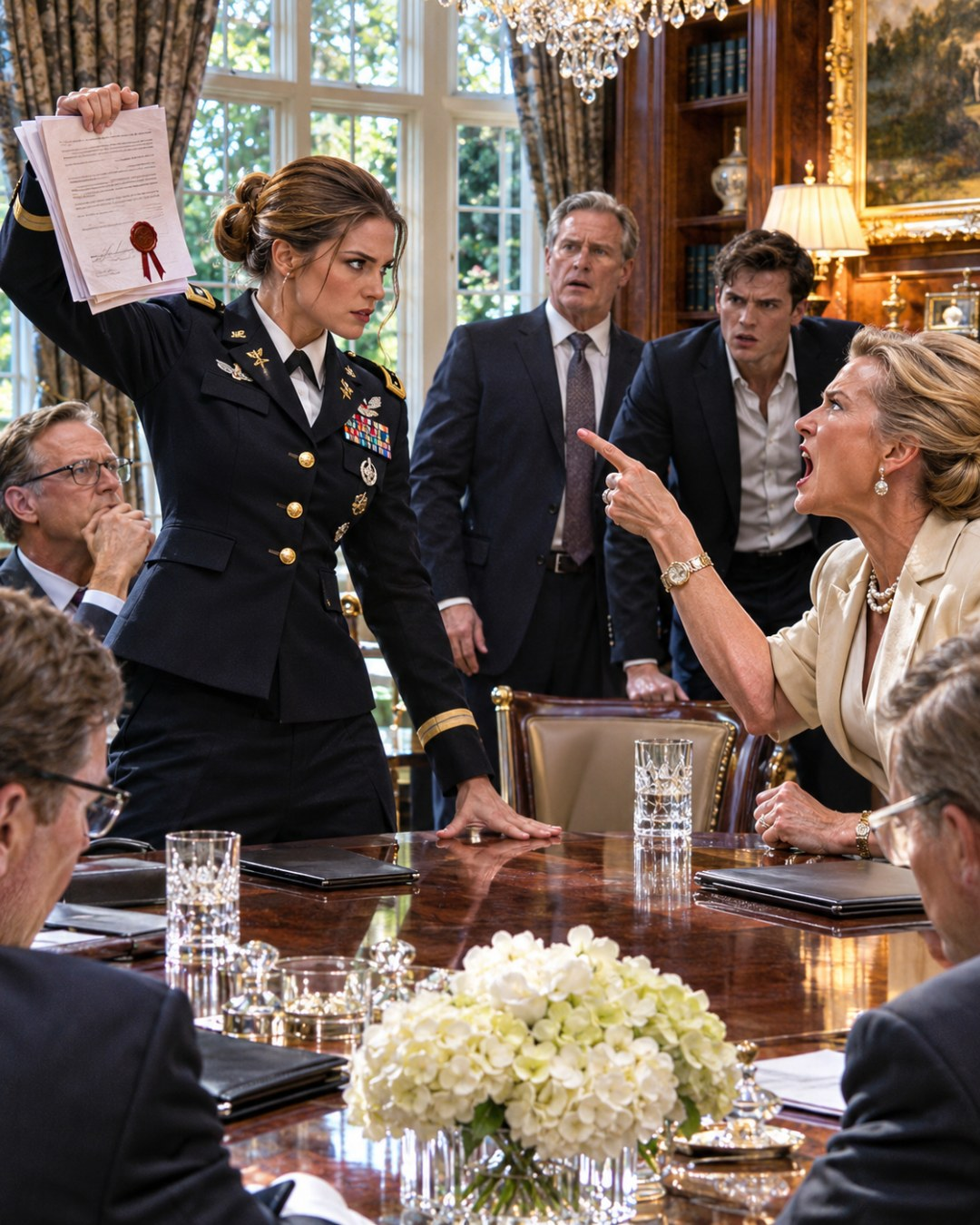
"I was the one who changed the hospital records."
Margaret Ellis stood at the end of the hallway, her face drained of color.
For several seconds, nobody moved.
I stared at the woman who had represented my father for years. The woman who had helped me challenge the inheritance waiver. The woman who had sat beside me while I discovered that my sister was alive.
The woman I had trusted to help me find the truth.
"Margaret," I whispered.
She closed her eyes.
"I changed the records, Sienna."
Behind me, Claire made a small sound.
I turned toward her.
She was standing beside Natalie Brooks, her hands pressed against her mouth.
I wanted to reach for her.
But I couldn't move.
Margaret took another step backward.
"Please let me explain."
I looked at Rebecca Lawson.
She was already standing.
"Margaret, you should have independent counsel before making any further statements."
Margaret nodded.
"I know."
"Then don't say anything you haven't discussed with your attorney."
Margaret looked at me.
Her eyes filled with tears.
"But she deserves to know."
I took a slow breath.
"Yes," I said. "I do."
Margaret began crying.
I held her gaze.
"But I deserve the truth in a form that doesn't disappear the moment someone challenges it."
She stopped.
I continued.
"We have documents. Recordings. Witnesses. Investigators. We're going to establish what happened properly."
Margaret nodded.
"I understand."
I looked at the phone in Rebecca's hand.
The still image showed my father sitting behind his desk on the morning he died.
Margaret stood beside him.
And beneath the image was a transcript containing the name of the person who had altered the hospital records.
Her name.
I felt my chest tighten.
"Did Dad know?" I asked.
Margaret swallowed.
"Yes."
"When?"
"The morning he died."
I closed my eyes.
My father had finally discovered the truth.
And before he could tell me, he was gone.
For a moment, grief threatened to overwhelm everything else.
Then I remembered his voice.
The difference between protecting a person and protecting a lie.
I opened my eyes.
"Margaret, I'm going to ask you one question."
She nodded.
"Did you know my sister was alive when you helped me search for her?"
Her face crumpled.
"Yes."
Claire began crying.
I felt something inside me break.
Margaret looked at her.
"I'm so sorry."
Claire shook her head.
"Don't."
Margaret stopped.
My sister's voice trembled.
"You don't get to apologize before I understand what you did."
Margaret lowered her eyes.
"You're right."
I turned toward Rebecca.
"Please arrange for investigators to receive the full video and any related statements. Margaret should have her own attorney present."
Rebecca nodded.
"Already being coordinated."
I looked at Margaret one final time.
"Whatever happens next, I need you to understand something."
She raised her eyes.
"You didn't lose my trust because you made a mistake thirty-eight years ago."
Tears slid down her cheeks.
"You lost it because you watched me search for my sister and chose to keep lying."
Margaret covered her face.
I turned away.
For the first time since Dad died, I knew that finding the truth would not bring him back.
But I also knew I wasn't going to let another person decide how much of it I was allowed to hear.
The full explanation took weeks.
Not because anyone wanted to delay it.
Because thirty-eight years of deception couldn't be untangled in one conference room.
There were hospital records to authenticate.
Bank transfers to trace.
Witness statements to compare.
Estate documents to examine.
And the circumstances of my father's death required a separate investigation.
I took leave from my military duties through the proper channels. I used civilian attorneys and investigators for the family matters, kept my command responsibilities separate, and refused every suggestion that my rank should somehow make the process move faster.
My father had taught me to respect the truth.
My career had taught me to respect the process required to establish it.
I needed both.
Three days after Margaret's confession, Rebecca called Claire and me into her office.
The independent document examiner had completed a preliminary comparison of the historical hospital forms.
The altered authorization had originally identified a temporary medical transfer.
It had not contained a valid parental consent to adoption.
Someone had changed the classification.
Someone had inserted a notation indicating that my parents had relinquished their rights.
And someone had replaced a page containing the original transfer instructions.
Margaret's signature appeared on the altered record.
But the handwriting analysis and document history suggested that the changes had been made in more than one stage.
Rebecca placed the findings on the table.
"Margaret has admitted participating in the first alteration."
I looked at Claire.
She was sitting beside me, her expression controlled.
"What did she do?" I asked.
Rebecca consulted her notes.
"According to the statement she gave with counsel present, she was a junior attorney working on the Whitcomb financial dispute. Richard told her that the hospital needed a corrected administrative record to reflect a temporary transfer."
I stared.
"And she believed him?"
"She says she did initially."
I looked down.
Rebecca continued.
"She later learned that the amended paperwork was being used to support a permanent adoption. By then, Harold Vane had already released Claire to the placement agency."
Claire swallowed.
"Did Margaret try to stop it?"
Rebecca hesitated.
"She says she raised concerns with her supervising attorney."
"And?"
"She was told the matter had been resolved by the parents."
I closed my eyes.
"Did she verify that?"
"No."
Claire looked toward the window.
Rebecca continued.
"Years later, Margaret obtained information suggesting the adoption had been completed without valid consent from Arthur. She kept a copy of the original transfer memorandum."
My attention sharpened.
"Why didn't she tell Dad?"
"She says Richard threatened to expose her role in changing the records."
I looked at Rebecca.
"And she stayed silent."
"Yes."
Claire spoke quietly.
"Even after she became Arthur's attorney?"
Rebecca nodded.
"Yes."
My sister stared at the table.
"Then she knew he was mourning me."
I reached for her hand.
Claire squeezed my fingers.
Rebecca's expression softened.
"Margaret has acknowledged that."
I took a slow breath.
"Did she ever tell Grandma?"
"Yes."
I went still.
"When?"
"Shortly before Eleanor established the trust protections."
I closed my eyes.
Grandma.
The woman who had hidden letters in button boxes.
The woman who had commissioned safeguards against unauthorized transfers.
The woman who had known something was terribly wrong long before I did.
"Did Grandma know Claire was alive?"
Rebecca nodded.
"She had credible evidence that the second baby survived, but she did not know where Claire had been placed."
I swallowed.
"Why didn't she tell Dad?"
Rebecca looked at me.
"According to Margaret, Eleanor intended to confront Richard after obtaining the original records. She feared that an unsupported accusation would cause the documents to disappear."
I stared.
"And then?"
"Richard learned she was investigating. The records were moved. Margaret withdrew from the matter. Eleanor continued trying to locate Claire through other channels."
I looked down.
"She never found her."
"No."
For a moment, I couldn't speak.
Grandma had loved me fiercely.
She had protected the Boston house.
She had written warnings for Dad.
But she had also spent years trying to find the granddaughter she had never been allowed to know.
Claire began crying.
I put my arm around her.
"She wanted you," I whispered.
Claire looked at me.
"She didn't even know me."
I shook my head.
"She knew you were hers."
My sister closed her eyes.
And for the first time, she cried for a grandmother she had never met.
The original hospital records finally emerged from Harold Vane's private archive.
His son, Thomas Vane, had initially resisted requests for access.
Then investigators obtained the necessary legal authority.
The archive contained decades of correspondence, financial records, and administrative documents.
Some were ordinary business papers.
Others were not.
Among them was a letter from Richard Caldwell instructing Harold to ensure that the second Sterling child was transferred under a confidential medical arrangement.
The letter had been written before Claire and I were born.
Richard had planned the transfer in advance.
He had not merely taken advantage of a confused hospital situation.
He had created one.
The records also contained a memorandum from Harold acknowledging that Arthur Sterling had never signed a permanent relinquishment.
That was the document Dad had spent his final days trying to obtain.
It proved that Richard's story about a voluntary adoption had been false.
And it explained why Harold had been so frightened when Dad confronted him.
The financial records revealed the rest.
Richard had diverted money from the Whitcomb partnership through a network of intermediary companies.
When the missing funds threatened to become public, he used the unresolved financial settlement with Daniel Whitcomb to pressure my mother.
Then he used Claire's disappearance to keep everyone afraid.
Daniel accepted money to remain silent.
Harold altered administrative records.
Margaret helped create the first false document and then concealed what she knew.
My mother learned years later that Claire might be alive.
Instead of telling Dad, she allowed Richard to convince her that exposing the truth would destroy the family.
Every person had made a choice.
Some choices had been made under pressure.
Some had been made out of greed.
Some had been made out of fear.
But the consequences had fallen on two little girls.
One who grew up believing she was an only child.
And one who grew up wondering why her birth family had abandoned her.
I stared at the records for a long time.
Then I closed the folder.
"Claire needs to see these."
Rebecca nodded.
"She will."
I looked toward the window.
"And I want her adoptive parents' names kept out of any public accusation unless the evidence requires otherwise."
Rebecca agreed.
"The records indicate they believed the placement was lawful."
I nodded.
"They loved her."
"Yes."
I took a slow breath.
"Then they shouldn't be treated as villains because other people lied."
The inheritance dispute was resolved before the criminal cases reached their final stages.
Charles Whitmore and the other attorneys cooperated with the independent review.
The September twenty-first amendment was established as a posthumous fabrication.
The purported signatures and witness information did not match the original execution records.
Thomas Bell's preserved copy of Dad's September twelfth amendment matched the version recovered from Grandma's travel trunk.
The document examiner found no material differences between the two executed copies.
The estate's independent counsel petitioned the appropriate court for instructions concerning the trust and the disputed transfers.
After the evidence was reviewed, the court recognized the valid amendment and rejected the later fabricated version.
Richard's attempt to expand his control over the trust failed.
The unauthorized transactions were referred for further accounting and recovery proceedings.
The Boston property remained protected.
And the waiver my mother had tried to force me to sign became evidence of the effort to conceal the disputed transfers.
I remember the day Rebecca called with the ruling.
I was sitting in Dad's old study.
The office had been professionally examined, and the estate representative had finally allowed me to return.
The photograph from my commissioning ceremony was back on the wall.
I had asked them to leave it there.
My phone rang.
"Sienna," Rebecca said, "the court has issued its decision."
I closed my eyes.
"Tell me."
"The challenged amendment has been rejected."
I exhaled.
"And Dad's?"
"The September twelfth amendment has been accepted as valid for the matters before the court."
My throat tightened.
"What about the Boston house?"
"It remains protected under the trust."
I pressed my hand against my mouth.
Rebecca continued.
"The disputed transfers are subject to accounting and recovery. Richard has no authority to direct further transactions."
I closed my eyes.
For weeks, I'd been afraid that every document Dad left would be challenged.
Every signature questioned.
Every witness threatened.
Every safeguard destroyed.
But he had done enough.
Grandma had done enough.
And the truth had survived.
Rebecca's voice softened.
"Sienna?"
"I'm here."
"There's one more thing."
My pulse quickened.
"What?"
"The court has directed the trustees to address Claire's beneficiary status under the governing documents and applicable law."
I swallowed.
"Does that mean—"
"It means her claim will be evaluated properly, without the false waiver or Richard's interference."
I closed my eyes.
That was all I'd wanted.
Not a special favor.
Not an invented entitlement.
A fair determination.
The chance for my sister to receive whatever Dad and Grandma had lawfully intended for her.
"Thank you," I whispered.
Rebecca paused.
"Your father was very careful."
I looked at his photograph.
"Yes."
"He was."
Julian came to see me two days later.
He stood in the doorway of Dad's study, holding a cardboard box.
For a moment, he looked like the boy who used to sneak into my room and steal my candy.
Then I remembered the man who had stood silently while our mother tried to take my inheritance.
"Can I come in?" he asked.
I nodded.
He entered.
"I brought something."
He placed the box on the desk.
Inside were old family photographs.
Dad teaching Julian to ride a bicycle.
Grandma standing in the Boston garden.
Mom holding me as a baby.
And one photograph I'd never seen before.
Dad holding two newborn girls.
My breath caught.
"Where did you find this?"
Julian looked down.
"In an old album at the estate."
I lifted the photograph carefully.
Dad was sitting in a hospital chair.
He looked exhausted.
But he was smiling.
One baby rested in each arm.
Claire and me.
Together.
Before anyone separated us.
I stared at the photograph.
Tears blurred my vision.
Julian stood quietly.
Finally, he said, "I owe you an apology."
I looked up.
He swallowed.
"I knew Mom was pressuring you. I knew Richard was hiding things. And I let it happen because I thought you could afford to lose the money."
I said nothing.
Julian continued.
"I told myself you didn't need it."
I looked at him.
"And you did."
He nodded.
"Yes."
"Even though the debts were yours."
His eyes filled with tears.
"Yes."
I studied him.
"What happens to your businesses now?"
He took a slow breath.
"Two are closing. One is being sold. Rebecca Shaw is helping me work through the remaining obligations."
I nodded.
"Are you filing for bankruptcy?"
"Possibly. We're evaluating the options."
I looked at him.
"And the money Richard moved?"
"The accounting is separating legitimate business expenses from unauthorized transfers. I'm cooperating."
I nodded.
"Good."
Julian swallowed.
"I'm not asking you to save me."
I studied him.
For the first time, he sounded like he meant it.
"I can't fix everything," he said. "But I can stop making it worse."
I looked down at the photograph.
Then back at him.
"That's a start."
He nodded.
"I know."
He turned to leave.
"Julian."
He stopped.
I held up the photograph.
"Did Dad ever tell you about Claire?"
Julian shook his head.
"No."
I studied him.
"Do you want to meet her?"
His eyes filled with tears.
"If she'll let me."
I nodded.
"I'll ask."
He smiled sadly.
"Thank you."
The investigation into Dad's death was the hardest part.
Not because the evidence disappeared.
Because it didn't.
The recordings were preserved.
The emergency call records were recovered.
The medical examiner reviewed the available medical evidence, and additional forensic testing was performed where possible.
The original death certificate had listed a heart attack.
But the investigation found that the circumstances were more complicated.
Dad had experienced an acute medical crisis after consuming a drink in his office.
The surviving physical evidence and laboratory findings supported the presence of a substance that could have contributed to a dangerous cardiac event.
The exact sequence required expert interpretation.
But the recordings established something else.
Something that couldn't be explained away by uncertainty about the medical mechanism.
Richard had attempted to delay the emergency call.
And he had directed others to move Dad from the office before responders arrived.
The emergency response timeline confirmed a significant delay between the first signs of distress and the call for help.
That delay mattered.
Investigators also recovered communications showing that Richard had sought information about substances capable of affecting cardiac function.
The evidence was reviewed by prosecutors.
Richard was charged in connection with the financial fraud, falsified documents, and the circumstances surrounding Dad's death.
Harold Vane faced proceedings related to the historical records, subject to his health and the applicable legal limitations.
Daniel Whitcomb entered into a cooperation agreement concerning the financial transactions and his role in concealing Claire's identity.
Margaret Ellis surrendered her law license while disciplinary and criminal matters proceeded. She later entered a plea to charges arising from her falsification and concealment of records.
I didn't attend every hearing.
I didn't need to.
I attended the ones that mattered to Claire.
And the ones that mattered to Dad.
The final determination of Richard's responsibility for Dad's death came after a long legal process.
The jury heard the recordings.
The medical evidence.
The financial motive.
The emergency call timeline.
And testimony from the people who had been in the office.
My mother testified.
So did Daniel.
So did Harold, through procedures appropriate to his condition.
Richard's defense challenged the evidence.
That was his right.
But the jury ultimately found him guilty of the charges concerning Dad's death, as well as the principal fraud offenses.
When the verdict was read, I didn't feel triumphant.
I felt exhausted.
I thought about Dad sitting behind his desk.
About the photograph on the wall.
About the way he'd called my name when he couldn't breathe.
And about the years Richard had stolen from Claire.
The verdict couldn't return any of those things.
But it meant the truth had been heard.
Publicly.
Under oath.
With evidence.
And Richard could no longer use money or fear to silence everyone around him.
My mother's role was more difficult to understand.
She had known Claire might be alive.
She had visited her adoptive family.
She had offered money to keep them away.
She had participated in the pressure campaign against me.
But the evidence did not establish that she had planned Claire's original transfer or knew Richard intended to harm Dad.
She cooperated with investigators.
She provided records.
She testified about the delayed emergency call.
And she accepted responsibility for her own conduct.
The civil consequences were substantial.
She relinquished disputed authority over trust matters, returned funds where required, and entered agreements resolving claims arising from her participation in the improper transactions.
Her relationship with Claire and me was not repaired by those legal steps.
That required something harder.
Time.
Truth.
And the willingness to accept that forgiveness could not be demanded.
One afternoon, several months after the verdict, she came to the Boston house.
Claire and I were sitting in Grandma's garden.
The roses had begun blooming.
My mother stopped at the gate.
She looked uncertain.
It was strange to see her that way.
For most of my life, Victoria Sterling had entered every room as though she owned it.
Now she waited.
"May I come in?" she asked.
I looked at Claire.
My sister considered the question.
Then nodded.
"Yes."
Mom walked toward us.
She carried no gifts.
No expensive flowers.
No envelope.
Just a small handbag and an expression I had never seen before.
Humility.
She sat across from us.
For a while, nobody spoke.
Then she looked at Claire.
"I went to see your adoptive parents' graves."
Claire went still.
My mother continued.
"I brought flowers."
Claire looked down.
"They would have liked that."
Mom began crying.
"I wish I'd thanked them."
My sister's eyes filled with tears.
"They loved me."
"I know."
"They were good people."
Mom nodded.
"I know."
Claire took a slow breath.
"Then don't ever talk about them as though they took me from you."
My mother shook her head.
"I won't."
Claire looked at her.
"They didn't know."
"I understand."
My sister wiped her cheeks.
"They were my parents."
Mom nodded.
"Yes."
"And Arthur was my father too."
My mother's face crumpled.
"Yes."
Claire looked down.
"I don't know what that makes you."
My mother began crying.
"I don't know either."
For a moment, the garden was silent.
Then Claire whispered, "Maybe we don't have to decide today."
Mom looked up.
Hope flickered across her face.
"No," she said softly. "We don't."
I watched them.
It wasn't forgiveness.
Not yet.
But it was the beginning of an honest conversation.
And after everything we'd endured, that mattered.
The Boston house became the center of our new family.
Not because it was valuable.
Not because Grandma had protected it with complicated legal documents.
But because it was the one place where the past no longer felt entirely broken.
Claire loved the library.
She said the windows reminded her of the house where she'd grown up.
Julian loved the garden.
He began helping with repairs on weekends, partly because he needed something useful to do and partly because he wanted to rebuild relationships without asking anyone for money.
I loved Grandma's sewing room.
The hidden compartment remained open behind a protective glass panel.
Inside it, we displayed copies of her letters.
Not the originals.
Those were preserved.
But enough for visitors to understand why the house mattered.
The woman who commissioned it, Clara Whitcomb, had refused to let her brothers control her inheritance.
Grandma had told me that story when I was a little girl.
I used to think it was about a stubborn woman who loved a beautiful house.
Now I understood why Grandma repeated it.
It was about ownership.
Choice.
And the right to decide what happened to the things entrusted to you.
Claire and I eventually established a charitable program through properly administered family funds and outside donations.
It helped young adults leaving foster care access education, legal assistance, and housing support.
We didn't name it after ourselves.
We named it the Eleanor and Arthur Foundation.
Claire insisted that the program also recognize adoptive families who provided loving homes.
I agreed.
It felt right.
Our family had been damaged by people who treated children as assets.
We wanted to help people who understood that children were never property.
One evening, almost two years after Dad died, Claire and I sat on the back porch of the Boston house.
The air smelled of rain.
The garden lights glowed softly.
Inside, Julian was arguing with a recipe.
I could hear him asking the oven why it refused to cooperate.
Claire laughed.
"He's going to burn dinner."
"Probably."
"Should we help him?"
I shook my head.
"He needs to learn."
She laughed again.
I looked at her.
She was wearing one of my sweaters.
I pointed at it.
"That's mine."
Claire smiled.
"I know."
"You stole it."
"Borrowed."
"You've had it for three months."
She shrugged.
"I thought sisters were supposed to steal each other's clothes."
I stared at her.
Then laughed.
She laughed too.
For a moment, we were just two women sitting on a porch.
Not beneficiaries.
Not witnesses.
Not daughters of a man whose death had become a criminal case.
Just sisters.
Claire leaned back in her chair.
"Do you ever think about what our lives would have been like if none of this had happened?"
I considered the question.
"Sometimes."
"Do you think we'd have been close?"
I looked at her.
"Probably."
She smiled.
"Probably?"
I shrugged.
"You might have been annoying."
She laughed.
"You would have been worse."
"Definitely."
We sat quietly.
Then Claire looked toward the garden.
"I used to think finding my birth family would answer every question."
I nodded.
"Did it?"
"Some."
She looked at me.
"But it gave me new ones."
I smiled sadly.
"That's family."
She nodded.
Then whispered, "I'm glad I found you."
My throat tightened.
I reached for her hand.
"I'm glad you found me too."
Later that night, after Julian had successfully rescued dinner, I went into Dad's old study.
We had brought some of his books to Boston.
His favorite chair stood beside the window.
The photograph from my commissioning ceremony hung above the desk.
Beside it was another photograph.
Dad holding two newborn girls.
Claire and me.
I stood looking at it for a long time.
Then I opened the bottom drawer.
Inside was the dark blue notebook Dad had given me six weeks before he died.
The notebook that started everything.
I turned to the final page.
If anything happens, ask about the amendment.
I ran my fingers over the words.
For so long, I'd thought the notebook was a warning about money.
And it was.
But it was also a warning about the people who used money to control the truth.
Dad had known something was wrong.
He had tried to protect us.
He had prepared documents, preserved evidence, and trusted people he hoped would do the right thing.
Some had failed him.
Others had finally found the courage to tell the truth.
And in the end, the records he'd preserved had helped us recover what Richard tried to take.
I closed the notebook.
Then I opened the sealed letter Grandma had left for me in the Boston house.
I'd read it many times since the investigation ended.
But one paragraph always made me stop.
My darling Sienna, there may come a day when people tell you that love requires you to surrender what is rightfully yours. They may call your refusal selfish. They may tell you that keeping the peace matters more than knowing the truth.
Do not believe them.
Real love does not ask you to disappear so someone else can remain comfortable.
I smiled through tears.
Grandma had known.
Not every detail.
Not every lie.
But enough.
Enough to protect me.
Enough to protect the possibility of Claire.
Enough to leave a house where we could finally become the family we should have been.
I placed the letter beside Dad's notebook.
Then I looked at the photographs.
"Thank you," I whispered.
I didn't know whether anyone could hear me.
But I wanted to say it.
For the trust.
For the letters.
For the recordings.
For the love that had survived thirty-eight years of lies.
And for the chance to choose what happened next.
The following spring, Claire and I hosted a family dinner at the Boston house.
Nothing elaborate.
No formal invitations.
No expensive centerpieces.
No attorneys.
Just people we wanted around our table.
Julian arrived early with groceries.
Evelyn brought a pie.
Leonard Price came with his wife.
Rebecca Lawson stopped by long enough to accept a glass of lemonade and refuse to discuss work.
Andrew Keller brought flowers for the garden.
My mother arrived last.
She stood at the front door holding a small pot of white roses.
Claire opened it.
For a moment, they looked at each other.
Then Claire smiled.
"Those are pretty."
Mom nodded.
"I thought Eleanor would have liked them."
"She would have."
My mother hesitated.
"May I come in?"
Claire stepped aside.
"Of course."
I watched from the hallway.
Mom looked at me.
I nodded.
She smiled.
Not the polished smile she'd worn at the estate.
Something smaller.
More uncertain.
More real.
We hadn't forgotten what happened.
We never would.
But we had stopped pretending that forgetting was the price of moving forward.
At dinner, Julian told a terrible joke.
Claire laughed so hard she nearly spilled her drink.
Evelyn scolded him for using the wrong serving spoon.
Leonard told a story about Dad losing his car keys while they were sitting in his pocket.
My mother laughed.
Then began crying.
Nobody rushed to silence her.
Nobody told her to compose herself.
Claire reached across the table and handed her a napkin.
Mom whispered, "Thank you."
Claire nodded.
"You're welcome."
I watched them.
For years, our family had been organized around one rule.
Don't upset Victoria.
Don't question Richard.
Don't make Julian feel ashamed.
Don't ask about the past.
Don't tell Sienna the truth.
Now there were no rules like that.
People could disagree.
They could apologize.
They could admit they were wrong.
They could leave the room and come back when they were ready.
And nobody had to surrender themselves to belong.
After dinner, Claire and I walked into the garden.
The roses were blooming.
The windows glowed behind us.
I could hear Julian laughing inside.
Claire looked at the house.
"Do you ever think about selling it?"
I shook my head.
"No."
She smiled.
"Good."
I looked at her.
"Why?"
"Because I like having somewhere to come home to."
My throat tightened.
I put my arm around her shoulders.
"Me too."
She leaned against me.
For a while, we stood together beneath the evening sky.
Then Claire looked up.
"Do you think Dad would be proud?"
I thought about everything we'd survived.
The documents.
The lies.
The courtroom.
The grief.
The difficult conversations.
The slow rebuilding.
And the family gathering inside the house Grandma had protected.
I smiled.
"I think he'd be very proud."
Claire nodded.
"Of both of us?"
I looked at her.
"Especially both of us."
She smiled through tears.
Then hugged me.
I held her tightly.
For thirty-eight years, I had believed I was my father's only daughter.
For thirty-eight years, Claire had believed her birth family had abandoned her.
For years, my mother had confused control with love.
Julian had confused rescue with responsibility.
And Richard had believed that money could make every truth negotiable.
He had been wrong.
My father hadn't left me an inheritance so I could become wealthy.
He had left it because he wanted me to have choices.
Grandma hadn't protected the Boston house because she loved its walls.
She had protected it because she understood that a home could become a place of refuge when the people who should protect you failed.
And Claire hadn't come into my life to take something from me.
She had come into my life because she was always supposed to be there.
I looked toward the warm windows.
My family was waiting inside.
Not the family I had imagined when I returned to Greenwich after Dad's funeral.
Not the family Richard had tried to preserve through fear.
The family we had built through truth.
Through accountability.
Through second chances that were freely offered, never demanded.
I took Claire's hand.
"Come on," I said. "Julian's probably eating the rest of the pie."
She laughed.
"Then we'd better hurry."
We walked back toward the house together.
And when I opened the door, I didn't feel like a daughter returning to a place where she had to prove she belonged.
I felt like a woman coming home.






Comments 0