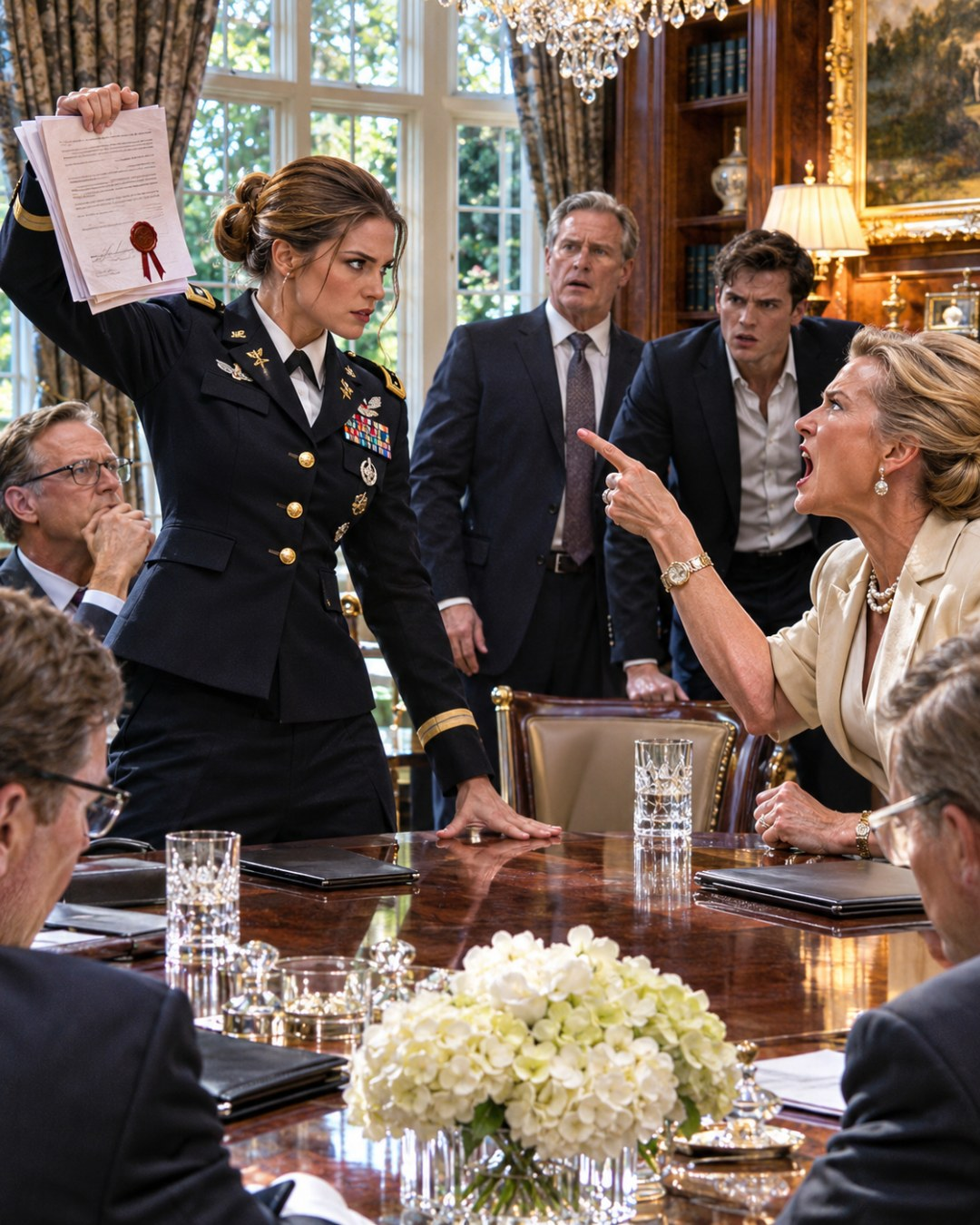
My mother stood in the kitchen doorway.
Victoria Sterling.
The woman who had hired five attorneys to pressure me into surrendering my inheritance.
The woman who had admitted knowing about an authorization bearing my forged signature.
The woman who had apparently visited my twin sister's adoptive family thirty-eight years after giving birth to two daughters—and years before telling me that my sister existed.
She wore a dark wool coat over a cream blouse. Her hair, usually arranged with perfect precision, hung loosely around her face.
She looked twenty years older than she had at the estate.
But it wasn't her appearance that frightened me.
It was the expression in her eyes.
She wasn't angry.
She was terrified.
"Mother?" I whispered.
She looked past me toward Evelyn Mercer.
"Don't let her give you that document."
I turned slowly.
Evelyn stood beside the kitchen table, holding a faded hospital form.
Her face had gone white.
"Victoria," she whispered.
My mother stepped into the room.
"Put it down."
Evelyn didn't move.
"Victoria, she deserves to know."
"Not like this."
I raised one hand.
"Both of you, stop."
They fell silent.
I looked at Margaret Ellis.
She was already standing beside the table, her notebook open.
Then I looked at my mother.
"How did you get here?"
"My attorney arranged transportation."
"Does she know you're here?"
"Yes."
"Did you come alone?"
She nodded.
I studied her.
She appeared exhausted, but she was steady on her feet. A small medical bandage covered part of her wrist.
"Are you safe?" I asked.
Her expression softened for a fraction of a second.
"Yes."
"Then sit down."
She looked toward the chair.
For a moment, I thought she would refuse.
Then she sat.
I turned to Evelyn.
"Put the document on the table."
Evelyn obeyed.
I didn't touch it.
Not yet.
Andrew Keller had been documenting every item we found, and I wasn't about to abandon that process because my mother had appeared unexpectedly.
"Andrew," I said, "please photograph the form before anyone handles it."
He nodded.
My mother closed her eyes.
"Sienna, please."
I looked at her.
"You're going to have to stop saying that."
Her eyes opened.
"Stop saying what?"
"Please. Come home. Don't ask questions. Don't read that. Don't talk to Evelyn."
My voice remained quiet.
"You've spent my entire life telling me what I shouldn't know."
She looked down.
"Not anymore."
I stared at her.
"Then tell me the truth."
She began trembling.
For several seconds, nobody spoke.
Then she whispered, "The signature belongs to Margaret."
The room went completely still.
I turned toward my attorney.
Margaret's expression changed.
Not dramatically.
She didn't gasp.
She didn't step backward.
She simply looked at the document with an intensity I had never seen before.
"What?" I asked.
My mother pointed toward the form.
"Margaret Ellis signed it."
I looked at Margaret.
She was staring at the faded paper.
"Margaret?"
She took a slow breath.
"May I see it?"
Andrew had finished photographing the document.
He placed it inside a clear protective sleeve and turned it toward her.
Margaret leaned closer.
At the bottom of the form was a signature.
M. Ellis.
My stomach tightened.
I recognized the handwriting.
Or thought I did.
But the date was thirty-eight years old.
Margaret was in her early sixties.
She would have been a young attorney then.
"Did you sign this?" I asked.
Margaret looked at me.
"I don't remember signing this document."
My mother gave a bitter laugh.
"Of course you don't."
Margaret ignored her.
She examined the form again.
"That appears to be my signature, but I need to establish what this document is and whether it's authentic."
I stared at her.
"Have you ever worked on my family's legal matters before?"
"Yes."
"Before Grandma created the trust?"
"Yes."
"Before I was born?"
She hesitated.
Then nodded.
"I assisted with certain legal matters involving Arthur and the Whitcomb partnership."
My chest tightened.
"Why didn't you tell me?"
"Because I didn't understand that those matters were connected to your inheritance dispute until recently."
I held her gaze.
"Margaret, I asked you whether there was anything about this family you hadn't told me."
She looked down.
"I should have been more forthcoming."
My mother spoke sharply.
"She should have told you she was there when your sister disappeared."
Margaret turned toward her.
"Victoria, I was not present at the delivery."
"But you were at the hospital."
Margaret went still.
I looked between them.
"Was she?"
Margaret took a slow breath.
"I visited Arthur at the hospital after he called me."
My heart pounded.
"When?"
"The morning after you were born."
I stared.
"And you signed this?"
She looked at the form again.
"I may have witnessed an acknowledgment of receipt of documents. I need to see the entire record."
My mother laughed bitterly.
"You always had an explanation."
Margaret's expression hardened.
"And you always preferred an explanation that kept Richard out of the conversation."
Silence.
I looked at both women.
For years, my mother had treated Margaret as a distant professional acquaintance.
Someone Dad trusted.
Someone Grandma respected.
Someone whose name rarely came up at family dinners.
Now I was discovering that Margaret had been involved with my family before I was born.
Before the trust.
Before the adoption.
Before nearly every secret I was trying to untangle.
I took a slow breath.
"Margaret, do you believe your prior involvement creates a conflict in representing me?"
She looked at me.
"Given what we're learning, it may."
"Then we need independent counsel to review that."
She nodded immediately.
"I agree."
My mother looked surprised.
I continued.
"Andrew can help arrange a referral. Until that's resolved, I don't want anyone making assumptions about this document."
Margaret nodded.
"That's appropriate."
I looked at my mother.
"And you don't get to use this to stop me from asking questions."
Her eyes filled with tears.
"I know."
"Then start talking."
My mother folded her hands in her lap.
For several seconds, she stared at the kitchen floor.
Then she said, "Arthur called Margaret because the hospital told him our second daughter had died."
My throat tightened.
"Why did he call a lawyer?"
"Because he didn't believe the paperwork."
I sat down slowly.
My mother continued.
"The hospital said there had been complications. They told us the baby couldn't be saved."
"Did you see her?"
She shook her head.
"I held her after she was born. Then they took her for observation."
Her voice broke.
"I never saw her again."
I looked at Evelyn.
She was crying silently.
My mother wiped her cheeks.
"Arthur demanded to know what happened. They gave him forms. He said the dates didn't make sense."
"What dates?"
"The time of death. The transfer to the nursery. The release authorization."
My attention sharpened.
"Release authorization?"
She nodded.
"One form said our daughter had been transferred for additional care. Another said she had died before the transfer."
I stared.
"And Dad noticed?"
"Yes."
"Did you?"
She looked down.
"I was barely conscious."
I believed that could be true.
But it didn't explain what happened afterward.
"Then what?"
"Arthur called Margaret because he wanted someone independent to examine the paperwork."
I looked at Margaret.
She nodded slowly.
"I remember Arthur calling me from a hospital. He was distressed. I remember being asked to witness the delivery of an envelope containing documents."
My stomach tightened.
"Did you examine them?"
"Not fully. I was a junior associate, and I was there to document receipt."
"Receipt by whom?"
Margaret looked at the form.
"That's what I need to verify."
My mother leaned forward.
"The hospital administrator."
Margaret frowned.
"Which administrator?"
My mother's expression changed.
"Harold Vane."
I went still.
Vane.
Thomas Vane.
The man connected to Northbridge Capital Partners.
The man whose business relationship with Richard had surfaced during our review.
"Harold Vane?" I repeated.
My mother nodded.
"He was the hospital's legal administrator."
I looked at Margaret.
She was already writing the name.
"Is he related to Thomas Vane?" I asked.
My mother nodded slowly.
"His father."
I felt cold.
The connections were tightening.
The old partnership.
The hospital.
The adoption.
The lending company.
The transfer of trust money.
And Richard.
Always Richard.
"How did Richard know Harold Vane?" I asked.
My mother closed her eyes.
"Through Daniel Whitcomb."
I stared at her.
"Explain."
She took a shaky breath.
"Daniel's family invested in medical properties. Harold handled legal and administrative work for several institutions."
"And Richard?"
"He arranged financing."
I looked down.
A network of people.
Business associates.
Financial arrangements.
Professional favors.
A group that had apparently remained connected for decades.
My mother continued.
"Richard told me Harold could help us resolve the confusion."
"Was Richard at the hospital?"
"Yes."
I felt my stomach tighten.
"Why?"
"He came with Daniel."
The room went silent.
I stared at her.
"Daniel Whitcomb was at the hospital when I was born?"
My mother nodded.
"Yes."
I couldn't speak.
For years, I had imagined my birth as a private moment between my parents.
Now I was learning that my mother's former fiancé and the man who would eventually become my stepfather had been there too.
"Why?" I whispered.
My mother looked down.
"Daniel said he needed to discuss the settlement."
I stared.
"While you were giving birth?"
"He came afterward."
I shook my head.
"That's insane."
She began crying.
"I know."
"Did Dad know Daniel was there?"
"Not at first."
My pulse quickened.
"What happened?"
"Arthur was with you in the nursery when Daniel arrived."
I looked at Evelyn.
She nodded.
"I remember seeing him in the hallway."
I stared at her.
"You never told me."
She looked ashamed.
"I didn't know what it meant then."
My mother continued.
"Daniel said the settlement had to be finalized before Arthur transferred certain assets into family arrangements."
I felt cold.
"He was still trying to collect money?"
"Yes."
"From Dad?"
"From me."
I stared at her.
"And Richard was helping him?"
She nodded.
I closed my eyes.
My mother had signed a financial agreement before marrying Dad.
Daniel had apparently used that agreement to demand compensation.
Richard had helped arrange the paperwork.
And somewhere in the middle of that dispute, my twin sister had disappeared.
"Mother," I said quietly, "did Daniel know Claire was alive?"
She hesitated.
"I believe he did."
My chest tightened.
"When did you learn that?"
She looked away.
"Years later."
"How many years?"
She swallowed.
"Seventeen."
I stared at her.
"Seventeen years?"
She nodded.
"Your grandmother confronted me."
I felt cold.
"Grandma knew?"
"She suspected."
"What did she say?"
My mother's voice broke.
"She told me there were records showing the second baby had been transferred to another facility."
I stared.
"And what did you do?"
She began crying harder.
"I asked Richard."
I closed my eyes.
Of course.
Richard.
The man she trusted.
The man who had been involved from the beginning.
The man who had apparently spent decades controlling what everyone knew.
"What did he say?"
"He told me the records were wrong."
"And you believed him?"
"I wanted to."
I looked away.
That was the most honest thing she had said.
Not that she believed him.
That she wanted to.
Because believing him meant she didn't have to confront the possibility that her daughter was alive.
It meant she didn't have to admit she had been deceived.
It meant she didn't have to explain to Arthur why she had kept the secret.
And it meant she didn't have to face what her own choices might have allowed.
"Then why did you visit Claire's adoptive family in 2005?" I asked.
My mother went still.
She looked at me.
"How do you know about that?"
"Claire sent me a photograph."
Her face crumpled.
"Oh, God."
"She says you offered her adoptive parents money to keep her away from us."
My mother covered her mouth.
I waited.
Then she whispered, "I did."
The room fell silent.
I felt something inside me break.
"Why?"
She began sobbing.
"Because Richard told me Arthur would leave me if he discovered the truth."
I stared at her.
"You chose your marriage over your daughter?"
She shook her head.
"I thought I was protecting the family."
"No."
My voice was quiet.
"You were protecting yourself."
She looked at me.
For a moment, I thought she would argue.
Instead, she nodded.
"Yes."
The admission hurt more than another lie would have.
Because now there was nowhere left to hide.
No excuse.
No misunderstanding.
No complicated financial document.
Just a mother who had known one of her daughters might be alive and had chosen silence.
I looked away.
I couldn't forgive her.
Not then.
Maybe not ever.
But I could keep listening.
Because the truth mattered more than my anger.
Andrew arranged for another attorney, Rebecca Lawson, to review Margaret's potential conflict.
Rebecca was a Massachusetts estate litigator with no known connection to my family.
She joined us by video call.
After hearing a concise explanation, she recommended that Margaret step back from advising me on any matters involving the hospital form until the conflict could be assessed.
Margaret agreed.
There was no argument.
No attempt to pressure me.
No claim that I was being unreasonable.
That alone made the conversation different from every discussion I'd had with my family.
Rebecca also recommended preserving the hospital form, obtaining authenticated records, and avoiding assumptions about the legal significance of Margaret's signature.
I agreed.
My mother listened quietly.
When the call ended, Margaret turned toward me.
"Sienna, I'm sorry."
I looked at her.
"For what?"
"For not telling you earlier that I had been involved with your family during that period."
I studied her.
"Did you know Claire was alive?"
"No."
"Did you help arrange her adoption?"
"No."
"Did you ever receive money connected to it?"
"No."
I held her gaze.
"Will you cooperate with an independent review?"
"Completely."
I nodded.
"Then that's what matters now."
Margaret looked relieved.
But I wasn't ready to trust anyone blindly.
Not anymore.
At three in the morning, my mother finally told me about the night before Dad died.
We were sitting alone at the kitchen table.
Margaret had gone upstairs.
Andrew was speaking with the preservation contractor.
Evelyn had retired to a guest room.
For the first time in years, my mother and I were alone without a crowd, without Julian, without Richard, and without anyone telling us what we were supposed to say.
She stared at her hands.
"Arthur called me into his office on September seventeenth."
I said nothing.
"He had documents spread across the desk."
"What documents?"
"Bank records. Hospital records. A copy of the old settlement agreement."
I leaned forward.
"Did he know about Claire?"
"Yes."
"Did he know you'd visited her adoptive family?"
My mother closed her eyes.
"Yes."
I felt cold.
"What did he say?"
Her voice broke.
"He asked me how I could let him mourn a daughter who was still alive."
I closed my eyes.
I could imagine Dad asking that.
Not shouting.
Not threatening.
Just devastated.
My mother began crying.
"I told him I was afraid."
"Of Richard?"
"Of everything."
I looked at her.
"What did Dad do?"
"He told me fear wasn't an excuse."
My throat tightened.
Of course he did.
"He said we had to find Claire. We had to tell you. We had to correct the records."
I nodded slowly.
"And Richard?"
"He was furious."
"Was he there?"
"Not at first."
My attention sharpened.
"Then who was?"
She hesitated.
"Daniel Whitcomb."
I sat straighter.
"Daniel was in Dad's office?"
"Yes."
"Why?"
"Arthur invited him."
I nodded.
That matched what she'd told me earlier.
"What did Daniel bring?"
"A recording."
My pulse quickened.
"From the hospital?"
She nodded.
"Yes."
"Did you hear it?"
"Part of it."
I gripped the table.
"What was on it?"
My mother looked at me.
"Voices."
"Whose?"
"Daniel. Richard. Harold Vane."
I felt cold.
"And?"
She closed her eyes.
"Mine."
The room went silent.
I stared at her.
"What were you saying?"
She began crying.
"I don't remember everything."
"Mother."
"I was frightened. I was in pain. I had just given birth."
I took a slow breath.
"What did the recording capture?"
She whispered, "Someone asked whether I understood the arrangement."
I felt my stomach tighten.
"What arrangement?"
She looked down.
"The transfer."
I stared.
"Of Claire?"
She nodded.
I couldn't speak.
For a moment, the room seemed to tilt.
I gripped the edge of the table.
"Did you agree?"
She began sobbing.
"I don't know."
I stared at her.
"Mother."
"I remember someone telling me the second baby needed special care. I remember Richard saying there was a family who could provide it."
My heart pounded.
"And you agreed?"
"I was told it was temporary."
I closed my eyes.
Temporary.
A word that could hide almost anything.
"Did you sign something?"
She nodded.
"I think so."
I stared.
"Then what happened?"
"I fell asleep."
I looked away.
The story was terrible.
But it was also incomplete.
My mother might have been deceived.
She might have been coerced.
She might have been too impaired to understand what she signed.
Or she might have participated more knowingly than she was willing to admit.
I couldn't decide which version was true because it hurt less.
I needed the recording.
I needed the original hospital records.
I needed independent evidence.
"What did Dad say when he heard it?" I asked.
My mother began crying again.
"He said he wanted every document preserved."
I nodded.
"And Daniel?"
"He wanted money."
I stared.
"How much?"
"Two million dollars."
My stomach tightened.
"To keep quiet?"
"To surrender the original recording and related documents."
I looked down.
Extortion.
Or something dangerously close to it.
"What did Dad say?"
"He refused."
I closed my eyes.
Of course he did.
"He told Daniel that if the recording proved a crime, it belonged with investigators, not in a private settlement."
I swallowed.
"And Richard?"
"He came in while they were arguing."
My pulse quickened.
"What happened?"
My mother looked away.
"Arthur confronted him."
"About Claire?"
"Yes."
"And the trust money?"
"Yes."
I leaned forward.
"What did Richard say?"
"He said Arthur didn't understand what would happen if the truth came out."
I felt cold.
"Did he threaten Dad?"
My mother hesitated.
"He said everyone would suffer."
I stared.
"Then what?"
"Arthur told him to leave."
"Did he?"
"Eventually."
I took a slow breath.
"And Daniel?"
"He left too."
I looked at her.
"Was Dad alone afterward?"
She nodded.
"For a while."
My attention sharpened.
"For a while?"
She looked down.
"Someone else came."
I felt my stomach tighten.
"Who?"
My mother hesitated.
"Harold Vane."
I stared.
"The hospital administrator?"
She nodded.
"He was much older by then. He had retired years earlier."
"Why did he come?"
"Arthur wanted him to explain the original paperwork."
I looked at her.
"Did he?"
She began crying.
"Not while I was there."
I took a slow breath.
"Then what happened?"
"I left."
"What time?"
"Just after nine."
"And Dad?"
"He was still in the office."
I looked down.
Dad had died the next day.
The official cause was a heart attack.
But the final hours of his life were now crowded with people who had reasons to fear what he knew.
Daniel Whitcomb.
Richard Caldwell.
Harold Vane.
And my mother.
I looked at her.
"Did you see Dad alive the next morning?"
She nodded.
"At breakfast."
I exhaled.
That mattered.
He had survived the confrontation.
At least through the night.
"What did he say?"
My mother's eyes filled with tears.
"He told me he was going to tell you everything."
I closed my eyes.
"And?"
"He said I could stand beside him when he did, or I could keep lying."
I couldn't speak.
She whispered, "I told him I needed time."
My throat tightened.
"What did he say?"
She began sobbing.
"He said we had already wasted thirty-eight years."
I looked away.
I wanted to hear Dad's voice.
Just once.
I wanted to ask him what happened.
I wanted to tell him I understood why he was angry.
I wanted to tell him Claire was alive.
I wanted to tell him I would find her.
But he was gone.
And all I had were documents, recordings, and people who had spent decades lying.
By morning, Rebecca Lawson had arranged for the hospital form to be reviewed by an independent document examiner.
She also began coordinating requests for historical hospital records, adoption records where legally available, and relevant estate documents.
I called Claire's attorney.
I didn't ask to speak to Claire directly.
I simply said I wanted her to know I was willing to meet whenever she felt safe.
Her attorney thanked me.
Then said, "My client has one request."
"What is it?"
"She wants the truth about Arthur."
My throat tightened.
"Tell her I'm trying to find it."
A pause.
Then:
"She also wants to know whether he loved her."
I closed my eyes.
I thought about Dad's notebook.
Make sure both my girls know the truth.
I swallowed.
"Tell her he spent his last days trying to bring her home."
The attorney was silent.
Then quietly said, "I will."
At ten fifteen, Andrew received confirmation from the New Haven storage facility.
Arthur Sterling had rented a unit there.
The rental agreement remained active.
The estate representative had begun the process of obtaining lawful access.
But there was a problem.
The facility manager reported that someone had attempted to enter the unit the previous evening.
My stomach tightened.
"Who?"
Andrew looked at the email.
"Two individuals."
"Names?"
"One identified himself as Richard Caldwell."
I felt cold.
"And the other?"
"The facility wouldn't disclose the name without proper authorization."
I looked at Rebecca.
She was already making notes.
"Can they preserve the access records and surveillance footage?"
"Yes," Andrew said. "We've requested preservation."
I nodded.
"Was Richard allowed inside?"
"No. The manager says access was denied because his name wasn't on the account."
I exhaled.
At least the documents might still be safe.
But Richard knew where Dad had stored them.
That meant he had been following the same trail we were.
And perhaps he knew exactly what the recording contained.
I looked at my mother.
She was sitting near the window.
Her face had gone pale.
"Mother," I said, "did Richard know about the storage unit?"
She hesitated.
"Yes."
I stared.
"How?"
"He found a receipt in Arthur's desk."
I closed my eyes.
Of course.
The receipt Leonard had mentioned.
"Did he tell you what he wanted from the unit?"
She looked down.
"The recording."
I nodded.
"And the hospital records?"
"Yes."
I looked at Rebecca.
"We need to move quickly."
She nodded.
"Lawfully, but quickly."
At noon, Claire's attorney called again.
This time, she sounded concerned.
"Colonel Sterling, my client wants to meet you today."
My heart jumped.
"Is she safe?"
"Yes."
"Where?"
"At our office in New Haven."
I looked at Rebecca.
She nodded.
"We can arrange that."
The attorney continued.
"There's something else."
I felt my stomach tighten.
"What?"
"Claire received a message from Richard."
I went still.
"What did it say?"
"He claimed Arthur left her a personal recording."
My heart pounded.
"Did he send it?"
"No."
"Then what does he want?"
The attorney hesitated.
"He wants her to meet him alone."
I closed my eyes.
"She shouldn't do that."
"She won't."
I exhaled.
"Good."
The attorney continued.
"But Richard included a photograph."
I sat straighter.
"Of what?"
"A small digital recorder."
My pulse quickened.
"Does he have it?"
"We don't know."
I looked at Rebecca.
She was already reaching for her phone.
"Can you forward the photograph through counsel?" I asked.
"Yes."
A moment later, Rebecca received the image.
She opened it.
A black digital recorder lay on a wooden desk.
Beside it was a handwritten note.
September 17.
I stared.
Dad's final confrontation.
The night before he died.
The night Daniel brought the hospital recording.
The night Richard threatened him.
The night Harold Vane came to the office.
"Rebecca," I said, "we need to establish whether that's the original recording or a copy."
She nodded.
"And preserve the message."
I looked at my mother.
She was staring at the screen.
Her face had gone white.
"Mother?"
She didn't answer.
"Do you recognize the recorder?"
She nodded slowly.
"Arthur used one like that."
My heart pounded.
"For what?"
"Business meetings."
I looked at the photograph.
Dad had always kept careful records.
He wrote notes.
He saved documents.
He asked questions.
And when he believed something important might be disputed, he documented it.
Maybe he had recorded the confrontation.
Maybe the device contained the truth about Claire.
Maybe it contained the truth about the missing money.
And maybe it explained why Richard had been so desperate to make me sign that waiver.
At two thirty, we arrived in New Haven.
Claire's attorney met us in a private conference room.
Her name was Natalie Brooks.
She was in her forties, with short dark hair and a calm, professional manner.
She shook my hand.
"Colonel Sterling."
"Sienna, please."
She nodded.
"Claire is nervous."
"So am I."
Natalie gave a small smile.
"She asked me to tell you that she doesn't know what to say."
I swallowed.
"Neither do I."
Natalie looked relieved.
"That may help."
I sat down.
Rebecca took the chair beside me.
Margaret had remained in Boston to cooperate with the independent review of her earlier involvement.
My mother was staying with her attorney.
Evelyn had gone home.
For the first time since the dining room confrontation, I was about to meet someone who hadn't spent decades trying to control my inheritance.
Someone who might understand what it felt like to be used by people who claimed to love you.
Natalie looked toward the door.
"Are you ready?"
I took a slow breath.
"Yes."
She stood.
Then opened the door.
Claire Bennett stepped inside.
For a moment, neither of us moved.
She was my height.
Her hair was dark blond.
Her eyes were blue.
She wore a simple gray sweater and black trousers.
There was nothing dramatic about her appearance.
No expensive jewelry.
No designer handbag.
No carefully arranged expression.
Just a woman standing in a doorway, looking at me as though she was seeing a photograph come to life.
I stood slowly.
"Claire?"
She nodded.
"Sienna."
Her voice trembled.
I felt tears rise.
She looked at my face.
Then whispered, "You have his eyes."
My throat tightened.
"Dad's?"
She nodded.
"I saw pictures."
I couldn't speak.
She stepped closer.
"I don't know what I'm supposed to do."
I gave a small, broken laugh.
"Neither do I."
For a moment, we stood awkwardly.
Then Claire began crying.
"I'm sorry."
I shook my head.
"Don't apologize."
She wiped her cheeks.
"I thought I was prepared."
"So did I."
She laughed through tears.
Then she opened her arms.
I stepped forward.
And for the first time in thirty-eight years, I hugged my sister.
She held me tightly.
I held her just as tightly.
Neither of us spoke.
There was too much to say.
Too many years.
Too many birthdays.
Too many ordinary moments we had never shared.
When we finally stepped apart, Claire looked at me.
"I used to wonder if I looked like anyone."
My throat tightened.
"Now you know."
She smiled through tears.
"Yeah."
We sat.
Natalie gave us a few minutes before returning to the discussion.
Claire told me about her adoptive parents.
They had loved her.
They had raised her in a small house outside New Haven.
Her adoptive father was a mechanic.
Her adoptive mother taught elementary school.
Both had died within the last decade.
She had become a nurse because she wanted to help people who were frightened.
I listened.
I asked questions.
I told her about Dad.
About his terrible jokes.
His love of old movies.
His habit of keeping black ballpoint pens in every drawer.
His insistence on calling me every birthday, no matter where I was stationed.
Claire smiled.
"He sounds wonderful."
"He was."
Her eyes filled with tears.
"I wish I'd met him sooner."
I swallowed.
"So do I."
Then she looked down.
"I did meet him."
I went still.
"I know."
She nodded.
"Three weeks before he died."
My chest tightened.
"What happened?"
Claire took a slow breath.
"He cried."
I closed my eyes.
She continued.
"He looked at me for a long time. Then he said he was sorry."
I swallowed.
"For what?"
"For not finding me sooner."
Tears slid down my cheeks.
Claire wiped her own eyes.
"He said he had been told I died."
I nodded.
"He believed that."
"I know."
She looked at me.
"He showed me photographs of you."
My throat tightened.
"What did he say?"
She smiled sadly.
"He said you were stubborn."
I laughed through tears.
"That sounds right."
"He said you were brave."
I looked down.
"And he said he hoped we'd like each other."
I couldn't speak.
Claire reached across the table and took my hand.
"I think he would have been happy today."
I nodded.
"He would."
After an hour, Natalie returned with a folder.
"Claire has something she wants to share."
I looked at my sister.
She nodded.
"Arthur gave me a copy of a document."
"What document?"
"A letter."
I felt my pulse quicken.
"From whom?"
"Daniel Whitcomb."
I sat straighter.
Claire opened the folder.
Inside was a typed letter dated September seventeenth.
It was addressed to Arthur Sterling.
The subject line read:
Final Settlement and Release of Original Records.
I stared.
The letter demanded payment in exchange for the surrender of certain documents connected to Claire's birth and adoption.
It also referenced the R.C. Holdings transfer.
I looked at Rebecca.
She was reading carefully.
"Was this the document Daniel brought to Dad?" I asked.
Claire nodded.
"Arthur said Daniel wanted more money."
My stomach tightened.
"More than the $1.8 million?"
"Yes."
"How much?"
"Two million."
I closed my eyes.
That matched my mother's account.
Claire continued.
"Arthur refused."
I nodded.
"He told me Daniel was trying to use my adoption as leverage."
I looked at her.
"Did Daniel contact you directly?"
She nodded.
"Yes."
"When?"
"About a year ago."
My pulse quickened.
"What did he want?"
"He said he knew my birth family."
I stared.
"And?"
"He offered to tell me everything if I helped him recover money he claimed was owed."
I felt cold.
"Did you agree?"
"No."
I exhaled.
"He kept contacting me. Eventually I hired Natalie."
I looked at her attorney.
Natalie nodded.
"We've preserved the communications."
Claire continued.
"Then Arthur found me."
I swallowed.
"How?"
"He said someone had sent him a copy of my adoption record."
My attention sharpened.
"Who?"
Claire shook her head.
"He wouldn't tell me."
I looked at Rebecca.
She made a note.
Claire continued.
"He said he needed to verify the information before he explained everything."
I nodded.
"That sounds like Dad."
She smiled sadly.
"He was careful."
I looked down at the letter.
"Did he tell you about Richard?"
Claire's expression darkened.
"Yes."
"What did he say?"
"That Richard had been involved in the original arrangement."
I nodded.
"And?"
Claire hesitated.
"He said Richard wasn't acting alone."
I felt cold.
"Who else?"
She looked toward Natalie.
Then back at me.
"He didn't know for certain."
I nodded slowly.
That was important.
Dad had suspicions.
Not conclusions.
He had been trying to establish the truth.
Just as I was.
Claire opened another folder.
"There's something else."
I looked up.
"What?"
"Arthur gave me a photograph."
She placed it on the table.
It showed my father standing outside the Greenwich estate.
Beside him was a man with silver hair.
Daniel Whitcomb.
I stared.
The photograph had been taken recently.
Dad looked tired.
Daniel looked confident.
And behind them, partially visible through the open front door, stood Richard Caldwell.
I felt my pulse quicken.
"When was this taken?"
Claire looked at me.
"September seventeenth."
I stared.
"The night before Dad died."
She nodded.
I looked at the photograph again.
Dad.
Daniel.
Richard.
Three men connected to a secret that had lasted thirty-eight years.
Then Claire said something that made my stomach tighten.
"Arthur told me there was another person in the office that night."
I looked up.
"Who?"
She hesitated.
"He didn't say."
I stared.
"But he gave me something."
"What?"
She reached into her handbag.
And removed a small memory card.
My heart began to pound.
"What's that?"
"A copy of a recording."
I stopped breathing.
"From Dad?"
She nodded.
"He said I should keep it somewhere safe."
I looked at Rebecca.
She was already reaching for a protective sleeve.
"Have you listened to it?" I asked.
Claire hesitated.
"Only part."
My stomach tightened.
"What did you hear?"
She looked down.
"Arthur arguing with Richard."
I nodded.
"And?"
"Daniel demanding money."
I closed my eyes.
"What else?"
Claire's expression changed.
"There was a woman's voice."
I felt cold.
"My mother?"
She shook her head.
"No."
I stared.
"Then who?"
Claire hesitated.
"I didn't recognize her."
I looked at Rebecca.
She was watching us carefully.
Claire continued.
"Arthur asked the woman why she had kept the hospital records hidden."
My heart pounded.
"What did she say?"
Claire swallowed.
"She said she was trying to protect someone."
I leaned forward.
"Who?"
Claire looked at me.
"She wouldn't say."
I took a slow breath.
"Did Dad identify her?"
Claire nodded.
I felt cold.
"What name did he use?"
She looked toward the memory card.
Then whispered, "I didn't hear it clearly."
I stared at her.
"Can we listen to the recording?"
Natalie nodded.
"We've arranged for a forensic copy. The original card will remain preserved."
Rebecca agreed.
A technician connected the verified copy to a laptop.
We gathered around the table.
I felt my heart pounding.
The audio began.
Static.
Then Dad's voice.
Calm.
Controlled.
"Daniel, I'm not paying another dollar."
A man's voice replied.
"You don't understand what you're risking."
Dad answered.
"I understand exactly what you're trying to do."
Another voice.
Richard.
"Arthur, be reasonable."
Dad's response was sharp.
"Don't tell me to be reasonable after what you've done."
I closed my eyes.
It was him.
Dad.
Alive.
Speaking.
For one moment, the sound nearly broke me.
Then the recording continued.
Daniel said, "The documents belong to me."
Dad replied, "They concern my daughter."
Richard interrupted.
"Arthur, if this becomes public, it will destroy the family."
Dad's voice hardened.
"Then perhaps the family should have thought about that thirty-eight years ago."
I gripped the table.
Claire reached for my hand.
We listened.
A chair scraped.
Someone walked across the room.
Then Dad spoke again.
"Why are you here?"
A woman's voice answered.
"Because you asked me to come."
I froze.
The voice was familiar.
Older.
Steady.
Controlled.
I leaned closer.
Dad said, "I asked you to bring the original hospital authorization."
The woman replied, "I brought it."
Richard spoke sharply.
"You shouldn't have done that."
The woman answered.
"You've had thirty-eight years to tell the truth."
My heart pounded.
I looked at Rebecca.
She was staring at the screen.
Dad spoke again.
"Who authorized the transfer?"
Silence.
Then the woman whispered, "Arthur, you know who signed the form."
Dad answered.
"I know who signed it. I want to know who ordered it."
My stomach tightened.
The woman began crying.
"I didn't understand what they were doing."
Richard shouted.
"That's enough."
Dad's voice became colder than I had ever heard it.
"Richard, sit down."
A chair scraped.
Then Dad said, "I'm going to ask one more time."
The room went silent.
"Who gave the instruction to move my daughter out of that hospital?"
The woman took a shaky breath.
Then whispered, "It wasn't Victoria."
I stopped breathing.
Dad said, "Then who?"
There was a long pause.
Then the woman spoke.
"Arthur, I was told the child would be safer away from this family."
My heart pounded.
"By whom?" Dad demanded.
The woman began crying.
"By someone who knew about the Whitcomb agreement."
I looked at Claire.
Her face was pale.
Dad spoke again.
"Give me the name."
A sound interrupted the recording.
A door opening.
Footsteps.
Then Richard said something I couldn't understand.
The woman gasped.
Dad shouted, "Don't touch that!"
A sharp noise followed.
Something striking the desk.
Then the recording stopped.
I stared at the laptop.
For several seconds, nobody moved.
Claire was crying silently.
I gripped her hand.
Rebecca looked at Natalie.
"We need the full recording analyzed."
Natalie nodded.
"And we need to identify the woman."
I looked down.
The voice.
I knew it.
I had heard it recently.
In Boston.
In my grandmother's house.
But I couldn't immediately place it.
I closed my eyes.
I replayed the sound in my mind.
You've had thirty-eight years to tell the truth.
My stomach tightened.
I opened my eyes.
"Evelyn."
Claire looked at me.
"What?"
I stared at the laptop.
"The woman sounds like Evelyn Mercer."
Rebecca looked at me.
"Are you certain?"
I shook my head.
"No."
But my pulse was racing.
Evelyn had been at the hospital.
Evelyn had kept the document.
Evelyn had known Claire was alive.
Evelyn had stood behind my sister in the photograph.
And Evelyn had repeatedly insisted that Richard wasn't acting alone.
I looked at Claire.
"Did you ever hear Evelyn discuss the original authorization?"
She hesitated.
"Yes."
"What did she say?"
Claire looked down.
"She said Arthur was asking the wrong question."
I felt cold.
"What did she mean?"
Claire shook her head.
"I don't know."
I looked toward the laptop.
Then at the hospital form.
Then at the photograph of my mother outside Claire's adoptive home.
Everything pointed toward a secret older than Richard's financial scheme.
A secret that might explain why Grandma created the trust.
Why Dad had been desperate to find the original documents.
And why someone had tried to erase his final instructions.
I took a slow breath.
"Rebecca, we need to speak with Evelyn again."
She nodded.
"I agree."
I reached for my phone.
Before I could dial, a message appeared.
From Evelyn.
Do not come back to the Boston house.
I stared.
Another message followed.
Someone has been inside Arthur's storage unit.
My stomach tightened.
I looked at Rebecca.
She leaned closer.
Then a third message arrived.
The original recording is gone.
I stopped breathing.
A fourth message appeared.
And the person who took it left something behind.
I typed:
What?
Three dots appeared.
Then disappeared.
I waited.
Finally, Evelyn sent a photograph.
It showed the inside of a storage unit.
Cardboard boxes.
A metal shelf.
A small wooden desk.
And on the desk, a sealed envelope.
My name was written across the front.
But beneath it was another name.
A name I had never expected to see connected to my father's final investigation.
I enlarged the photograph.
Then my phone rang.
Evelyn.
I answered.
"Evelyn?"
Her breathing was rapid.
"Sienna, listen to me."
"What happened?"
"Someone was here."
"Where are you?"
"At the storage facility."
My stomach tightened.
"Why did you go there?"
"Because Arthur told me to."
I stared.
"When?"
"Before he died."
I looked at Rebecca.
She was already standing.
"Evelyn, are you safe?"
A pause.
Then:
"I don't know."
I gripped the phone.
"Leave the unit. Go to the office. Call the police if you feel threatened."
Evelyn began crying.
"Sienna, the envelope..."
"What about it?"
"It isn't from Arthur."
My heart pounded.
"Then who wrote it?"
She whispered, "Someone who knew he was going to die."
I stopped breathing.
"What?"
Footsteps sounded in the background.
Evelyn gasped.
Then whispered, "Oh, God."
I stood.
"Evelyn?"
A door slammed.
The phone struck something hard.
I heard a man's voice.
Low.
Familiar.
"Give me the envelope."
My blood ran cold.
I knew that voice.
I had heard it in my father's recording.
I had heard it in the Greenwich dining room.
And I had heard it threaten my mother.
Richard Caldwell.
I gripped the phone.
"Evelyn, get away from him!"
A scuffle.
A sharp cry.
Then silence.
I stared at the screen.
The call was still connected.
I heard footsteps.
Slow.
Approaching the phone.
Then Richard spoke.
"Sienna."
My heart pounded.
"Where is Evelyn?"
He laughed quietly.
"You're asking the wrong question."
I felt cold.
"What have you done?"
He ignored me.
"Your father made a terrible mistake."
I gripped the phone.
"What mistake?"
"He believed the truth would save his family."
I stared.
Richard continued.
"But some truths destroy everyone who touches them."
I took a slow breath.
"Richard, where is Evelyn?"
A pause.
Then:
"Come to the storage facility."
I looked at Rebecca.
She was already calling for assistance.
"Why?"
Richard's voice became colder.
"Because there's something you need to see."
I felt my pulse quicken.
"What?"
He hesitated.
Then whispered, "The woman who signed the original authorization."
I stopped breathing.
"What woman?"
Richard laughed.
"You've been looking for her all week."
My stomach tightened.
"Who?"
He lowered his voice.
"She's standing right in front of me."
I stared at the phone.
Then I heard another voice.
A woman's voice.
Weak.
Trembling.
"Sienna?"
My heart stopped.
I knew that voice.
I had heard it in my grandmother's kitchen.
I had heard it crying over my father's letter.
And I had heard it on the recording from September seventeenth.
Evelyn Mercer.
But before I could speak, Richard said:
"Tell her what you did."
A long silence.
Then Evelyn whispered:
"Sienna, I need you to understand why your grandmother made me promise never to tell you who really signed the order."
I gripped the phone.
"Who signed it?"
She began crying.
Then said:
"The person who ordered your sister taken from the hospital was..."






Comments 0