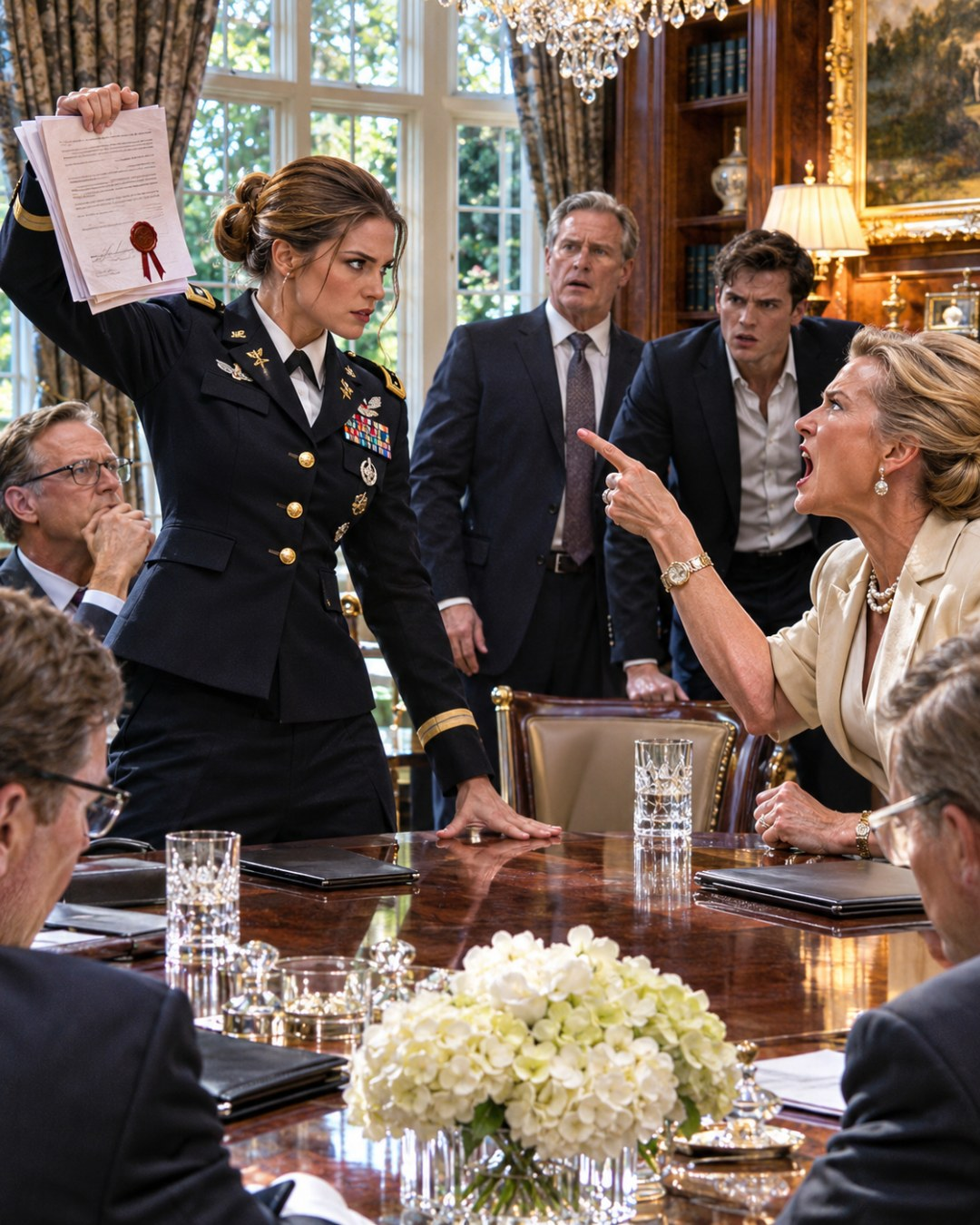
"The person who removed that file was Margaret Ellis."
The man's voice came through my mother's phone so clearly that nobody in the dining room could pretend they hadn't heard him.
For three seconds, no one moved.
Then my mother looked at me.
Not at Charles Whitmore.
Not at Richard.
Not at the five attorneys she had hired to pressure me into surrendering my inheritance.
At me.
"Your lawyer?" she whispered.
I kept my expression neutral.
"Margaret is my father's longtime attorney."
Victoria tightened her grip on the phone.
"She stole Arthur's trust documents?"
"That's not what the man said."
"He said she took them!"
"He said security footage showed her removing a file. Those are two different things."
My mother opened her mouth, but Whitmore spoke first.
"Mrs. Sterling, please ask the caller to identify himself."
Victoria looked irritated.
"Charles, I know who he is."
"Then the rest of us should know as well."
She hesitated.
The hesitation was brief.
But I noticed.
"This is Leonard Price," she said. "He manages certain administrative matters for the family."
I recognized the name.
Leonard Price had worked for my father for nearly fourteen years. His official title had changed several times, but his responsibilities generally involved managing records, coordinating outside accountants, and maintaining access to the private office my father kept in a separate wing of the estate.
I had met him perhaps six times.
He was a thin, quiet man who wore inexpensive suits and remembered everyone's birthday.
My father trusted him.
At least, I had always believed he did.
"Mr. Price," Whitmore said, leaning toward the phone, "this is Charles Whitmore. I understand you're reporting that Margaret Ellis removed a trust file."
"That's correct."
"From where?"
"Mr. Sterling's private records room."
"When?"
"Approximately eleven fifteen this morning."
"Did you personally witness the removal?"
"No. I reviewed the security footage."
"Was Ms. Ellis authorized to access those records?"
Another pause.
"I don't know."
Whitmore glanced at me.
"Then we should avoid characterizing this as theft."
My mother made an impatient sound.
"Charles, honestly."
He ignored her.
"Mr. Price, please preserve the original footage, access logs, and any related communications. Do not alter or delete anything."
"Understood."
"And do not distribute the recording until the circumstances have been established."
"Yes, sir."
My mother ended the call.
Then she pointed at me.
"You knew."
I met her eyes.
"Knew what?"
"That Margaret was coming here."
"No."
"Don't lie to me."
"I'm not."
"She works for you!"
"She doesn't work for me. She's an attorney. And she represented Dad long before I needed her advice."
Victoria looked toward Whitmore.
"Do you see what she's doing? She's brought another lawyer into our home to interfere with a private family matter."
I glanced at the five attorneys seated around the table.
"That's an interesting complaint."
Julian gave a humorless laugh.
"Can we please stop playing games?"
I turned toward him.
"You're welcome to explain the trust if you know something about it."
His expression tightened.
"I don't."
"Then why are you so nervous?"
"I'm not nervous."
He was.
His left foot had been moving beneath the table for the past ten minutes.
I had noticed the habit when he was fourteen.
He did it whenever he was worried about being caught doing something he shouldn't.
Back then, it usually involved borrowing Dad's car without permission.
Now, I suspected the consequences were considerably more expensive.
Whitmore placed the deed on the table.
"Colonel Sterling, before we go further, I think we need to establish precisely what this document references."
I walked back toward him.
He pointed to a handwritten notation near the bottom of the second page.
It was faded but legible.
Sterling Family Preservation Trust — supplemental schedule, June 2005.
Below that was a series of initials.
A.S.
And another set.
M.E.
Arthur Sterling.
Margaret Ellis.
I recognized both.
But the date troubled me.
June 2005.
I had been seventeen.
Still living at home.
Still trying to convince my mother that joining the military after graduation was not an act of personal betrayal.
"Do you remember your father discussing a trust that summer?" Whitmore asked.
I shook my head.
"No."
"Did you sign any documents?"
"Not that I remember."
"Did he ever mention placing the Boston property into a separate legal arrangement?"
"He said Grandma wanted it protected."
"Protected from whom?" my mother demanded.
I looked at her.
"That's what we're trying to find out."
Victoria folded her arms.
"Your grandmother was an unreasonable woman."
I felt my jaw tighten.
My grandmother, Eleanor Sterling, had been many things.
Stubborn.
Proud.
Occasionally impossible.
She believed coffee should be served hot enough to burn your tongue and that anyone who arrived more than fifteen minutes late without calling had no respect for other people's time.
But she had loved me without conditions.
When I was sixteen, after my mother discovered my application to a military academy preparatory program, we had an argument so severe that I left the house and took a train to Boston.
Grandma met me at the station.
She didn't lecture me.
She bought me dinner.
Then she asked what I wanted.
Not what my mother wanted.
Not what would look impressive in a family newsletter.
What I wanted.
I told her I wanted a life that belonged to me.
She listened.
Then she said, "A family that loves you won't require you to disappear to make everyone else comfortable."
I had carried those words through every difficult year of my adult life.
And now, standing in my father's dining room, I wondered whether she had known something about my family that I had been too young to understand.
"Grandma was careful," I said.
My mother laughed.
"She was paranoid."
"Those aren't the same thing."
"She never trusted me."
I looked at her.
"Why?"
Victoria went still.
It was a small reaction.
But Whitmore noticed it too.
He glanced between us.
Richard stepped forward.
"Perhaps this isn't the time to revisit old disagreements."
I turned toward him.
"Did you know about the trust?"
He hesitated.
"Arthur had several estate-planning arrangements."
"That's not what I asked."
"Sienna, I wasn't involved in every financial decision your father made."
"Then which ones were you involved in?"
His face hardened.
"You're beginning to sound accusatory."
"I'm asking questions."
"You're implying wrongdoing."
"No. I'm trying to understand why my father established a trust when I was seventeen, why a document allegedly signed after his death is being used to pressure me into surrendering property, and why the original trust file is suddenly being removed from his office."
Richard looked away.
I waited.
He didn't answer.
Whitmore closed the deed.
"At this point, I believe this meeting should be adjourned."
My mother stared at him.
"Absolutely not."
"Victoria—"
"I hired your firm to settle this matter."
"And I am advising you that the information currently available is insufficient to proceed."
"You're letting my daughter manipulate you."
Whitmore's expression became firm.
"Mrs. Sterling, your daughter has identified discrepancies that require investigation. That is not manipulation."
For the first time that evening, I almost felt sorry for him.
He had probably expected an uncomplicated inheritance dispute involving a wealthy widow, a difficult daughter, and a few signatures.
Instead, he had walked into a room full of missing records, contradictory dates, and a family whose members appeared unable to answer basic questions.
He gathered the documents into a neat stack.
"Nothing should be signed tonight."
My mother looked as though he had slapped her.
Julian threw up his hands.
"Unbelievable."
I turned toward him.
"What exactly did you expect to happen?"
He stared at me.
"You know what? Fine. You want to make everything difficult? Go ahead."
"Julian."
"No, Mom. I'm tired of this."
He stepped toward the table.
"You have no idea what's at stake."
"Then explain it."
He stopped.
I waited.
His eyes moved toward Richard.
Then Victoria.
Neither spoke.
"That's what I thought," I said.
Julian's face flushed.
"You think you're better than everyone."
"No."
"You walk around with your military title like it makes you special."
"I haven't mentioned my rank once."
"Everybody else has!"
"Because it's my title."
He looked ready to shout again.
Instead, he turned away.
And I noticed something.
His phone was vibrating in his hand.
He glanced at the screen.
His expression changed immediately.
The anger disappeared.
Something much closer to panic replaced it.
He declined the call.
A second later, the phone vibrated again.
He declined it again.
I filed the observation away.
Not every nervous gesture meant something.
But patterns mattered.
And Julian had been unusually interested in the outcome of a meeting he claimed was simply about fairness.
My mother sat down heavily.
"Arthur would be ashamed of this."
The words landed harder than I wanted them to.
I looked at her.
"Of what?"
"Of you."
I said nothing.
"Turning his death into an investigation. Bringing lawyers into our home. Accusing your own family of stealing."
I slowly placed my folder on the table.
"Mother, you invited five attorneys here and asked me to surrender everything Dad left me."
"Because Julian needs help."
"Then ask me for help."
"We did."
"No. You demanded my inheritance."
Her eyes narrowed.
"You have a government salary, benefits, a pension. You don't need those properties."
"That isn't the point."
"Then what is?"
I looked at the will.
"Dad made a decision. You don't get to erase it because you disagree."
For a moment, my mother looked exhausted.
Then the anger returned.
"You always loved him more."
The room went quiet.
Even Julian looked surprised.
I stared at her.
"What?"
"You heard me."
"Mother—"
"He could do no wrong in your eyes."
"That's not true."
"You worshiped him."
"No. I loved him."
"And what about me?"
The question was so unexpected that I didn't answer immediately.
My mother looked at me with an expression I hadn't seen in years.
Not the polished society hostess.
Not the woman who could make a room full of strangers feel inadequate with a single glance.
Just a mother who seemed furious that love had never worked the way she wanted.
"I loved you too," I said quietly.
She looked away.
For one second, I thought the conversation might become honest.
Then she said, "You certainly had a strange way of showing it."
I felt the familiar ache of an old argument.
There were years of things I could have said.
About the birthdays she forgot while planning charity events.
About the graduation ceremony she skipped because a friend's daughter was getting married.
About the way she introduced Julian as her brilliant entrepreneur and me as the daughter who worked somewhere in government.
But I didn't say any of them.
This wasn't the place.
And my father's estate wasn't a weapon I intended to use to settle childhood grievances.
"I didn't come here to fight about who loved whom," I said.
"Then sign."
"No."
Her expression closed.
The moment was gone.
Whitmore stood.
"I'll be contacting Ms. Ellis directly."
My mother turned toward him.
"Charles, I expect you to remember who your client is."
"I do."
"Then act like it."
He regarded her for a moment.
"Part of representing you is advising you when not to proceed."
She said nothing.
He turned toward me.
"Colonel Sterling, would you be willing to provide Ms. Ellis's contact information?"
"Certainly."
I gave him the number.
He wrote it down.
Then he gathered his briefcase.
The other attorneys followed his lead.
My mother watched them with open disbelief.
"You can't simply leave."
Whitmore paused.
"We can continue once the records have been reviewed."
"And when will that be?"
"I'll be in touch."
He walked toward the door.
The others followed.
Richard moved aside.
Julian stared at his phone.
I watched the attorneys leave.
Their departure changed the room.
Five strangers had arrived to give my mother the appearance of overwhelming authority.
Now they were leaving with questions she couldn't answer.
And the silence they left behind was far more uncomfortable than their presence had been.
My mother stood.
"This is your fault."
I picked up my folder.
"No. This is the result of asking questions."
She looked toward Richard.
"Do something."
He sighed.
"Victoria, perhaps we should all get some rest."
She stared at him.
"That's your solution?"
"It's been a difficult evening."
"You stood there and let her humiliate me."
Richard looked at me.
I could see the calculation in his eyes.
He wanted the confrontation to end.
He wanted me to leave.
And most of all, he wanted nobody to ask another question about the amendment.
"I think Sienna should go home," he said.
I nodded.
"That's exactly what I intend to do."
Julian looked up.
"Good."
I turned toward him.
"One thing before I leave."
He groaned.
"What now?"
"Who keeps calling you?"
His face changed.
"Nobody."
"Your phone has been ringing repeatedly."
"That's none of your business."
"You're right."
I held his gaze.
"Unless it concerns Dad's estate."
He laughed nervously.
"You're unbelievable."
I didn't answer.
My mother moved toward the doorway.
"Get out, Sienna."
I looked at her.
"Gladly."
I walked past her.
Then I stopped.
There was one more thing I needed to know.
"Mother."
She turned.
"What?"
"Did Dad know about Julian's debts?"
Her expression became rigid.
"Of course."
"All of them?"
Julian stepped forward.
"Don't start."
I ignored him.
"Did Dad know exactly how much Julian owed?"
My mother folded her arms.
"Your father supported his son."
"That's not an answer."
"He knew enough."
I looked at Richard.
"Did he?"
Richard's jaw tightened.
"Sienna, leave."
I nodded slowly.
"All right."
Then I walked out.
I didn't hurry.
There was no reason to.
Outside, the three black SUVs were still parked along the curved driveway.
The attorneys stood near their vehicles, speaking quietly.
Whitmore looked up as I approached.
"Colonel Sterling."
"Mr. Whitmore."
He stepped away from the others.
"I wanted to say something before you left."
I waited.
"I was not aware of the discrepancy involving the September amendment."
"I assumed as much."
He looked surprised.
"Why?"
"Because you reacted when I mentioned it."
A faint smile crossed his face.
"Your father raised an observant daughter."
The words caught me off guard.
I looked toward the estate.
"He did."
Whitmore's expression softened.
"I knew Arthur professionally. Not closely, but enough to respect him."
"Then you know he was careful."
"Extremely."
"Would he have signed an amendment without telling Margaret Ellis?"
Whitmore hesitated.
"People sometimes change attorneys."
"Did he?"
"I don't know."
I studied him.
"Do you believe the document is genuine?"
He looked toward the house.
Then back at me.
"I haven't seen the original. It would be irresponsible to give you an opinion."
It was a fair answer.
I appreciated it.
He lowered his voice.
"But I will tell you this. Your mother's instructions to our firm were unusually specific."
"How?"
"She wanted the waiver prepared before any meeting with you."
"That doesn't surprise me."
"She also insisted that it include a release of potential claims relating to prior transfers."
I felt something tighten in my stomach.
"Prior transfers?"
"Yes."
"Which transfers?"
He shook his head.
"I can't disclose privileged client communications."
"I understand."
"But you should have your own counsel examine the language carefully."
"I will."
He nodded.
Then he added, "And Colonel Sterling?"
"Yes?"
"Whatever your father intended, I hope the truth comes out."
I looked at him for a moment.
"So do I."
He walked toward his SUV.
I continued to my car.
My uniform garment bag lay across the back seat.
I had brought it because I was scheduled to attend an official ceremony the following morning and had planned to stay overnight near Washington after the family meeting.
Now, I suspected I would be spending the night making phone calls instead.
I placed my folder on the passenger seat.
Then I called Margaret Ellis.
She answered on the second ring.
"Sienna."
"Margaret."
"Are you still at the estate?"
"Outside."
"Did they ask you to sign?"
"Yes."
"Did you?"
"No."
"Good."
Her relief was immediate.
I looked back at the house.
"Margaret, there's something you need to explain."
A pause.
"Go ahead."
"Leonard Price called my mother. He said security footage showed you removing Dad's original trust file from his records room this morning."
Silence.
Then Margaret said, "I was wondering when they would discover that."
I sat up straighter.
"You were there?"
"Yes."
"Why didn't you tell me?"
"Because I wasn't certain what I would find."
"What did you find?"
She hesitated.
"Sienna, are you alone?"
"Yes."
"Are you still on the estate property?"
"In my car."
"Drive somewhere public."
I looked toward the house.
"Margaret—"
"Please."
Her voice had changed.
Margaret Ellis was not a dramatic woman.
She had been practicing estate law for more than thirty years.
She spoke slowly, chose her words carefully, and never sounded alarmed unless there was a reason.
I started the engine.
"Where should I go?"
"There's a hotel about ten minutes from the estate. The Harborview."
"I know it."
"Go there. Park near the entrance."
"Why?"
"Because I need to tell you something about your father's trust, and I don't want you sitting outside that house when I do."
I glanced toward the windows.
For a moment, I thought I saw someone watching from the second floor.
Then the curtain moved.
I put the car in drive.
"All right."
I left the estate.
The road curved between stone walls and tall trees.
I had driven it hundreds of times.
As a teenager, I used to imagine that every turn away from the house was a small step toward freedom.
Now, at thirty-eight, I felt something different.
Not fear.
Not exactly.
More like the uneasy recognition that the place I had called home contained secrets I had never been allowed to see.
Margaret remained on the phone.
"Tell me when you're parked."
I drove in silence.
At the hotel, I pulled into a space near the entrance.
"All right," I said. "I'm here."
"Good."
"Now tell me what happened."
Margaret took a breath.
"Your father contacted me eleven days before he died."
I went still.
"He did?"
"Yes."
"He never mentioned it."
"He asked me not to discuss it with anyone until he had made certain decisions."
"What decisions?"
"He was reviewing the administration of a trust established by your grandmother."
"The Sterling Family Preservation Trust."
"Yes."
I looked down at my father's notebook.
"Why was he reviewing it?"
"Because he discovered something that concerned him."
"What?"
Margaret paused.
"Certain distributions had been made from accounts connected to the trust."
"Distributions to whom?"
"That was one of the questions he wanted answered."
I frowned.
"How much money?"
"Enough to require a formal accounting."
"Margaret."
"I know."
"How much?"
She exhaled.
"Based on the preliminary records, approximately two million dollars."
I stared through the windshield.
Two million.
My father had been wealthy.
But he wasn't careless.
He would have noticed a transfer of that size.
"Was the money stolen?"
"I can't say that. Not without reviewing the trust instrument, authorizations, and complete financial records."
"Then why did Dad call you?"
"Because he believed the transfers might not have been properly authorized."
I closed my eyes.
For a moment, I saw him sitting across from me at lunch.
His tired expression.
The blue notebook.
The way he had insisted I keep it.
"Did he know who received the money?"
"He suspected."
"Who?"
Margaret hesitated.
"I don't want to accuse anyone without evidence."
"Then tell me what the records say."
"The preliminary account statements show transfers to an entity called Sterling Hospitality Development."
I opened my eyes.
Julian's company.
Of course.
I had heard that name before.
It appeared on restaurant signage, investor presentations, and the glossy brochures Julian loved to distribute at family gatherings.
"Julian," I said.
"His company, yes."
I looked toward the hotel entrance.
People moved through the revolving doors.
A couple carried shopping bags.
A valet helped an older woman into a car.
Ordinary life continued around me.
Meanwhile, I was learning that my father's death might have left behind far more than an inheritance dispute.
"Did Dad confront him?" I asked.
"I don't know."
"Did he confront my mother?"
"I don't know that either."
"Then what happened?"
Margaret's voice became quieter.
"He asked me to obtain the original trust file."
"Why didn't you?"
"I requested it. Leonard Price told me the records were being reorganized and would take several days to retrieve."
"And then Dad died."
"Yes."
I looked at the notebook again.
"Why did you go to the estate today?"
"Because Leonard contacted me yesterday."
I frowned.
"He contacted you?"
"He said he had located the original file and that I could collect it."
"Then why did he tell my mother you removed it?"
"Because I did remove it."
"With permission?"
"With his written permission. I have the email."
I leaned back.
"Then why did he sound as though you'd stolen it?"
"That's what concerns me."
I said nothing.
Margaret continued.
"When I arrived this morning, Leonard wasn't there."
"Who let you in?"
"A member of the household staff."
"Did they know you were coming?"
"Yes. Leonard had left instructions."
"And the file?"
"It was in Arthur's records room."
"Where?"
"In a locked cabinet. The staff member gave me the key Leonard had left."
I frowned.
"That sounds straightforward."
"It should have been."
"But?"
"When I opened the cabinet, I found the trust file exactly where Leonard said it would be."
"Then what's the problem?"
Margaret paused.
"The original document was missing."
I sat forward.
"What?"
"The folder contained copies, account summaries, correspondence, and several schedules. But the executed trust agreement itself wasn't there."
"Could it have been filed somewhere else?"
"Possibly. But your father was meticulous. He had a specific place for original signed instruments."
I knew that.
Dad kept originals in clearly labeled folders.
He once spent an entire Sunday reorganizing receipts because a contractor had placed them in the wrong year.
"Did you take the rest of the file?"
"Yes. I made a written inventory and left a receipt."
"Then why did Leonard call my mother?"
"I don't know."
I looked at the clock on the dashboard.
It was almost eight thirty.
"Margaret, what was in the file?"
"Enough to confirm the trust existed. Enough to establish that your grandmother intended the Boston property to be held under specific conditions. And enough to show that your father had serious concerns about the administration."
"What else?"
She hesitated.
"There was a letter."
"From Dad?"
"Yes."
I stopped breathing for a moment.
"A letter to whom?"
"To you."
I stared at the phone.
"To me?"
"Your name was on the envelope."
"Did you open it?"
"No."
"Where is it?"
"With me."
I swallowed.
"Why didn't you tell me?"
"Because I wanted to verify the circumstances before giving you something that might have been placed there recently."
I understood the caution.
But understanding didn't make the waiting easier.
"Margaret, what did the envelope look like?"
"Ordinary white stationery. Your father's handwriting. No postage."
"Was it sealed?"
"Yes."
I looked down at the blue notebook.
My father had left me seven words.
Now there was a letter.
And an original trust agreement that had apparently disappeared.
"Can you bring it to me?"
"Yes."
"When?"
"I'm about twenty minutes away."
I looked toward the hotel lobby.
"I'll wait."
"Sienna?"
"Yes?"
"There's one more thing."
I closed my eyes briefly.
"Of course there is."
"When I inventoried the trust file, I found a supplemental schedule dated June 2005."
"The one referenced in Grandma's deed."
"Exactly."
"What did it say?"
Margaret hesitated.
"The schedule identified you as a beneficiary of certain trust interests."
"That much I expected."
"But it also contained a handwritten notation."
I looked down at the notebook.
"What notation?"
"Your father wrote that no distribution should be made to Sterling Hospitality Development without your written approval."
I stared ahead.
"My approval?"
"Yes."
"But I never approved anything."
"I know."
"And two million dollars went to Julian's company?"
"According to the preliminary statements."
I felt my pulse quicken.
Not because I was afraid.
Because the pieces were beginning to fit together.
My mother had insisted I sign away my inheritance.
The waiver included a release of claims relating to prior transfers.
Julian was desperate for money.
Richard had assembled incomplete documents.
And my father had left instructions pointing toward an amendment.
I looked at the notebook again.
"Margaret, why would Dad require my approval?"
"That's what we need to establish from the original agreement."
"Could someone have forged it?"
"Possibly. Or there may be a valid amendment we haven't seen. We need evidence before drawing conclusions."
I nodded.
She couldn't see me.
But the habit remained.
"All right."
"I'll meet you in the lobby."
"Margaret?"
"Yes?"
"Thank you."
Her voice softened.
"Your father was my friend, Sienna. I intend to help make sure his wishes are respected."
The call ended.
I sat in the car for another minute.
Then I opened the blue notebook.
I had read the final page dozens of times.
But now I examined the entire book again.
The cover was worn.
The elastic band was stretched.
The first pages were blank.
So were most of the others.
I turned each one carefully.
Near the middle, I noticed a faint indentation.
Something had been written on a page above it.
The original page was gone.
I angled the notebook toward the dashboard light.
The impressions were difficult to read.
I didn't try to guess.
Instead, I photographed the page and made a note to have it examined by an appropriate document specialist.
Then I turned to the final page.
If anything happens, ask about the amendment.
Below the sentence was something I hadn't noticed before.
A tiny mark near the bottom edge.
Not a word.
Not a number.
A short horizontal line.
I ran my fingertip over it.
Then I noticed another line on the inside back cover.
The two marks aligned when the notebook was closed.
I frowned.
Dad had never been careless with his notebooks.
I examined the back cover more closely.
There was a slight separation between the cardboard and the lining.
I slipped a fingernail beneath the edge.
The lining lifted.
Inside was a narrow folded piece of paper.
My heart began to pound.
I carefully removed it.
The paper was old and creased.
On one side, my father had written a date.
June 14, 2005.
On the other side were four words.
Ask Eleanor's second witness.
I stared at them.
Eleanor.
My grandmother.
She had died seven years earlier.
I read the note again.
Second witness.
Not attorney.
Not trustee.
Witness.
I thought about the trust schedule.
June 2005.
The same month.
The same year.
Someone had witnessed something.
Something my father believed mattered enough to hide inside a notebook.
I reached for my phone.
Then stopped.
Margaret was already on her way.
I would show her the note in person.
I placed it carefully inside a clean envelope from my folder.
Then I stepped out of the car.
The hotel lobby was bright and quiet.
A pianist played softly near the bar.
Business travelers moved between the elevators and reception desk.
I chose a table near the windows, ordered coffee, and waited.
At eight fifty-two, Margaret Ellis entered.
She was fifty-eight, with short dark hair, practical shoes, and the expression of a woman who had spent decades listening to wealthy people explain why ordinary rules should not apply to them.
She carried a brown leather briefcase.
When she saw me, she walked directly to the table.
"Sienna."
I stood.
She hugged me.
It surprised me.
Margaret had never been particularly affectionate.
But she held me for several seconds.
"I'm sorry," she said quietly.
I knew she wasn't talking about the meeting.
"Thank you."
We sat.
She placed her briefcase on the chair beside her.
"Are you all right?"
"Ask me after we finish."
She gave a faint smile.
"Fair enough."
I showed her the folded note.
She read it.
Then read it again.
Her expression changed.
"Where did you find this?"
"Inside Dad's notebook."
"Which notebook?"
I showed her.
She examined the cover.
Then the hidden compartment.
"Arthur," she murmured.
There was something almost affectionate in the way she said his name.
"You recognize it?" I asked.
"Yes."
"From where?"
"He used to carry one like this to every meeting."
I felt my throat tighten.
"Did he ever mention a second witness?"
Margaret looked at the note.
"No."
"Could it refer to the trust?"
"Possibly."
"Who witnessed Grandma's documents?"
"That depends on which document we're discussing."
"The June 2005 agreement."
She opened her briefcase.
"I brought copies of the schedules."
She removed a folder and placed it between us.
The pages were neatly organized.
My father's handwriting appeared in several margins.
Seeing it made my chest ache.
Margaret turned to a particular page.
"This is the supplemental schedule."
I leaned forward.
There was my name.
Sienna Sterling.
Age seventeen.
A description of certain trust interests.
And the reference to the Boston property.
Then I saw something else.
A handwritten notation.
Beneficiary consent required for specified distributions.
Below it were two initials.
A.S.
And E.S.
I looked at Margaret.
"Eleanor Sterling."
"Yes."
"But Grandma was the original grantor?"
"According to the available copies, yes."
I studied the page.
"Where are the witnesses?"
Margaret turned another page.
"The signature page isn't included."
I looked up.
"Missing?"
"From the file I received."
"Convenient."
She didn't smile.
"Potentially significant."
I leaned back.
"Margaret, I need you to tell me something."
"Of course."
"Do you think Dad knew someone was taking money from the trust?"
She considered the question carefully.
"I think Arthur suspected that transactions had occurred without the authorization required by the governing documents."
"That's a very lawyerly answer."
"It's the most accurate one I can give."
I nodded.
"Fair."
She reached into her briefcase again.
Then she removed a white envelope.
My name was written across the front.
Sienna.
Just that.
No surname.
No title.
The same way Dad had addressed birthday cards for as long as I could remember.
I stared at it.
For a moment, I couldn't reach for it.
Margaret placed it gently on the table.
"He wanted you to have this."
I swallowed.
"How do you know?"
"Because it's addressed to you."
"But why leave it in the trust file?"
"I don't know."
I looked at the envelope.
The seal was intact.
My hands were steady when I picked it up.
That surprised me.
I had imagined that opening a letter from my dead father would make me cry.
Instead, I felt strangely calm.
Perhaps because I had spent the entire evening preparing myself for another difficult truth.
I slipped a finger beneath the flap.
Then I stopped.
"Margaret."
"Yes?"
"If this is evidence, should we document it first?"
She nodded.
"That's wise."
We photographed the envelope from both sides.
Margaret noted the time and location.
Then she watched as I opened it.
Inside was a single sheet of paper.
Folded twice.
I recognized my father's handwriting immediately.
My dear Sienna,
If you're reading this, something has happened that prevented me from explaining everything in person.
I stopped.
The words blurred.
I blinked hard.
Then continued.
I hope I was wrong about what I discovered. I hope the missing records have an innocent explanation. I hope the people I love have been honest with me.
But hope is not the same as proof.
Your grandmother established the trust because she wanted certain property protected from decisions made under pressure. She believed that love and money should never become tools for controlling another person.
I should have listened more carefully when she warned me.
I looked up.
Margaret was watching quietly.
I returned to the letter.
There are things I allowed because I wanted peace in this family. There are questions I failed to ask because I didn't want to know the answers.
That was my mistake.
It must not become yours.
My throat tightened.
I could hear his voice in every sentence.
Reserved.
Careful.
Unwilling to accuse anyone without evidence.
If anyone asks you to sign away your rights, do not do it until you have reviewed the original trust agreement and the amendment I requested.
The amendment is important.
It concerns more than the Boston house.
I stopped.
The words seemed to grow heavier.
More than the Boston house.
What else?
I continued.
I asked Margaret to help me verify several transactions. If I cannot finish that work, I want you to know that I trusted your judgment.
Not because of your rank.
Not because of your career.
Because you have always been willing to ask the question everyone else wants to avoid.
A tear fell onto the table.
I wiped my face quickly.
Margaret said nothing.
I was grateful.
The final paragraph was shorter.
Whatever happens, remember that you are not responsible for saving people from the consequences of their choices.
I love you.
Dad.
I read the last two words again.
Then again.
I had heard him say them hundreds of times.
But there was something unbearable about seeing them written in ink when I knew I would never hear his voice again.
I folded the letter carefully.
For several minutes, neither of us spoke.
Then Margaret reached across the table.
"You don't have to do everything tonight."
I nodded.
"I know."
But I also knew something else.
My father had been worried before he died.
Worried enough to leave instructions.
Worried enough to hide a note.
Worried enough to involve Margaret.
And the people who had just tried to pressure me into surrendering my inheritance were the same people who stood to benefit from the transactions he had questioned.
I looked at Margaret.
"What amendment did Dad request?"
She hesitated.
"He wanted to strengthen the trust's protections."
"How?"
"He was considering additional approval requirements for certain transactions."
"Whose approval?"
"Yours."
I stared at her.
"Mine?"
"Yes."
"Why?"
"Because he believed you would act independently."
I thought about my mother.
Her anger.
Her certainty.
The way she had insisted my father's wishes no longer mattered.
"Did he finish it?"
Margaret looked down.
"That's what I haven't been able to establish."
I frowned.
"What do you mean?"
"He instructed me to prepare a draft. I did. But before we could complete the process, he told me he had found another document that might affect the amendment."
"What document?"
"He wouldn't say over the phone."
"Did you meet?"
"We were supposed to."
"When?"
She looked at me.
"September nineteenth."
I felt cold.
The day after he died.
Margaret continued.
"He called me on September seventeenth and said he had discovered something in the original trust records. He wanted to meet privately."
"Did he sound frightened?"
She thought for a moment.
"Concerned. More than I'd ever heard him."
I stared at the letter.
"What exactly did he say?"
Margaret hesitated.
Then she spoke slowly.
"He said, 'Margaret, I think someone has been using Eleanor's trust as though the rules no longer apply. And I think I know why.'"
I felt my stomach tighten.
"Did he name anyone?"
"No."
"Did he tell you what he found?"
"Only that he wanted to show me a document."
I looked at the hidden note.
Ask Eleanor's second witness.
The pieces were getting closer.
Not close enough.
But closer.
"Margaret, who was Grandma's second witness?"
She opened the folder again.
"I don't know."
"Can we find out?"
"We can search the original estate records, the notarial records, and any archived copies."
"How long?"
"That depends on what survived."
I nodded.
"Then that's where we start."
Margaret closed the folder.
"Sienna, before we do anything else, I want you to promise me something."
"What?"
"Do not confront your mother with the contents of this letter tonight."
I looked at her.
"Why?"
"Because we don't yet know what happened."
I considered that.
She was right.
The documents raised serious questions.
They didn't establish who had authorized the transfers.
They didn't prove forgery.
And they certainly didn't prove that my father's death was anything other than the heart attack reported by his doctors.
I had spent enough years working with sensitive information to know the danger of turning suspicion into certainty.
"I won't," I said.
"Good."
My phone vibrated.
I glanced at the screen.
Julian.
A text message.
You need to stop digging into things you don't understand.
I showed Margaret.
She read it.
Her expression tightened.
"Don't respond."
"I wasn't going to."
Another message arrived.
Mom is furious. You have no idea what you're doing to this family.
I placed the phone facedown.
Margaret watched me.
"Are you worried?"
"About Julian?"
"About what comes next."
I looked toward the windows.
Outside, cars moved along the street.
People were going home.
Having dinner.
Calling their children.
Living ordinary lives.
I thought about my father's letter.
Then my grandmother's house.
Then the trust.
"I'm worried about what Dad discovered," I said.
Margaret nodded.
"So am I."
We spent another hour reviewing the documents.
She explained the distinction between the estate assets and the trust property.
She showed me the available account summaries.
We identified dates that required verification.
And we agreed that any further review would need to be handled through appropriate legal channels.
I wasn't going to use my military position to investigate my family.
That would have been wrong.
And unnecessary.
I had something more useful.
Independent counsel.
Records.
And the patience to let facts develop.
At ten fifteen, Margaret closed her briefcase.
"I'll contact the relevant institutions tomorrow."
"I'll send you the notebook photographs."
"Good."
"And the letter?"
"Keep the original secure. I'll retain the photographs and my notes."
I nodded.
She stood.
Then paused.
"Sienna."
"Yes?"
"Your father was proud of you."
I looked down.
"I know."
"No," she said gently. "I don't think you understand how proud."
I looked up.
"He spoke about you constantly. Not your promotions. Not your assignments. You."
My throat tightened.
Margaret smiled sadly.
"He said you were the only person in the family who never asked him for anything he couldn't give."
I couldn't answer.
She touched my shoulder.
Then walked toward the elevators.
I remained at the table.
For a while, I simply sat there.
Then I opened the letter again.
I read every line.
Every word.
Every careful sentence my father had written.
When I reached the paragraph about the amendment, I stopped.
Something bothered me.
He had written:
The amendment I requested.
Not the amendment I signed.
Not the amendment I completed.
The amendment I requested.
I read the sentence again.
Then I looked at the waiver my mother had tried to make me sign.
It referred to an amendment dated September twenty-first.
Three days after Dad died.
My father had requested an amendment before his death.
Someone had produced an amendment dated afterward.
Those facts did not establish exactly what had happened.
But they demanded an explanation.
I took out my phone and photographed the relevant pages again.
Then I sent Margaret a short message.
Please compare the amendment referenced in Victoria's waiver with Dad's requested draft. I think they may be different documents.
She replied almost immediately.
Agreed. I'll request the complete drafting history.
I put the phone away.
Then I noticed the small folded note beside my coffee cup.
Ask Eleanor's second witness.
I picked it up.
There had to be a reason Dad had hidden it.
A reason he hadn't simply written the witness's name.
Perhaps he didn't know it.
Perhaps he wanted me to find it myself.
Or perhaps the identity mattered more than the document.
I examined the paper under the light.
The handwriting was unmistakably his.
But on the reverse side, beneath the date, there was a faint indentation.
I tilted it.
A few letters appeared.
Not enough to read.
I photographed the note from several angles.
Then I placed it back in the envelope.
At ten thirty-eight, my phone rang.
An unfamiliar number.
I considered letting it go to voicemail.
Then answered.
"Colonel Sterling."
A man's voice spoke quietly.
"Ms. Sterling, my name is Leonard Price."
I sat upright.
"Mr. Price."
"I'm sorry to call so late."
"What can I do for you?"
He hesitated.
"I need to correct something I said earlier."
I looked toward the lobby entrance.
"Go ahead."
"I told your mother that Margaret Ellis removed the trust file."
"She did."
"Yes. But I made it sound as though she had no authorization."
"Why?"
Silence.
Then he said, "Because your mother was standing beside me when I called."
I felt my attention sharpen.
"Where are you now?"
"At the estate."
"Is she still there?"
"No."
"Then what do you need to tell me?"
His breathing became audible.
"Your father gave me instructions before he died."
I sat completely still.
"What instructions?"
"He told me that if anyone tried to force you to sign an inheritance waiver, I was supposed to contact you."
"Why didn't you?"
"Because I was afraid."
"Of whom?"
Another silence.
Then he whispered, "I can't discuss that over the phone."
I looked down at my father's letter.
"Mr. Price, if you have information relevant to the estate, you should speak with Margaret Ellis."
"I know."
"Then call her."
"I tried."
"And?"
"She didn't answer."
I glanced at the clock.
Margaret had probably gone to her room.
"I'll contact her."
"No," Leonard said quickly. "Please listen."
His voice sounded strained.
"Your father left something in his office."
"What?"
"A document."
"Which document?"
"The one he wanted Margaret to see."
I gripped the phone.
"The amendment?"
"No."
"Then what?"
Leonard lowered his voice.
"Something connected to the trust."
I waited.
He continued.
"Your father found evidence that money had been transferred without the approvals he expected. He started asking questions."
"About Julian's company?"
A pause.
"Yes."
"Who authorized the transfers?"
"I don't know."
"Did Dad know?"
"He believed he did."
I closed my eyes.
"What did he find?"
Leonard took a shaky breath.
"He found a payment record."
"To whom?"
"I can't say until I show you."
"Why not?"
"Because I need you to see the original."
I looked at the hotel entrance.
"Then give it to Margaret."
"I can't."
"Why?"
"Because it isn't in the trust file."
"Where is it?"
"In Arthur's private office."
I stood.
"Mr. Price, don't remove anything. Preserve the document and contact Margaret. She can arrange for it to be collected properly."
He was silent.
Then he said something that made my blood run cold.
"Colonel Sterling, I don't think we have that much time."
I looked toward the street.
"Why?"
"Because someone has been searching the office."
"Who?"
"I don't know."
"Are you safe?"
He didn't answer.
"Mr. Price?"
A faint sound came through the phone.
A door opening.
Then footsteps.
Leonard whispered, "Someone's here."
I stood motionless.
"Leave the room if you can. Call the police if you're in danger."
He didn't respond.
Instead, I heard him breathing.
Then a second voice spoke somewhere near him.
A woman's voice.
Calm.
Familiar.
"Leonard, who are you talking to?"
My mother's voice.
Leonard made a small sound.
Then the phone went silent.
I stared at the screen.
The call had ended.
I immediately called Margaret.
She answered after several rings.
"Sienna?"
"Leonard Price just called me."
"What did he say?"
I told her.
Everything.
The instructions.
The document.
The missing approvals.
The footsteps.
My mother's voice.
Margaret listened without interrupting.
When I finished, she was quiet for several seconds.
Then she said, "I'm coming downstairs."
"Margaret—"
"Stay in the lobby."
The call ended.
I looked at the glass doors.
A black sedan had pulled up outside.
A man stepped out.
He wore a dark coat.
He looked toward the hotel entrance.
Then down at his phone.
I watched him for a moment.
He didn't come inside.
Instead, he walked toward the parking area.
I told myself not to assume anything.
Hotels had guests.
People arrived at night.
A man looking at his phone was not evidence of a threat.
Still, I moved closer to the reception desk.
Then I called Leonard back.
No answer.
I tried again.
Voicemail.
I left a message.
"Mr. Price, this is Sienna Sterling. Please contact Margaret Ellis as soon as possible. If you're in immediate danger, call emergency services."
I ended the call.
Margaret appeared from the elevators a minute later.
She had changed into a dark cardigan and carried her phone.
"What happened?"
I repeated the final part of the conversation.
Her expression grew serious.
"We need to document this."
"I already noted the time."
"Good."
"Should we call the police?"
"If we have reason to believe he's in immediate danger, yes. But we should be clear about what we actually heard."
I nodded.
Then my phone vibrated.
A message from an unknown number.
No greeting.
No name.
Just a photograph.
I opened it.
The image showed my father's private office.
His desk.
His old leather chair.
The brass lamp he had used for years.
And a document lying open beneath the light.
At first, I couldn't read the text.
Then I enlarged the photograph.
The heading became visible.
STERLING FAMILY PRESERVATION TRUST.
Below it was a handwritten notation.
Second witness confirmation.
My heart began to pound.
I enlarged the image again.
There was a signature line.
A name had been written beneath it.
But the photograph cut off before the signature.
Another message arrived.
Your father knew who signed it.
I stared at the screen.
Then a third message appeared.
And he knew why they lied.
Margaret leaned closer.
"What is it?"
I showed her.
She went still.
"Where did that come from?"
"Unknown number."
She studied the photograph.
Then looked at me.
"Sienna, there's something I need to tell you."
I turned toward her.
"What?"
She hesitated.
"I recognized that document."
I stared at her.
"From where?"
Margaret's face had gone pale.
"Arthur showed me a partial copy years ago."
"When?"
"Shortly after your grandmother established the trust."
"Why didn't you mention it?"
"Because I didn't understand what it meant until now."
I felt my pulse quicken.
"Margaret, who was the second witness?"
She looked toward the hotel entrance.
Then back at me.
Her voice dropped.
"Sienna, the second witness wasn't a stranger."
I waited.
She swallowed.
"It was someone your father trusted with everything."
My phone vibrated again.
Another photograph.
This time, the entire signature page was visible.
Margaret reached for my wrist.
"Don't open that yet."
I looked at her.
"Why?"
Her eyes filled with something I had never seen in them before.
Fear.
"Because if that's the original signature page, the name on it could explain why your father was so frightened."
I looked down at the phone.
The new image finished loading.
The signature was coming into focus.
And the name beneath it belonged to...






Comments 0