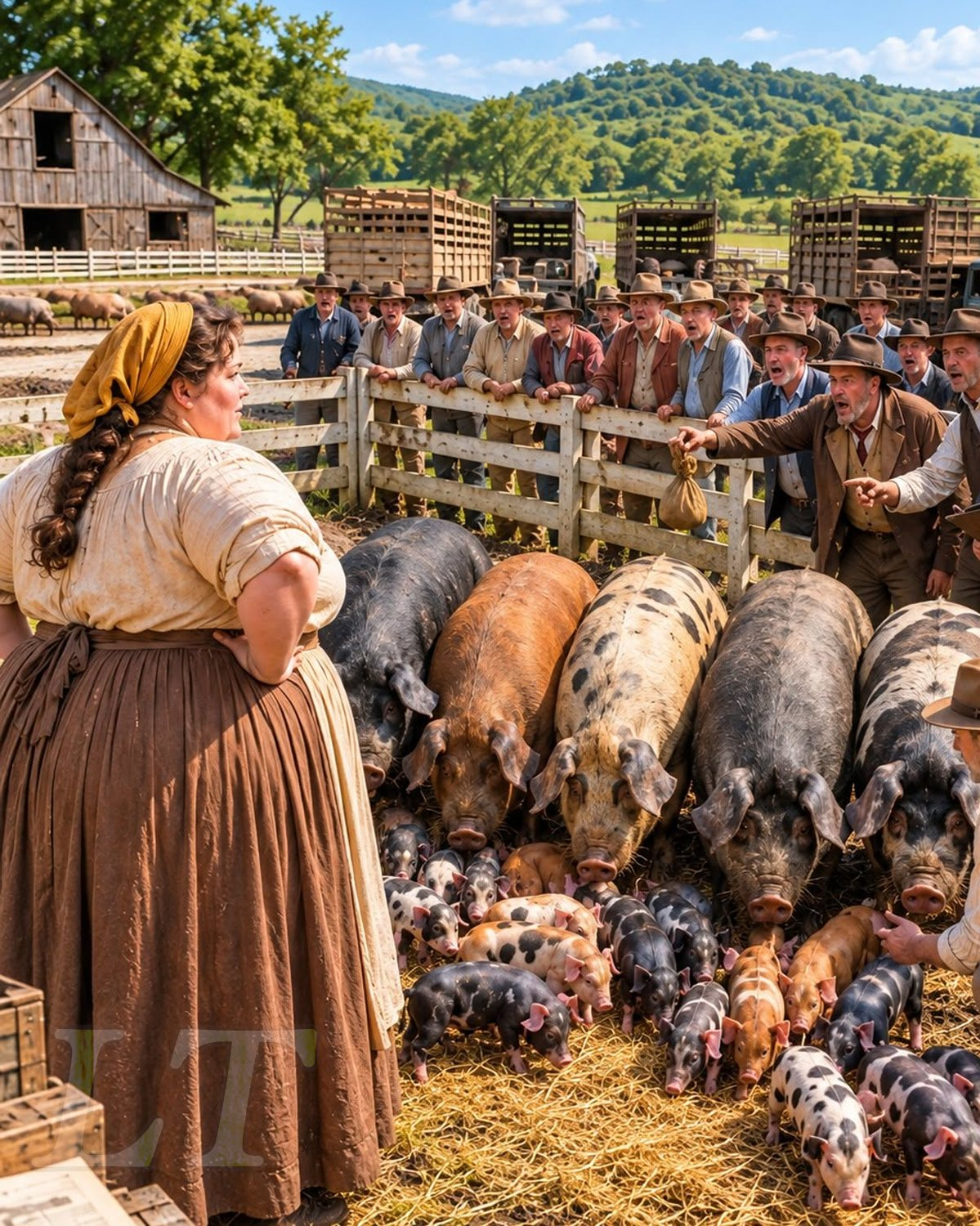
The sheriff stood on my porch with a court order in his hand.
Behind him, Hollis Brackett sat on his horse, looking as though he had already won.
"Miss Voss," the sheriff said, "I need you to read this."
I stepped outside.
Tomas followed me.
The sheriff unfolded the document and held it where I could see the official seal.
It authorized temporary seizure of six Blackmir sows pending resolution of an ownership dispute.
I read every line.
Then I looked at the signature.
"Who requested this order?"
"Hollis Brackett filed the petition."
"And what evidence did he provide?"
The sheriff glanced toward Hollis.
"That's a matter for the court."
"Then why are you here to take my animals before the ownership question has been decided?"
Hollis finally dismounted.
"Because those animals were part of a temporary custody arrangement involving your uncle. Their ownership has never been properly settled."
Tomas stepped forward.
"That's not what the records say."
Hollis turned toward him.
"With respect, Tomas, this is a legal matter."
"Then perhaps you should have brought the original agreement."
Hollis's expression tightened.
The sheriff looked between them.
"Let's keep this civil."
I returned to the farmhouse and brought out the foundation registration certificate.
I also carried the letter from the former county livestock registrar, Edwin Mercer.
"These documents were found among my uncle's private records. They establish that Peter Voss maintained ownership of the Blackmir breeding group."
The sheriff examined them.
He read the registration number.
Then he looked at the court order again.
"Mr. Brackett, did you provide these documents when you filed your petition?"
Hollis adjusted his coat.
"They were not available to me."
"They were registered county documents."
"That certificate does not address the temporary custody agreement."
I held up the letter.
"Then perhaps this will."
The sheriff began reading.
His expression changed slightly when he reached the paragraph explaining that no legitimate transfer of ownership had been established.
Hollis stepped closer.
"Those records are incomplete."
"Then you should have supplied the complete records with your petition," the sheriff replied.
For several seconds, nobody spoke.
I felt the cold evening air against my face.
The six sows were in the bottom pasture.
I could hear one of them moving through the straw.
The sheriff folded the letter.
"Miss Voss, I am not going to remove the animals tonight. There is a disputed ownership claim, but the documents you've presented raise questions that need to be reviewed."
Hollis's jaw tightened.
"You cannot simply ignore a court order."
"I'm not ignoring it. I'm documenting the conflicting evidence and referring the matter back for clarification."
He turned toward me.
"Do not sell, transfer, slaughter, or otherwise dispose of the animals while this matter is under review."
"I have no intention of doing that."
The sheriff nodded.
Then he climbed onto his horse.
Hollis remained beside the fence.
For a moment, he looked at me as though he wanted to say something.
Finally, he spoke.
"You've made this unnecessarily complicated."
I folded my arms.
"I inherited a farm. I didn't create your paperwork."
His eyes narrowed.
"Your uncle understood how business worked."
"Then perhaps you should have dealt with him instead of trying to frighten me."
Hollis stared at me.
Then he mounted his horse.
Before leaving, he turned toward Tomas.
"You should be careful about involving yourself in this."
Tomas didn't answer.
The horses disappeared down the road.
I stood on the porch until the sound of their hooves faded.
Then I looked at Tomas.
"Can he still take them?"
"Not tonight."
"Tomorrow?"
"That depends on what Edwin Mercer can confirm."
I looked toward the barn.
"I don't want to spend every day fighting this man."
Tomas placed a hand on my shoulder.
"Then we need to make sure he has nothing left to fight over."
The following morning, we left for the county seat.
Edwin Mercer lived in a modest house behind the old agricultural office.
He was seventy years old, with thinning white hair and a careful manner of speaking.
When Tomas introduced me, Edwin immediately recognized my uncle's name.
"Peter Voss's niece?"
"Yes."
He looked at the documents I carried.
Then he sighed.
"I wondered when this would happen."
I sat down.
"You knew Hollis was trying to acquire the Blackmirs?"
Edwin nodded.
"I knew he had been making offers. I also knew Peter refused them."
"Why?"
"Because Peter believed the breed deserved to survive independently of any single commercial buyer."
Edwin opened a cabinet and removed a thick folder.
Inside were copies of livestock registration records.
He searched through several pages.
Then he found one marked with the date of the winter flood.
"This is the original custody record."
I leaned forward.
The document explained that several Blackmir animals had been temporarily placed under Hollis Brackett's care after a severe flood damaged their original enclosure.
Hollis had provided temporary shelter.
He had also supplied feed and transportation.
But the agreement contained a specific condition.
The animals were to be returned to their registered owner when the original farm became accessible again.
Peter Voss retained ownership.
Hollis had never purchased the animals.
I read the document twice.
"Then why is he claiming ownership now?"
Edwin removed his glasses.
"Because the agreement was never properly closed in the county's later administrative records."
"Did my uncle know?"
"He certainly did."
"Then why didn't he resolve it?"
Edwin looked toward the window.
"Peter tried. Several times."
He found another document.
"This is a letter he sent to my office. He requested confirmation that the custody agreement had expired and that the animals had been returned to his possession."
I read the date.
It was more than five years earlier.
Beside the letter was an official acknowledgment.
The ownership remained with Peter Voss.
I felt a wave of relief.
"Can we use this?"
"Yes. I'll prepare a certified copy."
Edwin gathered the papers.
"But there's something else."
I looked up.
He removed a second folder.
It contained a list of livestock registrations from several neighboring counties.
"Over the years, the Blackmir population declined. Some animals were sold without proper breeding records. Others disappeared from the registry entirely."
He pointed to several names.
"Peter spent a long time trying to preserve the surviving lines."
"How many remain?"
Edwin hesitated.
"That is difficult to establish. But your uncle's group is particularly important."
I looked at the six names in the foundation register.
The Admiral.
Ruby.
June.
Martha.
Belle.
Agnes.
"Are they really among the last?"
"Your six animals represent one of the most complete surviving groups we can currently document."
Tomas nodded.
"That's what I've been telling her."
Edwin looked at me.
"Then you need to protect their records as carefully as you protect the animals."
I thanked him.
He promised to send the certified documents to the county court.
For the first time, I believed Hollis might lose his claim.
But when Tomas and I returned to Hollow Farm, another problem was waiting.
The barn roof had developed a new leak.
Water was dripping directly above the feed storage area.
I stood beneath the damaged boards and looked up.
Tomas shook his head.
"That needs repairing before the next heavy rain."
"I know."
"How much money do you have?"
I looked at him.
"Not enough."
He gave a small laugh.
"Then we'll have to be creative."
That afternoon, I began working through my options.
I had some bookkeeping experience.
Several farmers in the area needed help organizing their accounts, calculating feed expenses, and keeping track of livestock purchases.
I decided to offer my services.
The first person I approached was a grain merchant named Walter Hayes.
He listened to my proposal, examined a few sample ledgers, and agreed to pay me for organizing his monthly accounts.
It wasn't much.
But it was something.
I began visiting farms twice a week.
I calculated expenses, recorded purchases, and helped several older farmers make sense of their paperwork.
In return, I received money, materials, and occasional supplies.
Walter provided roofing boards.
Another farmer traded me fence wire for several hours of bookkeeping.
Delia brought food whenever she could.
Slowly, Hollow Farm began to change.
The barn wall was reinforced.
The worst sections of the roof were repaired.
The broken gate was replaced.
I also built a separate area for the sows so I could observe them more carefully.
Tomas visited regularly.
He taught me how to examine body condition, recognize signs of illness, and maintain breeding records.
He also insisted that I keep detailed notes about the animals' diet.
We didn't want to assume the marsh provided everything they needed.
We monitored their health, supplemented their feed where necessary, and made sure they always had clean water and dry shelter.
Every evening, I updated the ledger.
The six Blackmirs were no longer simply animals I had inherited.
They were the beginning of a project.
And I was determined to understand every part of it.
By the middle of summer, the drought had begun.
The surrounding fields changed first.
Grass turned yellow.
Creeks became narrow.
Stock ponds began shrinking.
Farmers who had once laughed at my muddy pasture started complaining about feed prices.
Hollis Brackett's cattle operation was particularly affected.
He owned several large upland pastures.
Without enough natural grazing, he had to purchase additional feed.
His expenses increased.
Meanwhile, Hollow Farm remained surprisingly green.
The bottomland retained moisture.
The creek continued flowing.
The vegetation along the banks remained healthy.
And the Blackmirs continued foraging.
They seemed unaffected by conditions that were creating serious problems elsewhere.
One afternoon, Walter Hayes stopped by.
He stood at the fence and watched the sows.
"Your animals look better than they did when you arrived."
"They're doing well."
"How much feed are you buying?"
I explained that we still purchased necessary supplements and maintained a careful feeding schedule, but the animals were able to use much of the suitable vegetation growing along the bottomland.
Walter looked toward the dry hills.
"That's something."
"It seems to be."
He studied the animals again.
"Maybe Brackett knew something after all."
I looked at him.
"What do you mean?"
"He wouldn't have offered you that kind of money without a reason."
I didn't answer.
Walter removed his hat.
"People around here are beginning to talk."
"About what?"
"About the Blackmirs."
I felt a small sense of satisfaction.
But Walter wasn't finished.
"Some think you should sell while the market is interested. Others think Brackett is going to make another move."
I looked across the pasture.
"Let him."
Walter smiled.
"That's what I like about you, Miss Voss. You don't seem to scare easily."
After he left, I returned to the farmhouse.
I opened the breeding register.
Tomas had been checking the animals regularly.
Their body condition remained good.
Their behavior was normal.
But I had noticed changes.
The Admiral was eating more slowly.
Ruby had begun spending more time near the sheltered section of the enclosure.
June seemed less interested in following the others.
I mentioned these observations to Tomas.
He examined the animals carefully.
Then he asked me to bring the original records.
We spent most of the afternoon comparing their histories.
He checked the dates.
He reviewed their previous breeding records.
Then he looked at me.
"Marin, I think we need to prepare."
"For what?"
He smiled.
"Your sows may be pregnant."
I stared at him.
"All six?"
"We need to confirm it properly. But the signs are encouraging."
My hands suddenly felt cold.
I looked toward the animals.
The Admiral was standing beside Ruby.
For months, I had been thinking about survival.
Taxes.
Repairs.
Hollis.
The possibility of losing the farm.
Now I was being asked to imagine something else.
New life.
A future beyond the six animals.
Tomas examined them again over the following days.
He remained cautious.
He refused to make promises until he was certain.
But his observations continued to support the possibility.
By September, the answer became clear.
All six sows were pregnant.
I was standing beside the fence when Tomas gave me the news.
He had brought his old notebook and spent the morning examining each animal.
When he finally finished, he closed the book.
"Well?"
I asked.
He looked at me.
"All six."
I gripped the fence.
"Are you certain?"
"As certain as I can be at this stage."
I looked toward the pasture.
Six animals.
Six pregnancies.
For several seconds, I couldn't speak.
Tomas estimated that the first farrowing could produce more than forty piglets if everything went well.
Forty.
I had arrived at Hollow Farm with sixty-seven dollars and six animals everyone considered worthless.
Now those same animals might produce enough offspring to establish a sustainable breeding program.
I calculated the possibilities in my head.
Six could become forty.
Forty could become a larger foundation.
A larger foundation could preserve the breed.
For the first time, I could see a future that didn't end with a tax sale.
But Tomas brought me back to reality.
"Don't celebrate too early."
I nodded.
"Of course."
"Pregnancy is only the beginning. We need proper shelter, nutrition, and a safe farrowing area."
"I'll start preparing."
He looked toward the barn.
"Winter is coming."
I spent the next several weeks improving the facilities.
I repaired the inner partitions.
I added clean straw.
I checked the roof again.
I arranged separate spaces for the sows and prepared additional supplies.
Tomas helped me make a schedule for monitoring them.
I also continued my bookkeeping work.
Every dollar mattered.
Every repair mattered.
And every healthy day mattered.
Then, one afternoon, Hollis Brackett returned.
He arrived without warning.
This time, he wasn't alone.
Two men rode behind him.
I was standing near the barn when I heard the horses.
I walked toward the gate.
Hollis dismounted.
He looked at the repaired fence, the stronger barn wall, and the animals moving across the bottomland.
His expression was difficult to read.
"Miss Voss."
"Mr. Brackett."
"I hear you've been making improvements."
"I have."
He glanced toward the pasture.
"Your animals appear healthy."
"They are."
"All six?"
I didn't answer immediately.
He looked toward the Admiral.
Then toward the others.
"Have you confirmed their breeding condition?"
I felt my shoulders tighten.
"Why do you ask?"
"Because I have a revised offer."
He removed a folded document from his coat.
This time, the amount was considerably larger.
It was enough to settle every outstanding obligation on Hollow Farm and leave me with more money than I had ever earned in the city.
I looked at the paper.
Then I handed it back.
"No."
Hollis seemed almost amused.
"You haven't even read the conditions."
"I don't need to."
His smile disappeared.
"Think carefully, Marin."
"I have."
He stepped closer.
"A woman in your position benefits from the goodwill of established men in this county."
I looked directly at him.
"Are you threatening me?"
"I'm advising you."
"And what happens if I refuse your goodwill?"
His eyes became cold.
"You'll find out."
He mounted his horse.
His two companions followed.
Before leaving, he looked back toward the barn.
I knew what he was thinking.
The six sows were becoming more valuable every month.
And he was running out of time.
I returned to work.
October passed.
The pregnancies progressed.
The farm grew quieter as the weather cooled.
Every evening, I checked the animals and recorded their condition.
The Admiral became increasingly restless.
Ruby began spending more time in her sheltered area.
Tomas visited frequently, explaining what to expect when the first farrowing began.
Then, one November night, I heard a strange sound from the barn.
It was shortly after midnight.
I had been sitting at the kitchen table, updating the breeding records, when a low grunt came from the direction of the livestock enclosure.
I stood immediately.
Another sound followed.
Then the unmistakable movement of straw.
I grabbed my lantern and hurried outside.
The barn door was partly open.
Warm animal breath drifted into the cold air.
I entered.
The Admiral was lying in her prepared farrowing area.
Her breathing was heavy.
She shifted her weight and gave a low grunt.
I stopped several feet away.
"Easy, girl."
She turned her head slightly.
I had watched this animal for months.
I knew her habits.
I knew how she reacted when frightened.
I knew how she moved when searching for food.
But I had never seen her like this.
I placed the lantern on a nearby shelf and checked the clean bedding.
Everything was ready.
I remembered Tomas's instructions.
Observe.
Keep the area quiet.
Don't interfere unnecessarily.
Call for help if something goes wrong.
I hurried back into the farmhouse and found the telephone.
The connection crackled.
After several attempts, I reached Tomas.
"It's the Admiral."
He was awake immediately.
"Has she started?"
"I think so."
"I'll be there."
I returned to the barn.
The first piglet arrived shortly afterward.
It was small, dark, and covered in wet straw.
I watched the Admiral carefully.
She turned toward the newborn.
Then she began cleaning it.
I waited.
The piglet moved.
Its tiny legs trembled.
Then it made a faint sound.
I felt my throat tighten.
A second piglet arrived.
Then a third.
I counted each one.
One.
Two.
Three.
The barn was filled with quiet movement.
The Admiral remained calm.
I kept the bedding clean and made sure the newborns stayed close to their mother.
By the time Tomas arrived, six piglets had been born.
He entered quietly.
"How is she?"
"Calm."
He examined the sow and the newborns.
"Good. Keep watching."
Another piglet arrived.
Then another.
The hours passed.
The number continued growing.
Eight.
Nine.
Ten.
The tenth piglet was smaller than the others.
It moved weakly and struggled to find warmth.
I picked it up carefully after checking that the mother was settled.
Its body was cold.
I wrapped it in a clean cloth and held it close beneath my coat.
Tomas watched me.
"Keep it warm."
I nodded.
For forty minutes, I remained beside the wall, holding the tiny animal.
I could feel its faint movements against my hands.
At first, it barely responded.
Then it shifted.
A small sound came from its throat.
I looked down.
It was breathing more strongly.
When I returned it to the bedding, it moved toward its mother.
After several attempts, it began nursing.
I sat down against the barn wall.
My eyes filled with tears.
Tomas placed a hand on my shoulder.
"That's one more."
I nodded.
I couldn't speak.
For months, people had told me the animals were worthless.
They had laughed at the farm.
They had questioned my ability to survive.
But here, in the middle of a cold November night, something was happening that no one had expected.
The first Blackmir piglets were being born.
And they were alive.
By dawn, the Admiral had delivered ten healthy piglets.
Tomas checked each one.
He examined the sow.
He made sure the smallest animal was nursing.
Then he looked at me.
"Ten."
I glanced around the enclosure.
Ten tiny lives.
I counted them again.
Ten.
"Is that good?"
Tomas smiled.
"That's very good."
I looked at the Admiral.
She was exhausted but calm.
I moved closer and rested my hand against the wooden partition.
"You did well," I whispered.
Tomas began preparing to leave.
But before he reached the door, he stopped.
"Marin."
I looked up.
"There's something you need to understand."
"What?"
"These are only the first ten."
I nodded.
"The others are still pregnant."
He looked toward the remaining five farrowing areas.
"And if everything goes well, your uncle's breeding program may be about to become much larger than either of us imagined."
I looked at the sleeping piglets.
For the first time, Hollow Farm felt full of possibility.
But the morning brought another surprise.
Delia arrived with a basket of food.
She entered the barn and stopped when she saw the piglets.
"Oh, Marin."
Her eyes filled with tears.
"Peter would have loved to see this."
I smiled faintly.
"Thank you."
She looked at the Admiral.
Then she noticed the number written in my notebook.
"Ten?"
"Ten healthy piglets."
Delia shook her head in amazement.
"People won't believe it."
I returned to the kitchen with her.
She placed the basket on the table.
Then she lowered her voice.
"I heard something in town."
I looked up.
"What?"
"Hollis has been asking about the farrowing."
My expression hardened.
"How does he know?"
"Someone saw the lights in your barn last night."
I said nothing.
Delia hesitated.
"He also visited the livestock exhibition committee."
I frowned.
"Why?"
She looked toward the window.
"I don't know exactly. But he was asking whether a small independent farm could exhibit heritage breeding stock this winter."
I felt a flicker of hope.
"That sounds like good news."
Delia shook her head.
"Not if Hollis has anything to do with the decision."
I looked at the notebook on the table.
The first ten piglets had been born.
Five sows still had to farrow.
There was so much to do.
So much to protect.
And now Hollis was trying to interfere with the next stage of the breeding program.
I returned to the barn.
The Admiral was resting.
The piglets were gathered close to her.
I counted them one more time.
Ten.
Then I heard a wagon approaching.
It stopped outside the gate.
A boy jumped down and ran toward the farmhouse.
He was carrying a folded letter.
"Miss Voss!"
I stepped outside.
"This just came from the county livestock exhibition committee!"
I took the letter.
The envelope bore the official committee seal.
I opened it.
The first paragraph informed me that Hollow Farm's application for an exhibition place had been placed under review.
The second paragraph contained a decision.
I read it twice.
Then I reached the final line.
Hollow Farm's Blackmir breeding group had been denied a place at the county's largest livestock exhibition.
And beneath the decision was the name of the man who had led the vote.
Hollis Brackett.






Comments 0