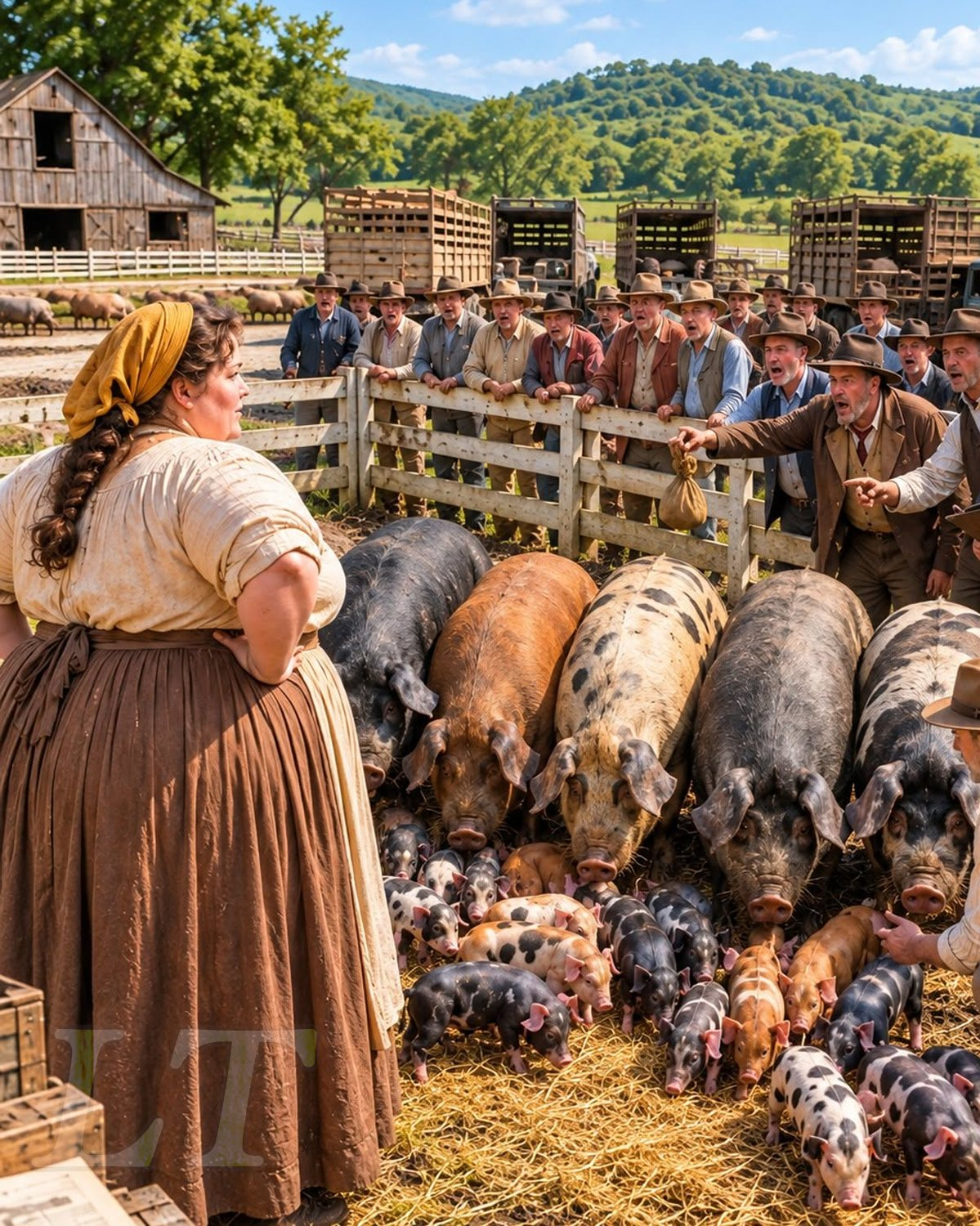
"He's trying to make sure nobody else ever gets the chance to own their future."
Nathaniel Cross's words stayed with me long after he finished explaining the document.
I stood beside the wooden fence, looking at the photograph of the Admiral.
The picture had been taken years before she arrived at Hollow Farm. Her distinctive scar was visible near her right ear.
There was no doubt about it.
Someone had been searching for these animals long before I inherited them.
And Hollis Brackett had known exactly what he wanted.
I looked at Nathaniel.
"Why didn't your organization stop him?"
He closed his leather case.
"We tried to investigate the proposal, but the documentation he provided was incomplete. He claimed he represented the interests of several livestock owners who wanted to consolidate the remaining Blackmir stock."
"Consolidate?"
"Acquire the surviving animals under one ownership structure. Establish a controlled breeding program. Eventually manage the registration and distribution of the offspring."
I glanced toward the barn.
"So he wanted to own the entire breed?"
Nathaniel considered his words.
"He wanted to control the surviving breeding foundation. Whether that was his only intention, I cannot say."
I didn't like that answer.
But I appreciated his honesty.
"Why are you searching for them?"
He opened his case again and removed another document.
"Our organization has been trying to locate surviving heritage livestock populations that may have agricultural value under changing environmental conditions. Blackmirs are particularly interesting because of their historical adaptation to wet bottomland."
I studied the document.
It contained references to older breeding groups, descriptions of their physical characteristics, and several unsuccessful attempts to locate surviving stock.
One entry mentioned Peter Voss.
I looked up.
"You knew my uncle?"
"Not personally. We corresponded once. He refused to release his records without guarantees that the animals would remain protected."
That sounded exactly like Peter.
Nathaniel continued.
"He believed the breed should be preserved as a living agricultural resource, not treated as a private curiosity."
I thought about the old notebook.
The handwritten warnings.
The breeding compatibility markings.
The careful observations.
My uncle had spent years protecting something most people couldn't even recognize.
"Would your organization help me?"
Nathaniel nodded.
"If your records can be independently verified, we may be able to support a formal preservation assessment."
"Would that stop Hollis from buying them?"
"Not automatically. But it would make the ownership and preservation questions much harder to manipulate."
I looked toward the barn.
The Admiral was resting with her ten piglets.
Ruby's eight were moving through the straw.
Four more sows were still pregnant.
I had eighteen new animals to protect.
And possibly many more on the way.
I needed help.
But I also needed to be careful about who I trusted.
"Can you provide that support in writing?"
Nathaniel smiled slightly.
"That's a reasonable request."
He handed me his card.
"I'll return after reviewing the records. I won't ask you to sign anything today."
I thanked him.
Before leaving, he looked once more toward the livestock enclosure.
"Miss Voss, I should warn you about something."
"What?"
"Hollis has influence beyond the livestock exhibition committee. If he believes your animals are becoming publicly recognized, he may try to discredit the breeding program before anyone can verify it."
I folded his card and placed it in my pocket.
"He's already trying."
Nathaniel nodded.
"Then you should prepare for more than an argument over an exhibition place."
He climbed into his carriage.
As he drove away, I remained beside the fence.
The farm was quiet.
But I no longer felt alone in the way I had when I first arrived.
There were people who understood the Blackmirs.
There were records that supported my uncle's ownership.
And there were organizations willing to examine the animals independently.
Hollis had money and influence.
I had something he couldn't simply purchase.
The truth.
The following morning, Tomas arrived before breakfast.
I showed him Nathaniel's documents.
He read the proposal carefully.
When he reached the section concerning the Blackmir consolidation project, he shook his head.
"That's what I was afraid of."
"Why?"
"Because controlling a breeding program means controlling which animals reproduce, where the offspring go, and who receives the next generation."
I sat at the kitchen table.
"Is that necessarily bad?"
"Not always. A well-managed preservation program can be valuable. But it should never depend entirely on one person's commercial interests."
He pointed toward the foundation register.
"Your uncle understood that."
I opened the notebook.
"Then we need to make sure the records are recognized."
Tomas nodded.
"Arthur can help with the breed assessment. Edwin can confirm the historical registration. Nathaniel may be able to provide independent support."
I began writing a list.
Three names.
Three different areas of expertise.
It was the beginning of a plan.
But before I could organize everything, a wagon stopped outside.
Delia stepped down.
She carried a basket and a folded newspaper.
"Have you seen this?"
She placed the newspaper on the table.
The headline concerned the county livestock exhibition.
The committee had announced a special public statement regarding its decision to exclude certain heritage livestock entries.
I read the article.
The committee chairman had defended the rejection.
According to the statement, Hollow Farm had failed to provide sufficient evidence of the breed's commercial relevance.
It also suggested that the six adult sows were not representative of a recognized breeding population.
I looked at Tomas.
"That's false."
He nodded.
"Of course it is."
Delia sat down.
"People are beginning to repeat it."
I folded the newspaper.
"Who?"
"Several farmers. A few merchants. People who don't know anything about the Blackmirs."
I understood.
Hollis wasn't simply preventing me from attending the exhibition.
He was creating a public narrative.
If he convinced enough people that the animals were ordinary pigs with exaggerated claims attached to them, nobody would question his attempts to acquire them.
I stood.
"I'm going to the committee meeting."
Tomas looked surprised.
"Today?"
"Yes."
"Marin, they may not listen."
"Then I'll make sure they have the records."
Delia nodded.
"Good."
Tomas hesitated.
"Let's prepare properly first."
We spent the afternoon assembling documents.
I organized the original foundation certificate, the custody agreement, Edwin's correspondence, and the breeding register.
Arthur agreed to provide a preliminary independent assessment.
Nathaniel promised to send written confirmation that his organization had been searching for Blackmir stock.
I also prepared photographs of the six sows and the first eighteen piglets.
Every photograph included a date.
Every animal had an identification record.
I wanted the committee to see that I wasn't asking for special treatment.
I was asking for an opportunity to present documented evidence.
The next morning, Tomas accompanied me to the county agricultural hall.
The building was crowded.
Farmers, livestock buyers, merchants, and committee members filled the wooden benches.
A large banner hung above the entrance.
RED WILLOW COUNTY LIVESTOCK EXHIBITION — ANNUAL AGRICULTURAL SHOW.
Several people recognized Tomas.
A few greeted me.
Others looked away.
I noticed Hollis near the front.
He was speaking with two committee members.
When he saw me, his expression barely changed.
But he stopped talking.
I approached the registration desk.
"Good morning. My name is Marin Voss. I'm requesting an opportunity to present additional evidence regarding Hollow Farm's Blackmir breeding group."
The woman behind the desk examined my documents.
"Your application has already been reviewed."
"I understand. I am requesting reconsideration based on new independent information."
She looked toward the committee room.
"Have you made an appointment?"
"No."
"Then I can't promise anyone will see you."
I placed the folder on the counter.
"Would you please give this to the committee secretary?"
She hesitated.
Then she accepted it.
Tomas and I took seats near the back.
The meeting began shortly afterward.
Several exhibitors discussed stall assignments.
Others raised questions about feed inspections and transportation arrangements.
Then the chairman announced the heritage livestock section.
Hollis stood.
He adjusted his waistcoat and addressed the committee.
"I would like to clarify the recent decision concerning Hollow Farm."
I felt my stomach tighten.
He continued.
"The committee has a responsibility to maintain consistent standards. We cannot allow every unusual animal to be presented as a valuable heritage breed without proper verification."
Several people nodded.
Hollis gestured toward the chairman.
"This is not a personal matter. It is about protecting the reputation of the exhibition."
I looked around.
Nobody challenged him.
Then Hollis added something that made my hands tighten around my notebook.
"Furthermore, I understand Miss Voss has been making claims about a breeding population that may not actually exist."
I stood.
"That's not true."
The room became quiet.
Hollis turned toward me.
"Miss Voss. I wasn't aware you intended to address the committee."
"I submitted records requesting reconsideration."
He smiled faintly.
"I believe those records have already been examined."
"By whom?"
The chairman raised his hand.
"Please. One at a time."
I remained standing.
"My six sows have documented breeding histories. Their original registration is confirmed. I have veterinary observations, historical records, and an independent assessment in progress."
Hollis shook his head.
"Those documents do not establish commercial significance."
"They establish that the animals belong to a recognized heritage breeding line."
"According to whom?"
"According to the original county registration."
He glanced toward the chairman.
"Which is precisely the kind of historical documentation that requires careful interpretation."
I felt anger rising.
But I kept my voice steady.
"Then let the independent inspectors examine the animals."
Hollis gave a small laugh.
"That would be a waste of everyone's time."
A man near the front raised his hand.
He was one of the commercial livestock exhibitors.
"What's the actual problem with letting her display them?"
Hollis turned toward him.
"The exhibition has limited space. We need to prioritize productive operations."
I looked at the man.
"My farm has seventy-eight acres. The animals are healthy. Their breeding records are documented. And the land they're raised on remains productive during the drought."
A few people turned toward me.
I continued.
"All I'm asking is permission to show the animals and their records."
The chairman looked uncomfortable.
"Miss Voss, the decision has already been made."
"Then I would like the reason entered into the official minutes."
Hollis's expression changed.
He hadn't expected that.
The chairman looked down at his papers.
"Very well."
I sat down.
Tomas leaned toward me.
"Good."
The meeting continued.
But I noticed something.
Several people were no longer looking at Hollis.
They were looking at me.
For the first time, someone had challenged the decision in public.
When the meeting ended, I gathered my papers.
Hollis approached before I reached the door.
"You should have accepted my offer."
I looked at him.
"Which one?"
His jaw tightened.
"Don't play games."
"I'm not."
He lowered his voice.
"You're making enemies you don't understand."
I held his gaze.
"Then perhaps they should explain themselves."
He stepped closer.
"You think a few old records and some muddy pigs make you important?"
"No."
I glanced toward the people leaving the room.
"I think evidence makes a difference."
His face hardened.
Then he walked away.
Outside, Tomas waited beside the wagon.
He looked at me.
"How do you feel?"
"Tired."
He smiled.
"That's understandable."
I climbed aboard.
But before Tomas could move the reins, a man approached.
He was carrying a leather folder.
"Miss Voss?"
"Yes?"
"My name is George Whitaker. I represent a regional agricultural journal."
I looked at the folder.
He continued.
"I've been following the dispute involving Hollow Farm."
I exchanged a glance with Tomas.
"How did you hear about it?"
"Someone forwarded the committee's announcement. I also received a copy of the old Blackmir foundation records."
"From whom?"
He hesitated.
"An anonymous source."
I didn't like the sound of that.
"What do you want?"
"An interview. I'd like to publish a piece about the surviving Blackmir breeding group."
Tomas looked interested.
I remained cautious.
"Would you be willing to visit the farm first?"
"Certainly."
"Then you can examine the animals and the records."
He nodded.
"I'd prefer that."
I gave him the farm's address.
He promised to visit within the week.
As we drove home, I thought about the meeting.
Hollis had prevented me from entering the exhibition.
But he hadn't stopped people from becoming curious.
And curiosity could be more powerful than a committee vote.
The next few days were busy.
The Admiral's piglets were growing.
Ruby's litter was healthy.
The other sows were approaching their own farrowing dates.
I continued recording everything.
I also began preparing a proper display area inside the barn.
If the county exhibition wouldn't allow the public to see the Blackmirs, I wanted visitors to be able to understand the animals whenever they came to Hollow Farm.
I collected old photographs.
I copied historical descriptions.
I prepared simple explanations of the breed's adaptation to wet ground.
I didn't want to exaggerate anything.
I wanted people to see what was actually there.
Tomas helped me arrange the records.
Arthur agreed to visit again once the remaining sows had farrowed.
Nathaniel sent a formal letter confirming his organization's interest in independently reviewing the breeding group.
For the first time, I began to believe that Hollow Farm might become known beyond Red Willow County.
Then, on a cold afternoon, I received a letter from the exhibition committee.
It was short.
The committee had formally rejected my request for reconsideration.
No explanation beyond the original decision.
No additional review.
No opportunity to appeal before the exhibition opened.
I placed the letter on the kitchen table.
Tomas read it.
"They're determined."
I nodded.
"Then we stop asking them."
He looked at me.
"What do you mean?"
I picked up a clean sheet of paper.
I wrote two words at the top.
OPEN DAY.
Tomas watched.
I continued.
"If they won't let us bring the Blackmirs to the exhibition, we'll bring the exhibition to Hollow Farm."
He considered the idea.
"Invite the public?"
"Farmers. Buyers. Journalists. Agricultural inspectors. Anyone who wants to see the animals."
"And the records?"
"Everything."
He smiled slowly.
"Peter would have liked that."
I began making a list.
Visitors.
Food.
Parking.
Livestock safety.
Weather protection.
Farm repairs.
I had no idea how many people would come.
But I knew one thing.
Hollis could control a committee meeting.
He could influence a vote.
He could discourage farmers from supporting me.
But he couldn't decide what people would think after seeing the animals with their own eyes.
That evening, I spoke with Delia.
She agreed to help prepare food.
Walter offered to organize parking.
Tomas promised to supervise the livestock displays.
Arthur would provide his independent assessment.
Nathaniel said he would return with representatives from his organization.
The idea began to grow.
I worked on the announcement until late at night.
The headline was simple.
HOLLOW FARM OPEN DAY — SEE THE SURVIVING BLACKMIR BREEDING GROUP.
I added the date.
I included a brief description of the farm and its history.
I mentioned the forty-one piglets we hoped would eventually be part of the breeding program, although only eighteen had been born so far.
I also invited anyone with historical information about the breed to attend.
The following morning, Walter took copies into town.
Delia delivered several to neighboring farms.
Tomas posted one at the agricultural supply store.
For the first time, Hollow Farm was advertising something other than a property for sale.
It was inviting people to witness a piece of agricultural history.
But Hollis was not going to remain quiet.
Two days after the announcement appeared, I received a visit from the county's livestock inspector.
His name was Robert Gaines.
He arrived without warning and asked to examine the animals.
I welcomed him.
He inspected the enclosures.
He checked the water supply.
He examined the sows and the piglets.
He also reviewed the health records.
I answered every question.
When he finished, he made several notes.
"Your facilities are basic, but the animals appear to be receiving appropriate care."
"Is there a problem?"
"Not at this time."
He closed his notebook.
"I've been asked to review the conditions before your public event."
"By whom?"
He hesitated.
"The county office received a complaint."
I felt my stomach tighten.
"What kind of complaint?"
He looked toward the barn.
"An allegation that you intend to display unregistered livestock and make misleading claims about their breeding status."
I stared at him.
"That's ridiculous."
"I understand your position. That's why I came to inspect."
I handed him the certified registration documents.
He examined them.
Then he nodded.
"I'll include these in my report."
"Will the complaint prevent the event?"
"Not based on what I've seen today."
I thanked him.
Before leaving, he turned toward me.
"Miss Voss, I'd advise you to keep every record organized. There appears to be considerable interest in this matter."
"I intend to."
He climbed into his vehicle and drove away.
I watched him until he disappeared.
Then I returned to the kitchen.
Another complaint.
Another attempt to make the farm look unreliable.
Hollis was running out of ways to control the animals directly.
So he was attacking the credibility of the person protecting them.
I opened my notebook.
I recorded the inspection date, the complaint, and the results.
Then I continued preparing for Open Day.
The following afternoon, Nathaniel called.
He had reviewed the original records.
His organization was willing to send two representatives to inspect the animals and consider supporting a formal preservation program.
I thanked him.
He also mentioned that the journal reporter, George Whitaker, had confirmed his visit.
Everything was coming together.
I had visitors.
I had independent support.
I had historical documentation.
And I had eighteen healthy piglets.
But the remaining four sows still needed to farrow.
I couldn't afford to become distracted.
One evening, Tomas came by with an update.
"Belle may be close."
I followed him into the barn.
Belle was moving restlessly.
We prepared her farrowing area.
Then we waited.
The first piglet arrived before midnight.
Another followed.
By morning, Belle had delivered seven healthy piglets.
I added the numbers to the ledger.
Ten from the Admiral.
Eight from Ruby.
Seven from Belle.
Twenty-five.
Three sows remained.
I stood beside the enclosure and watched the newborns.
They were small, dark, and full of energy.
Tomas checked them.
"Good litter."
I nodded.
"Twenty-five."
"More to come."
He looked toward the remaining animals.
"Don't forget what we discussed. We need to maintain proper records and identify the bloodlines before making future breeding decisions."
"I haven't forgotten."
I returned to the farmhouse.
There was a letter waiting on the kitchen table.
It had no return address.
The envelope was thick.
I opened it carefully.
Inside was a single sheet of paper.
The handwriting was unfamiliar.
The message was short.
Miss Voss,
You are making a serious mistake by organizing this event.
Some people in Red Willow County have invested a great deal of time and money in keeping the Blackmir matter private.
If you proceed, you may discover that your problems are much larger than a rejected exhibition application.
There was no signature.
I read it twice.
Then I placed it beside the other documents.
I wasn't frightened.
But I was beginning to understand how far Hollis's influence might reach.
The next morning, I showed the letter to Tomas.
He read it silently.
Then he looked at me.
"Do you recognize the handwriting?"
"No."
He turned the paper over.
There was a faint mark near the bottom.
A small impression from a stamp.
He tilted it toward the light.
I leaned closer.
The mark was barely visible.
But I recognized the shape.
It was the same decorative emblem used on the stationery of Brackett Livestock Company.
Tomas slowly lowered the paper.
"Marin, this is getting serious."
I folded the letter.
"Then we need to make sure Open Day happens."
He nodded.
But as we returned to the barn, I noticed something wrong.
The outer gate was open.
I was certain I had locked it the previous evening.
A section of the fence near the creek had been disturbed.
And on the muddy ground, just beyond the enclosure, were fresh wagon tracks.
I followed them toward the road.
They stopped beside the old barn.
Something had been left near the entrance.
A small wooden crate.
I approached carefully.
There was a paper label attached to the top.
It carried no name.
Only a handwritten message.
FOR MARIN VOSS — OPEN BEFORE THE NEXT FARROWING.
I looked toward Tomas.
He was standing several feet behind me.
Neither of us moved.
Then, from inside the barn, came a sudden, unfamiliar sound.
A piglet was screaming.
I turned toward the door.
And when I looked down into the crate, I saw something that made my blood run cold.
Inside was one of my uncle's original Blackmir breeding tags—and it was covered in fresh blood.






Comments 0