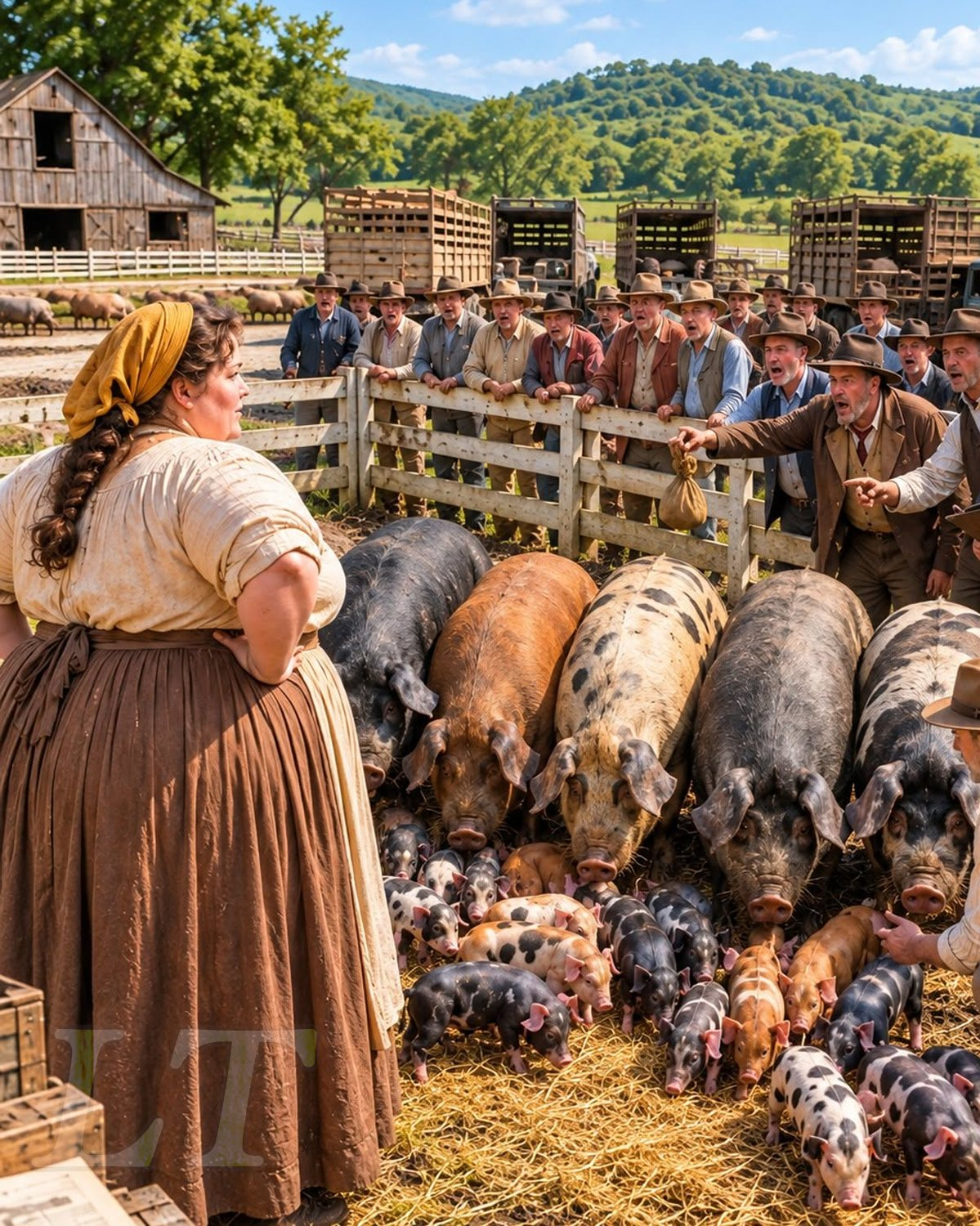
I was dragging a broken wooden gate across the mud when a man shouted from behind me.
"Don't bother fixing that place. It'll belong to someone else by spring."
Hollis Brackett had just arrived.
In his hand was a folded property purchase agreement.
On the bottom corner, someone had written a number in pencil.
Six.
He wasn't looking at the farmhouse.
He was looking at my pigs.
And that was the first thing that made me suspicious.
My name is Marin Voss. I was twenty-seven years old when I inherited Hollow Farm, and on the morning I arrived, I had sixty-seven dollars in my purse, five months before the next property tax deadline, and absolutely no idea how to keep seventy-eight acres of failing farmland alive.
I also inherited six enormous black sows.
According to the estate documents, their assessed value was negligible.
That word appeared on the livestock inventory in neat black type.
Negligible.
I remember staring at it for a long time.
Not because I didn't understand the word.
Because I understood exactly what it meant for my future.
My uncle Peter had died unexpectedly. He had owned Hollow Farm for most of his adult life, although the last several years had not been kind to him. The roof leaked. The barn needed repairs. The farmhouse porch was beginning to separate from its foundation, and the county had placed liens against the property after several unpaid tax installments.
I had spent six years working as an accounts clerk in a city warehouse.
I knew how to balance ledgers, calculate expenses, and recognize when someone was hiding a problem inside a column of numbers.
But I had never raised livestock.
I had never repaired a barn.
And I had never owned a farm.
The wagon driver who brought me from the railway station had offered to help carry my luggage to the porch. He had been polite until he noticed the animals.
Then he stopped.
"Those the Blackmirs?"
I followed his gaze.
Six enormous sows stood near the creek, their dark bodies covered in patches of dried mud.
"I suppose so."
He studied them.
"Your uncle kept them longer than anyone around here thought sensible."
"Why?"
The driver hesitated.
Then he lowered his voice.
"Because Hollis Brackett wanted them."
I looked back at him.
"Who is Hollis Brackett?"
The man gave a humorless laugh.
"You'll find out."
He lifted my last suitcase, placed it beside the porch, and climbed back onto his wagon.
Before leaving, he turned around.
"One piece of advice, Miss Voss."
I waited.
"Don't let that man know how desperate you are."
Then he drove away.
I spent that first evening reading my uncle's estate documents at the old kitchen table.
The table had a deep scratch near one corner, and the chair beneath me creaked every time I shifted my weight.
I spread the paperwork across the wood.
Property taxes.
Outstanding loans.
Repair estimates.
Livestock inventory.
The numbers were worse than I had expected.
Even if I sold everything I owned, I would barely cover the immediate expenses.
I opened my purse.
Sixty-seven dollars.
I counted the bills twice.
Then I looked at the livestock assessment again.
Six Blackmir sows.
Assessed value: negligible.
I turned off the kitchen lamp sometime after midnight.
But I couldn't sleep.
Something about the driver's warning stayed with me.
Why would a wealthy businessman want six animals that nobody considered valuable?
The following morning, I discovered that the answer was not going to come easily.
I was attempting to repair the back fence when a woman approached carrying a covered basket.
She was in her sixties, with silver hair pinned beneath a faded blue scarf.
"You're Peter's niece?"
"Marin Voss."
"Delia Pratt."
She placed the basket on the fence.
"I brought you bread."
I thanked her.
She looked toward the creek.
The six sows were moving slowly through the wet ground, their noses searching beneath the grass.
Delia watched them for several seconds.
"Hollis will come."
I remembered the driver's warning.
"Why does everyone keep telling me that?"
"Because he has been trying to acquire this farm for years."
I frowned.
"What does he want with seventy-eight acres of swamp?"
Delia turned toward me.
"He doesn't want the land."
I waited.
She lowered her voice.
"He wants those hogs."
Before I could ask another question, she picked up her empty basket.
"Be careful, Marin."
Then she walked back down the road.
Four days passed.
I spent most of them cleaning the farmhouse, checking the barn, and trying to understand the condition of the property.
The roof needed immediate attention.
The barn's western wall had begun leaning outward.
The old water pump worked only when the handle was pulled at exactly the right angle.
And the bottom pasture was so wet that my boots sank several inches with every step.
The six sows, however, seemed perfectly comfortable.
They moved through the mud without difficulty.
They searched beneath the roots along the creek.
They ate vegetation I wouldn't have considered feeding to a domestic animal.
They seemed healthier than anything else on the property.
I began keeping notes.
It was an old habit from my warehouse days.
Every morning, I recorded where each sow went, what she ate, and how much time she spent near the creek.
I also began marking the animals individually.
One had a small pale scar near her right ear.
Another had a broader forehead.
A third had a distinctive white patch beneath her chin.
I needed to know whether all six were behaving similarly.
By the fourth afternoon, I had filled three pages.
Then I heard the sound of a horse approaching.
I stepped out of the barn.
A tall man in an expensive forest-green overcoat rode through the open farm gate.
His horse was clean despite the mud.
His leather boots looked as though they had never touched the ground.
He dismounted without asking permission.
"Miss Voss?"
"Yes."
"Hollis Brackett."
He extended his hand.
I shook it.
His grip was firm, but his eyes were already moving past me toward the livestock enclosure.
"I understand you've inherited a difficult situation."
"I've read the paperwork."
"Then you understand the financial pressure."
"I do."
He nodded as if I had just confirmed something amusing.
"Your uncle was a stubborn man. Good heart, perhaps. Terrible business instincts."
I said nothing.
He walked toward the fence.
"These structures need work. The drainage is inadequate. The ground is practically useless for conventional livestock."
"I've noticed."
"And those animals..."
He paused.
"Well, let's not pretend they have much commercial value."
I watched him.
"Then why are you interested in buying them?"
His expression remained pleasant.
"I'm interested in acquiring the entire property."
He removed a folded document from his coat.
"I've reviewed your outstanding obligations. The taxes, the liens, the repairs. I can save you considerable trouble."
He handed me the offer.
I opened it.
The amount was insulting.
It wasn't enough to cover the outstanding debts, let alone compensate me for the property.
I looked up.
"This is your offer?"
"It's a generous solution to an unpleasant problem."
"For you, perhaps."
His smile tightened.
"Miss Voss, I don't think you understand your position."
"I understand it exactly."
I folded the paper.
Then I returned it.
"No, thank you."
For several seconds, Hollis didn't move.
It was the first time I had seen his pleasant expression falter.
He glanced toward the pigs.
"They're an obsolete breed."
"Then why buy them?"
"I'm buying the property."
"The property floods."
He looked at me.
I looked back.
The silence stretched between us.
Something had changed.
Not much.
Just enough.
He climbed onto his horse.
"Offer stands for two weeks."
"I'll remember."
He rode away without saying goodbye.
I stood beside the fence until the sound of his horse disappeared.
Then I looked down at the folded document still in my hand.
There was something strange about the offer.
The property valuation was low, as expected.
The barn was practically worthless.
The farmhouse had been assessed as a liability.
But the livestock section contained a separate handwritten notation.
Six Blackmir sows.
Priority acquisition.
I read it twice.
Priority.
Not incidental.
Not included as an afterthought.
Priority.
I returned to the kitchen and placed the document beside my uncle's estate papers.
For the first time since arriving, I began to suspect that the farm's greatest problem wasn't its debt.
It was that somebody else knew something about my inheritance that I hadn't discovered yet.
The following morning, I walked to the creek.
The six sows were already there.
They were rooting through the wet ground, pushing aside fallen leaves and uncovering small roots beneath the surface.
I watched them for nearly an hour.
Then I noticed something.
They weren't simply wandering.
Each animal seemed to follow a similar route along the creek margin.
They avoided the drier pasture.
They returned repeatedly to the same sections of wet soil.
I knelt beside one of the disturbed patches.
Beneath the surface were roots, insects, and thick vegetation.
Food.
Natural food.
Food that required no purchased feed.
I stood up slowly.
The land everyone called useless might be useful to these animals.
And if that was true, Hollis Brackett had not come to my farm because he felt sorry for a struggling young woman.
He had come because he wanted something.
Something he believed I didn't understand.
That afternoon, I found my uncle's oldest livestock notebook inside a wooden cabinet in the barn.
The leather cover was cracked.
Several pages were missing.
But the first intact page contained a handwritten heading.
BLACKMIR BREEDING RECORDS.
I sat on an overturned feed bucket and began reading.
The first entries were more than thirty years old.
There were references to breeding lines, physical characteristics, and survival rates on wet bottomland.
I didn't understand all the terminology.
But I recognized enough to know the notebook wasn't ordinary farm bookkeeping.
Then I reached the final page.
My uncle had written a sentence in uneven handwriting.
Never sell the last healthy Blackmir breeding group to anyone who refuses to explain why they want it.
I read the sentence again.
Outside, the six sows continued moving through the mud.
I closed the notebook.
And for the first time, I understood why my uncle had kept them.
But I still didn't know how valuable they were.
I needed someone who did.
That evening, I took the notebook and walked toward the neighboring farm.
An elderly farmer named Tomas Radic had known my uncle for decades.
If anyone could explain the Blackmirs, it would be him.
I reached his porch just before sunset.
He opened the door, looked at the notebook in my hands, and invited me inside.
I placed it on his kitchen table.
"I need to ask you something about these animals."
He adjusted his glasses.
"Which animals?"
"The Blackmir sows."
His hand stopped halfway toward the coffee pot.
He looked at me.
Then at the notebook.
Then back at me.
"How many do you have?"
"Six."
His face changed.
"Alive?"
"Yes."
"Healthy?"
"As far as I can tell."
Tomas slowly pulled out a chair.
He sat down.
Then he said something that made me forget about the debt, the leaking roof, and the broken barn.
"Marin, do you have any idea what your uncle left you?"
Before I could answer, he opened the notebook to a page I hadn't noticed.
There was a name written across the top.
And beneath it, a date from more than forty years earlier.
The last registered Blackmir breeding line.
Tomas stared at the handwriting for a long moment.
Then he turned the notebook toward me.
"Your uncle wasn't keeping ordinary livestock."
"What was he keeping?"
Tomas took a slow breath.
"One of the last surviving breeding groups of a rare heritage hog."
I looked down at the page.
He continued.
"Blackmirs were developed for land exactly like yours. Wet ground. Marshes. Creek bottoms. Places where ordinary cattle and pigs struggle."
I remembered the six animals rooting along the creek.
"They can live on that?"
"They can do more than live on it. They can thrive."
Tomas leaned back.
"For generations, farmers selected them for strong legs, broad feet, hardiness, and their ability to find food in ground other animals couldn't use."
I felt something shift inside me.
"What does that make them worth?"
"That depends on how many healthy breeding animals remain."
He turned another page.
Several names had been crossed out.
Others were followed by dates and notes.
Then Tomas pointed to the final surviving entries.
"Your uncle's animals may be among the last viable breeding groups in this county."
I stared at him.
"Why didn't he tell me?"
"Perhaps he wanted you to understand the farm before you understood the animals."
I thought about Hollis's offer.
His handwritten notation.
Priority acquisition.
The way he had watched the sows instead of the farmhouse.
Everything suddenly looked different.
Tomas closed the notebook.
"There's something else you need to know."
I waited.
"Hollis has been asking questions about Blackmir stock for years. He's visited farms, contacted livestock dealers, and offered money to people who owned related animals."
"Why?"
Tomas looked toward the window.
"Because the breed is becoming increasingly difficult to find."
He paused.
"And because the drought is changing what farmers need."
I remembered the neighboring fields.
The dry pastures.
The rising price of feed.
Tomas continued.
"Your bottomland holds water when the upland pastures turn brown. Those sows can use food growing naturally along the creek. That's a serious advantage."
I looked down at my hands.
They were still stained with dirt from repairing the fence.
For the first time, I didn't see myself as the owner of a failing farm.
I saw the possibility of rebuilding something.
Something that had survived for generations.
Something that could disappear if I made one bad decision.
"Will you teach me?" I asked.
Tomas studied me.
"You've never raised pigs."
"No."
"You've never managed a breeding program."
"No."
"You understand that one disease outbreak could destroy everything you have?"
"I understand."
He nodded slowly.
"Then we'd better begin tomorrow."
I thanked him and started toward the door.
But before I reached it, Tomas spoke again.
"Marin."
I turned.
"Don't accept another offer from Hollis Brackett."
"I wasn't planning to."
He looked at me with an expression I couldn't quite read.
"Good. Because I heard he was coming back."
"Why?"
Tomas lowered his voice.
"This time, he won't be coming alone."
That night, I returned to Hollow Farm with the notebook held tightly against my chest.
The six sows were sleeping near the creek.
The farmhouse still needed repairs.
The barn still leaned.
The taxes were still due.
I still had sixty-seven dollars.
But now I knew what I had inherited.
And somewhere across Red Willow County, Hollis Brackett knew it too.
At eleven o'clock, I heard three heavy knocks against my farmhouse door.
I looked through the window.
A man stood on the porch.
He held a sealed envelope.
And beneath the porch light, I recognized the initials stamped into the red wax.
H.B.






Comments 0