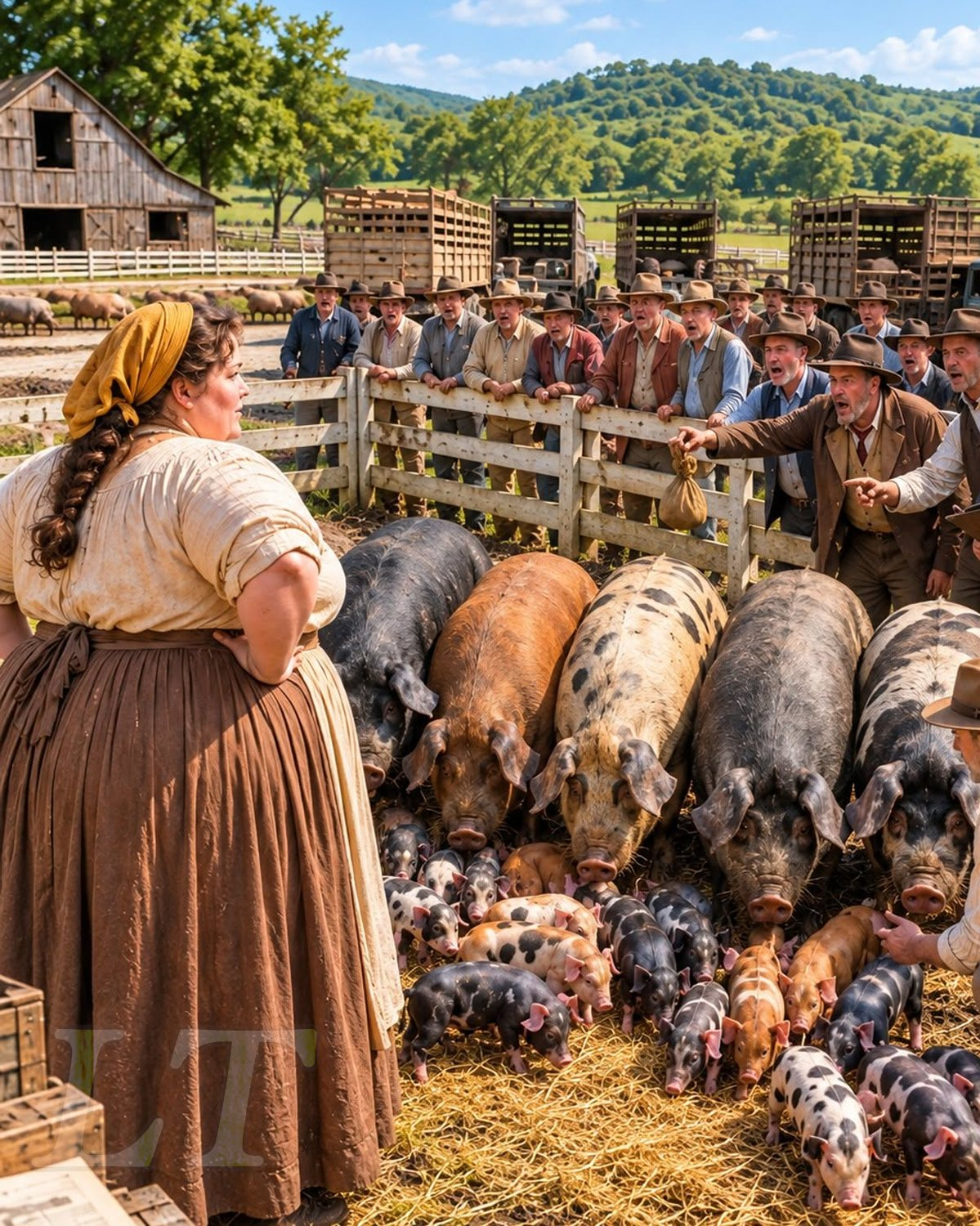
I stared at the red-sealed envelope in my hands.
OPEN ONLY IF HOLLIS CLAIMS THE FARM.
My uncle's handwriting was unmistakable.
Tomas stood beside me, holding the original Blackmir Preservation Trust agreement.
"Marin, I think you should open it."
I carefully broke the seal.
Inside was a handwritten letter, a legal document, and a small folded sheet of paper.
I opened the letter first.
Dear Marin,
If you are reading this, then Hollis has finally made the mistake I always expected him to make.
He has mistaken patience for weakness.
He has mistaken poverty for helplessness.
And he has mistaken the value of something for the right to own it.
I paused.
My throat tightened.
I left you Hollow Farm because I believed you would see what others refused to see. The six Blackmir sows were never worthless. The bottomland was never useless. And the records were never just old pieces of paper.
You have inherited something much greater than livestock.
You have inherited a responsibility.
The enclosed legal document confirms your appointment as successor custodian of the Blackmir Preservation Trust. This appointment was approved by the original custodians before my death.
You have the right to protect the breeding program, maintain the records, and ensure that no individual can claim exclusive control over the surviving lines.
But remember something important.
You do not have to become wealthy to prove that you succeeded.
You only have to make sure the things we tried to save are still here when the next generation arrives.
I am sorry I could not explain everything while I was alive.
I wanted you to have a choice.
With love,
Uncle Peter.
I lowered the letter.
For a moment, the cellar seemed unusually quiet.
Tomas put his hand on my shoulder.
"Peter trusted you."
I looked at the legal document.
It contained the signatures of all five original custodians.
Peter Voss.
Eleanor Whitmore.
Tomas Radic.
Samuel Cross.
Hollis Brackett.
The appointment of a successor custodian had been approved eleven years earlier.
There was no ambiguity.
I had not simply inherited six animals.
I had inherited the responsibility of protecting an entire preservation program.
I unfolded the final sheet.
It contained a list of assets belonging to the trust.
Historical breeding records.
Original registration documents.
Financial statements.
Preservation correspondence.
And a detailed inventory of the surviving Blackmir animals.
At the bottom was a handwritten note.
The archive at Hollow Farm is the controlling copy. No transfer or commercial acquisition can override the original preservation agreement.
I looked at Tomas.
"Hollis doesn't know this exists."
Tomas nodded.
"Not yet."
I carefully placed everything back inside the metal box.
Then I called Edwin Mercer.
He arrived less than an hour later.
When he saw the documents, he immediately understood their importance.
He examined the original agreement, the successor appointment, and the trust records.
Then he looked at me.
"Marin, this changes the entire case."
"Can we use these documents at the hearing?"
"Absolutely. We'll need to verify the signatures and establish the chain of custody, but this is exactly the evidence we've been missing."
I handed him Samuel's declaration.
He read it.
Then he smiled.
"Between this document and Samuel's testimony, Hollis's argument is going to be very difficult to sustain."
I looked toward the barn.
"Then let's finish this."
The morning of the hearing arrived.
Open Day was scheduled for ten o'clock.
The court hearing was scheduled for nine.
I dressed simply.
A dark blue blouse.
Black trousers.
Comfortable shoes.
I wasn't going to a business negotiation.
I was going to defend something my uncle had spent his life protecting.
Tomas drove.
Edwin sat beside me, carrying the original documents in a locked briefcase.
Nathaniel followed in his own vehicle.
When we arrived at the courthouse, Hollis was already waiting.
He wore an expensive charcoal suit.
Two attorneys stood beside him.
He glanced toward our vehicle.
Then his eyes settled on the briefcase.
His expression changed slightly.
"Marin."
"Mr. Brackett."
He approached.
"I hope you've reconsidered."
"I haven't."
His attorney stepped forward.
"Miss Voss, our client has made a reasonable offer to resolve this matter."
I looked at Hollis.
"By buying the animals?"
"By bringing them under proper management."
"They're already under proper management."
Hollis smiled.
"Your enthusiasm is admirable. Your experience is another matter."
I didn't respond.
Edwin stepped between us.
"We'll discuss the matter inside."
The hearing began shortly afterward.
The courtroom was modest.
Several local farmers had attended.
Delia sat near the back.
Arthur Bell was there.
Eleanor had arrived with Samuel Cross.
I hadn't expected Samuel to travel so far, but he had insisted.
He wanted to speak for himself.
Hollis sat at the opposite table.
His attorneys presented their case first.
They argued that the Blackmir Preservation Trust had become inactive.
They claimed that the original custodians had failed to maintain proper administrative procedures.
They also argued that Hollis had made substantial investments in preserving the remaining breeding stock.
According to their presentation, he was the only person with the financial resources and commercial infrastructure necessary to protect the breed.
I listened without interrupting.
Then Edwin stood.
He presented the original trust agreement.
He showed the court the annual financial reports.
He introduced Samuel's signed declaration.
He explained that the trust had continued operating through its custodians even when public meetings had become less frequent.
Then he presented the successor appointment.
The judge examined the document carefully.
"Miss Voss, are you aware that this agreement appoints you as successor custodian?"
"Yes, Your Honor."
"Do you understand the responsibilities involved?"
"Yes."
"Can you explain your intentions regarding the animals?"
I stood.
"I intend to preserve the original Blackmir breeding lines, maintain accurate records, and make the animals available for independent assessment."
The judge listened.
I continued.
"I also intend to prevent exclusive commercial ownership of the breed. The animals are part of a historical preservation project. Their value should be measured by the future they can help protect, not simply by the amount someone is willing to pay for them."
The judge looked toward Hollis's table.
"Mr. Brackett, do you dispute the authenticity of this agreement?"
His attorney stood.
"We dispute its current enforceability."
Edwin presented the financial reports.
Samuel then took the witness stand.
He explained the original agreement.
He described the winter flood.
He confirmed that B-017 had survived.
He also testified that Hollis had attempted to obtain exclusive breeding rights without the consent of the other custodians.
Hollis's attorney questioned him.
"Mr. Cross, isn't it true that you withdrew from the preservation project?"
"I withdrew from the public administration of it."
"So you abandoned your responsibilities?"
"No."
"Did you maintain regular meetings?"
"No."
"Did you maintain the records?"
"Yes."
The attorney paused.
Samuel continued.
"I maintained the original records privately because I believed they were at risk."
"At risk from whom?"
Samuel looked directly toward Hollis.
"From people who wanted to own what they had promised to protect."
The courtroom became silent.
The attorney moved to another question.
"Do you have proof that Mr. Brackett attempted to acquire exclusive control?"
Samuel nodded.
He produced the original correspondence.
Edwin submitted it as evidence.
The judge examined the documents.
Then Nathaniel provided an independent explanation of the Blackmir breeding program.
He described the importance of preserving distinct genetic lines and the risks of allowing one commercial operator to control a small surviving population.
Arthur Bell submitted his assessment of the Hollow Farm animals.
The report confirmed that the six original sows and their offspring displayed characteristics consistent with the documented historical Blackmir population.
Tomas also testified.
He described the animals' adaptation to wet ground.
He explained how they foraged along creek margins and used their broad feet to move through soft soil.
He also described the work Marin had completed since inheriting the farm.
The repaired barn.
The new enclosures.
The veterinary records.
The breeding inventory.
The careful monitoring of all forty-six piglets.
When the judge asked whether the farm was capable of supporting the breeding program, Tomas answered without hesitation.
"Yes, Your Honor."
Hollis's attorney attempted to challenge the financial sustainability of the operation.
Edwin presented Marin's bookkeeping records.
He showed the repair costs, barter arrangements, feed expenses, and projected income.
The numbers were modest.
But they were realistic.
I had not borrowed money recklessly.
I had not promised impossible returns.
I had built the operation gradually.
And I had documented every decision.
Finally, the judge addressed Hollis directly.
"Mr. Brackett, do you have evidence that you hold exclusive legal rights to the Blackmir breeding group?"
Hollis stood.
He looked at the documents.
Then at Samuel.
Then at me.
"My company has invested substantial resources in the breed."
"That wasn't my question."
Hollis hesitated.
"No, Your Honor."
The judge turned toward his attorneys.
"Do you have evidence that the preservation trust was formally dissolved?"
They conferred briefly.
Then one of them stood.
"Not at this time."
The judge looked down at the file.
After a short recess, she returned.
Her decision was clear.
The original preservation agreement remained valid pending further administrative review.
The appointment of Marin Voss as successor custodian was accepted provisionally, subject to final verification of the trust records.
Hollis's request for temporary control of the Hollow Farm animals was denied.
The court also prohibited unauthorized transfers of the protected breeding stock.
Finally, the judge ordered an independent review of the Crossridge transfer records and the removal of B-017.
I sat motionless.
Edwin leaned toward me.
"We've won the immediate case."
I looked at him.
"Does that mean the animals stay here?"
"Yes."
I exhaled.
For the first time in months, I felt the pressure in my chest begin to lift.
Across the courtroom, Hollis was speaking quietly with his attorneys.
He did not look toward me.
He gathered his papers and left.
I watched him disappear through the doors.
I didn't feel triumphant.
I felt relieved.
The animals were safe.
The records were protected.
And my uncle's work would continue.
We arrived at Hollow Farm shortly before ten.
Cars were already lining the road.
People had come from neighboring counties.
Some were farmers.
Others were livestock enthusiasts.
Several represented agricultural preservation organizations.
Delia stood near the entrance, greeting visitors.
Walter was helping people park.
Arthur had arranged a small display of historical photographs.
Nathaniel's organization had prepared information about the Blackmir breed.
And beside the barn stood a wooden sign.
HOLLOW FARM — BLACKMIR PRESERVATION OPEN DAY.
I stepped out of the vehicle.
Delia hurried toward me.
"Well?"
I smiled.
"We're keeping the animals."
She hugged me.
For several seconds, neither of us spoke.
Then she stepped back.
"Peter would have been so proud."
I looked toward the barn.
"I think he knows."
The event began.
Tomas spoke first.
He explained the history of the Blackmirs and their adaptation to wet, marginal land.
He described their broad feet, their natural foraging habits, and their ability to use vegetation that other livestock often ignored.
Arthur presented the independent assessment.
Nathaniel explained the importance of maintaining genetic diversity.
Eleanor spoke about the original preservation group.
Samuel stood beside her.
Together, they described the winter flood and the efforts made to protect the surviving breeding lines.
I watched the audience carefully.
People listened.
They asked questions.
They took photographs.
Some had never heard of Blackmirs before.
Others remembered seeing similar animals on older farms.
Then it was my turn.
I stepped forward.
I had prepared a speech the previous evening.
But when I looked at the crowd, I decided not to read it.
"My name is Marin Voss."
I looked toward the barn.
"When I arrived here, I had sixty-seven dollars, a failing farm, and six pigs everyone told me were worthless."
A few people smiled.
"I had no experience running a farm. I didn't know how to repair a barn, manage a breeding program, or maintain heritage livestock."
I paused.
"But I knew how to keep records."
I held up my notebook.
"And I knew that when a number doesn't make sense, you should ask why."
The audience became quiet.
"I started watching the animals. I learned what they ate, where they moved, and how they survived on land that other people had abandoned."
I looked toward the bottom pasture.
"Then I discovered that the land everyone called worthless was exactly what these animals needed."
I continued.
"My uncle Peter understood that. He spent years protecting these animals and their history."
I paused.
"He didn't leave me a profitable business. He left me something that needed saving."
I looked at the six original sows.
"Today, those six animals have forty-six surviving piglets. Together, they represent a new beginning for the Blackmir preservation program."
People began applauding.
I raised my hand slightly.
"I don't want anyone to misunderstand what we're doing here. This is not a private commercial project. The records will be independently maintained. The breeding program will be transparent. Qualified specialists will have access to the animals and their history."
I looked toward Samuel and Eleanor.
"We're going to preserve what previous generations worked so hard to protect."
The applause grew louder.
For the first time, I felt that Hollow Farm was no longer isolated.
People understood why it mattered.
After the speeches, visitors were invited to walk through the farm.
They examined the six original sows.
They watched the piglets moving around their enclosures.
Arthur answered questions about their physical characteristics.
Tomas explained how the animals navigated the wet pasture.
One young boy stood beside the fence for several minutes.
He pointed toward the Admiral.
"Is that the oldest one?"
I nodded.
"She's one of the original six."
"What's her name?"
"The Admiral."
He smiled.
"Why?"
"Because she seems to be in charge."
The boy laughed.
His mother thanked me.
I watched them move toward the next enclosure.
Then I noticed a familiar vehicle approaching the entrance.
A black livestock trailer.
Nathaniel turned.
"Marin."
I looked toward the road.
The vehicle stopped.
A man climbed out.
It was Leonard Price.
He approached us.
"Good morning."
"Leonard. What brings you here?"
He smiled.
"I thought you might want to see something."
He opened the trailer.
Inside stood a large black boar.
His coat was dark.
His shoulders were broad.
And near his front hoof was a distinctive white marking.
I stopped breathing.
Nathaniel stepped forward.
"Is that him?"
Leonard nodded.
"B-017."
I looked at Samuel.
He was standing a few feet away.
His eyes filled with emotion.
"Well," he whispered. "There you are."
The old boar stepped down carefully.
He looked around.
Then he began sniffing the ground.
Tomas approached slowly.
He examined the animal from a respectful distance.
The physical characteristics matched the original descriptions.
Arthur joined him.
He looked at the identification tag.
Then he checked the historical photograph.
"It's him."
I felt tears forming.
B-017 had survived.
The foundation boar had not disappeared.
He had been protected all those years by Samuel and a small group of people who refused to surrender the original breeding line.
Leonard explained that Samuel had arranged the transport after the court confirmed that Hollis had no exclusive authority over the animal.
The preservation trust had approved the transfer to a designated holding enclosure at Hollow Farm.
I looked at Samuel.
"Why didn't you tell me he was coming?"
He smiled.
"Because I thought you deserved one surprise that wasn't bad news."
I laughed.
For the first time since arriving at Hollow Farm, I laughed without feeling that something terrible was waiting around the corner.
We prepared a separate enclosure for B-017.
Arthur recommended a full veterinary assessment before any breeding decisions were made.
Nathaniel arranged for independent genetic testing.
The animal would not be bred immediately.
The priority was his health and the careful preservation of the original line.
Everything would be documented.
Everything would be reviewed.
Nothing would be rushed.
That was exactly what Peter would have wanted.
The following weeks brought more changes.
The court completed its review of the Crossridge transfer records.
It found that Hollis had removed protected materials without the required authorization.
He was ordered to return the remaining archive documents and cooperate with the preservation trust's independent review.
The original breeding records were recovered.
Several missing pages were located in a storage facility connected to Brackett Livestock.
They confirmed the historical relationship between B-017, F-009, and the surviving Hollow Farm animals.
The county also corrected the livestock registry.
The Blackmirs were no longer listed as an obsolete population of negligible value.
They were officially recognized as a protected heritage breeding group under the newly documented preservation program.
Hollis Brackett lost his attempt to acquire exclusive control.
His company also faced an investigation into its handling of the original transfer records.
He never returned to Hollow Farm.
A few months later, I received a formal letter from his attorneys.
It offered to purchase the farm again.
The amount was considerably larger than his original offer.
I read it once.
Then I placed it in a drawer.
I didn't need to answer.
Hollow Farm was no longer for sale.
Spring arrived.
The bottomland became green again.
The creek moved steadily through the pasture.
The Blackmirs spent their days rooting through the wet ground.
The forty-six piglets had grown.
Some had already entered the next stage of the preservation program.
Their health records were complete.
Their parentage had been documented.
The breeding decisions were reviewed by Arthur and Nathaniel's specialists.
No animal was transferred without the approval of the trust.
And for the first time in decades, the Blackmir breeding program had a clear future.
Eleanor began visiting once a week.
Samuel came whenever his health allowed.
Tomas remained my closest adviser.
Delia helped organize the farm's educational visits.
Walter continued repairing anything that broke.
Nathaniel's organization established a long-term preservation partnership.
The farm also began generating modest income through educational tours, agricultural workshops, and carefully supervised breeding arrangements.
I paid the remaining property taxes.
I repaired the farmhouse roof.
I replaced the broken barn wall.
And I finally had enough money to hire someone to help with the daily work.
I didn't become wealthy.
But I no longer lived in fear of losing everything.
One afternoon, I sat at my uncle's old kitchen table.
The original ledger was open in front of me.
I turned to the first page.
The handwriting was familiar.
Blackmir population — six surviving sows.
Beneath it, I wrote a new entry.
Blackmir Preservation Program — Hollow Farm.
Original sows: six.
First generation surviving piglets: forty-six.
Foundation boar B-017: recovered and under protected care.
Historical breeding records: restored.
Preservation trust: active.
I paused.
Then I added one final sentence.
The work continues.
I closed the ledger.
Outside, the afternoon sun fell across the bottom pasture.
The Admiral stood near the creek.
Her piglets moved around her.
B-017 rested in his separate enclosure.
Tomas was repairing a gate.
Delia was talking with a group of visitors.
Eleanor and Samuel sat together on the porch, looking toward the animals.
For a moment, I thought about the day I first arrived.
Sixty-seven dollars.
A collapsing farmhouse.
A broken barn.
Six enormous black sows standing in the mud.
And a man who believed I would be desperate enough to sell everything.
He had looked at the land and seen a failure.
He had looked at the animals and seen a bargain.
My uncle had looked at the same things and seen a future.
I finally understood the difference.
The farm had never been worthless.
It had simply been waiting for someone willing to recognize its value.
That evening, I walked down to the creek.
The water moved quietly through the grass.
I stood there for a while, listening to the animals in the distance.
Then I looked back at the farmhouse.
The roof was repaired.
The barn was standing.
The records were safe.
The animals were healthy.
And the farm belonged to the future again.
I returned to the kitchen and placed Peter's letter beside the ledger.
I read his final words once more.
You do not have to become wealthy to prove that you succeeded.
You only have to make sure the things we tried to save are still here when the next generation arrives.
I folded the letter carefully.
Then I placed it inside the original archive.
Outside, the Blackmirs continued moving through the green bottomland.
Forty-six piglets had become the beginning of a new generation.
The original foundation line had survived.
And Hollow Farm, once marked as a worthless property, had become the home of a living legacy.
For the first time, I wasn't trying to save the farm from disappearing.
I was building a future on it.
And I knew exactly what my uncle would have said if he could have seen it.
We saved them, Peter. Every last one we could.






Comments 0