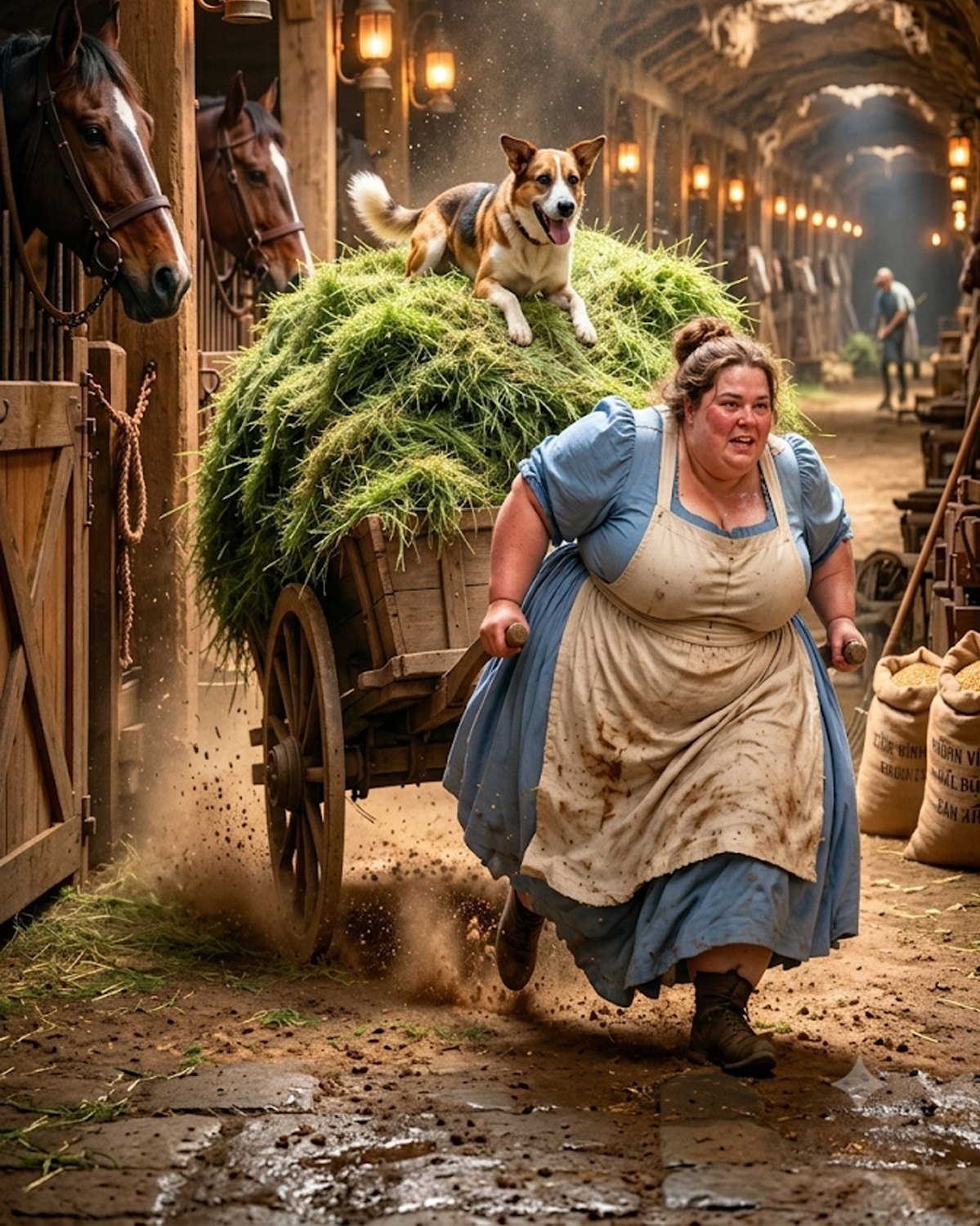
Delphine Whitlock placed forty-three dollars on the kitchen table.
"That's everything, Clover. We're going to have to make it work."
The cow stood outside the open farmhouse door, chewing lazily on a mouthful of grass.
Delphine counted the money again.
Forty-three dollars.
Not forty-four.
Not forty-five.
Exactly forty-three dollars and some loose coins that barely deserved counting.
She arranged the bills into a neat stack, then opened her father's old leather notebook.
The first page contained his handwriting, followed by years of measurements, farm expenses, livestock records, and small observations about the land.
She turned to a clean page.
At the top, she wrote:
KETTLE DRAW — BUILDING PLAN
Below it, she listed everything she needed.
Timber.
Iron fittings.
Nails.
Tools.
Drainage materials.
Ventilation equipment.
Feed.
Repairs to the farmhouse.
She stopped writing.
The list was already longer than her remaining money could support.
Delphine leaned back in her chair.
For a moment, she considered whether she had made a terrible mistake.
She had sold the family farm, purchased a neglected property, and moved into a farmhouse that needed more repairs than she could afford.
Her inheritance had not made her wealthy.
It had simply given her one opportunity to start again.
And now she was expected to build something that nobody in the valley believed could work.
She looked through the window.
Beyond the pasture, the hillside rose behind the farmhouse.
That was where her future would be decided.
She closed the notebook.
"All right," she whispered. "Let's begin."
The first problem was the farmhouse.
Its roof leaked near the eastern chimney. Several windows had loose frames, and the back door required a hard pull before it would close properly.
The kitchen stove worked, but its iron door had a damaged hinge.
Delphine spent the first several days making the house livable.
She repaired the door with a piece of salvaged iron, replaced the worst window frame, and patched the roof with boards she found inside an old storage shed.
She did not attempt to make everything beautiful.
Beauty could wait.
Survival could not.
Her animals needed shelter before the winter arrived.
Clover and Ruth were dairy cows. They required dependable feed, dry bedding, and protection from freezing winds.
Fletcher, her aging workhorse, needed special attention.
His left hind leg had become stiff over the years, and Delphine knew that a severe winter could make his condition worse.
She also had eleven chickens.
They were not particularly intelligent, but they were excellent at finding ways to escape their enclosure.
Every morning, Delphine counted them.
Every evening, she counted them again.
On the fourth morning, she discovered that one had escaped and was sitting on the farmhouse windowsill.
Delphine stared at it.
The chicken stared back.
"You have eleven acres of land to explore," she said. "And you choose my windowsill."
The chicken flapped its wings.
Delphine sighed and carried it back to the enclosure.
It was the first time she had laughed since arriving at Kettle Draw.
The sound surprised her.
She had been so occupied with calculations, repairs, and worries that she had almost forgotten what ordinary life felt like.
But there was no time to dwell on it.
The hillside was waiting.
Her first inspection began at sunrise.
Delphine carried a measuring tape, a wooden stake, a small hammer, and her father's notebook.
She walked the entire eastern slope.
She examined the vegetation, the direction of the hillside, and the way rainwater traveled across the surface.
The limestone shelf was the most promising feature.
It was broad enough to support a substantial excavation, but the surrounding ground varied considerably.
Some sections were hard and compact.
Others contained loose clay and small stones.
She marked the areas that appeared stable.
Then she returned to the farmhouse to examine the old sketch in her father's notebook.
The drawing was rough, but it showed a familiar hillside profile.
Her father had made several measurements during his visits to Kettle Draw years earlier.
She compared those measurements with her own.
The limestone shelf appeared to extend farther than she had initially expected.
That was encouraging.
But something bothered her.
The eastern side contained a narrow underground drainage route.
If she ignored it, groundwater could collect behind the structure.
The walls might remain dry during ordinary weather, only to become dangerously saturated after prolonged rain.
She studied the drawing again.
Her grandmother had taught her that earth could protect a building from extreme temperatures.
But she had never suggested that every hillside was automatically safe.
The ground had to be understood.
Its weight, moisture, and natural movement mattered.
Delphine picked up a pencil.
She drew a new diagram.
Then she added another.
By lunchtime, the table was covered with measurements.
She had also written three questions in large letters.
WHERE DOES THE WATER GO?
WHICH SECTIONS REQUIRE ADDITIONAL SUPPORT?
HOW WILL THE AIR MOVE THROUGH THE BARN?
She stared at the questions.
Those were the problems she needed to solve before the first major excavation.
On the following afternoon, Delphine visited the blacksmith's shop.
Everett Concincaid was working near the forge when she entered.
He was a broad-shouldered man in his forties, with dark hair beginning to gray around the temples.
His sleeves were rolled up, and a leather apron covered most of his clothes.
He looked up.
"Morning, Miss Whitlock."
"Good afternoon, Everett."
"What brings you here?"
"I need iron fittings."
He placed his hammer on the anvil.
"For a wagon?"
"No. For a barn."
He waited.
Delphine realized that everyone in the valley was beginning to associate the word barn with something unusual whenever she said it.
"An underground barn," she clarified.
Everett rubbed his chin.
"I've heard about that."
"Then you've heard the jokes."
"I've heard plenty of jokes."
She placed her measurements on the workbench.
Everett examined them carefully.
Unlike the shopkeeper, he did not laugh.
He studied the dimensions, then traced one of the support positions with his finger.
"These fittings are going to need room for movement."
Delphine leaned closer.
"Because of the ground?"
"Seasonal movement. Timber expands and contracts. The hillside may shift slightly with changes in moisture."
He picked up a small iron bracket.
"Something too rigid in the wrong place can become a weakness."
Delphine considered his words.
"Could you make fittings that allow a little movement without losing their strength?"
Everett looked at her.
"Yes. But they'll take time."
"I understand."
"And they'll cost more than ordinary brackets."
She opened her purse.
"I can pay for a few now. The rest will have to wait."
Everett glanced at the coins.
Then he looked toward the measurements again.
"Your father used to bring me drawings like these."
Delphine raised her eyes.
"You knew my father?"
"Samuel? Of course. He was a good man."
Everett returned the papers.
"He never liked spending money twice on the same repair."
Delphine smiled faintly.
"Neither do I."
Everett nodded.
"Then we'll make these properly the first time."
For the first time since arriving in Kettle Draw, she had found someone who was willing to discuss her project without treating it as a joke.
She left the shop with a promise that the first fittings would be ready within two weeks.
It was a small victory.
But small victories mattered when forty-three dollars had to support an entire future.
The following morning, an elderly farmer appeared beside the excavation.
His name was Gideon Thorne.
He was in his late sixties, with a deeply lined face, white hair, and a walking stick polished smooth from years of use.
He had farmed in Kettle Draw longer than most residents could remember.
Delphine was marking the position of a timber support when she noticed him watching.
"Good morning," she said.
Gideon did not immediately respond.
He walked toward the excavation and examined the exposed earth.
Then he tapped one of the wooden supports with his walking stick.
"Who told you to put that there?"
"No one. I calculated the position."
He looked at her.
"Based on what?"
"The measurements in my father's notebook and the visible limestone shelf."
Gideon crouched carefully.
He examined the exposed ground near the eastern wall.
Then he shook his head.
"Your measurements aren't the problem."
Delphine waited.
"The problem is what you haven't seen yet."
He pointed toward a section of the excavation.
"That slope carries more weight than you think. The ground above it isn't uniform. You move the supports without understanding the load, and the whole eastern section could become unstable."
Delphine felt her stomach tighten.
"Are you certain?"
"I've seen two hillside structures fail. One killed a mule. The other buried half a man's storage chamber."
She looked toward the exposed wall.
"Can you show me?"
Gideon studied her expression.
He seemed surprised that she had asked rather than argued.
"Bring your measuring tape."
They spent nearly two hours examining the slope.
Gideon explained where the ground appeared firm and where the excavation needed additional reinforcement.
He showed her how to recognize small signs of movement around the exposed limestone.
He also pointed out a section where water might collect if the excavation continued at its present angle.
Delphine wrote everything down.
She did not pretend to understand every detail immediately.
Instead, she asked questions.
Some were simple.
Others required Gideon to think before answering.
By the time they finished, she had changed three support positions and adjusted the angle of the eastern excavation.
Gideon looked at her notebook.
"You actually listen."
"Why wouldn't I?"
"Some people ask for advice because they want someone to agree with them."
Delphine closed the notebook.
"I didn't come here to be agreed with."
The old farmer looked toward the hillside.
Then he nodded.
"Good. This project might have a chance after all."
It was not a promise of success.
But it was more encouragement than she had received from anyone else.
That evening, Delphine found herself thinking about her grandmother.
She remembered the old storage chamber, the smell of cool earth, and the way her grandmother kept vegetables fresh long after the harvest season.
She remembered asking why the chamber never became as hot as the kitchen.
Her grandmother had explained that the earth absorbed and released heat slowly.
The temperature underground changed much more gradually than the air outside.
Delphine had never forgotten that lesson.
Now she wanted to apply it on a much larger scale.
But she also knew that a livestock barn was not simply a root cellar with a bigger door.
Animals produced heat and moisture.
Without proper ventilation, damp air could collect.
Condensation could damage the timber.
The animals could become sick.
A poorly designed underground structure could be more dangerous than an ordinary wooden barn.
She needed a way to exchange air without allowing freezing drafts to sweep directly across the stalls.
She spent the evening studying her sketches.
She drew two possible ventilation routes.
She considered the entrance, the ceiling height, and the natural movement of air through the chamber.
Then she returned to her father's notebook.
A small note appeared near the bottom of one page.
Cold air settles. Warm air rises. Never forget the movement of both.
Delphine read it twice.
She began sketching again.
By midnight, she had a preliminary ventilation plan.
It was not perfect.
But it was a beginning.
The next several weeks tested her patience.
She worked every day.
Some mornings, the ground was too wet to excavate safely.
On others, the limestone resisted her tools so stubbornly that she made almost no progress.
She learned to recognize when to stop.
That was harder than she expected.
Delphine had always been determined, but determination sometimes made her push too far.
One afternoon, she worked until her hands trembled.
She had moved several heavy stones and was attempting to clear a section near the eastern wall.
A small amount of soil fell from the upper edge.
She froze.
The sound was slight.
But it was enough.
She stepped away and examined the area.
The ground had not collapsed.
Still, the warning was clear.
She put down her tools.
For several minutes, she stood looking at the excavation.
She wanted to keep working.
She wanted the barn finished before anyone could laugh at her again.
But she remembered Gideon's warning.
She remembered her grandmother's lessons.
And she remembered her father's words about never wasting money on a repair that could have been prevented.
She left the excavation for the day.
That evening, she wrote a new rule in her notebook.
NO WORK ABOVE OR BELOW AN UNSUPPORTED SECTION.
The following morning, she repositioned the supports.
It cost her another day.
But she preferred losing a day to losing the entire hillside.
Mabel Fenwick first appeared at the farmhouse near the end of June.
She was a widow in her early fifties, with gray-brown hair pinned neatly beneath a simple bonnet.
Her husband had once owned a small farm nearby.
After his death, she had struggled with debts connected to Orson Blackwell's lending operation.
She now lived in a modest cottage and earned money through preserving food, sewing, and occasional farm work.
Delphine had seen her at the dairy exchange.
They had exchanged greetings but never spoken at length.
That morning, Mabel arrived carrying a covered basket.
"I brought something for you."
Delphine opened the door.
"What's this?"
"Fresh bread. You look as though you've been living on coffee and stubbornness."
Delphine laughed softly.
"That may be accurate."
Mabel stepped inside.
She looked around the kitchen, noticing the construction diagrams and account books spread across the table.
"You're doing the barn yourself?"
"Most of it."
Mabel examined one of the drawings.
"I heard the men talking about it."
"Then you heard what they think."
"I heard what they always think."
There was something tired in her voice.
Delphine looked at her.
Mabel placed the basket on the table.
"My husband used to say that people in this valley were very generous with advice when it wasn't their money being spent."
Delphine smiled.
"Your husband sounds familiar."
Mabel laughed.
Then her expression became serious.
"Be careful with Blackwell."
Delphine looked up.
"Why?"
"He doesn't like people who refuse his help."
"I noticed."
Mabel sat down.
"He owns the mercantile, controls much of the feed supply, and has influence over the people who buy farm produce. If he decides someone is troublesome, that person can find it difficult to earn a living."
Delphine remembered the loan document.
Especially the clause about the spring.
"Did he ever try to take your property?"
Mabel looked down at her hands.
"He didn't have to force my husband to borrow money. He simply made the offer sound like the only sensible choice."
She paused.
"When the farm began struggling, the payments became harder. Then the fees increased. By the time we understood the agreement, there was very little left to save."
Delphine said nothing.
Mabel looked toward the window.
"Your father would have hated seeing you go through this."
Delphine swallowed.
"Did you know him?"
"Everyone knew Samuel. He was one of the few men in this valley who could disagree with Blackwell without trying to humiliate him."
Mabel stood and adjusted her bonnet.
"I can't build your barn. But I know people, prices, suppliers, and which merchants still have enough courage to do business honestly."
Delphine looked at her.
"That would help more than you know."
Mabel nodded.
"Then I'll come back tomorrow."
By July, Delphine's project had attracted more attention.
The excavation was larger now.
The entrance had taken shape, and the first major timber supports had been installed.
Everett delivered the custom iron fittings.
Gideon inspected the eastern wall.
Mabel helped Delphine arrange a more reliable buyer for her dairy products.
The work was beginning to resemble a real building.
But the expenses were mounting.
Every purchase required careful consideration.
Delphine began keeping two account books.
One recorded what she had spent.
The other recorded what she still owed.
She sold butter and eggs whenever possible.
She repaired broken equipment rather than replacing it.
She collected usable timber from an abandoned shed and sorted it according to condition.
Some boards were too damaged for structural work.
Others could be used for interior storage and stall partitions.
Nothing was wasted.
Her remaining money fell from forty-three dollars to thirty-one, then twenty-six.
She watched every coin disappear.
Still, she refused to approach Blackwell for a loan.
One afternoon, she went to the dairy exchange to collect payment for her butter.
The buyer, Mr. Harlan, was unusually quiet.
He counted the money and pushed it across the counter.
Delphine noticed the amount was lower than expected.
"There's a mistake."
Harlan avoided her eyes.
"Prices have changed."
"Since when?"
"Recently."
"Nobody told me."
He shrugged.
"That's the market."
Delphine examined the figures.
The price had dropped considerably.
"Did the other farmers receive the same reduction?"
Harlan looked uncomfortable.
"Some of them."
"Some?"
He closed the account book.
"Miss Whitlock, I don't want trouble."
She studied him.
"Neither do I."
He lowered his voice.
"Mr. Blackwell has been asking questions about your property."
Delphine felt her attention sharpen.
"What questions?"
"About the spring. About the boundaries. About whether your barn construction is affecting the water."
She placed the money inside her purse.
"Is there a problem with the water?"
"I didn't say there was."
"Then why are you telling me?"
Harlan glanced toward the front window.
"Because you should understand that people are talking."
Delphine thanked him and left.
Outside, she stood beside her wagon for several moments.
Blackwell's interest in the spring was becoming impossible to ignore.
He had mentioned it during his visit.
Now he was asking other people questions.
She returned to Kettle Draw and walked directly toward the eastern hillside.
The narrow strip of green vegetation was still there.
She crouched and examined the soil.
It was darker than the surrounding ground.
She pressed her fingers into it.
The earth was cool and slightly damp.
She looked toward the excavation.
Then toward the direction of the natural drainage channel.
A thought entered her mind.
What if the spring and the underground drainage route were connected?
What if Blackwell knew something about the water beneath her property that she had not yet discovered?
She stood slowly.
Her father's notebook was waiting inside the farmhouse.
She needed to compare his old measurements with the property boundary records.
But first, she wanted to understand the land itself.
She walked along the eastern slope, following the green vegetation until it disappeared behind a cluster of limestone rocks.
There, partly hidden beneath a patch of grass, she noticed a small wooden marker.
It was old.
The wood had darkened with age, and one side had been damaged by weather.
Delphine knelt and cleared the grass.
A number had been carved into the surface.
She recognized the handwriting immediately.
It belonged to her father.
But the number was not a measurement she had seen in his notebook.
It was a property survey reference.
She returned to the farmhouse and searched through the papers Samuel had left behind.
After nearly an hour, she found an old folded map.
It showed Kettle Draw and several neighboring properties.
The spring was marked near the boundary.
But a narrow line extended beneath the hillside.
It continued beyond the edge of Delphine's land.
She traced it with her finger.
Then she noticed another marking.
A small cross had been drawn beside a name.
ORSON BLACKWELL.
Delphine stared at the map.
Her father's handwriting was unmistakable.
He had known something about Blackwell's connection to the spring.
And he had recorded it years before Delphine had even purchased Kettle Draw.
She turned the paper over.
There was another note.
A single sentence.
If Blackwell ever comes asking about the water, check the original survey before signing anything.
Delphine felt a chill that had nothing to do with the evening air.
She placed the map beside the notebook.
Then she heard a wagon approaching.
She moved toward the window.
A polished black buggy was coming up the road.
It stopped at the entrance to her property.
The driver stepped down.
He was not Orson Blackwell.
He was a man Delphine had never seen before.
He carried a leather case under one arm and a rolled survey map in his hand.
He looked toward the farmhouse.
Then he called out:
"Miss Whitlock? I'm here on behalf of Mr. Blackwell. We need to discuss the boundary of your spring."
Delphine slowly closed her father's notebook.
The stranger reached inside his case.
And when he unfolded the document, she saw the signature line already waiting for her name.






Comments 0