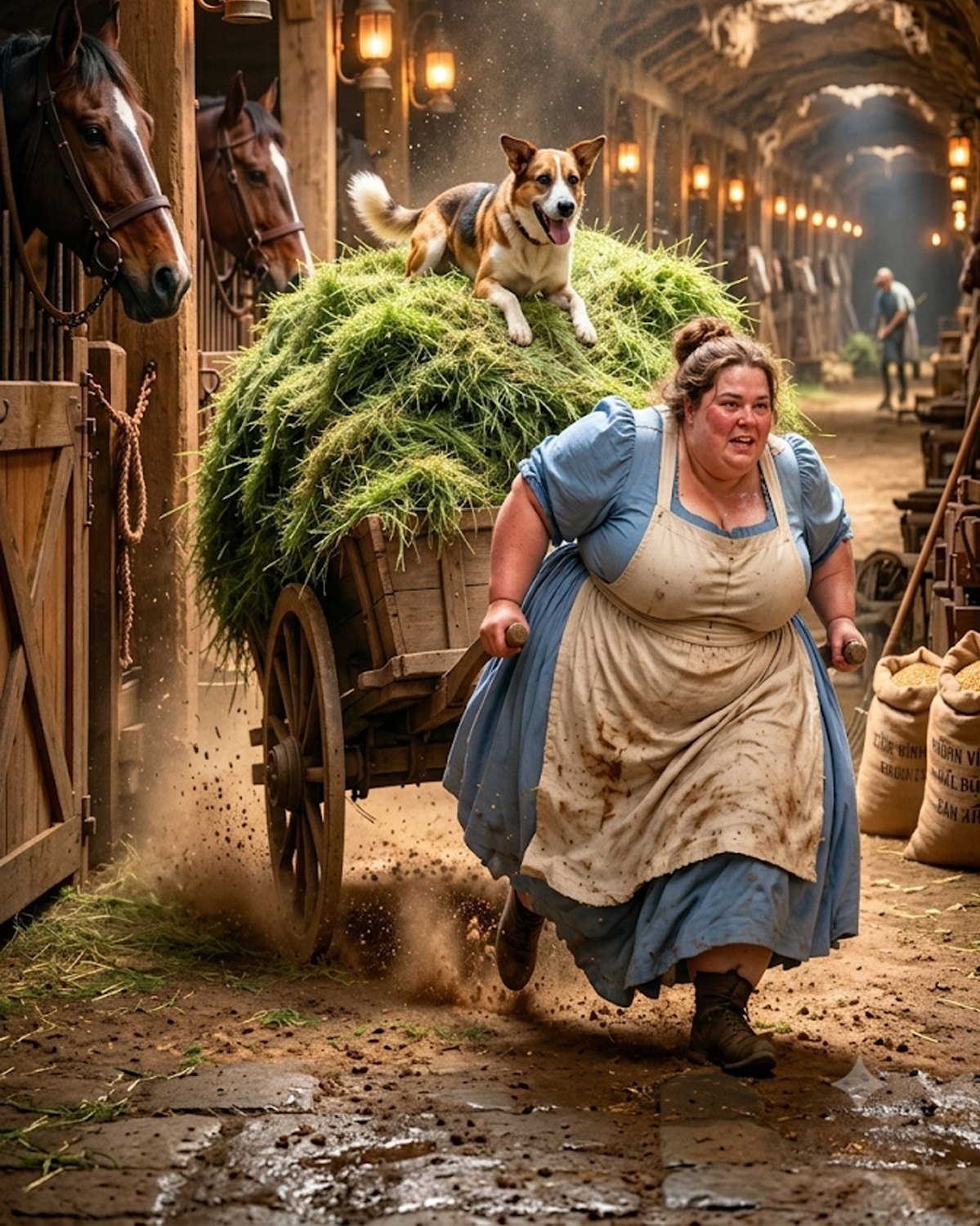
"Delphine, don't open that door."
Harold stood behind her, his face pale.
The lantern in Delphine's hand trembled slightly.
She looked at the wooden door concealed beneath the western wall of her underground barn.
Three knocks had come from the other side.
Then a voice had whispered her name.
She turned toward Harold.
"Tell me exactly what you found."
He swallowed.
"A document."
"What kind of document?"
"An agreement bearing your father's signature. It transfers the entire reservoir to Orson Blackwell."
Delphine stared at him.
"Samuel would never have signed that."
"I know."
"Then why are you telling me this?"
Harold looked toward the door.
"Because I found another page beneath it. Someone wrote that the document was only valid if the original trusteeship was voluntarily dissolved."
Delphine remembered the original deed.
The maintenance ledger.
The signatures of the trustees.
And the evidence of Blackwell's payments to Edwin Shaw.
She understood that the document might be another attempt to manufacture ownership.
But the knocking came again.
This time, louder.
Delphine raised the lantern.
"Who is inside?"
A man's voice answered.
"Someone who has been waiting twenty years for the truth to come out."
Walter Briggs appeared at the entrance.
He had heard the exchange.
His expression changed immediately.
"Step away from that door."
He examined the hinges and the surrounding stonework.
Then he noticed a small iron release mechanism near the floor.
"This is not an ordinary storage room."
Everett and Gideon arrived moments later.
Together, they inspected the structure.
Walter found a narrow ventilation opening above the door.
He called into the darkness.
"Identify yourself."
A long silence followed.
Then came the answer.
"My name is Thomas Blackwell."
Walter froze.
Delphine looked at him.
"Thomas Blackwell?"
Walter slowly nodded.
"Henry's younger son."
Harold stepped backward.
"That isn't possible."
The voice came again.
"I understand why you think that."
Walter examined the old mechanism.
"How long have you been down there?"
"Long enough."
Delphine looked at Walter.
"Open it."
He hesitated.
"The supports may be unstable."
"Then reinforce them."
Everett brought the necessary tools.
Gideon checked the ceiling.
They worked carefully, securing the surrounding timber before attempting to release the door.
After several minutes, the mechanism finally moved.
The wooden door opened inward.
A narrow underground room appeared.
Inside stood an elderly man holding a lantern.
His hair was completely white.
His clothes were old but carefully maintained.
Beside him sat a wooden chair, a small table, and several document boxes.
He looked at Delphine.
Then at Walter.
"Samuel's daughter."
Delphine nodded.
"Yes."
The old man lowered his lantern.
"I have something your father wanted you to see."
Thomas Blackwell explained that he had been living in the hidden inspection chamber for several months, not twenty years.
He had not been hiding from the world.
He had been hiding the original records.
After his father, Henry Blackwell, died, Thomas discovered that Orson intended to use the family name and the old water agreements to gain control of the reservoir.
Thomas had confronted him.
The disagreement became bitter.
Orson accused him of trying to steal the family inheritance.
Thomas accused Orson of betraying everything their father had built.
Their relationship broke apart.
Thomas left Kettle Draw.
But before leaving, he took several original documents from the Blackwell family archive.
He knew Orson would eventually search for them.
The papers included Henry's original inspection records, a second copy of the trusteeship agreement, and correspondence concerning the installation of the unauthorized B-17 diversion mechanism.
Thomas returned to the valley years later.
He discovered that Samuel Whitlock had also been investigating the water system.
The two men met secretly.
Samuel offered to help preserve the documents.
He knew the underground barn project might eventually uncover the old inspection chamber.
Thomas agreed to leave the records beneath the western wall.
But he had never expected the situation to become so dangerous.
"When Blackwell discovered that the chamber had been opened," Thomas explained, "I knew he would come looking for the papers."
Delphine studied him.
"Was he the person who entered the passage last night?"
Thomas nodded.
"He came here yesterday with another man. They forced the entrance, but they didn't find the room."
"Why didn't you leave?"
"Because I knew the original records were safer here than anywhere else."
Walter examined the documents.
Then he found a familiar page.
It was Henry Blackwell's original trusteeship agreement.
The signatures were clear.
Henry Blackwell.
Thomas Blackwell.
Samuel Whitlock.
Walter Briggs.
And Margaret Whitlock.
Every surviving trustee had been included.
At the bottom was a declaration that the reservoir must remain a shared community resource.
No private owner could claim exclusive control.
Delphine read the final paragraph.
The water of Kettle Draw shall remain available to the farms and households that depend upon it, regardless of changes in property ownership.
She looked at Thomas.
"Why did Orson claim that Henry had filed a document against my property?"
Thomas gave a sad smile.
"Because Orson has been using my father's name without permission."
He removed another paper from the box.
It was the original signature register.
The document filed by Orson had been created using a copied signature.
It was not an authentic legal claim.
And the date proved something even more important.
Henry had died before the document was supposedly submitted.
Delphine finally understood.
Blackwell had not inherited a legal right to the reservoir.
He had inherited a family name.
And he had used that name to frighten people into surrendering rights that had never belonged to him.
The following morning, the independent engineering inspection began.
Pembroke arrived with two county engineers.
Elias brought the original deed, the maintenance ledger, and the trusteeship agreement.
Walter and Thomas accompanied them into the underground chamber.
Delphine remained near the entrance.
The inspectors examined the damaged eastern wall.
They measured the timber supports.
They checked the drainage channel.
They tested the ventilation.
Then they examined the B-17 control mechanism.
One engineer removed the outer casing.
Inside, they found several unauthorized modifications.
The emergency overflow had been deliberately obstructed.
A secondary valve had been installed to redirect water toward Blackwell's property.
The modification had weakened the original drainage balance.
The inspector examined the metal fittings.
"These components were installed recently."
Walter nodded.
"Within the last few months."
"Could they have caused the pressure damage?"
"Yes."
The engineer continued examining the mechanism.
Then he found a small metal plate concealed beneath the casing.
It carried the initials O.B.
Orson Blackwell.
The plate had been stamped with a date.
The same date as the first disputed excavation order.
Pembroke examined it.
His expression hardened.
"Mr. Blackwell will have to explain this."
Delphine stood beside the original reservoir map.
For years, she had been told that the underground barn was foolish.
That she was inexperienced.
That she was wasting her inheritance.
Yet the structure had protected her animals through the harshest winter in the valley's recorded history.
And now the same hillside was providing the evidence needed to protect the entire community.
The engineer finally straightened.
"The original structure is sound."
Delphine looked at him.
"Are you certain?"
He nodded.
"Your drainage design is functioning correctly. The damage was caused by interference with the secondary control system, not by the construction of the barn."
Gideon smiled.
Everett let out a long breath.
Walter placed one hand on the limestone wall.
"Samuel would have liked that."
Delphine looked toward the underground chamber.
For the first time since her father died, she felt that something he had begun was finally being completed.
Orson Blackwell was summoned to the county office that afternoon.
He arrived wearing his finest coat.
His expression was confident.
He expected another argument about property boundaries.
Instead, Pembroke presented him with the engineering findings.
Blackwell read the report.
Then he looked at the original trusteeship agreement.
His face changed.
"These documents are incomplete."
Elias placed Thomas Blackwell's signature register on the desk.
"They are original records."
Blackwell turned toward Thomas.
"You have no right to be here."
Thomas looked at him calmly.
"I have every right to be here."
"You abandoned the family."
"I left because I refused to help you destroy it."
Blackwell's jaw tightened.
He turned toward Pembroke.
"This is a family dispute."
"No," Pembroke replied. "It concerns the unauthorized alteration of a protected community water system."
Blackwell stood.
"You're making a serious mistake."
Pembroke did not move.
"We have records of improper payments, forged registration documents, unauthorized excavation, and deliberate interference with the emergency drainage system."
Blackwell looked toward Edwin Shaw.
The clerk had already been called to provide a statement.
He lowered his head.
"I followed Mr. Blackwell's instructions."
Blackwell slammed his hand against the desk.
"You're lying."
Edwin looked up.
"I have the original instructions."
He handed over a folder.
Inside were letters, payment receipts, and copies of Blackwell's orders.
One instructed Edwin to remove the original maintenance agreement from the county index.
Another directed him to register a revised water access document.
A third referred to the planned excavation of Delphine's eastern hillside.
Blackwell's face turned pale.
But the final document was the most damaging.
It was a letter addressed to Nathaniel Price.
It instructed him to submit a disputed agreement bearing Samuel Whitlock's forged signature.
Price stood.
"I can confirm that I received that instruction."
Blackwell looked around the room.
For the first time, nobody was defending him.
The investigation continued for several weeks.
Blackwell's private water claims were suspended.
The disputed agreements were invalidated.
The county ordered a complete restoration of the original drainage system.
Edwin Shaw was dismissed from his position and later faced legal proceedings for falsifying public records.
Nathaniel Price cooperated with the investigation and admitted his role in registering documents without proper verification.
He accepted responsibility for his actions.
The county also reviewed Blackwell's financial dealings with several farmers.
Evidence showed that he had used misleading agreements and improper pressure to acquire control over water access and adjoining property rights.
The case eventually reached the district court.
Thomas Blackwell testified about his father's original intentions.
Walter explained the engineering modifications.
Elias presented the legal documents.
Margaret confirmed the history of the trusteeship.
And Delphine described the damage caused by the unauthorized excavation.
Blackwell's attorneys attempted to argue that the underground system had been abandoned.
But the original maintenance ledger proved otherwise.
The court ruled that the reservoir remained protected under the original community trusteeship.
The private transfer agreements were declared invalid.
Blackwell was ordered to surrender all claims over the shared water system.
He was also held financially responsible for the unauthorized excavation and the damage to the eastern drainage structure.
His influence in Kettle Draw collapsed.
The man who had once controlled the mercantile, the feed operation, and much of the valley's available credit could no longer dictate the terms under which farmers received water.
But Delphine did not celebrate his downfall.
She had spent too much of the winter worrying about the survival of her animals and the security of her property.
What mattered now was rebuilding.
And this time, she would not have to do it alone.
The restoration of the underground water system began in early spring.
Walter Briggs supervised the engineering work.
Everett Concincaid repaired the iron fittings.
Gideon Thorne inspected the hillside supports.
Elias Mercer handled the legal arrangements.
Thomas Blackwell helped identify the original equipment.
And Delphine coordinated the work.
The first task was clearing the blocked emergency overflow.
The workers removed several tons of compacted stone and debris.
Beneath it, they discovered the original drainage channel.
It was still intact.
Walter inspected the opening.
"Your father was right. The channel can be restored."
Delphine crouched beside him.
"Will it work?"
He smiled.
"It was designed to work long before either of us was born."
They repaired the regulating gate.
They replaced the damaged metal components.
They restored the ventilation system.
They also installed a separate inspection hatch so future maintenance would not require dangerous excavation.
Every adjoining landowner was invited to observe.
The farmers who had once laughed at Delphine now stood beside her, asking questions and offering help.
Thomas Bell brought lumber.
Joseph Redding supplied additional tools.
Mabel organized meals for the workers.
Margaret kept the original documents in a secure location.
For the first time in years, the valley was working together.
The final test came in April.
Three days of heavy rain swept through Kettle Draw.
The hillsides became saturated.
Water rushed through the limestone channels.
The eastern drainage system began carrying a substantial volume of groundwater.
Everyone gathered near the collection chamber.
Walter watched the main gate.
Gideon checked the supports.
Everett inspected the overflow.
Delphine stood beside the measurement marks.
The water rose.
Then it reached the emergency channel.
A low rushing sound filled the chamber.
The overflow opened.
Water flowed through the restored passage and emerged safely on the western side of the hillside.
Nobody moved.
They watched the water continue flowing.
No pressure built beneath the barn.
No cracks appeared in the eastern wall.
The drainage system was working.
Walter removed his spectacles.
"Well, Miss Whitlock."
He looked at her.
"I believe we've done it."
Delphine smiled.
It was the first genuine smile she had allowed herself in months.
Gideon laughed.
Everett shook Walter's hand.
And outside, the farmers began cheering.
The underground system had survived.
The barn had survived.
And the water that Blackwell had tried to control was flowing freely again.
By early summer, Delphine's farm had become one of the most successful small operations in Kettle Draw.
Her dairy cows were healthy.
Clover and Ruth produced more milk than they had the previous year.
Fletcher had recovered completely.
The chickens multiplied.
And the underground barn remained remarkably stable.
Its temperature stayed cool during the warmest afternoons and comfortable during cold nights.
The ventilation prevented moisture from collecting on the ceiling.
The drainage channels remained clear.
Delphine began selling milk, butter, and eggs to neighboring communities.
Her income improved steadily.
But she refused to repeat Blackwell's mistakes.
She never used water access as a weapon.
She helped establish a cooperative maintenance fund for the underground system.
Every participating farmer contributed according to an agreed arrangement.
The money was used for repairs, inspections, and improvements.
No single person controlled the accounts.
The records were available to everyone.
The valley finally had a water system that served the people who depended on it.
And Delphine had a farm that could support itself.
One afternoon, Thomas Blackwell visited the barn.
He stood near the entrance, examining the timber supports.
"Your father would have been proud."
Delphine looked at him.
"I wish he could have seen it."
Thomas nodded.
"So do I."
He handed her a small envelope.
Inside was a letter from Henry Blackwell.
It had been written shortly before his death.
The letter explained that Henry had always admired Samuel Whitlock's honesty and believed the valley's water system should remain a shared resource.
He had also written about his son.
Orson believes wealth is measured by how much a man can control. I believe it is measured by how many people can depend on him without fear.
Delphine folded the letter carefully.
"Do you think Orson will ever understand?"
Thomas considered the question.
"I don't know."
He looked toward the hillside.
"But his actions no longer determine the future of this valley."
Delphine nodded.
That was enough.
Harold also began rebuilding his life.
He sold the remaining equipment from his failed business and used the money to settle part of his debt.
He cooperated fully with the investigation.
He publicly admitted that he had helped Blackwell obtain family information.
It was not an easy confession.
Several people refused to forgive him immediately.
Margaret was among them.
But Harold continued working.
He repaired fences.
He helped maintain the shared drainage channels.
He volunteered at the cooperative's supply yard.
He never asked Delphine to forget what he had done.
One evening, he approached her beside the barn.
"I owe you an apology."
Delphine continued checking the entrance supports.
"You've already apologized."
"I know. But I wanted you to hear something else."
She looked at him.
"I was jealous of you. I thought you had received everything while I had been left with nothing."
Delphine listened.
Harold continued.
"But you built something with almost nothing. And I nearly destroyed it because I couldn't accept that."
He lowered his eyes.
"I don't expect you to trust me again immediately."
Delphine studied him.
"Trust takes time, Harold."
"I understand."
"Then keep doing the right thing, even when nobody is watching."
He nodded.
She extended her hand.
Harold looked at it.
Then he shook it.
It was not a complete restoration of their relationship.
But it was a beginning.
And for now, that was enough.
The following autumn, the cooperative organized a small gathering near the underground barn.
Farmers arrived with their families.
Mabel prepared food.
Everett brought a newly forged iron sign.
Gideon stood beside the entrance.
Walter and Thomas were invited to speak.
But Delphine was asked to say a few words.
She stood before the crowd.
The sign behind her read:
KETTLE DRAW COMMUNITY WATER AND FARMING COOPERATIVE.
She looked at the faces gathered before her.
Some had laughed at her when she began digging.
Others had doubted her ability to manage the property.
A few had actively tried to stop her.
But many had eventually helped her.
She spoke quietly.
"When I first came to this hillside, I had very little money. I had two cows, an old horse, a few chickens, and an idea that most people thought was foolish."
A few people laughed gently.
"I didn't know everything. I made mistakes. I had to listen, learn, and change my plans more than once."
She looked toward Walter.
"Some people helped me understand the engineering."
Then toward Gideon.
"Others helped me understand the ground."
She glanced at Everett.
"And others reminded me that even the strongest structure depends on the quality of its smallest fittings."
Everett smiled.
Delphine continued.
"But the most important thing I learned was that a person doesn't have to be right about everything to build something worthwhile."
She paused.
"She only has to be willing to keep learning."
The crowd applauded.
Mabel wiped her eyes.
Margaret stood beside Thomas.
And Walter looked toward the hillside with quiet satisfaction.
That evening, Delphine walked alone through the underground barn.
Clover and Ruth were resting.
Fletcher stood comfortably in his stall.
The ventilation system moved fresh air through the chamber.
The walls remained dry.
She touched the limestone.
It was cool beneath her palm.
The same stone that had first inspired her idea.
The same hillside that people had called worthless.
The same earth that had protected her animals during the brutal winter.
She remembered the laughter from the ridge.
The warnings.
The false documents.
The threats.
The collapse.
The night Blackwell had arrived asking for help.
And the day Walter Briggs had stepped out of the darkness.
So much had happened beneath this hillside.
But the barn was no longer a symbol of conflict.
It was a place of safety.
A place where animals survived.
A place where neighbors worked together.
A place where the truth had finally been brought into the open.
Delphine returned to the farmhouse.
On the kitchen table lay her father's old leather notebook.
She opened it to the first page.
Beneath the measurements and drawings, Samuel had written a sentence years earlier.
Build carefully. Trust the ground. Never let fear make your decisions.
She ran her fingers across the words.
Then she closed the notebook.
Outside, the evening light stretched across Kettle Draw Valley.
The farms were thriving.
The water was flowing.
And the underground barn stood firm beneath the hillside.
Delphine had arrived with forty-three dollars and a plan that nobody believed in.
She had lost her father.
She had faced humiliation, betrayal, and a winter that nearly destroyed everything.
But she had never surrendered the future she wanted to build.
She had not defeated Blackwell by becoming crueler than him.
She had defeated his scheme through patience, evidence, courage, and the help of people who eventually chose to stand together.
And when winter returned, the animals beneath her hillside would be warm again.
Not because she had been lucky.
Because she had built something strong enough to last.
The woman they had called crazy had become the person the entire valley trusted.
And the barn they had laughed at had become the safest place in Kettle Draw.






Comments 0