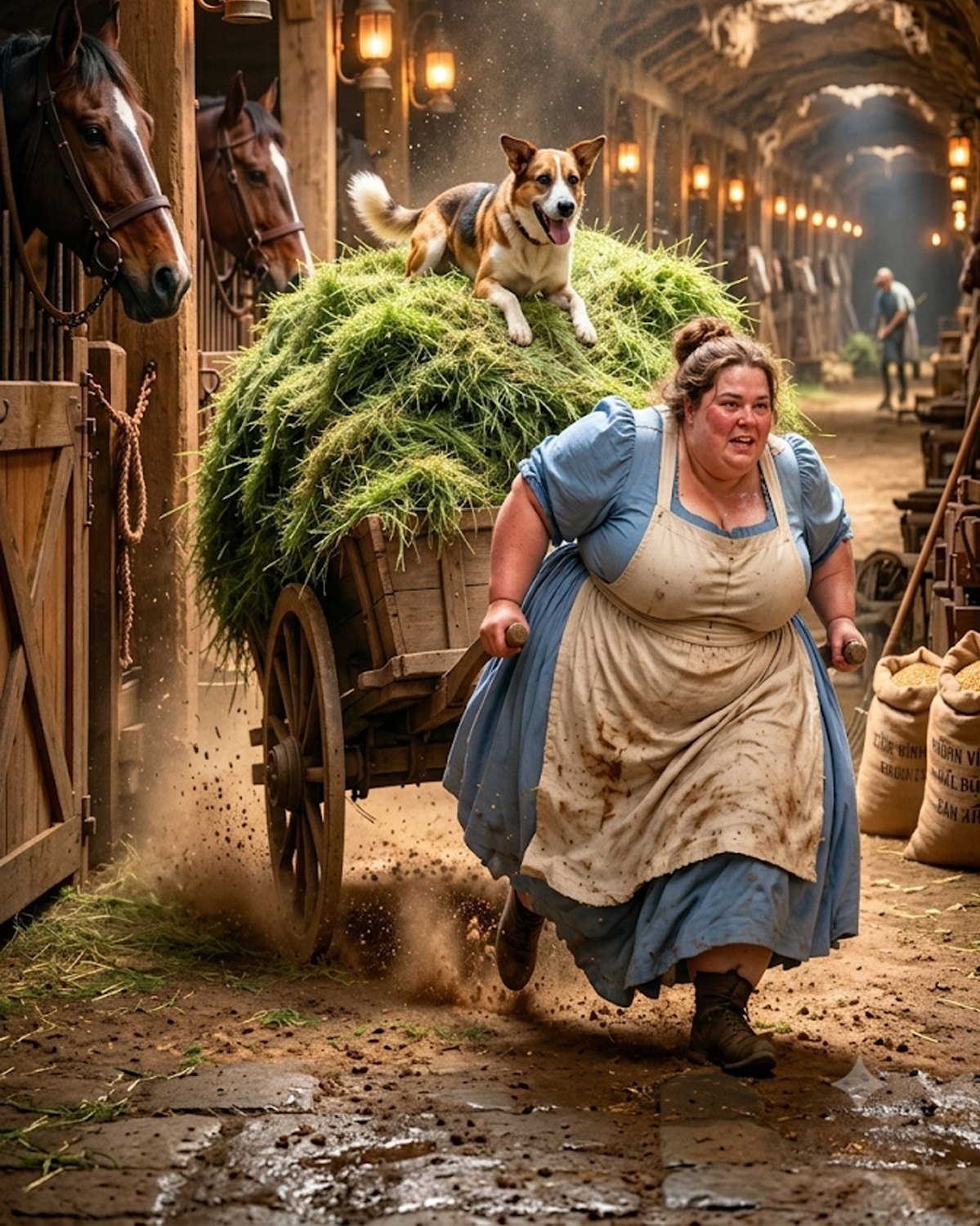
Delphine Whitlock drove her pickaxe into the hillside.
"Keep laughing. I'll finish before winter."
Orson Blackwell watched from his polished buggy, holding a loan agreement with a marked line beside the property's spring rights.
He hadn't come to help her.
The laughter from the ridge was loud enough to frighten the chickens.
Three men stood beside their wagons, watching a young woman attack a limestone hillside with a pickaxe. One slapped his knee. Another nearly dropped his tobacco pouch.
A third shouted, "Miss Whitlock, are you building a barn or digging a hole to bury yourself?"
Delphine stopped swinging.
She leaned against the wooden handle and wiped sweat from her forehead with the back of her wrist.
Her chestnut hair had escaped its braid. Red clay covered the front of her work dress, and her hands were beginning to blister.
She looked up at the men.
"Neither," she answered. "I'm building a place for my animals."
That only made them laugh harder.
The largest of the men pointed at the hillside.
"Nobody puts a livestock barn underground! What happens when the whole thing caves in? You'll have to dig your cows out with a teaspoon!"
Delphine glanced toward the excavation.
The opening was still rough. Timber supports had been positioned along the interior, and piles of limestone fragments lay beside the entrance.
It wasn't beautiful.
It wasn't finished.
But she knew what she was doing.
At least, she believed she did.
She picked up her pickaxe again.
The men eventually grew bored and drove away, still laughing.
Delphine waited until the sound of their wagons disappeared before allowing herself to sit on a flat stone.
Her back hurt.
Her shoulders burned.
There was dirt beneath her fingernails, and a small cut on her left palm had begun bleeding again.
She examined the wound.
Then she looked toward the unfinished chamber.
"One more section," she whispered.
She stood up.
There was no one else who would do it for her.
And she had less time than anyone realized.
Three months earlier, Delphine had buried her father.
Samuel Whitlock had been a quiet farmer, the kind of man who rarely raised his voice and never wasted words.
He had spent forty years working the same land.
He taught Delphine how to repair fences, recognize healthy soil, calculate feed requirements, and judge the condition of a horse by watching how it moved.
He had also taught her something that most people in Kettle Draw Valley refused to accept.
Being a woman did not make her less capable of understanding difficult things.
When Delphine was nine, he had taken her to her grandmother's old storage chamber built into a hillside.
The entrance had been hidden behind a wooden door and covered with earth.
Inside, the temperature remained surprisingly steady despite the summer heat outside.
Her grandmother stored potatoes, preserved vegetables, and other supplies there.
Delphine remembered placing her palm against the cool stone wall.
"Why is it colder in here?" she had asked.
Her grandmother had smiled.
"The earth protects what we build inside it, child. Never forget that."
Those words had remained with Delphine for twenty years.
They became particularly important after Samuel fell ill.
For nearly two years, she managed much of the farm herself.
She arranged feed deliveries, repaired damaged fencing, cared for the animals, and handled the accounts.
Some neighbors quietly acknowledged her work.
Others considered it temporary.
They assumed that once her father died, a male relative would take control.
Her cousin Harold Whitlock was particularly certain of that.
He arrived only a few weeks after the funeral.
Harold entered the farmhouse without waiting to be invited.
He was wearing a clean brown suit and carrying a leather document case.
Delphine was sitting at the kitchen table, reviewing her father's old account books.
She looked up when he placed several papers in front of her.
"What's this?"
"An offer for the farm."
She didn't touch the documents.
"Whose offer?"
"A buyer I know. A respectable man with enough money to settle the outstanding mortgage."
Delphine slowly closed the account book.
"And why would I sell?"
Harold pulled out a chair.
"Because you're alone."
She stared at him.
He continued before she could answer.
"The mortgage is still running. The equipment is old. The fencing needs work. You can't manage a farm like this indefinitely."
"I managed it while Father was sick."
"That was different."
"How?"
Harold shifted in his chair.
He seemed uncomfortable whenever she asked him to explain himself.
"People are going to talk, Delphine. A young woman running a farm alone isn't exactly practical."
"People have been talking since I was born."
"Don't make this difficult."
She looked at the papers again.
The proposed sale price was lower than the property's reasonable value.
Much lower.
She noticed that the buyer's name appeared on a separate document connected to Orson Blackwell's mercantile operation.
That made her suspicious.
"Who arranged this?"
"Orson knows people who can help."
"Orson Blackwell?"
"He's a businessman. He understands property."
Delphine pushed the documents back across the table.
"I don't want to sell."
Harold sighed.
"You're making an emotional decision."
"No. I'm making a financial one."
He stood.
"You'll regret this."
Delphine walked to the door and opened it.
"Get out of my house."
Harold stared at her as though he had never heard a woman speak to him that way.
Then he collected his papers and left.
She watched him walk down the path.
Only when he disappeared did she return to the kitchen.
Her father's notebook was still on the table.
She opened it.
Inside the front cover, Samuel had written a sentence in his careful handwriting:
Never let another person convince you that your inheritance is a burden simply because they want to own it.
Delphine ran her finger over the words.
She had made her decision.
She would sell the old farm herself.
She would keep what remained of her inheritance.
And she would find land where she could build something worth keeping.
The opportunity appeared in May.
A neglected property called Kettle Draw was being sold at a price Delphine could afford.
The land was not impressive.
The pasture was modest, the farmhouse weather-beaten, and the fences needed extensive repairs.
The water source was also disputed.
Still, Delphine noticed something interesting about the hillside behind the property.
Its upper surface was covered with sparse grass and low vegetation.
The eastern side contained a narrow strip where the grass remained unusually green.
She examined the ground carefully.
Then she walked around the slope, studying its shape.
The hillside contained a broad limestone shelf approximately eight feet beneath the surface.
She had seen something similar in her grandmother's old storage chamber.
The idea came to her gradually.
A conventional wooden barn would require expensive lumber, roofing, and constant repairs.
It would also expose her livestock to the full force of the winter winds.
But a structure built into the hillside could use the surrounding earth as natural insulation.
She could excavate a chamber, reinforce it with timber, install proper drainage, and create controlled ventilation.
It would require careful planning.
She would need advice.
She would need materials.
And she would have to work quickly.
But the basic idea was sound.
Delphine purchased Kettle Draw.
By the time she arrived in May, she had forty-three dollars remaining.
She also had two dairy cows, Clover and Ruth, an aging workhorse named Fletcher, and eleven chickens.
She unloaded her belongings beside the farmhouse.
Then she walked toward the hillside.
For several minutes, she stood quietly.
There was no crowd.
No laughter.
No one telling her what she couldn't do.
She placed her hand against the limestone.
It was cool.
She smiled faintly to herself, then immediately returned to work.
The first week was difficult.
Delphine had underestimated how much labor excavation would require.
The ground was harder than expected.
Some sections contained loose stones that had to be removed individually.
Other sections resisted every strike of her pickaxe.
She worked from sunrise until the light disappeared.
At night, she studied her father's notebook and drew construction diagrams by candlelight.
She calculated the dimensions of the chamber and marked the positions where timber supports would be needed.
She also made a list of materials.
The list was longer than her money could support.
She crossed out anything unnecessary.
She would use salvaged timber where possible.
She would purchase iron fittings only when absolutely necessary.
And she would do most of the labor herself.
The following Monday, she visited the general store.
The shopkeeper, Mr. Harlan, looked up as she entered.
"Morning, Miss Whitlock."
"Morning. I need timber, nails, and a few tools."
"What are you building?"
"A livestock barn."
He reached for his order book.
"Where?"
"Into the hillside behind my property."
His pencil stopped.
He looked at her.
"Into the hillside?"
"Yes."
"Underground?"
"Earth-sheltered. With reinforced timber supports and drainage."
Mr. Harlan stared for a moment.
Then he called toward the back of the store.
"Caleb! Come listen to this!"
A young clerk appeared.
When Harlan explained the project, Caleb laughed.
"That's a new one."
Delphine placed her measurements on the counter.
"I need these materials. Nothing more."
Harlan studied the list.
"You know, a proper wooden barn would be easier."
"I know."
"And safer."
"Not necessarily."
He raised his eyebrows.
Delphine collected her paper.
"Then I suppose we'll see."
She left the store without purchasing anything.
The next day, she returned with a smaller list and enough money for the first materials.
She wasn't going to waste time arguing with people who had already decided she was foolish.
The rumors spread faster than the construction.
At the dairy exchange, two farmers discussed her project while waiting for their deliveries.
At the blacksmith's shop, someone joked that Delphine would soon be keeping her cows in a cave.
At the general store, a customer claimed she had spent her entire inheritance on a hole in the ground.
Delphine heard the stories.
She ignored most of them.
But one morning, a polished buggy stopped outside her property.
The driver wore a dark coat and an expensive hat.
Orson Blackwell stepped down.
He was a tall, broad-shouldered man in his early fifties, with carefully combed dark hair and an immaculate appearance.
He controlled the mercantile, much of the valley's feed supply, and a considerable portion of the credit available to local farmers.
His influence extended far beyond his business.
When Blackwell offered advice, people listened.
When he refused credit, people struggled.
He approached Delphine with a pleasant smile.
"Miss Whitlock."
"Mr. Blackwell."
"I hear you're building something unusual."
"I'm building a barn."
He glanced toward the hillside.
"That much is obvious."
He chuckled.
Delphine waited.
Blackwell removed a folded document from his coat.
"I've been thinking about your situation. A young farmer needs reliable facilities. I could arrange a line of credit for a conventional wooden barn."
"Thank you, but I've already planned my construction."
He looked toward the excavation again.
"That hole?"
"That structure."
His smile tightened.
He explained that the loan could cover lumber, labor, and equipment.
The land would secure the debt.
She would have a proper barn before November.
Delphine examined the document.
The interest rate was high.
The repayment conditions were strict.
And one clause gave Blackwell considerable leverage over the property's water rights if she defaulted.
She looked up.
"I don't need the loan."
Blackwell's expression remained pleasant.
"Without that spring, this hillside is nothing but limestone and red clay."
Delphine felt something change.
He had emphasized the spring.
Not the livestock.
Not the construction.
The water.
She folded the document and handed it back.
"I'll manage."
Blackwell accepted it.
"Of course."
He placed it inside his coat.
Then he looked at her with a smile that no longer reached his eyes.
"Winter has a way of teaching people when they've made mistakes."
Delphine met his gaze.
"Then I suppose winter will teach us both something."
For a moment, neither spoke.
Finally, Blackwell returned to his buggy.
He climbed inside and drove away.
Delphine watched the vehicle disappear along the road.
Then she looked toward the hillside.
Something about his visit troubled her.
She couldn't yet explain what it was.
But she knew one thing.
Orson Blackwell had not come simply because he was curious about her barn.
And somewhere in his office, she suspected, there was already a plan involving her land.
She returned to the excavation.
The afternoon sun was beginning to disappear behind the ridge.
She lifted her pickaxe and struck the limestone.
Once.
Twice.
On the third strike, the ground gave a hollow sound.
Delphine stopped.
She knelt and brushed away the loose dirt.
A narrow crack had appeared beneath the stone.
She placed her palm against it.
Cool air moved through the opening.
Then she noticed something else.
The crack extended toward the eastern side of the hillside.
Toward the unusually green strip of vegetation she had noticed when she first purchased the property.
She reached for her father's notebook.
And as she opened it to check an old measurement, a loose sheet of paper slipped out.
It contained a sketch of the same hillside.
But Samuel had marked something she had never noticed before.
A small underground channel.
And beside it, in his handwriting, were four words:
DO NOT BLOCK THIS DRAINAGE.
Delphine stared at the page.
Then she looked toward the newly exposed crack.
Her father's warning suddenly made sense.
And she realized that the greatest danger to her underground barn might not be the weight of the earth above it.
It might be the water hidden beneath it.
Continue with all twelve chapters Make Delphine’s construction more believable






Comments 0