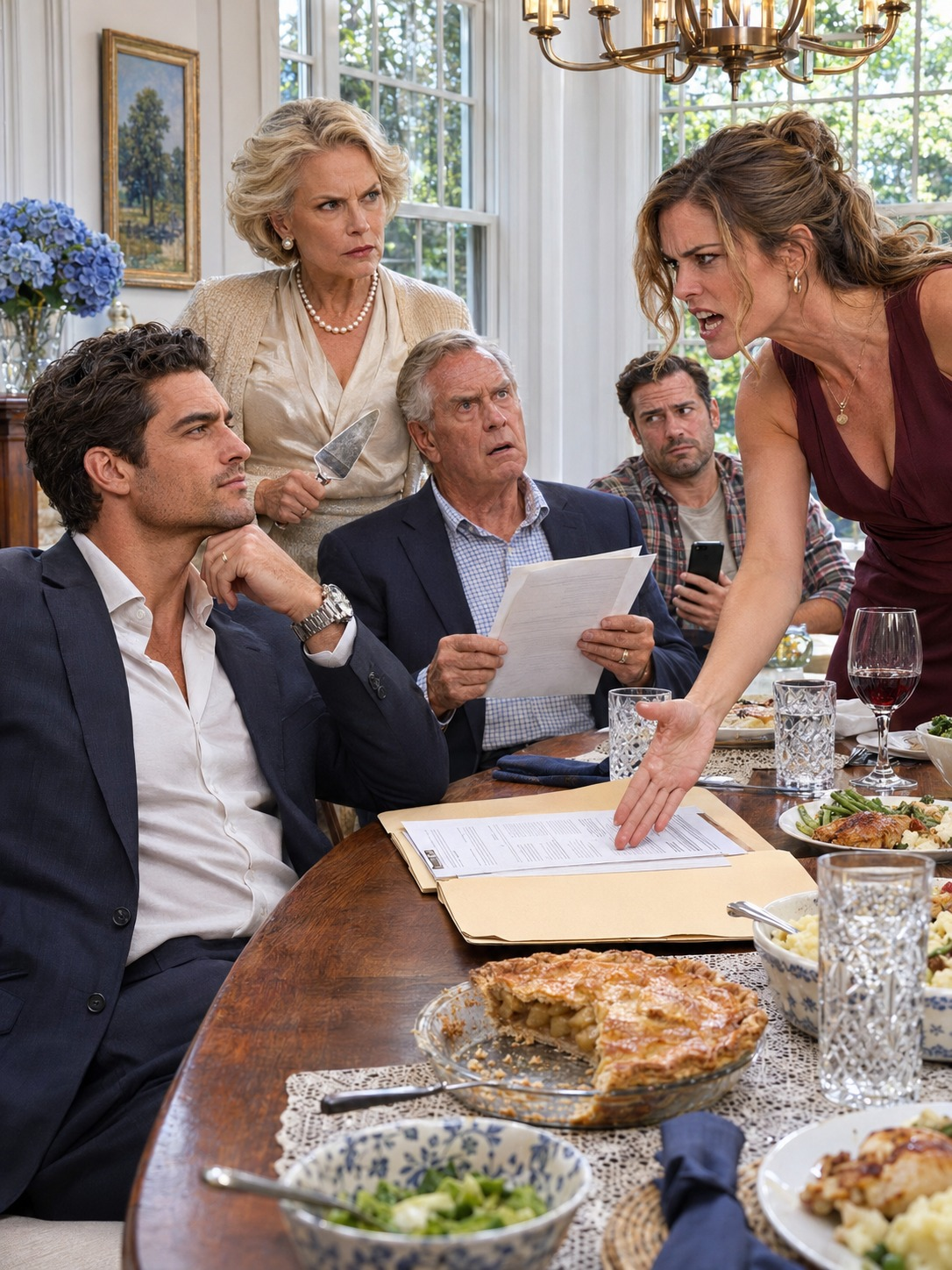
"Oliver doesn't know yet, but we've already decided he's staying with the children."
I read the handwritten sentence three times.
The photograph Darla had sent showed our printed flight itinerary lying on my parents' kitchen counter. My mother's handwriting stretched across the top margin in blue ink.
Beside it was a small handwritten note.
Darla's retreat: Saturday through Friday.
I stared at those words.
My mother hadn't misunderstood our departure date.
She hadn't forgotten our anniversary.
She had looked directly at our travel plans and decided they were less important than my sister's vacation.
And she'd made that decision without asking me.
My phone vibrated.
Another message from Darla.
Now you understand why everyone was so upset. Mom told me you'd take care of it.
I sat perfectly still.
For two days, I'd been trying to convince myself this was an unfortunate misunderstanding.
A scheduling problem.
A last-minute childcare emergency.
Something that had gotten out of hand because everyone was stressed.
But the photograph made that explanation difficult to believe.
My mother had known exactly what she was asking me to sacrifice.
And apparently, she'd promised my time to somebody else before I'd even heard about it.
The bathroom door opened.
Juniper stepped into the hotel room, drying her copper-red hair with a towel.
She took one look at my face.
"What happened?"
I handed her the phone.
She read the message.
Then enlarged the photograph.
Her expression changed.
Not dramatically.
Juniper wasn't someone who reacted to every unpleasant discovery with outrage.
But I knew her well enough to recognize the difference between surprise and disappointment.
This was disappointment.
Deep, exhausted disappointment.
"She wrote that on our itinerary?" Juniper asked.
I nodded.
"Looks like it."
"Before she called you?"
"Apparently."
Juniper looked at the photograph again.
"Oliver, your mother didn't ask you for help."
I swallowed.
"She decided I was helping."
"Exactly."
I looked toward the balcony.
Outside, the afternoon sunlight was beginning to soften over Athens.
People were walking below us, carrying shopping bags and talking over the noise of traffic.
Somewhere nearby, a church bell rang.
We were thousands of miles from home.
Yet somehow, my family's expectations had followed us into our hotel room.
I took the phone back.
Darla had sent another message.
You always help with the kids. Why would this time be different?
I stared at the screen.
That sentence bothered me almost as much as the photograph.
Because it revealed something I'd been refusing to acknowledge.
My sister hadn't thought she needed my permission.
She thought my history of saying yes meant she was entitled to another yes.
And when I refused, she treated it like a broken promise.
I typed a response.
Darla, I never agreed to watch your children. Mom had no right to promise that I would.
I read it twice.
Then sent it.
Her reply arrived almost immediately.
So now you're blaming Mom?
I exhaled.
I'm saying nobody asked me.
Three dots appeared.
Disappeared.
Appeared again.
Then:
You're unbelievable.
I set the phone down.
Juniper watched me.
"Are you going to keep answering?"
"No."
"Good."
I leaned back against the headboard.
For a moment, I wanted to call my mother.
I wanted to ask how she could look at an itinerary we'd spent two years planning and write something like that across the top.
I wanted to know whether she'd considered Juniper at all.
Whether she'd remembered the story about her grandmother.
Whether she'd thought about the money we'd saved.
But another part of me already knew what she'd say.
She'd tell me she was only trying to help Darla.
She'd say I was making too much of it.
She'd remind me that families made sacrifices.
And somehow, the conversation would end with me defending my decision to take my own wife on our anniversary vacation.
I was tired of defending it.
The next morning, Juniper woke before me.
When I opened my eyes, she was standing beside the balcony doors with a cup of coffee.
She had her travel journal tucked under one arm.
"Good morning," she said.
I checked the clock.
"You're up early."
"I couldn't sleep."
"Everything okay?"
She smiled.
"Everything's fine. I was just excited."
That made me smile too.
We had planned a full day exploring Athens before taking the ferry to Santorini.
Juniper wanted to visit a few small shops, find a bakery she'd read about, and spend the afternoon walking without a schedule.
It sounded perfect.
I got dressed.
We ate breakfast downstairs.
Then we stepped into the city.
For the first hour, I managed to forget about my phone.
We wandered through narrow streets lined with cafés and souvenir shops.
Juniper stopped to admire handmade jewelry.
I bought her a small silver pendant shaped like an olive branch.
She protested.
"Oliver, you don't have to buy me everything I look at."
"I know."
"Then why did you?"
"Because I wanted to."
She smiled.
"That's a dangerous habit."
I laughed.
For a moment, I felt like the man I'd been before every family gathering became an exercise in managing someone else's emotions.
We found a bakery and bought two pastries.
Juniper insisted hers was better.
I disagreed.
She made me taste it.
She was right.
We spent the next twenty minutes arguing playfully about whether I should admit defeat.
It was such a small thing.
Such an ordinary married-couple moment.
But it reminded me how much I'd missed being fully present with her.
Not physically present while worrying about somebody else's problem.
Actually present.
At lunch, we found a quiet restaurant with outdoor seating.
Juniper ordered a salad.
I ordered grilled chicken.
We shared bread and watched people pass.
Then she asked, "Have you thought about what you'll say to your mom when we get home?"
I set down my fork.
"A little."
"Want to talk about it?"
I considered the question.
"I don't think I want to argue about the trip anymore."
She nodded.
"That makes sense."
"I want her to understand that she can't volunteer me for things without asking."
"That's reasonable."
"And I want Darla to stop treating me like an emergency service."
Juniper smiled faintly.
"Also reasonable."
I looked at her.
"Do you think they'll understand?"
She took a sip of water.
"I think they'll hear you."
"That's not the same thing."
"No," she said. "It isn't."
I appreciated that she didn't offer false reassurance.
Juniper had always been honest with me, even when the truth was uncomfortable.
She didn't tell me my family would suddenly change because I'd finally stood up for myself.
She knew people didn't work that way.
Neither did I.
But I hoped something might be different.
That afternoon, we returned to the hotel to rest.
I had promised myself I wouldn't check my phone constantly.
But I also didn't want to disappear completely.
I had responsibilities at work, and I wanted to make sure there were no genuine emergencies at home.
So I turned it on.
The notifications appeared almost immediately.
More missed calls.
More messages.
The total number of missed calls since we'd left home had climbed beyond forty-three.
But those first forty-three had already become a symbol of something I couldn't ignore.
Forty-three attempts to make me change a decision I'd clearly communicated.
Forty-three calls while I was sitting beside my wife on an airplane.
Forty-three reminders that my family believed access to me should be unlimited.
I opened the newest messages.
Mom had written:
I hope you're proud of yourself. Your sister lost money she can't afford to lose.
Then:
Your father has barely slept because of this.
And finally:
Your grandmother would be ashamed of you.
I stopped reading.
My grandmother.
The words hit me harder than I'd expected.
My father's mother had died when I was twenty-eight.
She'd been a quiet woman with a dry sense of humor and a stubborn belief that people should keep their promises.
When I was a child, she used to take me fishing at a small lake outside town.
We'd sit together for hours.
Sometimes we caught something.
Sometimes we didn't.
She never seemed to care.
Once, when I was about ten, I asked her why she liked fishing so much.
She told me, "Because nobody can hurry a fish, and nobody can hurry me."
I remembered laughing.
She'd smiled and handed me another worm.
My grandmother had loved Darla too.
But unlike my parents, she hadn't always excused her behavior.
I remembered a Thanksgiving when Darla was seventeen.
She'd complained because Grandma hadn't made the dessert she wanted.
Grandma had looked at her across the table and said, "Sweetheart, disappointment won't kill you. You might even learn something from it."
Darla had stormed out.
Grandma had calmly continued eating.
That memory returned so clearly that I could almost hear her voice.
And now my mother was using her name to shame me.
I stared at the message.
Juniper looked up from her book.
"What is it?"
I handed her the phone.
She read the words.
Her expression softened.
"Oh, Oliver."
I looked away.
"She knows how much Grandma meant to me."
"I know."
"She knows."
Juniper moved closer.
"Your grandmother isn't here to speak for herself."
I nodded.
"And your mother doesn't get to decide what she'd think."
I swallowed.
For a long moment, I couldn't answer.
Then I said, "Grandma would've liked you."
Juniper smiled sadly.
"I wish I'd met her."
"She would've loved your stubbornness."
Juniper laughed.
"I'm not stubborn."
I raised an eyebrow.
She laughed again.
"Okay. Maybe a little."
I put the phone down.
But the message stayed with me.
Not because I believed my grandmother would be ashamed.
Because I couldn't understand why my mother was willing to use someone I'd loved so deeply as a weapon in an argument about babysitting.
That evening, Dad sent another message.
Don't bother coming to Thanksgiving.
I stared at it.
The holiday was still seven weeks away.
My father had always been proud of hosting Thanksgiving.
He carved the turkey.
Mom made the stuffing.
Darla brought a dessert she usually purchased from a bakery.
Juniper and I arrived early to help prepare everything.
For years, I'd handled the heavy lifting, set up extra chairs, carried serving dishes, and cleaned the kitchen afterward.
I had never minded.
At least, not until I started noticing that everyone else seemed to consider my help automatic.
Now Dad was threatening to exclude me.
I read the message again.
Then I thought about what Thanksgiving would look like without us.
Mom would still cook.
Dad would still carve the turkey.
Darla would still complain about something.
The children would still run through the house.
Life would continue.
And Juniper and I would be somewhere else.
Maybe at home.
Maybe with friends.
Maybe enjoying a quiet dinner together.
The thought didn't frighten me as much as I expected.
That surprised me.
For years, I'd been afraid of losing my place in the family.
But I was beginning to wonder whether that place had ever truly belonged to me.
Or whether it had been something I was expected to earn through constant service.
I didn't answer Dad's message.
Instead, I opened our travel itinerary.
The next morning, we were leaving for Santorini.
Juniper had been counting down to that day for two years.
I wasn't going to let another family argument steal it.
The following morning, we took the ferry.
Juniper stood beside me on the deck as Athens disappeared behind us.
The sea stretched toward the horizon.
She held the railing with both hands.
The wind lifted her hair.
She looked happier than I'd seen her in months.
"Can you believe we're doing this?" she asked.
I smiled.
"Not really."
She leaned against me.
"I keep thinking about Grandma."
I wrapped an arm around her shoulders.
"What do you think she'd say?"
Juniper looked out at the water.
"Probably that I should stop worrying about whether my hair looks terrible in the wind."
I laughed.
"Sounds like a smart woman."
"She was."
We stood together for a long time.
I didn't check my phone.
I didn't think about Darla's retreat.
I didn't wonder whether my parents were angry.
I watched the sea with my wife.
And for once, that was enough.
When Santorini finally appeared in the distance, Juniper gripped my arm.
"Oliver."
I followed her gaze.
White buildings climbed the cliffs.
The water was a deep blue.
The island looked almost unreal.
Juniper covered her mouth.
Her eyes filled with tears.
I didn't say anything.
I just held her.
She'd waited so long for this moment.
And I was grateful I'd been there to see it.
Our hotel overlooked the caldera.
From the terrace, we could see the sea stretching beneath the cliffs.
Juniper walked straight to the railing.
She stood there silently.
Then she took the old postcard from her bag.
She held it beside the view.
For a moment, she didn't move.
I watched her face.
The postcard had been a promise from someone who wasn't there anymore.
Now the promise had become real.
I took a photograph.
Juniper turned toward me.
"Did you get it?"
"Yeah."
"Can I see?"
I showed her.
She stared at the screen.
Then she began to cry.
Not loudly.
Not dramatically.
Just quiet tears slipping down her cheeks.
I put my arms around her.
She whispered, "I wish she could see this."
I held her tighter.
"I think she'd be proud of you."
Juniper pressed her face against my shoulder.
For several minutes, we stood together without speaking.
Then she wiped her eyes.
"I'm sorry."
I shook my head.
"Don't apologize."
She smiled.
"You're getting pretty good at saying that."
I laughed.
"Learning from the best."
That evening, we had dinner on a terrace overlooking the water.
The sun was setting.
The buildings glowed gold and pink.
Juniper wore the new sundress she'd bought before the trip.
She looked beautiful.
We ordered seafood and shared a dessert.
For most of the meal, we talked about the future.
Not my family's future.
Ours.
Juniper wanted to start taking one meaningful trip every year.
It didn't have to be expensive.
It didn't have to be far away.
She just wanted us to keep making memories.
I told her I wanted the same thing.
Then I admitted something I'd been thinking about for months.
"I've been considering pitching a new infrastructure project at work."
She looked interested.
"The one you mentioned last spring?"
I nodded.
"I've been putting it off."
"Why?"
I hesitated.
"Because it would mean more responsibility. Longer hours for a while. Maybe some travel."
Juniper tilted her head.
"And?"
"And I kept thinking somebody in the family would need me."
She looked at me for a long moment.
"Oliver, you can't build your entire life around emergencies that haven't happened yet."
I knew she was right.
The project could be a major step forward in my career.
I'd spent months developing the proposal.
But I'd hesitated because I was afraid of becoming less available.
Less useful.
Less dependable.
I looked out at the sea.
"Maybe I'll pitch it when we get home."
Juniper smiled.
"I think you should."
I reached across the table and took her hand.
For the first time in a long while, I felt excited about something that had nothing to do with solving somebody else's problem.
Later that night, we returned to our hotel.
Juniper went inside to change.
I stayed on the terrace.
The air was cool.
The lights from nearby buildings reflected on the water.
I took out my phone.
There were more messages.
I considered ignoring them.
Then I noticed one from my mother.
It had arrived only a few minutes earlier.
I don't know what Juniper has been telling you, but you've become a different person since you married her.
I stared at the screen.
Another message followed.
You used to care about your family.
I felt my jaw tighten.
My mother had criticized me before.
She'd called me selfish.
Ungrateful.
Disappointing.
But blaming Juniper was different.
My wife had never tried to separate me from my family.
She'd attended birthdays, holidays, school events, and family dinners.
She'd helped prepare meals.
Bought gifts.
Remembered anniversaries.
She'd encouraged me to support Darla when we could afford it.
And now my mother was treating her like the reason I'd stopped obeying.
I began typing.
Mom, Juniper has nothing to do with this. I made my own decision.
I paused.
Then added:
Please stop blaming my wife.
I sent it.
For several minutes, there was no response.
Then my phone rang.
Mom.
I stared at the screen.
I didn't want another argument.
But I also didn't want her to believe she could keep attacking Juniper without being challenged.
I answered.
"Mom."
Her voice was cold.
"So now I'm not allowed to have an opinion about my own son?"
"You're allowed to have an opinion."
"Apparently not."
"You're not allowed to blame Juniper for my decisions."
She made a sharp sound.
"Oliver, I know you. You've never been this selfish before."
I closed my eyes.
"Mom, I went on vacation."
"You abandoned your responsibilities."
"Your grandchildren are safe with you and Dad."
"That's not the point."
"Then what is the point?"
She hesitated.
Then said, "You embarrassed your sister."
I stared at the water.
"How?"
"She told people you were watching the children. She had everything arranged."
"Without asking me."
"She assumed you'd help."
"That was her mistake."
My mother went silent.
Then she said something I'd never heard her say before.
"Your sister has always needed more support than you."
I gripped the phone.
"Why?"
"Because she's had a harder life."
I almost laughed.
"Darla has a husband, three healthy children, and parents who help her constantly."
"That doesn't mean things are easy."
"I never said they were."
"Then why can't you show some compassion?"
I looked through the glass doors.
Juniper was inside, folding her dress carefully.
I watched her for a moment.
Then I said, "Mom, when was the last time you asked whether Juniper and I needed help?"
She didn't answer.
"When was the last time you asked how we were doing?"
"Oliver—"
"When was the last time you called without needing something?"
Her voice hardened.
"I will not be interrogated by my own son."
"I'm not interrogating you. I'm asking a question."
"Well, I don't appreciate your tone."
I took a breath.
"My tone is calm."
"You're being disrespectful."
"No, Mom. I'm disagreeing with you."
For several seconds, neither of us spoke.
Then she said, "Your father was right. You've changed."
I looked out at the sea.
"Maybe I needed to."
She hung up.
I lowered the phone.
My hands were trembling slightly.
Not from anger.
From the strange, unfamiliar feeling of having said exactly what I meant.
Juniper came outside a few minutes later.
She saw my expression.
"Your mom?"
I nodded.
"How bad?"
"She thinks you're turning me against the family."
Juniper looked down.
For a moment, she didn't speak.
Then she asked, "Do you believe that?"
"No."
She looked up.
"Not even a little?"
"Juny, you're the reason I've kept trying with them for so long."
Her eyes softened.
"You've always encouraged me to be patient. You've helped them more times than I can count."
She swallowed.
"I just don't want to be the reason you lose your family."
I stepped closer.
"You're not."
She looked at me.
"And I don't want you to think you have to choose between us."
I took her hands.
"I shouldn't have to."
She nodded.
"No. You shouldn't."
We stood together on the terrace.
The sea was dark beneath us.
Somewhere in the distance, music drifted from a restaurant.
For a moment, I felt peaceful.
Then my phone vibrated again.
I almost ignored it.
But the message wasn't from Mom.
It wasn't from Dad.
It was from Rowan.
My brother-in-law almost never contacted me directly.
Usually, Darla handled every request.
I opened the message.
Oliver, I need to tell you something about the retreat.
I frowned.
Another message appeared.
Darla doesn't know I'm contacting you.
I looked at Juniper.
"What is it?" she asked.
I didn't answer.
Three dots appeared beneath Rowan's name.
He was typing.
Then a photograph arrived.
It showed a payment confirmation from the retreat company.
I enlarged it.
The reservation date was visible.
So was the amount.
But what caught my attention was the line beneath the payment information.
The booking hadn't been made months earlier.
It had been made on Thursday.
The same Thursday we'd had dinner with my family.
The same night Darla had asked how much our trip cost.
I stared at the screen.
Then Rowan sent one final message.
There's something else. Look at who paid the deposit.






Comments 0