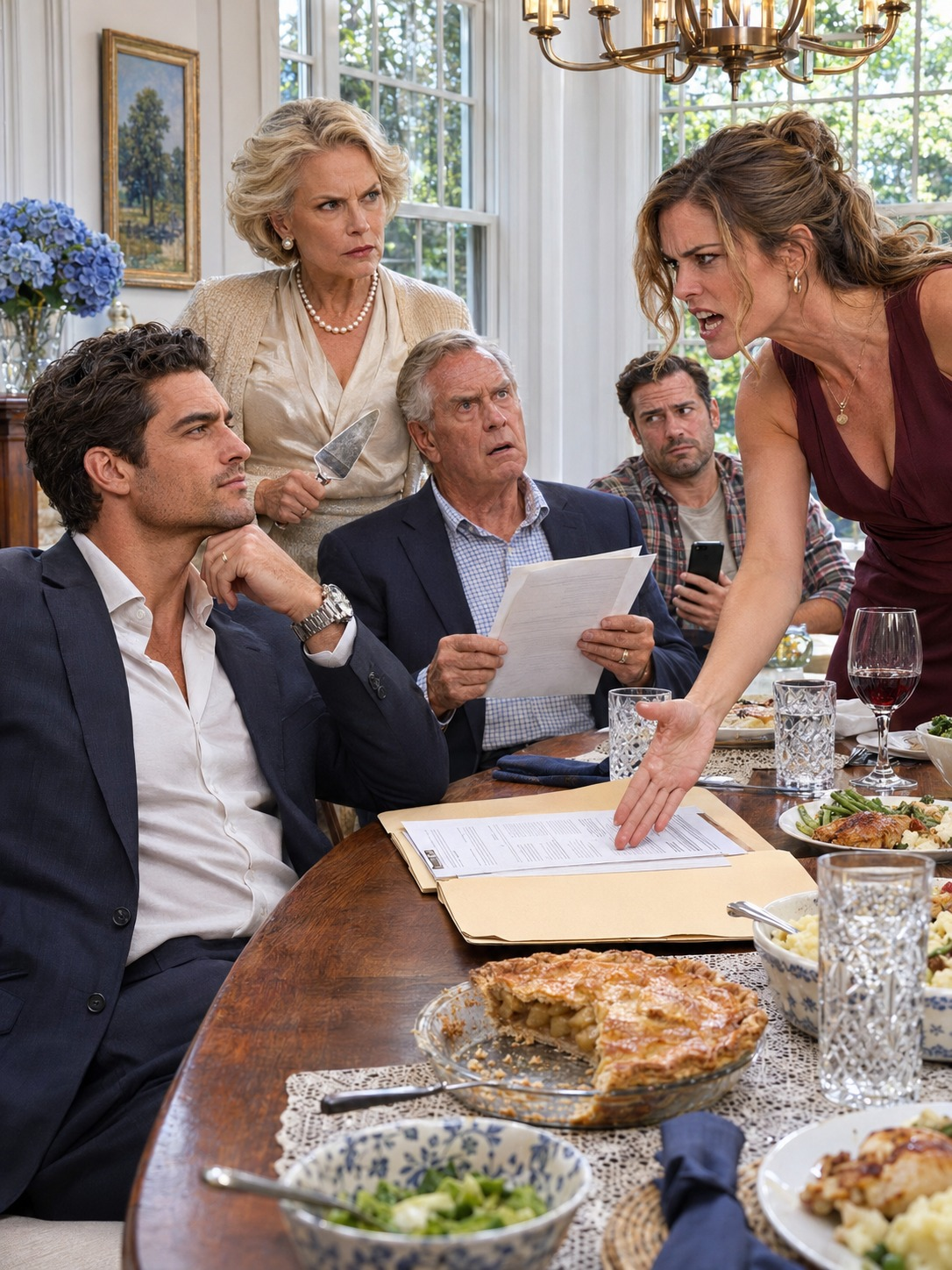
"She told us you had already promised to watch the children."
My father's words came through the phone so quietly that I almost thought I'd misheard him.
I sat upright on the edge of our hotel bed in Athens.
"What?"
"Darla said you agreed weeks ago. She said you knew about the retreat, that you'd offered to stay with the kids, and that you changed your mind at the last minute."
I stared at the wall.
Juniper stopped organizing our ferry tickets.
For a moment, neither of us moved.
Then I asked the only question that mattered.
"And you believed her?"
My father didn't answer.
That silence told me more than any explanation could have.
"Dad, I never promised anything like that."
"I know that now."
"How?"
He exhaled heavily.
"Because your mother mentioned the trip at dinner on Thursday. Darla was sitting right there. She knew you were leaving Saturday."
I rubbed my forehead.
"So why did you send me that message?"
"What message?"
"'Family comes first, Oliver.' Remember?"
Another silence.
Then he said, "I was trying to keep the peace."
I nearly laughed.
Keep the peace.
Those three words had cost me more than I cared to calculate.
For years, keeping the peace had meant lending money I couldn't afford to lose, changing plans I'd made months in advance, and swallowing insults because somebody else was having a difficult day.
And somehow, the person expected to keep that peace was always me.
"Dad," I said, "you threatened to exclude me from Thanksgiving."
He cleared his throat.
"Your mother was upset."
"That doesn't answer my question."
"I was upset too."
"Because I took my wife on our anniversary trip?"
"Because I thought you'd broken a promise to your sister."
"But you never asked me whether I'd made that promise."
He said nothing.
I looked at Juniper.
She was watching my face with the kind of concern that came from years of recognizing when my family was pulling me into another argument.
I turned on the speaker.
"Dad, Juniper's here. I'm putting you on speakerphone."
"All right."
I placed the phone on the bedside table.
Juniper sat beside me.
For several seconds, the only sound was traffic drifting through our open balcony door.
Then my father spoke.
"Look, Oliver, I'm not calling to start another fight."
"Then why are you calling?"
"Because I think things have gotten out of hand."
That was an understatement.
Forty-three missed calls.
Twenty-seven text messages.
A voicemail accusing me of abandoning children who were perfectly safe with their grandparents.
A photograph of my crying nephew.
And a Thanksgiving invitation revoked seven weeks before the holiday.
All because I hadn't canceled a vacation.
"What exactly has gotten out of hand?" I asked.
Dad hesitated.
"Your sister is very upset."
I closed my eyes.
Of course.
Even now, after admitting that Darla had misrepresented what happened, he was beginning with her feelings.
"Is she upset because she lost her retreat deposit?"
"That's part of it."
"What's the other part?"
"She feels like you've changed."
I looked at Juniper.
She raised her eyebrows slightly.
"Maybe I have," I said.
Dad sighed.
"That's what worries your mother."
Something inside me tightened.
"Why would that worry her?"
"Because you've always been close to your family."
"We're still family."
"You know what I mean."
"No, Dad. I don't think I do."
He sounded frustrated.
"You're making everything so difficult."
I leaned forward.
"How is taking a vacation difficult?"
"That's not what I'm saying."
"Then say what you mean."
My father went quiet.
I waited.
For once, I didn't rush to fill the silence.
Finally, he said, "We used to be able to count on you."
There it was.
Not we miss you.
Not we're sorry.
Not even we hope you're enjoying Greece.
We used to be able to count on you.
I stared at the phone.
"You can still count on me, Dad. But you can't count on me to cancel my life every time somebody else makes plans."
He didn't respond.
Juniper gently rested her hand over mine.
Then my father said something that surprised me.
"I suppose that's fair."
I looked up.
For a second, I thought we'd finally reached each other.
Then he added, "But you have to understand your sister's situation."
And just like that, we were back where we'd started.
My father had always been a man who believed in responsibility.
He worked for the same manufacturing company for thirty-eight years.
He rarely missed a day.
He paid his bills on time, kept his lawn immaculate, and believed a man's word should mean something.
Growing up, I admired him.
I wanted to be like him.
When I was fourteen, he taught me how to change the oil in his truck.
When I was sixteen, he helped me buy my first used car.
When I graduated from engineering school, he shook my hand and told me he was proud.
But there was another side to my father.
One I hadn't understood until I became an adult.
He hated conflict.
Especially conflict involving my mother and Darla.
My sister was five years older than me.
From the time we were children, she had a remarkable ability to turn ordinary disappointment into a family crisis.
If she didn't get invited to a birthday party, somebody had to call the other child's parents.
If she received a bad grade, the teacher was unfair.
If she lost something, somebody else must have moved it.
My mother responded to every problem as though Darla had been personally wronged by the universe.
Dad rarely challenged her.
He would simply look at me and say, "Oliver, be the bigger person."
At eight years old, I thought that meant being mature.
At seventeen, I thought it meant being kind.
At forty-two, I was beginning to realize it often meant accepting treatment nobody expected Darla to tolerate.
I remembered one Christmas when I was twelve.
Dad had bought me a model airplane kit.
It was expensive for our family at the time, and I'd been thrilled.
I spent the entire morning assembling it at the kitchen table.
Darla wanted to borrow the tiny paintbrushes.
I told her I needed them.
She complained to Mom.
Mom told me to share.
I explained that the brushes were part of the kit.
Darla grabbed them anyway.
When I protested, she knocked the unfinished airplane onto the floor.
One wing snapped off.
I remember staring at the broken pieces.
I was devastated.
Dad came into the kitchen after hearing the noise.
He looked at the airplane.
Then at Darla.
Then at me.
"Oliver, she's your sister. Don't make Christmas miserable over a toy."
Darla walked away.
I spent the afternoon trying to glue the wing back together.
Nobody asked her to apologize.
That memory had seemed small for years.
Just a childhood disagreement.
But sitting in Athens, listening to my father explain why I needed to understand Darla's feelings, I suddenly saw the same pattern.
The airplane had become a vacation.
The paintbrushes had become twenty-three thousand dollars.
And I was still being asked not to make things difficult.
"Dad," I said, "can I ask you something?"
"Go ahead."
"If Darla had saved for two years to take Rowan to Greece, would you have asked her to cancel so she could babysit somebody else's children?"
He hesitated.
"That's hypothetical."
"Answer it anyway."
"Every situation is different."
"Would you?"
He sighed.
"Probably not."
"Why?"
"Because Darla has three children and a lot on her plate."
I felt Juniper's hand tighten around mine.
"So because we don't have children, our time matters less?"
"That's not what I said."
"It's what you're telling me."
"Oliver, don't twist my words."
"I'm not twisting anything."
My voice was still calm, but my heart was beating harder.
I wasn't used to challenging my father.
Even as an adult, some part of me expected him to end every disagreement by declaring the discussion over.
But he couldn't send me to my room anymore.
He couldn't take away my car keys.
And he couldn't make me cancel a flight that had already landed.
"Dad, Juniper and I worked for two years to make this happen."
"I know."
"We saved twenty-three thousand dollars."
"I know that too."
"Then why did everyone act like it was disposable?"
He didn't answer.
I continued.
"Do you know what Juniper gave up to save that money?"
"Oliver—"
"She worked extra shifts. She stopped buying things she wanted. We postponed replacing our furniture. We skipped weekends away. We did all of that because this trip mattered to us."
"I understand."
"No, I don't think you do."
My father fell silent.
I looked at Juniper.
She was staring at the floor.
I could tell she was trying not to become emotional.
"Juny's grandmother dreamed of taking her to Santorini," I said. "She died before they could go. This trip isn't just some expensive vacation. It means something."
Dad cleared his throat.
"I didn't realize it was that important."
That hurt.
Because we'd told him.
Repeatedly.
He'd heard the story.
He'd seen the postcard.
He'd watched us save.
But somehow, he hadn't considered it important enough to remember when Darla needed something.
"That's the problem," I said quietly.
"What is?"
"You didn't think you needed to understand."
For a while, neither of us spoke.
I could hear a television playing somewhere in my parents' house.
Then Dad said, "Your mother thinks you've been pulling away from us."
I looked at Juniper.
She gave a small shake of her head.
Not telling me what to say.
Just reminding me that I didn't have to defend every decision.
"Maybe I have been," I admitted.
Dad sounded genuinely surprised.
"Why?"
I almost didn't know where to begin.
There had been so many little things.
The birthday dinners interrupted by emergency calls.
The weekends spent repairing Rowan's mistakes.
The loans that were never repaid.
The holidays when Juniper and I were expected to accommodate everyone else's schedules.
The way Darla could insult my wife and somehow I was the one expected to apologize for making the atmosphere uncomfortable.
I thought about the thousand dollars we'd given Rowan two years earlier.
Then the dental bills we'd helped cover when his insurance lapsed.
Then the weekends I'd spent babysitting while Darla attended events she described as essential.
I had never kept a formal list.
I didn't want to.
Love wasn't supposed to be a ledger.
But somewhere along the way, my family had begun treating my generosity as a permanent resource.
And I'd allowed it.
"Dad, when was the last time you called just to ask how I was doing?"
He didn't answer immediately.
"What do you mean?"
"I mean exactly that. When was the last time you called because you wanted to know how work was going? Or how Juny was doing? Or whether we needed anything?"
"Of course I care about those things."
"I know you care. I'm asking when you last asked."
Silence.
Then he said, "I suppose it's been a while."
I swallowed.
"Yeah."
For the first time during the conversation, my father sounded tired rather than angry.
"Oliver, I never meant to make you feel that way."
"I believe you."
And I did.
That was part of what made the situation so difficult.
I didn't think my father woke up every morning planning to hurt me.
I didn't think my mother consciously decided that Darla deserved more love.
I thought they'd spent so many years responding to my sister's crises that they'd forgotten I had needs of my own.
And because I rarely complained, they assumed I was fine.
But being quiet wasn't the same as being fine.
Juniper stood and walked toward the balcony.
She wanted to give me space.
I watched her open the glass door.
The warm afternoon air moved the curtains.
Then Dad spoke again.
"Your mother wants you to call Darla."
I almost smiled.
"Why?"
"To clear the air."
"Does Darla want to apologize?"
He hesitated.
"I don't think she's ready for that."
"Then what exactly am I supposed to say?"
"Maybe you could explain that you understand why she was upset."
"I do understand why she was upset. She lost money on a retreat."
"Oliver."
"But that doesn't make me responsible."
"Nobody's saying you're responsible for everything."
I looked at the phone.
"Dad, she sent me a picture of her crying child and told me I caused it."
He sighed.
"I didn't know about that."
"She did."
"That wasn't right."
"No, it wasn't."
Another silence.
Then Dad said, "I'll talk to her."
I wanted to believe him.
But I'd heard those words before.
Usually, talking to Darla meant asking her to calm down.
Then asking me to apologize so everyone could move on.
This time, I wasn't interested in moving on without changing anything.
"Dad, I don't want another argument. I'm here with my wife. We're celebrating our anniversary. We'll be home in two weeks."
"I understand."
"I'll talk to everyone when we get back."
"All right."
"And please don't involve the kids in this."
His voice softened.
"You're right about that."
I nodded, even though he couldn't see me.
For a moment, I thought the conversation was finally ending.
Then he said, "One more thing."
I waited.
"Your mother doesn't know I'm calling you."
I frowned.
"Why not?"
"Because she's still very upset."
"So?"
"So she thinks I should wait until you're ready to apologize."
I stared at the phone.
"Dad, I'm not apologizing for going on vacation."
"I know."
"Do you?"
He took a breath.
"Yes, son. I do."
I wanted to believe him.
But I also knew how quickly his position could change once my mother became upset.
"Then tell her that."
He didn't answer.
And that silence felt painfully familiar.
After we ended the call, I sat on the bed for several minutes.
Juniper came back inside.
"How do you feel?"
I thought about it.
"Exhausted."
She sat beside me.
"That makes sense."
"I don't understand why this has to be so complicated."
She rested her head on my shoulder.
"Because you're changing something they've depended on for a long time."
I looked at her.
"What?"
"The version of you who always says yes."
I stared at the floor.
She continued.
"They know how to deal with that Oliver. They know what makes him feel guilty. They know he'll eventually apologize. But they don't know what to do when he says no and means it."
I let that settle.
Then I asked, "Do you think I'm being too hard on them?"
Juniper considered the question.
"No."
"Not even a little?"
"I think you're being honest with them in a way you haven't been honest before."
I looked toward the balcony.
Outside, the city was moving through an ordinary afternoon.
People were working.
Shopping.
Eating lunch.
Living their lives.
Nobody out there knew that a man in a hotel room was struggling to accept that his family's disappointment didn't have to control him.
"I don't want to lose them," I admitted.
Juniper took my hand.
"Setting a boundary isn't the same as ending a relationship."
"What if they decide it is?"
Her expression softened.
"Then that's a decision they'll have to make."
I swallowed.
She leaned closer.
"But you don't have to make it for them."
We spent the rest of the afternoon exploring a neighborhood filled with small shops and outdoor cafés.
Juniper bought a handmade ceramic bowl.
I found a leather notebook I wanted to use for work.
We stopped for coffee and shared a pastry.
For a few hours, I managed to stop thinking about my family.
Then, while we were walking back toward the hotel, Juniper asked a question.
"Did your dad say anything about why Darla thought you had agreed to babysit?"
I frowned.
"Not really."
"Did he ask her?"
"He said she told them I'd promised."
Juniper looked thoughtful.
"That's strange."
"Why?"
"Because she knew about our trip."
"I know."
"And she knew we were leaving Saturday."
"Right."
"So why would she tell your parents you'd agreed to stay with the kids?"
I stopped walking.
Until that moment, I'd been focused on the unfairness of the demand.
But Juniper was asking something different.
Not why Darla wanted me to cancel.
Why she'd claimed I had already agreed.
"I don't know," I said.
Juniper looked at me carefully.
"Maybe she thought if your parents believed you'd broken a promise, they'd pressure you harder."
I considered that.
It was possible.
Painfully possible.
But I didn't want to accuse my sister of deliberately lying without hearing her explanation.
"Maybe it was a misunderstanding," I said.
Juniper nodded.
"Maybe."
But her expression told me she wasn't convinced.
Neither was I.
That evening, we returned to our hotel.
Juniper took a shower while I sat at the small desk near the window.
I opened my travel journal.
I hadn't written anything since we'd arrived.
For several minutes, I stared at the blank page.
Then I wrote:
Day Two. Athens.
Underneath, I added:
I spent most of my life thinking love meant never disappointing anyone.
I stopped.
Read the sentence.
Then continued.
Maybe love also means being honest about what you can give.
I closed the journal.
For the first time since the trip began, I felt a little lighter.
My father had acknowledged that Darla was wrong about the promise.
He had admitted that the picture of my nephew was inappropriate.
He had even agreed that I shouldn't have been expected to cancel.
Those were small things.
But they were more than I'd expected.
I wanted to believe they meant something.
Then my phone lit up.
A new message from Mom.
Your father told me what you said.
I stared at the screen.
Another message arrived.
I can't believe you accused us of treating you unfairly after everything we've done for you.
I sighed.
Before I could decide whether to respond, a third message appeared.
And don't think Juniper has nothing to do with this. You've changed ever since you married her.
My stomach tightened.
There it was.
The accusation I'd feared for years.
My mother was no longer simply angry with me.
She was blaming my wife.
I looked toward the bathroom.
Water was still running.
Juniper was humming softly.
She had no idea what my mother had just written.
I read the message again.
Then another notification appeared.
This one wasn't from Mom.
It was from Darla.
You want to know why I told them you'd agreed? Fine. I'll tell you exactly what happened.
I stared at the words.
Three dots appeared beneath her name.
She was typing.
Then the dots disappeared.
A photograph arrived instead.
It showed a printed itinerary lying on my parents' kitchen counter.
Our flight details.
Our hotel reservations.
Our departure date.
And across the top of the page, in handwriting I recognized immediately, someone had written a single sentence.
I enlarged the photograph.
The handwriting belonged to my mother.
And the sentence began:
Oliver doesn't know yet, but we've already decided—






Comments 0