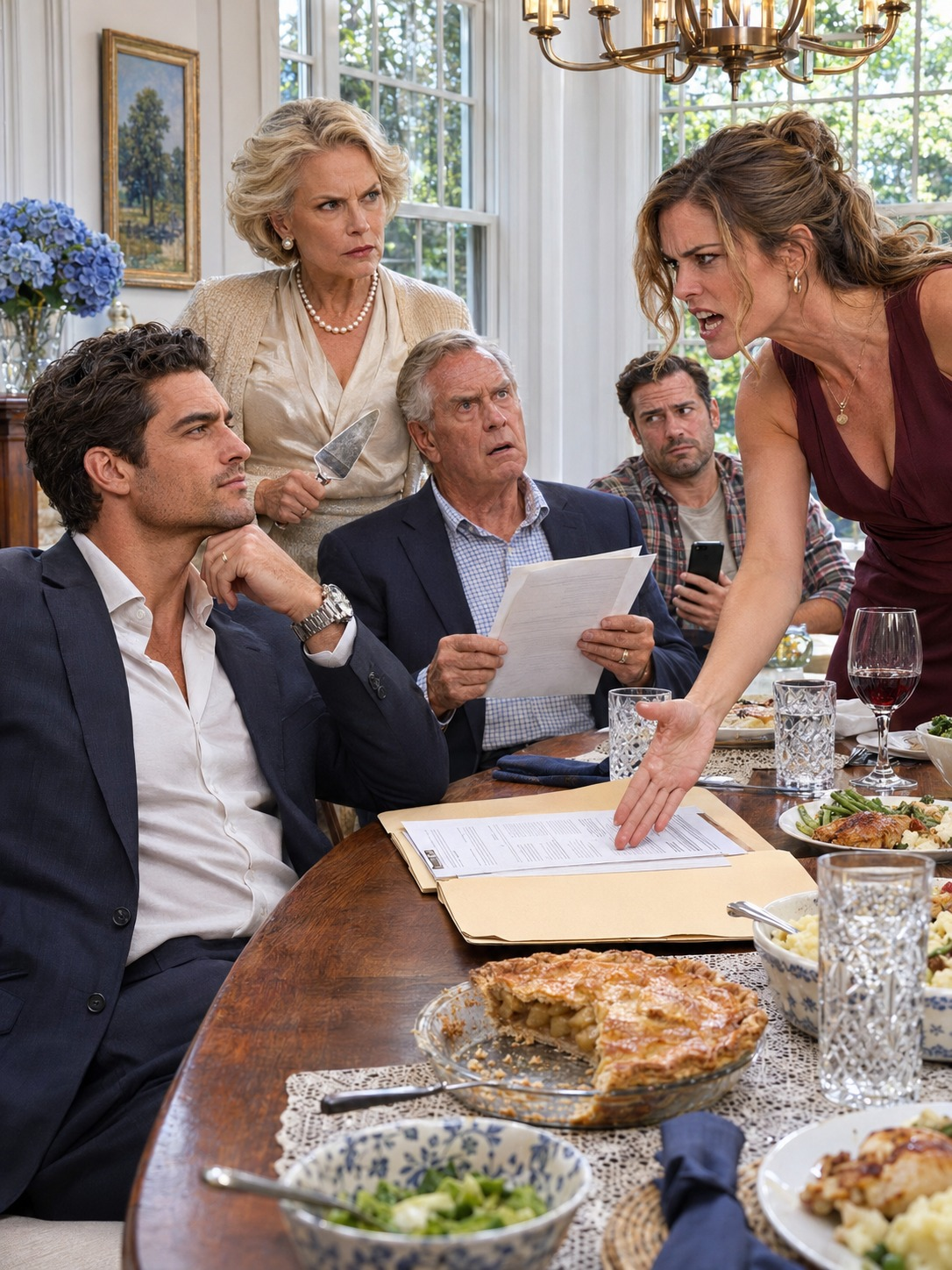
The name was Arthur Bennett.
My father.
For several seconds, I couldn't move.
I stared at the lender's final determination letter, reading the same sentence over and over.
Our investigation identified Arthur Bennett as the individual who electronically confirmed the accuracy of the submitted guarantor information after the initial application was received.
I looked up.
Dad was sitting across from me, his hands trembling.
Mom had turned away.
Juniper leaned closer, trying to read the document.
"Oliver?" she whispered.
I swallowed.
"Dad?"
He closed his eyes.
I felt something tighten inside my chest.
"Did you know?"
He didn't answer immediately.
"Dad, did you know Rowan used my name?"
He opened his eyes.
"Not when the loan was first submitted."
I stared at him.
"Then what does this mean?"
He looked at the letter.
"I found out afterward."
The room went silent.
I felt Juniper's hand settle gently against my back.
"When?" I asked.
Dad swallowed.
"August."
I stared at him.
August.
Before our anniversary trip.
Before the forty-three missed calls.
Before the twenty-five-thousand-dollar demand.
Before all the arguments about family loyalty.
"You knew in August?"
He nodded.
My voice came out barely above a whisper.
"And you didn't tell me?"
Dad looked down.
"No."
I leaned back.
For weeks, I'd believed my father was simply caught between his wife, his daughter, and a financial crisis he hadn't created.
He'd apologized.
He'd admitted he'd been unfair.
He'd even told me Grandma would have been proud of me.
But now I understood there was something he'd kept hidden.
Something that changed the meaning of every conversation we'd had.
"Explain it," I said.
Dad rubbed his face.
"When the lender called about the application, they asked whether I knew you were listed as a guarantor."
I stared at him.
"And?"
"I said yes."
My stomach dropped.
"Why?"
He looked at Mom.
Then back at me.
"Because Rowan told me you'd agreed to help if the business got into trouble."
I shook my head.
"I never agreed to anything."
"I know that now."
I leaned forward.
"Dad, you knew I hadn't signed anything."
He swallowed.
"I suspected."
The word hurt more than I expected.
Suspected.
He had suspected someone was using my name without permission.
And instead of calling me, he'd confirmed information to the lender.
"Did you sign my name?"
"No."
"Did you prepare the guarantee?"
"No."
"Then why did you confirm it?"
Dad's eyes filled.
"Because I thought if the loan went through, Rowan could save the business. Darla could keep her home. Your mother would stop worrying."
I stared at him.
"And what about me?"
He lowered his head.
That silence answered everything.
I stood and walked toward the window.
Outside, Christmas lights glowed across the neighboring houses.
Families were gathering.
Children were laughing somewhere down the street.
And inside my parents' kitchen, I was discovering how far my father had been willing to go to avoid disappointing my sister.
Juniper approached quietly.
She didn't tell me to calm down.
She simply stood beside me.
After a moment, I turned back.
"Dad, I need you to understand what you did."
He nodded.
"You didn't just make a bad decision about money."
"I know."
"You confirmed something about me without asking me."
His face crumpled.
"Yes."
"And then you asked me to pay twenty-five thousand dollars to solve the problem."
He began crying.
"I'm sorry, Oliver."
I looked at him.
For the first time, I didn't rush to make him feel better.
Mom reached for the letter.
"Arthur, tell him the rest."
Dad looked up.
I frowned.
"What rest?"
He wiped his face.
"The lender contacted me again after you disputed the documents."
I stared at him.
"And?"
"I told them everything."
He looked at the letter.
"I admitted that I had confirmed the guarantor information without speaking to you. I gave them the emails Rowan sent me. I told them you never authorized me to act on your behalf."
I looked down at the document.
The next paragraph explained that the lender had identified multiple failures in its verification process.
Rowan had submitted the unauthorized signatures.
Mom's email account had been used to transmit the forged estate authorization.
And Dad had falsely confirmed information he hadn't verified.
But the investigation also concluded that I had never signed, authorized, or ratified the guarantee.
The lender had withdrawn its claim that I was personally responsible.
I read the sentence aloud.
"Oliver Bennett has no contractual obligation arising from the disputed guarantee."
My voice shook.
Juniper squeezed my hand.
I read it again.
Then I looked at Dad.
"So I'm clear?"
He nodded.
"Yes."
I turned another page.
There was a formal release.
A confirmation that the lender would correct any inaccurate reporting connected to the disputed guarantee.
And a statement that the original loan remained the responsibility of the actual borrowers and property owners, subject to their separate arrangements.
I felt my knees weaken.
For months, I'd carried the fear that someone else's dishonesty might follow me for years.
Now, finally, I had written confirmation that the debt wasn't mine.
Juniper wrapped her arms around me.
I held her tightly.
And for a moment, I couldn't speak.
When I sat down again, Dad looked at me.
"I don't expect you to forgive me tonight."
I studied his face.
"Good."
He nodded.
"I deserve that."
I took a breath.
"Dad, I love you."
His eyes filled.
"But love doesn't mean I can pretend this didn't happen."
"I know."
I looked at Mom.
"And I need both of you to understand that I won't be lending the twenty-five thousand dollars."
She nodded immediately.
"We know."
I turned back to Dad.
"The offer is withdrawn."
He lowered his head.
"Understood."
"No more negotiations. No more emergency meetings. No more asking Juniper and me to rescue Darla and Rowan."
Dad nodded.
"Agreed."
I studied him.
"And if you ever find out someone is using my name again, you tell me immediately."
He looked directly at me.
"I will."
I wanted to believe him.
But trust would have to be rebuilt through actions.
Not promises.
Mom pushed the wooden box toward me.
"Oliver, there's still something I want you to have."
I looked at the envelope.
My name was written across the front in Grandma's familiar handwriting.
I opened it carefully.
Inside was a small photograph.
Grandma and me.
I couldn't have been older than ten.
We were standing beside a lake, holding fishing rods.
I was smiling so widely that my eyes had almost disappeared.
Behind the photograph was a short handwritten note.
My dear Oliver,
You were always happiest when you were curious about the world. Never let anyone convince you that your life must be smaller to make theirs easier.
Love, Grandma.
I stared at the words.
They were simple.
No elaborate instructions.
No dramatic revelations.
Just a reminder from someone who had loved me without demanding that I earn it.
I looked at the photograph.
Then at the framed picture of Grandma on the shelf.
My throat tightened.
"Thank you," I whispered.
Mom wiped her eyes.
"She loved you so much."
I nodded.
"I know."
For the first time that evening, I smiled.
Christmas came quietly.
Juniper and I spent Christmas Eve at home.
We cooked dinner together.
Watched an old movie.
And exchanged small gifts beside the tree.
I gave her a new camera lens she'd been saving for.
She stared at the box.
"Oliver!"
I laughed.
"Merry Christmas."
She threw her arms around me.
Then handed me a small package.
Inside was a framed photograph she'd taken in Santorini.
It showed us standing beside a white wall overlooking the blue water.
Juniper was laughing.
I had one arm around her waist.
Neither of us was looking at the camera.
We were looking at each other.
Beneath the photograph, she'd written:
The life we chose.
I stared at it.
Then looked at her.
"It's perfect."
She smiled.
"I thought you'd like it."
I kissed her.
And for a long moment, we stood together beneath the Christmas lights.
No ringing phones.
No demands.
No arguments.
Just us.
Over the following months, the remaining problems were resolved one by one.
The rental property sold in February.
The final price was lower than my parents had hoped, but high enough to repay the secured loan, outstanding fees, and selling expenses.
Dad called me after the closing.
"It's done," he said.
I sat at my desk.
"How do you feel?"
He sighed.
"Relieved. Sad. A little embarrassed."
I smiled faintly.
"That sounds understandable."
He was quiet.
Then said, "Your mother and I are going to be okay."
I closed my eyes.
"I'm glad."
"And Oliver?"
"Yeah?"
"Thank you for not giving us the money."
I blinked.
"What?"
Dad gave a small laugh.
"I know that sounds strange."
I waited.
"But if you'd paid, we probably would've kept pretending everything was fine."
I looked toward the window.
He continued.
"We needed to make our own decision."
I swallowed.
"Yeah."
Dad sighed.
"We should've done it years ago."
Rowan's situation took longer.
His business was closed.
He worked with his attorney and the lender to resolve the unauthorized documents.
The lender referred its findings to the appropriate authorities, and Rowan eventually accepted responsibility through a negotiated legal resolution.
He was required to complete community service, pay financial penalties, and comply with a restitution arrangement connected to the losses caused by his actions.
The process was difficult.
It was embarrassing.
And it was expensive.
But he stopped blaming everyone else.
He found steady employment with a construction company.
The work was less glamorous than running his own business.
The paycheck was smaller.
But it arrived regularly.
Darla and Rowan moved into a modest rented townhouse.
Their children adjusted more easily than the adults expected.
The youngest loved the small backyard.
The middle child made friends with the neighbors.
And the oldest was excited to have a bedroom she could decorate herself.
One afternoon, Darla sent me a photograph.
The children were sitting on the living room floor, surrounded by cardboard boxes.
They were laughing.
Beneath the picture, she'd written:
They're happy. I think we're going to be okay.
I stared at the message.
Then replied:
I'm glad. Give them a hug from Uncle Oliver.
For once, the conversation ended there.
No request.
No guilt.
No emergency.
Darla also withdrew the threatened legal claim.
Her attorney sent Evelyn written confirmation that she would not pursue it.
There was no dramatic courtroom confrontation.
No public humiliation.
Just a document confirming that the accusations against me were being abandoned.
Evelyn called with the news.
"Oliver, that matter is closed."
I leaned back in my chair.
"Thank you."
She laughed softly.
"You're welcome."
I hesitated.
"Can I ask you something?"
"Of course."
"Do you think I handled this badly?"
She was quiet for a moment.
Then said, "I think you tried very hard to protect people who weren't always protecting you."
I looked down.
"And I think you eventually learned to protect yourself."
I smiled faintly.
"That sounds about right."
Spring arrived.
My project at work moved forward successfully.
I was promoted to senior project lead.
The announcement came on a Thursday afternoon.
I called Juniper immediately.
She answered on the second ring.
"Hey!"
"Guess what?"
"What?"
"I got it."
There was a pause.
Then she screamed.
"OLIVER!"
I laughed.
She was already talking about dinner reservations.
Champagne.
A celebration.
I stood by the office window, smiling like an idiot.
For years, I'd measured my usefulness by how many problems I could solve for other people.
Now I was learning to celebrate my own achievements without feeling guilty.
That evening, Juniper met me at our favorite restaurant.
She wore the silver pendant from Greece.
I wore the watch she'd given me for our fifth anniversary.
We ordered dessert before dinner.
Because we could.
And because nobody was there to tell us we were being irresponsible.
My relationship with my parents changed slowly.
Not overnight.
Not because of one apology.
But through small, consistent choices.
Dad stopped calling me whenever Darla had a problem.
Mom stopped asking me to change plans at the last minute.
When Juniper and I said we couldn't attend a family gathering, they accepted it.
When we visited, they asked about our lives.
Not just our availability.
One Sunday afternoon, Dad invited me fishing.
Just the two of us.
We drove to the same lake Grandma used to take me to.
The water was calm.
The air smelled of pine.
For a while, we didn't speak.
Then Dad said, "I've been thinking about your grandmother."
I smiled.
"Me too."
He looked across the water.
"She used to tell me I was too afraid of conflict."
I laughed softly.
"That sounds like Grandma."
He nodded.
"She said avoiding an argument today often creates a bigger one tomorrow."
I looked at him.
"She was right."
Dad smiled sadly.
"She usually was."
We sat quietly.
Then he turned toward me.
"Oliver, I'm proud of you."
My throat tightened.
"Thanks, Dad."
He shook his head.
"No. I mean it."
I looked at him.
"I'm proud of the man you've become. And I'm sorry I made you feel like being a good son meant never saying no."
I swallowed.
For years, I'd wanted those words.
Now that I had them, I didn't need to argue.
I simply nodded.
Then cast my fishing line into the water.
Darla's apology took longer to become something I could trust.
She called occasionally.
Sometimes we talked for ten minutes.
Sometimes longer.
She asked about my work.
About Juniper's photography.
About our plans.
And she gradually stopped turning every conversation toward herself.
One Saturday, she invited us to the children's school performance.
Juniper and I went.
We sat in the third row.
The youngest spotted us from the stage and waved enthusiastically.
I waved back.
Afterward, Darla approached us.
She looked nervous.
"Thank you for coming."
I smiled.
"Wouldn't have missed it."
She glanced at Juniper.
Then took a breath.
"Juniper, I owe you a proper apology."
My wife looked at her.
Darla continued.
"I blamed you for things that weren't your fault. I said you weren't family. And I treated you like you were taking something away from me."
Juniper remained quiet.
Darla swallowed.
"You weren't."
My throat tightened.
She looked at me.
"Oliver was building a life with you. I should've been happy for him."
Juniper smiled gently.
"Thank you, Darla."
My sister nodded.
Then she asked, "Could we start over?"
Juniper considered the question.
"We can start from here."
Darla smiled through tears.
"I'd like that."
I looked at them.
And for the first time, I believed we might eventually have something healthier than the relationship we'd left behind.
Our eighth wedding anniversary arrived in September.
Juniper and I decided not to take another expensive international trip.
Not because we couldn't afford one.
But because we wanted something different.
We rented a small cottage beside a quiet lake for a week.
There was a wooden porch.
A fireplace.
A little kitchen.
And a view of the water.
Juniper brought her camera.
I brought a stack of books.
We cooked together.
Walked along the shoreline.
Watched the sunset.
And spent entire afternoons doing absolutely nothing.
On our anniversary evening, we sat outside beneath a blanket.
The sky was filled with stars.
Juniper leaned against my shoulder.
"Do you ever think about last year?"
I smiled faintly.
"Sometimes."
"The Greece trip?"
"All of it."
She nodded.
"Me too."
I looked at the water.
"I used to think the worst thing that could happen was disappointing my family."
Juniper turned toward me.
"And now?"
I considered the question.
"Now I think the worst thing would've been spending the rest of my life disappointing myself."
She smiled.
Then rested her head against my shoulder.
I kissed her hair.
"Thank you," I whispered.
She looked up.
"For what?"
"For standing beside me."
She smiled.
"Always."
I shook my head gently.
"Not always because you have to."
She laughed softly.
"Because I want to."
I smiled.
"That's even better."
On the final morning of our trip, I woke before sunrise.
Juniper was still asleep.
I made coffee.
Then stepped onto the porch.
Mist hovered above the lake.
The water was perfectly still.
I sat in a wooden chair and watched the sky slowly brighten.
My phone rested on the table beside me.
There were no missed calls.
No frantic messages.
No demands for money.
Just a photograph Darla had sent the previous evening.
The children were standing beside their new Christmas tree, grinning at the camera.
A message from Dad wished us a happy anniversary.
And one from Mom said she hoped we were having a wonderful time.
I smiled.
Then placed the phone facedown.
A few minutes later, Juniper appeared in the doorway.
She wore my old sweatshirt.
Her hair was messy.
She looked sleepy and beautiful.
"Morning," she whispered.
I smiled.
"Morning."
She walked over and sat beside me.
I handed her a cup of coffee.
She looked out across the lake.
"Beautiful."
I nodded.
"It is."
For a while, we watched the sunrise.
Then Juniper reached into her pocket.
She pulled out a small photograph.
It was the picture of us in Santorini.
The one she'd framed for Christmas.
She'd printed another copy.
On the back, she'd written a new message.
Eight years. A thousand memories. And a lifetime still ahead.
I stared at it.
Then looked at her.
She smiled.
"Happy anniversary, Oliver."
My throat tightened.
"Happy anniversary, Juny."
I pulled her close.
And as the sun rose above the lake, I thought about everything that had happened.
The twenty-three-thousand-dollar trip we'd refused to cancel.
The forty-three missed calls.
The twenty-five-thousand-dollar demand.
The forged signatures.
The family dinners.
The arguments.
The apologies.
The choices.
I thought about Grandma.
About the letter she'd left me.
About the boy in the photograph, standing beside a lake with a fishing rod and a smile too big for his face.
And I realized something.
That boy hadn't wanted to spend his life rescuing everyone.
He'd wanted to see the world.
To love someone.
To build something meaningful.
To be happy.
I looked at Juniper.
She was smiling at the sunrise.
And I knew that somewhere along the way, I'd finally given that boy the life he'd hoped for.
I took my wife's hand.
She leaned against me.
The lake shimmered beneath the morning light.
And for the first time in longer than I could remember, there was nothing I needed to fix.
Nothing I needed to prove.
Nothing I needed to sacrifice.
There was only the woman I loved.
The life we'd built.
And all the beautiful ordinary days waiting for us.
I kissed Juniper's forehead.
She smiled.
And together, we watched the sun rise.






Comments 0