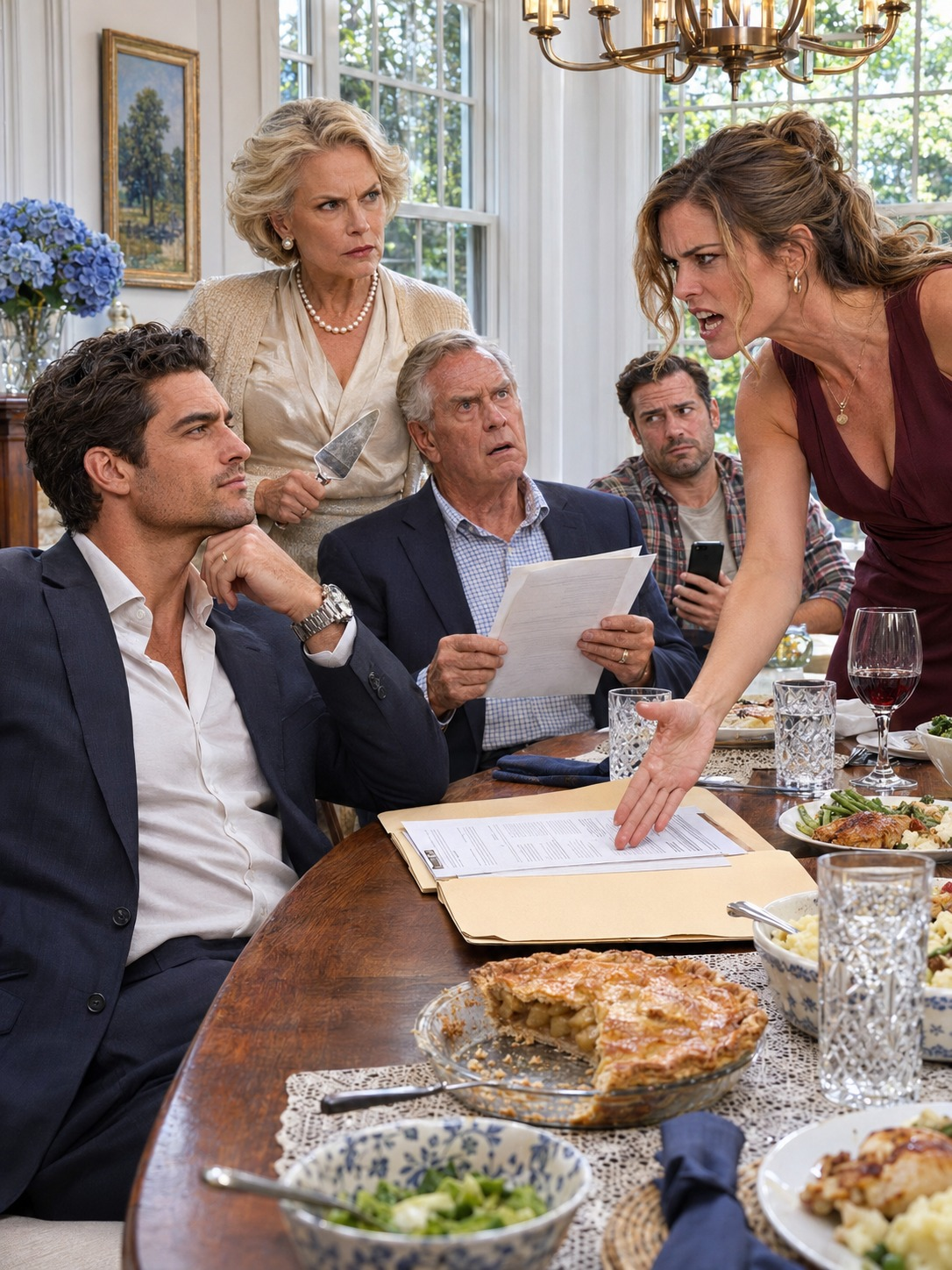
"Oliver, cancel your flight. Your sister needs you to watch her kids."
My mother's voice came through my phone at 10:15 on a Friday night.
Beside the front door sat two packed suitcases, and on top of the larger one was a luggage tag with two handwritten words: Athens, Greece.
My wife, Juniper, looked up from the couch.
She saw my expression change.
And before I said another word, she knew exactly who was calling.
The strange thing was that my mother already knew about the trip.
She knew how long we'd saved.
She knew how much it meant to Juniper.
She even knew our flight left at six the next morning.
But apparently, none of that mattered.
"Mom," I said carefully, "we're leaving in a few hours."
"I know, honey."
She said it so casually that I almost laughed.
"Then why are you asking me to cancel?"
"Because Darla needs help."
There it was.
The sentence I'd heard in one form or another for most of my adult life.
Darla needs help.
Darla needs money.
Darla needs someone to pick up the children.
Darla needs a break.
And somehow, no matter what Darla needed, the responsibility always found its way to me.
I was forty-two years old, a successful civil engineer, a husband of seven years, and a man who had spent most of his life being described as dependable.
For a long time, I thought dependable was a compliment.
That Friday night, I began to understand how easily it could become a trap.
"What happened?" I asked.
My mother sighed.
"Rowan has to leave town for work. Something came up unexpectedly."
Rowan was my brother-in-law.
He had been married to my older sister for fourteen years, and in that time, he'd started more businesses than I could comfortably remember.
There had been a landscaping company, an online electronics store, a home renovation partnership, and a consulting business that never seemed to have any actual clients.
Every new venture arrived with grand promises.
Every failure arrived with an explanation.
And almost every explanation ended with somebody asking me for money.
"Okay," I said. "And?"
"And Darla has her retreat."
I closed my eyes.
"What retreat?"
"Her wellness retreat. She's been planning it for months."
I remembered hearing about it at dinner the previous week.
Seven days at a luxury resort with yoga classes, massages, meditation workshops, and meals prepared by a private chef.
Darla had described it as something she desperately needed for her mental health.
I hadn't questioned that.
Being a parent to three children was exhausting, and everyone deserved time to recharge.
But there was a difference between needing rest and expecting someone else to cancel a twenty-three-thousand-dollar anniversary trip so you could get it.
"Mom, I'm not following."
She made an impatient sound.
"Oliver, please don't make this difficult. Rowan will be gone, and Darla can't get a refund. Somebody has to stay with the children."
I looked toward Juniper.
She was sitting very still.
Her hands rested in her lap.
"Why can't you and Dad watch them?" I asked.
"We have commitments."
"What commitments?"
"That's not the point."
"Then what is the point?"
"The point is that your sister needs her family."
I looked at our suitcases again.
The smaller one belonged to Juniper.
A pale blue ribbon was tied around its handle.
She'd attached it three days earlier because she said it would make the suitcase easier to recognize at baggage claim.
For some reason, that little ribbon made my chest tighten.
We had spent two years planning this vacation.
Two years of overtime.
Two years of skipped restaurant dinners.
Two years of putting spare money into a separate savings account.
And now my mother was asking me to throw it away as though we were discussing a canceled lunch reservation.
"Mom, we're going to Greece."
"I heard you."
"For two weeks."
"I know."
"We've already paid for everything."
"Money isn't everything, Oliver."
I stared at the phone.
It was an astonishing thing to hear from a woman who had called me countless times because somebody else needed financial help.
"You're right," I said. "Money isn't everything. That's why I'm going on this trip with my wife."
My mother went silent.
Not the thoughtful kind of silence.
The kind that meant she was deciding how angry she was allowed to become.
Then she said, "You can spend thousands of dollars traveling around Europe, but you can't help your own sister?"
I felt something familiar rise inside me.
Guilt.
It had been trained into me so thoroughly that I could almost feel it before anyone finished speaking.
"That's not fair."
"Fair?" she repeated. "You want to talk about fair? Your sister has three children. You and Juniper don't have children to worry about. You have more freedom than she does."
I looked toward my wife again.
Her expression didn't change.
But I saw her fingers tighten around the edge of a throw pillow.
My mother had made that comparison before.
Many times.
As though our decision not to have children somehow meant our time belonged to people who did.
"That doesn't make our plans less important," I said.
"Nobody said they weren't important."
"You're asking me to cancel them."
"Because this is an emergency."
"Mom, Darla's vacation isn't an emergency."
The silence that followed was sharper than anything she'd said.
Then her voice changed.
"Your father and I didn't raise you to be selfish."
There it was.
The accusation.
The one that had worked on me since childhood.
When I was twelve, selfish meant not giving Darla the last slice of birthday cake.
When I was seventeen, selfish meant refusing to drive her friends home after midnight.
When I was twenty-five, selfish meant not lending Rowan money for a business opportunity he promised would change everyone's lives.
By thirty-five, selfish had become a word my family used whenever I had something they wanted.
And I had spent years trying to prove it wasn't true.
"I'm not canceling," I said.
"Oliver."
"No, Mom."
"Think very carefully about what you're doing."
"I have."
She hung up.
I lowered the phone.
For several seconds, I didn't move.
Juniper waited.
She had become very good at waiting after calls from my family.
Finally, she asked, "Was that about Darla?"
I nodded.
"What does she need this time?"
"Someone to watch the kids for a week."
Juniper looked toward the suitcases.
Then back at me.
"Tomorrow?"
"Starting tomorrow."
She exhaled slowly.
"Of course."
There was no surprise in her voice.
That hurt more than I expected.
My wife had predicted this.
Not the exact request, perhaps, but the attempt.
At dinner the night before, we'd told my parents and Darla how excited we were about Greece.
My mother had smiled, but the smile hadn't reached her eyes.
Darla had asked how much we'd spent.
When I told her, she'd stared at me.
"Twenty-three thousand dollars?"
"Over two years," I'd explained.
She'd shaken her head.
"Must be nice."
I remembered the way she'd said it.
Not admiration.
Not curiosity.
Resentment.
As though the money had been taken from her personally.
Now, sitting beside Juniper, I wondered whether my sister's childcare problem had really appeared at the last minute.
But I didn't have evidence of anything.
And I was tired of guessing what my family was thinking.
"She wants me to cancel," I told Juniper.
"I figured."
"Mom says Darla's retreat is nonrefundable."
"So is most of our trip."
"Apparently, that's different."
Juniper gave a small, humorless laugh.
Then she reached for my hand.
"What do you want to do?"
It was such a simple question.
And somehow, it was the hardest one anyone had asked me that night.
Because Juniper wasn't telling me to choose her.
She wasn't demanding that I prove my loyalty.
She wasn't making threats or offering punishments.
She was asking what I wanted.
I looked around our living room.
There were travel guides on the coffee table.
A printed itinerary sat beside Juniper's notebook.
On the refrigerator was a postcard of Santorini, showing white buildings against a blue sea.
Her grandmother had given her a postcard almost exactly like it when she was a little girl.
Juniper had kept that picture for years.
When her grandmother died, she'd tucked it into a memory box along with photographs and handwritten letters.
The first time Juniper showed it to me, we'd been married less than a month.
"One day," she'd said, "I want to stand right there."
I'd promised we would.
But promises were easy when life was still mostly ahead of you.
Keeping them was harder.
Our honeymoon had been three nights at a small hotel two hours from home.
We'd been young, short on money, and convinced there would be plenty of time for something bigger.
Then came student loans.
Car repairs.
Job changes.
Family emergencies.
Always family emergencies.
One year, Darla needed help with a down payment on a vehicle.
Another year, Rowan needed a short-term loan to cover payroll.
Then there were medical bills, school expenses, and weekends when somebody needed childcare.
We kept postponing things.
Not because we didn't love each other.
Because we thought being good people meant always being available.
Two years earlier, on our fifth anniversary, Juniper had taken the Santorini postcard out of her memory box.
She'd placed it on the kitchen counter.
Then she'd said, "I don't want to keep waiting for our life to start."
That was the night we opened the savings account.
We named it Greece.
Every payday, money went into it.
Sometimes fifty dollars.
Sometimes five hundred.
Sometimes more, when I worked overtime.
Juniper stopped buying expensive coffee on her way to work.
I postponed replacing my car.
We made sacrifices that were small individually but enormous together.
And every month, when we checked the balance, we smiled.
It wasn't just a vacation fund.
It was proof that we could make a promise to each other and keep it.
Now, less than eight hours before our flight, my family wanted me to abandon that promise.
"I want to go," I said.
Juniper studied my face.
"Are you sure?"
"Yes."
"Because I don't want you spending the entire trip feeling guilty."
I swallowed.
"I probably will feel guilty."
She nodded.
"But I want to go anyway."
Her eyes softened.
"Then we go."
For a moment, I felt relieved.
Then my phone buzzed.
A text from Dad.
Family comes first, Oliver.
I read it twice.
My father wasn't a man who sent emotional messages.
He preferred short statements.
Instructions disguised as wisdom.
Growing up, I'd heard him say that family came first whenever somebody needed me to make a sacrifice.
But when I needed help, the same principle somehow became more complicated.
When I graduated from college with honors, Dad had congratulated me and then spent most of dinner discussing Darla's kitchen renovation.
When I received my first major promotion, he asked whether I could help Rowan secure financing.
When Juniper's grandmother died, my parents sent flowers but still expected us to attend Darla's birthday party that weekend.
Family came first.
But I was beginning to wonder which members of the family that sentence actually included.
Juniper leaned closer.
She read the message.
Then she looked at me.
"You don't have to answer tonight."
I nodded.
But my thumb was already hovering over the screen.
I wanted to explain.
I wanted to remind Dad how much we'd sacrificed.
I wanted to tell him that Juniper was family too.
That our marriage mattered.
That our time mattered.
That being available wasn't the same as being obligated.
I even started typing.
Dad, you know how important this trip is to us...
Then I stopped.
Because I knew exactly what would happen.
He would argue.
Mom would call again.
Darla would send pictures of her children.
Someone would accuse me of being cruel.
And by midnight, I'd be exhausted, apologizing for something I hadn't done wrong.
I deleted the message.
Turned off my phone.
And placed it facedown on the coffee table.
Juniper watched me.
"You're really doing it?"
"Doing what?"
"Not fixing everything."
I looked at her.
Then at the suitcases.
"I think I'm finally learning."
She leaned against my shoulder.
For the first time that evening, I could breathe normally.
We checked our passports.
Confirmed the airport transportation.
Set three alarms for 3:30 in the morning.
Juniper put her travel journal into her carry-on bag.
I checked the front door twice.
Everything was ready.
At 11:40, we climbed into bed.
I thought I would lie awake for hours.
Instead, I fell asleep almost immediately.
The alarm rang at 3:30.
By 4:05, we were in the car.
At 5:10, we passed through airport security.
At 5:45, Juniper bought two coffees and a blueberry muffin.
She was smiling.
Not a polite smile.
A real one.
The kind I hadn't seen enough of lately.
When boarding began, she reached for my hand.
"Ready?"
I looked at the gate.
At the passengers lining up.
At the plane waiting beyond the glass.
And I realized something.
For the first time in years, nobody else's problem was coming with us.
"Ready," I said.
At 6:02, we boarded our flight.
I slipped my phone into my carry-on without turning it on.
Juniper settled into the seat beside me.
She opened her travel journal and wrote the date at the top of the first page.
Then she showed me what she'd written underneath.
We finally made it.
I kissed her forehead.
The plane began moving.
And somewhere thousands of miles behind the journey we were about to take, my family was discovering that I wasn't coming to rescue them.
Eleven hours later, our plane touched down in Athens.
Juniper pressed her face toward the window.
I reached for my phone.
I turned it on.
The screen lit up.
Then it began vibrating.
Once.
Twice.
Again.
Notifications stacked so quickly that I couldn't read them.
Forty-three missed calls.
Twenty-seven text messages.
And one voicemail from my mother.
I pressed play.
Her voice came through the speaker.
"I hope you're happy, Oliver. Because after what happened this morning, your sister—"
The recording continued.
And then I heard someone crying in the background.






Comments 0