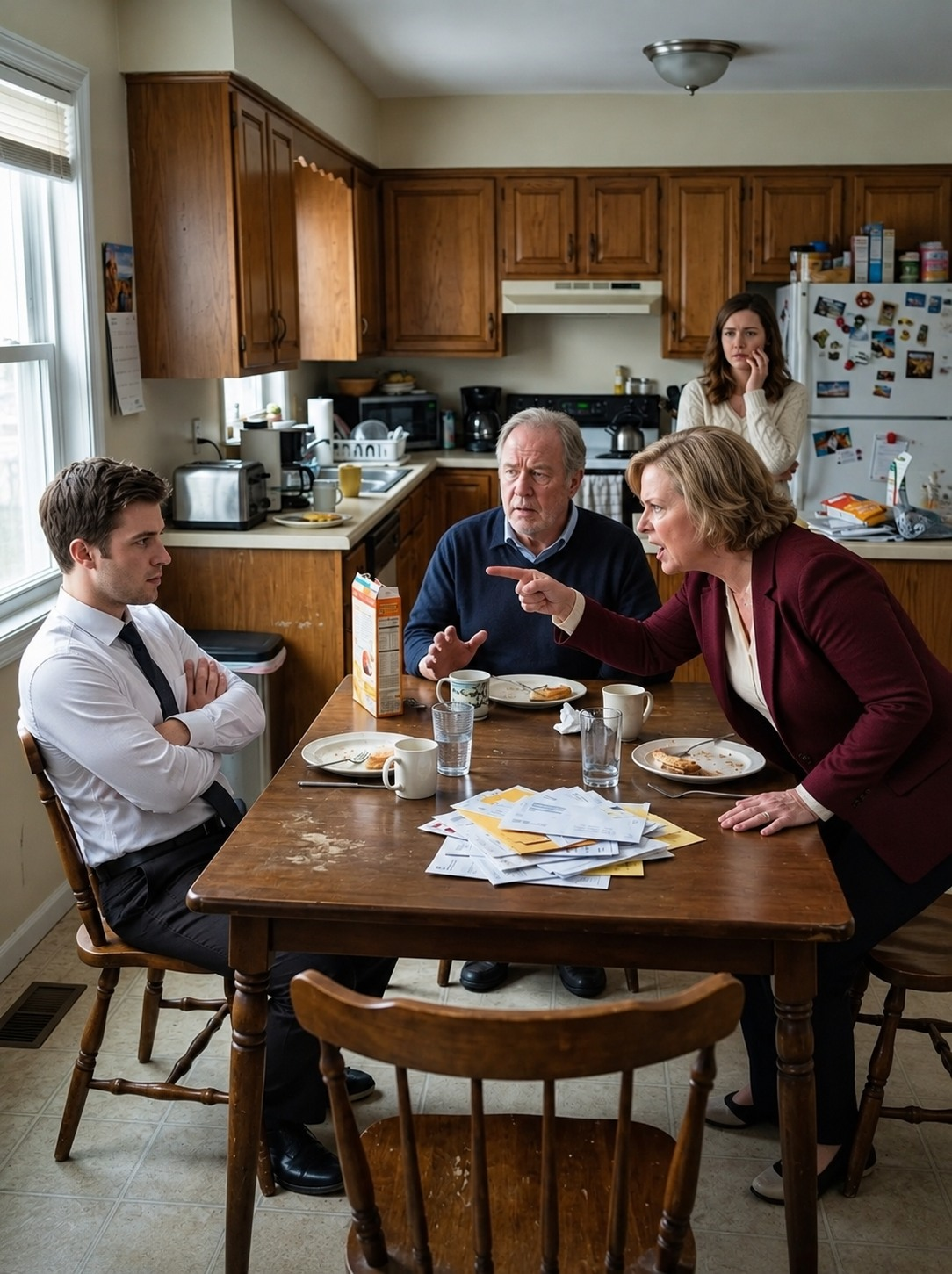
"Put that envelope down."
My mother's voice came through the phone so clearly that I could picture her standing in the garage doorway.
Dad didn't answer.
Neither did I.
For several seconds, all I heard was the rustling of paper and my father's uneven breathing.
Then Mom spoke again.
"Richard, I said put it down."
My father finally responded.
"Linda, whose signature is this?"
Silence.
I sat at my kitchen counter near Fort Carson, gripping my phone.
The blue envelope contained a letter from a bank about an account I'd never opened, a request to close it that I'd never submitted, and a second signature my father hadn't yet identified.
"Richard," Mom said quietly, "we need to talk about this without him listening."
My stomach tightened.
Dad looked at his phone.
"He's my son."
"I know that."
"His name is on these papers."
"Please."
Dad's voice grew firmer.
"No. You don't get to say please and make this disappear."
I closed my eyes.
I'd never heard him speak to her that way.
Not in thirty-two years.
Mom started crying.
"You're going to destroy everything."
Dad didn't raise his voice.
"Then tell me what you've done."
The silence that followed seemed endless.
Finally, Mom whispered, "I was trying to save our family."
I looked at the wall.
That sentence had become the explanation for everything.
Britney's debts.
The missing money.
The applications.
The forged signatures.
Every terrible decision had apparently been made in the name of saving the family.
But nobody had asked whether I wanted to be saved that way.
"Dad," I said, "don't argue. Just tell me whose name is on the second signature line."
He hesitated.
Then answered.
"Your mother's."
I closed my eyes.
There it was.
Not a stranger.
Not an unknown bank employee.
My mother.
The same woman who'd written He won't find out on an old financial document.
The same woman who'd admitted giving Britney access to my personal records.
The same woman who had begged me not to tell investigators about the four thousand dollars.
"Mom," I said, "did you sign that document?"
She didn't answer.
"Mom?"
Her voice trembled.
"I signed something."
"What?"
"I don't remember exactly."
I felt my jaw tighten.
"Please don't do that."
"Do what?"
"Tell me you don't remember every time the answer might be uncomfortable."
She began crying harder.
Dad said something quietly to her.
I couldn't make it out.
Then Mom took the phone.
"Honey, please listen to me."
"I'm listening."
"You have to understand what was happening back then."
"Then explain it."
She took a shaky breath.
"Britney was drowning."
I stared at the kitchen wall.
"In debt?"
"Yes."
"How much?"
"More than she told us."
"How much, Mom?"
She hesitated.
"Almost thirty thousand dollars."
I sat perfectly still.
Thirty thousand.
I had known Britney struggled with money.
I knew she carried credit card balances.
I knew she'd taken out personal loans.
But thirty thousand dollars was far beyond the occasional emergency she'd described.
"And you decided to use my credit?"
"I didn't decide it like that."
"Then how did you decide it?"
She started crying again.
"Britney said she could consolidate everything into one payment. She said she just needed help qualifying."
"Did she ask me?"
"No."
"Did you?"
"No."
"Then whose decision was it to use my information?"
Mom didn't answer.
I waited.
Finally, she whispered, "Mine."
The word landed heavily.
I looked down at my hands.
I had spent years believing that Britney was the problem and Mom was simply too softhearted to stop her.
Now I was hearing something different.
Mom hadn't merely excused Britney's behavior.
She had participated.
"Did you sign my name?" I asked.
"No."
"Did you know Britney would?"
She hesitated.
"I knew she had a copy of your signature."
I felt cold.
"A copy from where?"
"An old form."
"What form?"
"Something you signed before your deployment."
I closed my eyes.
My parents had kept copies of paperwork for years.
I had trusted them with documents because I believed they were safe there.
I never imagined those records could become tools for someone else's financial problems.
"Mom, did you tell Britney she could copy my signature?"
She started crying again.
"I didn't think she'd actually do it."
I stared at the wall.
That wasn't an answer.
But it told me enough to understand why she was frightened.
Dad took the phone back.
"Son, I'm going to photograph everything."
"Good."
"And I'm going to put the originals somewhere safe."
"Don't alter them. Keep the envelope and all the pages together."
"I will."
Mom said something in the background.
Dad answered firmly.
"No, Linda. I'm not hiding this."
I heard her begin crying again.
Then he said, "I'll call you later, son."
The call ended.
I sat motionless.
Outside my apartment, the afternoon sunlight stretched across the parking lot.
A delivery truck backed into a space.
Someone walked past carrying groceries.
Everything looked normal.
But nothing felt normal anymore.
I opened my laptop.
The documentation folder was already on the desktop.
I added a new entry to the timeline.
Mother admitted deciding to use my information for Britney's debt consolidation.
Then I stopped.
I reread the sentence.
It looked cold.
Almost clinical.
But it was accurate.
And accuracy mattered.
I added another note.
Mother stated she knew Britney possessed a copy of my signature but denied personally signing my name.
I saved the file.
Then I closed my eyes.
I wanted to call Mom back.
Not to argue.
To ask why.
Not why Britney needed money.
I understood that.
Not why she was frightened.
I understood that too.
I wanted to know why my mother had looked at the son who'd worked hard to build a stable life and decided his financial identity was something the family could borrow without permission.
I wanted to know why my refusal mattered less than Britney's desperation.
But I wasn't sure there was an answer that would make the decision hurt less.
At four that afternoon, Rachel Bennett called.
I answered immediately.
"Hello?"
"Mr. Carter, thank you for uploading the additional records."
"Of course."
"I've reviewed the materials you submitted, including the documents relating to your deployment."
I sat straighter.
"And?"
"They raise questions about the claimed authorization date and the signature record."
I took a breath.
"Okay."
She continued.
"We're requesting the original application package and related verification materials from the processing office."
"Have you found out who submitted the documents?"
"We're reviewing the submission history. I can't give you a final conclusion yet."
I understood.
But I was tired of waiting.
"Rachel, my mother admitted she helped my sister apply for the loan."
There was a pause.
"Would you be willing to provide a written account of that conversation?"
"Yes."
"Please do. Include the date, approximate time, and her exact words as best you remember them."
I made a note.
Then I said, "My father found an envelope containing a request to close the account. It has a signature that isn't mine and another signature belonging to my mother."
Rachel's tone changed.
"Do you have copies?"
"He's sending them."
"Please upload them when available."
"I will."
She paused.
"One more question. Has anyone asked you to withdraw your dispute?"
I thought about Mom's messages.
Britney's threats.
The repeated warnings about destroying the family.
"Yes."
"Has anyone offered to repay money in exchange for withdrawing it?"
"Not yet."
She was quiet for a moment.
"If that happens, please preserve the communication. Any repayment discussions should remain separate from the question of whether you authorized the account."
I nodded.
"Understood."
Before hanging up, I asked whether the older account could affect my credit while the investigation continued.
She explained that the institution was reviewing the reporting and would follow its dispute procedures.
I thanked her.
Then I sat back.
The word repayment stayed with me.
Because I knew my family.
Sooner or later, someone would suggest that Britney could simply pay the money back.
As though the only problem was the balance.
As though the signatures didn't matter.
As though my identity was a family resource that could be borrowed and returned.
I wasn't going to accept that.
At five thirty, Mom called again.
I considered letting it go to voicemail.
Then I answered.
"Hi, Mom."
She sounded exhausted.
"Are you busy?"
"Not right now."
"Can we talk?"
"We are talking."
She gave a weak laugh.
Then her voice broke.
"I don't want to lose you."
I closed my eyes.
"Mom."
"Please. Just let me explain."
I waited.
She took a shaky breath.
"Your sister was in terrible shape. She was getting collection calls every day. She couldn't sleep. She was afraid she'd lose her apartment and her car."
"I understand she was struggling."
"She told me if she couldn't consolidate the debt, everything would fall apart."
"Then she should have asked me."
Mom began crying.
"She said you wouldn't help."
I stared at the wall.
"Mom, I'd already given her thousands of dollars."
"I know."
"I'd paid bills. I'd covered insurance. I'd helped her find work."
"I know."
"Then why would she think I wouldn't help?"
Mom hesitated.
"Because she knew you'd ask questions."
I sat perfectly still.
There it was.
The answer.
Not because I was cruel.
Not because I didn't love her.
Because I would ask questions.
I would want to know the balance.
The interest rate.
The repayment plan.
Whether she could afford the payments.
Whether the loan made sense.
And Britney didn't want accountability.
She wanted access.
"Mom," I said quietly, "that's exactly why she needed to ask."
She sniffed.
"I know that now."
I took a slow breath.
"Did you know the application contained my signature?"
She hesitated.
"I knew Britney had copied it."
I closed my eyes.
"Did you see her do it?"
"No."
"Did you know she was going to submit it?"
A long silence.
Then she whispered, "Yes."
I stared at the phone.
For several seconds, I couldn't speak.
Mom continued crying.
"I thought she'd pay everything back before you noticed."
I looked at the ceiling.
That was the part that hurt most.
She hadn't believed I had agreed.
She had believed I wouldn't discover it.
"Mom, you knew I hadn't authorized it."
She didn't answer.
"You knew."
Her crying grew louder.
"I was scared."
I closed my eyes.
"So was I when I saw the credit inquiry."
She went quiet.
"I was scared when Britney threw coffee at me."
Silence.
"And I was scared when I learned there was an account opened while I was deployed."
Mom whispered, "I'm sorry."
I swallowed.
"I believe you're sorry now."
She started crying again.
"But being sorry doesn't change what happened."
"I know."
I waited.
Then she said, "What if Britney pays it back?"
I closed my eyes.
There it was.
Exactly what Rachel had warned me about.
"Mom, this isn't just about money."
"But if the balance is paid—"
"It doesn't change the fact that I didn't authorize the application."
She began crying harder.
"Please don't do this."
"Do what?"
"Take this outside the family."
I stared at the wall.
"The bank already has an investigation."
"Then tell them it was a misunderstanding."
"It wasn't."
"You don't know what will happen to Britney."
"Neither do you."
"She could lose everything."
I felt my chest tighten.
"Mom, I could have lost everything."
She went silent.
I continued.
"My credit. My financial stability. My career opportunities. My reputation."
"I never wanted that."
"But you were willing to risk it."
She didn't answer.
I looked down at my hands.
For a moment, I felt like a child again.
The little boy who hated disappointing his mother.
The teenager who apologized whenever Britney cried.
The young soldier who sent money home because he believed that was what a good son did.
I could feel that old guilt rising.
But I didn't let it decide for me.
"Mom, I'm not withdrawing the dispute."
She sobbed.
"Please."
"No."
"Please, honey."
"I can't."
"You can."
I closed my eyes.
"Then I won't."
The silence that followed was painful.
Mom took a shaky breath.
"Your father says he's going to tell the bank everything."
"Good."
"He says he can't trust me anymore."
I swallowed.
"I'm sorry you're both hurting."
She sniffed.
"Do you forgive me?"
I stared at the wall.
It was the question I'd been dreading.
I wanted to say yes.
I wanted to make her feel better.
I wanted to end the conversation with something comforting.
But forgiveness wasn't a switch I could flip because she was crying.
"Mom," I said, "I love you."
She waited.
"But I need time."
Her breathing grew uneven.
"How much time?"
"I don't know."
She started crying again.
I let her cry.
Not because I wanted to punish her.
Because I couldn't keep rescuing everyone from the discomfort of their own decisions.
After a moment, she whispered, "I understand."
I wasn't sure she did.
But I hoped she would.
Before hanging up, she said, "There's something you should know."
I sat straighter.
"What?"
"The money didn't all go to Britney."
I closed my eyes.
"I know. You said some went toward the house."
She hesitated.
"More than some."
My stomach tightened.
"How much?"
"I don't know the exact amount."
I rubbed my forehead.
"Mom."
"I swear. I don't."
I waited.
Then she whispered, "Your father was behind on the mortgage."
I sat perfectly still.
Dad?
Behind on the mortgage?
My father had always been careful with money.
He kept receipts in labeled envelopes.
He balanced the checkbook every Sunday.
He complained if the grocery bill was twenty dollars higher than expected.
I couldn't imagine him falling behind without telling anyone.
"How far behind?"
"Three months."
I stared at the wall.
"Why?"
She hesitated.
"He'd been helping Britney."
I closed my eyes.
Of course.
Dad had been paying her bills.
Mom had been covering the gaps.
I had been sending money.
And Britney had still needed more.
"Did Dad know the loan money was used for the mortgage?"
"No."
"Then how did you pay it?"
Mom started crying again.
"I told him I'd used savings."
I stared at the phone.
"Mom, you lied to him too."
"I know."
I took a slow breath.
"Does he know now?"
"No."
I closed my eyes.
"Then you need to tell him."
She sobbed.
"He'll never forgive me."
"I can't control that."
"Please don't tell him."
I stared at the wall.
"Mom, I'm not keeping secrets about financial records anymore."
She went quiet.
Then she whispered, "I thought you'd understand."
I looked at the photograph of the blue envelope.
"I understand you were afraid."
She sniffed.
"But I don't understand why you thought fear gave you permission to use my name."
She didn't answer.
We ended the call shortly afterward.
I sat quietly for several minutes.
Then I opened my laptop.
I added the conversation to my timeline.
The mortgage.
The savings story.
The loan proceeds.
The admission that Mom knew Britney planned to submit a copied signature.
I wrote everything down.
Then I saved the file.
At seven, Dad sent the photographs from the blue envelope.
There were six pages.
The bank letter.
The account closure request.
The signature page.
A payment history.
A transaction summary.
And a handwritten note.
I opened the transaction summary first.
Several payments had been made.
Some small.
Some large.
One payment matched the amount Mom had described as overdue mortgage installments.
Another went to a credit card account.
A third was labeled as an electronic transfer.
The recipient information was partially obscured in the photograph.
I enlarged it.
Still unclear.
I opened the handwritten note.
It was written on the back of an old bank statement.
There were dates.
Amounts.
Initials.
And a short sentence.
Keep this separate from his regular accounts.
I stared at the handwriting.
It looked like Mom's.
I saved the image.
Then I opened the payment history.
One detail caught my attention.
The account had not been consistently paid.
There were gaps.
Late payments.
Fees.
And then, several months earlier, a large payment had been made.
I looked at the amount.
It was more money than Britney had ever admitted owing.
I sat back.
Where had that money come from?
I checked the date.
It was the same week Britney had called me asking whether I still used the same bank.
My stomach tightened.
I opened our old messages.
There it was.
Hey, do you still use the same bank?
I'd answered.
Why?
Just curious.
I stared at the exchange.
Then I opened the bank statement again.
The payment had come from an account number I didn't recognize.
I made a note.
I would ask Rachel whether the source could be verified.
Before I could close the laptop, another message arrived from Dad.
Your mother told me about the mortgage.
I stared at the screen.
Then:
She says she was trying to protect me.
Another message.
I don't know what to believe anymore.
I typed:
You don't have to decide tonight. Just keep the records and tell the truth.
He replied:
I will.
I set the phone down.
For the first time, I wondered whether my father might actually follow through.
Not because he was angry.
Because he finally seemed to understand how much had been hidden from him.
At eight thirty, Rachel sent a secure message.
She confirmed receipt of the additional documents and asked whether I could provide a clearer copy of the transaction summary.
I replied that I would request one from Dad.
Then I asked whether the large payment could be traced.
She said the team was reviewing the transaction history and would contact me when they had verified information to share.
I thanked her.
Then I closed the laptop.
I was exhausted.
The burn on my cheek had begun to heal, but the skin still felt tight.
I washed my face carefully.
Applied the ointment.
Then looked at myself in the mirror.
I had spent the entire day talking about signatures, loans, and family secrets.
But underneath all of it was one simple truth.
I had said no.
And my family had decided that no didn't matter.
I turned off the bathroom light.
My phone rang.
Britney.
I let it ring.
Then a message appeared.
Mom told me what you said.
I didn't answer.
Another message.
You think you're protecting yourself, but you're hurting everybody.
I set the phone down.
Then a third message arrived.
If Dad finds out where the last payment came from, it's over.
I stared at the screen.
My pulse quickened.
I typed:
What last payment?
For several seconds, nothing happened.
Then Britney replied.
The one Mom made before you came home.
I sat up.
The large payment.
The one I had just noticed.
The one connected to an account I didn't recognize.
I typed:
Where did the money come from?
The three little dots appeared.
Disappeared.
Appeared again.
Then she sent a photograph.
It showed a bank transfer confirmation.
The amount matched the large payment on the account history.
The date matched too.
But the sending account wasn't Britney's.
It wasn't Mom's.
And it wasn't Dad's.
The account holder's name was mine.
I stared at the screen.
I had never made that transfer.
I opened my own bank records.
Checked the date.
Checked the amount.
There was no matching transaction in my primary accounts.
Then I noticed something on Britney's photograph.
The sending institution wasn't my usual bank.
It was a different financial company.
One I had never used.
And beneath the account holder's name was a note.
Authorized representative on file.
I felt my chest tighten.
Before I could call Rachel, another message arrived from Britney.
You should have left this alone.
Then:
Because that account isn't the only one Mom opened.
I stared at the phone.
A final message appeared.
It contained a photograph of a document.
At the top was my full name.
Below it was an account number.
And beside the account number was a handwritten date.
The date was three days after I'd returned from deployment.
I enlarged the image.
At the bottom was a signature.
Not mine.
Not Mom's.
Not Dad's.
It was Britney's.
And directly beneath it, in a box labeled Account Access, were four words that made my hands go cold.
Full authority granted indefinitely.
I reached for my phone to call the bank.
But before I could dial, an email notification appeared.
The subject line read:
New Account Activity — Immediate Verification Required.
I opened it.
The first line stated that a transaction had been initiated that evening.
The second line listed an amount larger than my entire emergency savings.
And the third line contained a name.
The name of the person who had authorized it.
I leaned closer.
Then my phone rang.
It was Dad.
I answered.
"Son," he whispered, "don't call your mother."
My stomach tightened.
"Why?"
He took a shaky breath.
"Because I just found out where she's going."
I stood up.
"Where?"
He didn't answer.
Then I heard a car engine start in the background.
Dad whispered:
"She's on her way to the bank. And she's carrying your identification documents."






Comments 0