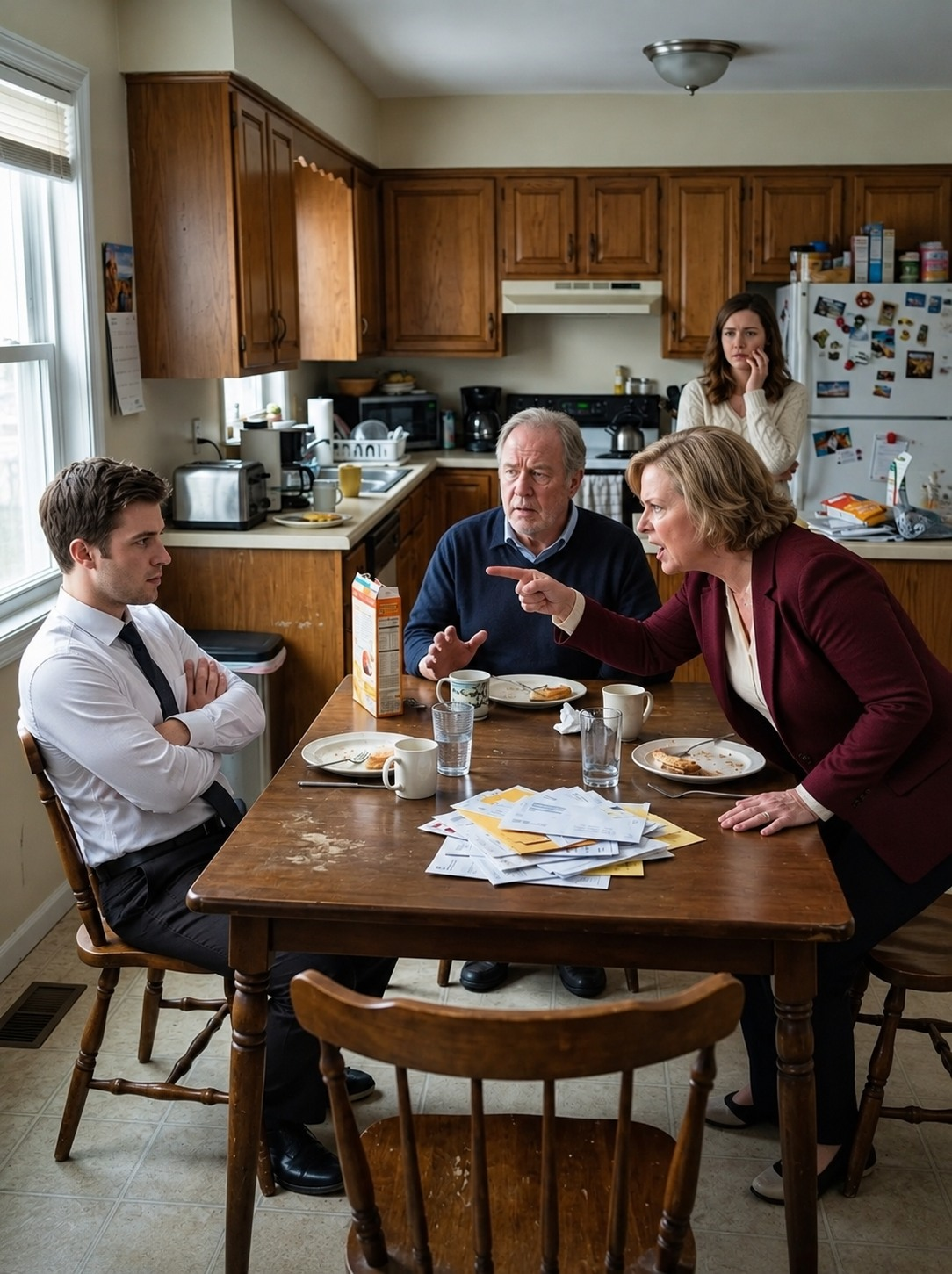
"Please don't tell your father what Britney used his name for."
I read my mother's message while the disputed loan application glowed on my laptop screen.
My name appeared beside a signature I hadn't written.
My father's name appeared beneath it.
And now my mother was asking me to keep a secret from the very man whose name was on the paperwork.
I looked at the phone.
Then at the document.
For the first time since Britney had thrown coffee in my face, I felt something worse than anger.
I felt afraid of what I might discover next.
Not because I had done anything wrong.
Because I was beginning to understand that the people I trusted most had been making decisions about my financial identity without telling me.
My phone was still connected to Dad's call.
"Dad?" I said.
No answer.
I could hear muffled voices in the background.
Britney was speaking quickly.
My father said something I couldn't understand.
Then Mom's voice rose.
"Just give him the phone!"
The call disconnected.
I stared at the screen.
A few seconds later, another message arrived from Mom.
Please don't make this worse.
I almost laughed.
I was sitting alone in my apartment near Fort Carson, six days earlier than I'd planned to return, with a burn on my cheek and a fraud investigation beginning to take shape.
And somehow, I was still the person being warned not to make things worse.
I typed a reply.
Mom, did Dad authorize Britney to use his name?
I waited.
The three little dots appeared.
Disappeared.
Appeared again.
Then she answered.
It's complicated.
I set the phone down.
That was becoming my family's favorite phrase.
It's complicated.
She didn't mean it.
You're overreacting.
Family helps family.
Every one of those statements had the same purpose.
To avoid answering a direct question.
I opened the lender's attachment again.
The document appeared to be a supplemental authorization form connected to the automobile financing application.
My name was listed in one section.
Dad's name appeared in another.
There were signatures.
Dates.
Boxes marked with checkmarks.
And a handwritten notation beside the second signature that was too faint to read clearly.
I enlarged the image.
Still unclear.
I downloaded the original file and saved it in my documentation folder.
Then I wrote down the questions I needed answered.
Had someone submitted an application using my identity?
Was my father listed as a guarantor or another authorized party?
Had he actually signed anything?
And why was my mother asking me not to tell him?
I didn't know the answers.
I wasn't going to invent them.
But I was going to find out.
The next morning, I woke before sunrise.
For a few seconds, I forgot where I was.
I reached toward the nightstand, expecting to hear the familiar sounds of my parents' house.
The coffee maker.
The television.
My father moving around the kitchen.
Instead, there was silence.
Then I rolled onto my left side.
Pain shot across my cheek.
Everything came back.
Britney.
The coffee.
The hospital visit.
The paperwork.
I sat up and went to the bathroom.
The mark beneath my jaw had darkened slightly overnight.
It wasn't a serious burn, according to the clinician, but it was uncomfortable enough to remind me of the incident every time I moved my face.
I took another photograph.
Same lighting.
Same angle.
I added the date and time to my notes.
Then I followed the care instructions I'd been given.
I had spent years documenting equipment discrepancies.
A damaged generator needed a record.
A missing radio needed a report.
A shipment arriving with broken seals required photographs and signatures.
It felt strange to apply that same discipline to my own family.
But I knew what happened when records didn't exist.
People remembered things differently.
Sometimes accidentally.
Sometimes conveniently.
And Britney had already started rewriting what happened.
At 7:12 that morning, she sent another message.
Mom said you're telling people I attacked you.
I looked at it.
Then replied.
You threw hot coffee at my face. I told the urgent care nurse what happened.
Her response was immediate.
You know I wasn't aiming for your face.
I stared at those words.
For a moment, I considered asking where she'd intended the coffee to land.
My shoulder?
My chest?
The kitchen wall?
But I didn't.
There was no productive answer.
I saved the message.
Then I muted her conversation.
I didn't block her.
Not yet.
If she continued sending messages about the incident or the loan application, I wanted a record.
But I wasn't going to spend the entire day responding to accusations.
I had work to prepare for.
My leave wasn't officially over, and I needed to coordinate my early return properly.
I contacted my supervisor, explained that a family situation had changed my plans, and confirmed the administrative steps required before resuming duty.
I didn't describe every detail.
I didn't need to.
I simply said that I had returned early and wanted to ensure my status was handled correctly.
My supervisor, Master Sergeant Daniel Mercer, had worked with me long enough to recognize when something was wrong.
"You sound tired," he said.
"Long drive."
"You okay?"
I hesitated.
"Family trouble."
He was quiet for a moment.
"Anything that could affect your work?"
That question mattered.
I held a security clearance.
I worked in a position where financial responsibility and accurate reporting weren't optional.
An unauthorized credit application wasn't something I could casually ignore, especially if it developed into a larger identity-theft problem.
"I'm dealing with a possible misuse of my personal financial information," I said.
Mercer's tone changed.
"Have you documented it?"
"Yes."
"Good. Make sure you follow whatever reporting procedures apply. Don't let somebody else's mess become your problem because you waited too long."
I looked at the folder open on my laptop.
"Understood."
He paused.
"And take care of yourself."
That last sentence caught me off guard.
Not because it was unusual.
Because nobody in my family had said it quite that plainly.
After the call, I sat at my kitchen counter with a cup of coffee I barely wanted.
I looked at the dark liquid.
Then pushed the mug away.
For the first time in my life, the smell of coffee made my stomach tighten.
I hated that.
Britney had already taken enough from my visit.
I wasn't going to let one morning change every ordinary thing I enjoyed.
Still, I poured the coffee out.
Some battles didn't need to be fought before breakfast.
At nine, I called the lender's fraud department again.
This time, I had the reference number ready.
The representative verified my identity and located the case.
I explained that I had received a document containing signatures I did not recognize as authorized.
She asked whether I had submitted the application.
"No."
Whether I had given anyone permission to use my information.
"No."
Whether I had signed any paperwork connected to the financing.
"No."
Then she asked whether I knew the other person listed on the document.
I hesitated.
"One of the names appears to be my father's."
"Did he authorize the application?"
"I don't know."
"Has he confirmed signing the document?"
"No."
She paused.
"All right. We'll note that."
I asked whether the application had resulted in an approved loan.
She explained that the investigation was ongoing and that she couldn't provide conclusions before the relevant records were reviewed.
I understood.
I didn't like waiting.
But I understood.
"Is there anything else I should do?" I asked.
"Continue monitoring your credit reports, preserve any relevant communications, and respond to requests from our investigation team."
I thanked her.
Before ending the call, I asked for written confirmation that I had disputed the inquiry and denied authorizing the application.
She said the department would provide the appropriate documentation.
I wrote down her name and the time.
Then I added another entry to my timeline.
By lunchtime, I had completed more paperwork than I'd expected to touch during my entire leave.
And I still hadn't heard from Dad.
I called him once.
No answer.
I sent a message.
Dad, I need to know whether you signed anything connected to Britney's car financing. Please call me when you can speak privately.
He read it.
Didn't reply.
That worried me more than I wanted to admit.
My father wasn't a man who ignored messages.
He might avoid arguments.
He might pretend problems would disappear if everyone stayed calm.
But when I asked him a direct question, he usually answered.
I thought about driving back to Denver.
Then I looked at the mark on my cheek.
No.
I wasn't going back into that kitchen just because everyone refused to communicate honestly.
If Dad wanted to talk, he had my number.
If the lender needed information, I would provide it.
If Britney wanted another argument, she could have it without me.
I opened my email and began reviewing the documents I'd saved.
That's when I noticed something I'd overlooked.
The original inquiry had been dated before my arrival at my parents' house.
That meant whatever had happened wasn't a spontaneous reaction to my refusal at breakfast.
The application had already been submitted.
Britney had asked for my credit card after the inquiry appeared.
I leaned back in my chair.
The order of events mattered.
She hadn't simply asked for help and become angry when I refused.
She had apparently been involved in some financing process connected to my information before she ever made that request.
I couldn't yet prove what she'd done.
But I could prove the timing.
And that changed how I understood the breakfast conversation.
I remembered how confidently she'd spoken.
You've got excellent credit.
Just let me use your card for a little while.
I'll pay it back.
She hadn't sounded desperate at first.
She'd sounded certain.
As though she expected me to agree because the decision had already been made somewhere else.
I opened my messages from the previous week.
Britney had texted me before I drove home.
Can't wait to see you! We should catch up about some financial stuff.
At the time, I'd barely noticed it.
I assumed she wanted advice.
Now I read it differently.
I scrolled farther.
Three days before my arrival, she'd sent another message.
Do you still use the same bank?
I'd replied with a simple question.
Why?
She'd answered:
Just curious.
I stared at the exchange.
I had forgotten it entirely.
I saved screenshots.
Then I checked my call history.
Britney had called twice that week.
Both calls were short.
Both involved questions about when I'd arrive, how long I'd stay, and whether I'd be busy during the visit.
At the time, it had sounded like ordinary family conversation.
Now I wondered whether she'd been planning when to approach me.
That didn't prove fraud.
But it gave me another reason to stop assuming her requests were harmless.
Around three that afternoon, Mom called.
I let it ring twice before answering.
"Hi, Mom."
"Are you working?"
"Not right now."
She sounded relieved.
"Good. I wanted to check on you."
"How's Dad?"
A pause.
"He's fine."
"Has he talked to Britney?"
"Yes."
"And?"
She sighed.
"Your father is very upset."
"About the coffee?"
"About everything."
I waited.
Then she said, "I wish you hadn't contacted the bank."
I closed my eyes.
"Mom, someone submitted an application using my information."
"We don't know that for sure."
"I have a credit inquiry and documents bearing my name."
"Maybe it was just a misunderstanding."
"Then the investigation should clear it up."
She didn't answer.
I continued.
"If nobody did anything wrong, there's nothing to hide."
"That's easy for you to say."
I felt my patience thinning.
"Why?"
"Because you're not the one who might lose everything."
The words hung between us.
I sat up.
"What does that mean?"
Mom went quiet.
"Mom?"
"I shouldn't have said that."
"Who might lose everything?"
"Your sister is under a lot of pressure."
"Financial pressure?"
"Yes."
"How much?"
"I don't know."
"Mom."
"I really don't."
I believed she was withholding something.
But I couldn't tell how much she actually knew.
There was a difference between being dishonest and being frightened.
My mother sounded frightened.
"Did Britney borrow money against the house?" I asked.
"No!"
The answer came sharply.
Then she softened.
"No. Nothing like that."
I waited.
"Did Dad sign something?"
She started crying.
Not loudly.
Just a quiet, exhausted sound.
"Please don't ask me these questions."
I looked at the wall.
"Mom, I need to protect myself."
"I know."
"Then help me understand what's happening."
She took a shaky breath.
"Your father said he would handle it."
"Handle what?"
"I can't talk about this right now."
The call ended.
I stared at the phone.
For a moment, I wanted to throw it across the room.
Instead, I placed it carefully on the counter.
I had spent ten years learning to remain calm when other people panicked.
That skill had served me well in the Army.
But it was becoming clear that staying calm around my family had a cost.
They interpreted my restraint as flexibility.
My patience as permission.
My silence as agreement.
And now, when I asked reasonable questions, they treated me like the threat.
I walked to the bathroom and checked my cheek again.
The redness had spread slightly beneath my jaw, but there was no sign of anything requiring emergency attention.
I followed the medical instructions and made a note to seek further care if the symptoms worsened.
Then I looked at myself in the mirror.
I thought about the younger version of me.
The twenty-five-year-old who had wired Britney four thousand dollars because he couldn't bear the thought of his sister losing her apartment.
He'd believed helping once would give her a chance to recover.
He hadn't understood that some people could turn a favor into an expectation.
And expectations into demands.
And demands into punishment when they weren't met.
I didn't hate Britney.
That was the strange part.
Even after everything, I didn't hate her.
I remembered teaching her how to change a tire when we were teenagers.
I remembered her driving me to school when my car wouldn't start.
I remembered the Christmas she spent an entire weekend helping me decorate my first apartment.
There had been good years.
Real ones.
But those memories didn't erase what happened at breakfast.
And they certainly didn't authorize anyone to use my financial identity.
By evening, I had finished organizing the documentation.
I created a separate list of questions for the lender.
I checked my credit files again.
I verified that the freezes and alerts I'd requested were being processed.
Then I changed the password on the phone account Britney had been using under my family plan.
I didn't disconnect her service that night.
Not yet.
I wanted to review the account terms and make sure any changes were handled properly.
But I was done being financially responsible for an adult who treated my help as an entitlement.
I sent her one final message.
I will no longer provide financial assistance or allow you to use accounts in my name. Any existing arrangements will be reviewed and ended appropriately. Do not submit applications or use my information without my written permission.
She didn't respond.
For nearly an hour, my phone stayed quiet.
I made dinner.
Ate half of it.
Washed the dishes.
Then sat on the couch with a book I couldn't concentrate on.
At 8:47 p.m., Dad finally called.
I answered immediately.
"Hey, Dad."
"Son."
His voice sounded different.
Tired.
Almost defeated.
"Are you alone?" he asked.
"Yes."
"Good."
I sat up.
"What's going on?"
He took a breath.
"I went through the papers again."
"Okay."
"I found something Britney didn't tell me about."
My stomach tightened.
"What?"
He hesitated.
Then said, "There's a second application."
I stared at the wall.
"Another car loan?"
"I don't think so."
"What kind of application?"
"I can't tell from the first page."
"Then read the rest."
"I tried."
His voice dropped.
"Some of the pages are missing."
I closed my eyes.
"Where did you get them?"
"Britney left them in the kitchen."
"Did you ask her?"
"Yes."
"And?"
He was silent.
Then he said, "She told me those papers weren't mine to look at."
I felt something cold move through my chest.
"Dad, your name is on the financing documents."
"I know."
"Then you have every reason to ask questions."
He exhaled.
"I told her that."
"What happened?"
"She started yelling."
I waited.
"Then your mother came in and told me to leave it alone."
I rubbed my forehead.
"Dad, listen to me. Don't sign anything else. Don't agree to anything over the phone until you understand what it is."
"I won't."
"And don't destroy any paperwork."
"I know."
He paused.
Then said, "There's something else."
I sat forward.
"What?"
"Britney said you already knew about the second application."
I stared at the phone.
"That's a lie."
"I thought so."
"I've never agreed to help her apply for anything."
"I believe you."
Those three words nearly broke me.
Not because they solved anything.
Because I hadn't realized how badly I needed to hear them.
For a moment, I couldn't speak.
Dad cleared his throat.
"I should've stood up for you this morning."
I looked down.
"Yes."
"I'm sorry."
I closed my eyes.
"Thank you."
He took a slow breath.
"Your mother doesn't want me talking to you about this."
"Why?"
"I don't know."
"Have you asked her?"
"Yes."
"And what did she say?"
He hesitated.
"She said if I knew everything, I'd never forgive Britney."
I sat perfectly still.
Outside my apartment, a car passed through the parking lot.
Its headlights swept briefly across the wall.
Then the room was quiet again.
"Dad," I said, "what exactly did Britney put your name on?"
He didn't answer.
Instead, I heard papers moving.
Then he said, "I'm going to send you a picture."
A notification appeared.
One image.
I opened it.
The photograph showed a document lying on our parents' oak kitchen table.
At the top was the name of a financial services company.
Below it was a reference number.
And near the bottom was a section labeled Applicant Information.
I enlarged the image.
My father's name appeared in one field.
Britney's appeared in another.
Then I saw a third field.
It contained my name.
But the address listed beneath it wasn't mine.
I zoomed closer.
The address was in Colorado.
A street I didn't recognize.
A city I hadn't lived in.
And beside the address was a handwritten notation.
Primary contact verified.
I stared at those words.
"Dad, who verified this?"
He didn't answer.
"Dad?"
I heard him breathing.
Then he said, "Son, I need to tell you something about the day Britney came to the house with those papers."
My grip tightened around the phone.
"What happened?"
He took a breath.
"She wasn't alone."
I sat up.
"Who was with her?"
There was a long silence.
Then Dad whispered, "Someone from the bank."
Before I could respond, another notification appeared on my laptop.
A new email.
From the lender's fraud department.
The subject line read:
Immediate Action Required — Verification of Additional Account.
I opened it.
The first sentence stated that the investigators had identified another account requiring review.
The second sentence contained an account reference.
Then I reached the third sentence.
It said the account had been opened using my personal information.
And the date of opening was nearly two years before Britney threw coffee in my face.
I looked at the screen.
Then at the phone.
"Dad," I said quietly, "I think this started a lot earlier than either of us knew."
He didn't respond.
Instead, I heard someone knocking on his front door.
Three sharp knocks.
Dad stopped breathing for a moment.
Then he whispered, "That's strange. Britney said nobody was coming."
I heard him walk toward the entrance.
The door opened.
A man's voice spoke.
"Good evening, sir. I'm here about the accounts connected to your son."
My father went silent.
Then the stranger said something that made my blood run cold.
"Before we discuss the money, I need to know whether your son is still alive..."






Comments 0