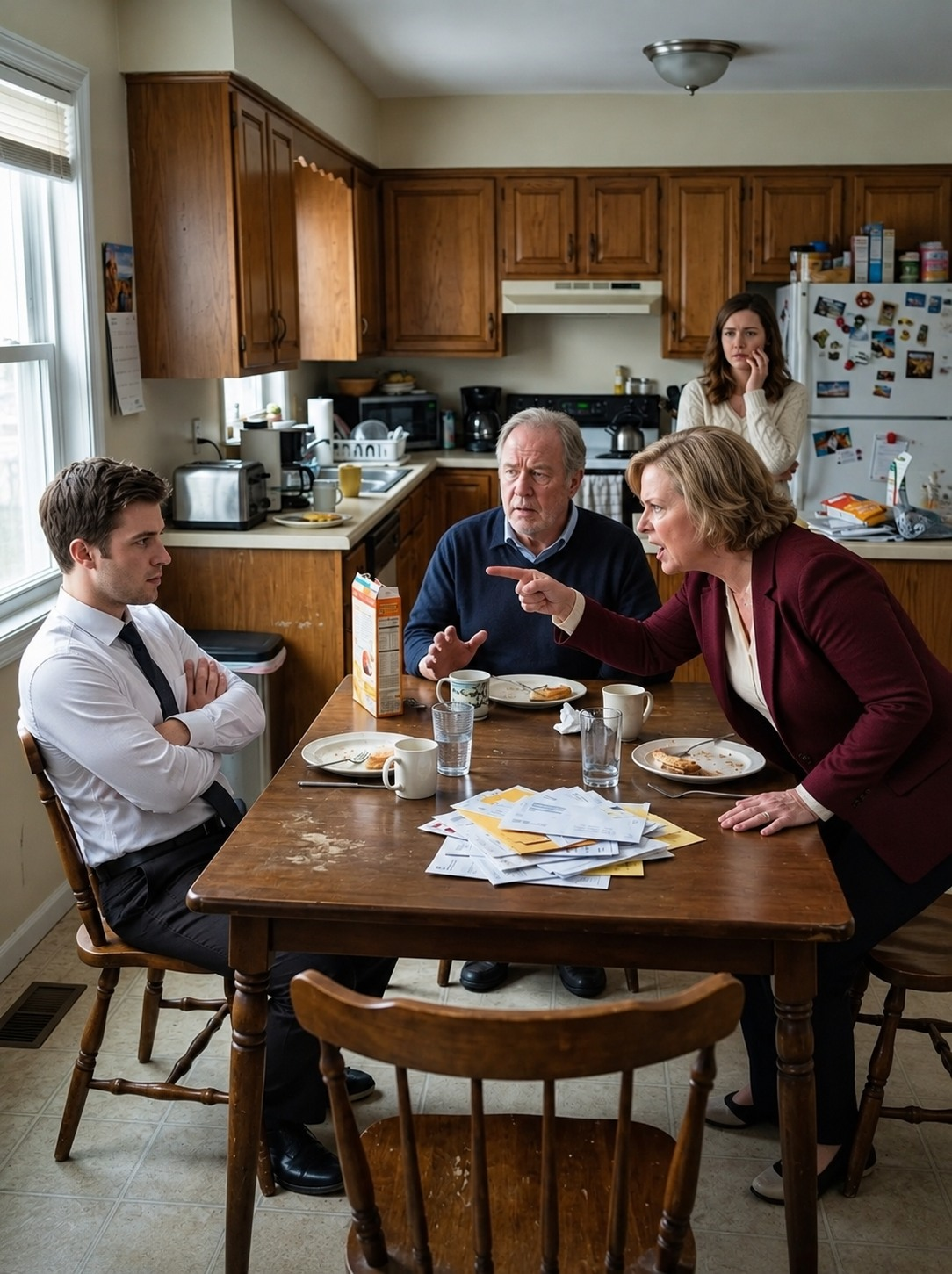
"Before we discuss the money, I need to know whether your son is still alive."
I heard those words through my father's phone, and for a moment, I forgot about the burn on my cheek.
My father stood in the doorway of our family home in Denver.
I was sitting nearly seventy miles away, near Fort Carson, staring at an email about an account I had never opened.
And a stranger had just asked whether I was dead.
"What kind of question is that?" Dad demanded.
The man answered calmly.
"Sir, I apologize. I'm trying to verify information associated with an account."
"Well, my son is alive."
"Thank you. Has he been living at this address?"
"No. He's in the Army."
There was a pause.
Then the man said, "That doesn't match what we were told."
My father didn't respond.
Neither did I.
I had spent ten years working in military logistics, where a missing signature could delay an entire shipment and a wrong serial number could trigger an investigation.
I understood discrepancies.
But I had never imagined hearing one that involved whether I was alive.
"Dad," I said into the phone, "ask him who he works for."
My father repeated the question.
The stranger identified himself as Martin Keller, a field representative working for a contracted account-verification company.
He explained that his office had been asked to confirm information connected to an unresolved financial account.
I immediately became suspicious.
Legitimate financial institutions didn't normally send strangers to people's houses to announce sensitive account information on the porch.
And identity thieves sometimes used convincing stories to collect even more personal details.
"Dad, don't give him anything," I said.
My father repeated my warning.
Keller sounded surprised.
"I'm not asking for personal information at this time."
"Then why are you here?" Dad asked.
"Because we have conflicting information concerning the account holder's status."
"What conflicting information?"
Another pause.
Then Keller said, "One of the records we received indicated that your son was deceased."
My father made a sound I had never heard from him before.
Not a word.
More like the air had been knocked out of his chest.
"That's impossible," he said.
"I understand, sir."
"No, you don't understand. I spoke to my son five minutes ago."
I pressed the phone harder against my ear.
"Dad, tell him to leave a business card. Don't discuss anything else."
My father repeated the instruction.
Keller agreed.
I heard paper rustling.
Then footsteps.
The front door closed.
For several seconds, neither of us spoke.
Finally, Dad said, "Son?"
"I'm here."
"Why would somebody tell a bank you were dead?"
I looked at the email on my laptop.
The account had apparently been opened nearly two years earlier.
I had no idea what information the lender possessed, whether Keller was legitimate, or how a death-related notation had entered the records.
But I knew one thing.
I wasn't going to solve it by guessing.
"I don't know," I said. "And until we verify who that man is, we don't assume anything he told you is accurate."
Dad took a shaky breath.
"All right."
"Take a picture of his business card."
"I will."
"And don't let Britney take it."
He was quiet.
Then he said, "You really think she'd do something like this?"
I looked at the red mark reflected in my dark laptop screen.
"Dad, this morning you didn't think she'd throw coffee at me."
He said nothing.
I regretted how harshly the words landed.
But I didn't take them back.
Because they were true.
A minute later, the photograph arrived.
Martin Keller.
Account Verification Services.
A Denver telephone number.
An office address.
No bank logo.
No account details.
I saved the image.
Then I told Dad I would contact the lender through its official fraud department.
"Don't call the number on the card yet," I said.
"Why not?"
"Because we haven't verified it."
Dad sighed.
"Everything has to be complicated with you."
I almost smiled.
"Everything gets complicated when people skip the verification part."
He didn't argue.
For once, that felt like progress.
After we hung up, I called the lender using the number from its official website.
I gave the representative my existing case reference.
Then I explained what had happened.
A man had appeared at my parents' home.
He claimed to be verifying an account.
He said records indicated I was deceased.
And I wanted to know whether he had any legitimate connection to the institution.
The representative placed me on hold.
I waited.
Five minutes passed.
Then eight.
When she returned, her voice was more serious.
"Sir, I can confirm that an outside verification request was initiated in connection with an account under review."
I sat straighter.
"Was Martin Keller assigned to it?"
"I'm unable to verify an individual representative's identity from this department. I can escalate that question."
"Please do."
"Of course."
I looked at the second email.
"What about the deceased notation?"
She paused.
"I can see that there is a disputed status indicator associated with the records we're reviewing."
"What does that mean?"
"It means the information requires verification. It does not establish that the information is correct."
I appreciated the distinction.
"Can you tell me who submitted it?"
"Not at this stage."
"Can you tell me whether the account has an outstanding balance?"
She hesitated.
"Because the account is under investigation, I need to refer that question to the assigned specialist."
I wrote down her name.
The time.
The case number.
Then I asked for written confirmation of the additional dispute.
By the time the call ended, it was almost ten at night.
I sat back and stared at the ceiling.
Two years.
That was the part I couldn't stop thinking about.
For nearly two years, something connected to my identity had apparently existed without my knowledge.
I had checked my credit periodically.
I paid my bills.
I kept my accounts organized.
Yet here I was, discovering records that suggested somebody had been using information associated with me.
I wondered what else I hadn't seen.
And then I remembered Britney's words from the previous afternoon.
You don't understand what you're getting involved in.
At the time, I'd assumed she was trying to frighten me.
Now I wasn't so sure.
I opened our message history.
Scrolled backward.
Past the insults.
Past the demands.
Past the occasional birthday greeting and holiday photograph.
Then I reached the messages from two years earlier.
There were dozens.
Most were ordinary.
A question about Mom's birthday.
A complaint about work.
A photograph of a dog she'd considered adopting.
But one exchange caught my attention.
Britney had written:
Hey, are you still stationed at the same place?
I'd answered:
Yes. Why?
She replied:
Just updating my emergency contacts.
I stared at the screen.
At the time, it had seemed harmless.
I hadn't thought about it again.
Now I saved it.
Then I kept scrolling.
Three weeks later, she'd asked for my mailing address.
I'd sent it.
She said she wanted to mail me something.
Nothing arrived.
I remembered that because I'd teased her about it during Christmas.
She'd laughed and said she'd forgotten.
I hadn't cared.
Now I wondered whether the address request had anything to do with the older account.
It was only a possibility.
I couldn't prove a connection.
But I wasn't going to ignore it.
I saved the exchange.
Then I shut down the laptop.
I needed sleep.
The next morning, I woke to seventeen notifications.
Six from Britney.
Four from Mom.
Two from Dad.
The rest were automated alerts from financial services.
I opened the alerts first.
One credit bureau confirmed that my security freeze was active.
Another confirmed receipt of a fraud alert request.
A third advised me to review recent activity.
I worked through them carefully.
Nothing suggested that my existing bank accounts had been emptied.
There were no unfamiliar charges on my primary credit card.
My checking account balance was correct.
That was reassuring.
But the disputed inquiries remained.
And the older account still needed investigation.
I made another cup of coffee.
This time, I drank it.
Slowly.
Standing beside my kitchen counter.
I wasn't going to let Britney take that from me too.
Then I opened Dad's messages.
The first contained a photograph of the business card.
The second said:
I checked the papers again.
The third:
Britney says the old account was supposed to be closed.
I stared at that sentence.
Supposed to be closed.
Not I don't know what account you're talking about.
Not There is no old account.
Supposed to be closed.
I called Dad immediately.
He answered on the second ring.
"Morning, son."
"Dad, what did Britney tell you?"
He sighed.
"She's been up all night."
"That's not what I asked."
"I know."
I waited.
Finally, he said, "She admitted there was an old financing arrangement."
My hand tightened around the mug.
"What kind?"
"She says it started as a way to consolidate some debts."
"Whose debts?"
"Hers."
"Did she use my information?"
Dad hesitated.
"She said you agreed to help."
I closed my eyes.
"No."
"That's what I told her."
"I never agreed to consolidate her debts."
"I believe you."
I set the mug down.
"Did she show you anything with my actual signature?"
"She showed me a copy of an agreement."
"Did you see me sign it?"
"No."
"Did you ever speak to me about it?"
"No."
"Then why did you believe her?"
Dad was silent.
The question was harder than I'd intended.
But it needed to be asked.
After a moment, he said, "Because she told me you two had worked everything out."
I looked toward the window.
That was the answer.
He believed her because believing her was easier than asking questions.
It was easier than calling me.
Easier than acknowledging that Britney might have done something serious.
Easier than admitting that the daughter he'd spent years protecting had become someone who couldn't be trusted with financial paperwork.
"Dad, what did you sign?"
He took a breath.
"I don't remember signing anything for the old account."
"What about the new car financing?"
"I signed a document Britney brought home."
I sat up.
"What document?"
"She said it was a statement confirming she lived at our address."
"Did you read it?"
A long pause.
"Not carefully."
I stared at the wall.
There it was.
The sentence that explained half my family's problems.
Not carefully.
Britney asked.
Somebody trusted her.
A document got signed.
And nobody checked what it actually said.
"Dad, I need you to find that document."
"I'll try."
"And don't sign anything else."
"I won't."
"Promise me."
"I promise."
I wanted to believe him.
But I had learned that promises made under pressure weren't always reliable.
After the call, I checked Britney's messages.
The first was predictable.
You really called the bank?
The second:
Do you have any idea what you've done?
The third:
They're calling everybody now.
I stopped scrolling.
Everybody?
Who was everybody?
The next message answered part of that question.
Mom's freaking out. Dad's asking questions. You're destroying this family over paperwork.
I stared at it.
Then I typed:
I did not authorize any application or account. I will cooperate with the lender's investigation.
I pressed send.
Her reply came immediately.
You think you're so smart.
I didn't respond.
Then:
You have no idea how much money is involved.
That message made me sit perfectly still.
I took a screenshot.
Then another.
For the first time, Britney had acknowledged that the issue involved a substantial amount of money.
Not a small car payment.
Not a temporary credit card charge.
Something larger.
I wanted to ask how much.
But I didn't.
If she wanted to explain, she could explain.
I wasn't going to negotiate with her through text messages while a financial institution was investigating disputed records.
At eleven, I received a call from an unfamiliar Denver number.
I let it go to voicemail.
A minute later, the notification appeared.
The caller identified herself as Rachel Bennett, an investigator assigned to a financial institution's fraud review team.
She asked me to return her call using the official number listed in the correspondence I'd received.
That was reassuring.
I verified the number independently.
Then called.
After several transfers, I reached her.
"Thank you for returning my call," she said.
Her voice was calm and professional.
"I understand you've disputed two separate matters."
"That's correct."
"One involving a recent automobile financing inquiry, and another involving an older account."
"Yes."
She asked me to confirm that I had not authorized either application.
I did.
Then she asked whether I recognized the address listed on the older account.
I read it from my notes.
"No."
"Have you ever received mail there?"
"Not that I know of."
"Have you ever lived there?"
"No."
"Do you know anyone who has?"
I hesitated.
"I don't recognize the address."
She made a note.
Then asked about Britney.
"Is she your sister?"
"Yes."
"Has she ever had access to your personal information?"
I thought about the years we'd spent growing up together.
The family records stored in my parents' house.
The old paperwork.
The addresses I'd shared.
"She knows my date of birth and has had some of my contact information," I said. "I don't know what other information she may have obtained."
"Understood."
Then she asked a question I hadn't expected.
"Did you ever authorize your sister to represent you in a financial transaction?"
"No."
"Did you ever sign a power of attorney allowing her to act on your behalf?"
"No."
"Did you ever agree to be a guarantor or co-borrower?"
"No."
She paused.
"All right."
I heard typing.
Then she said, "I want to make sure I understand one detail."
"Go ahead."
"You mentioned that your sister previously received financial assistance from you."
"Yes."
"Was that assistance documented?"
I almost smiled.
"Very well documented."
She paused.
"Can you explain?"
"In 2019, I transferred her four thousand dollars to prevent an eviction. I have the transfer confirmation and the messages surrounding it."
"Did you sign any agreement connected to that payment?"
"No."
"Did you authorize her to use your name to obtain financing afterward?"
"No."
Another pause.
"Would you be willing to provide copies of those records?"
"Yes."
She explained how to submit them securely.
I wrote down the instructions.
Then she asked whether I'd experienced any pressure from family members to withdraw the dispute.
I looked at Britney's messages.
"Yes."
She didn't sound surprised.
"Please preserve those communications."
"I already have."
"Good."
Then her tone changed slightly.
"There's one additional matter I'd like to clarify."
I sat straighter.
"What is it?"
"The older account includes information suggesting that the applicant's identity was verified through a third party."
I frowned.
"What third party?"
"That's part of what we're reviewing."
"Was it the person who came to my parents' house?"
"I can't confirm that."
I took a breath.
"Can you tell me how much money is involved?"
She paused.
"Not until we've completed the necessary verification and confirmed which records can be disclosed to you."
I understood the answer.
But I hated it.
"All right."
She continued.
"We may need additional information from you, including evidence of your location during certain dates."
I looked at my calendar.
"I can provide duty records and other documentation where appropriate."
"That may be helpful."
Then she asked one final question.
"Do you know whether your father has ever reported concerns about his own financial information being used without permission?"
I stared at the phone.
"No."
"Has he mentioned signing documents he didn't fully understand?"
I thought about our conversation that morning.
"Yes."
She was quiet.
Then she said, "I recommend that he independently review his credit reports and contact the relevant institutions if he identifies anything he didn't authorize."
I wrote that down.
"Is he involved in the same investigation?"
"I can't discuss another person's account."
"Understood."
When the call ended, I sat motionless for several minutes.
The situation was no longer just about Britney asking for my credit card.
It wasn't even just about the burn.
There were now two disputed financial matters.
An unfamiliar address.
A questionable signature.
A third-party verification.
And questions about whether my father had unknowingly become involved.
I called Dad.
No answer.
I sent a message explaining that he needed to review his own credit information.
He read it.
Then replied:
I think your mother knows more than she's telling us.
I stared at the screen.
That sentence hurt.
Not because it surprised me.
Because I'd been trying not to think it.
Mom had spent years defending Britney.
Explaining her behavior.
Softening the consequences.
Asking me to help.
But defending someone wasn't the same as knowingly participating in financial misconduct.
I didn't want to assume she'd crossed that line.
I needed facts.
I typed:
Then ask her directly. Don't accuse her. Just ask what she knows.
Dad replied:
I already did.
I waited.
Another message appeared.
She started crying.
Then:
She said she thought Britney had fixed it.
I felt my stomach tighten.
Fixed what?
Before I could ask, my phone rang.
Mom.
I answered.
"Hi."
She didn't greet me.
Instead, she said, "I need you to promise me something."
I closed my eyes.
"Mom, I'm not making promises without knowing what they're about."
Her breathing sounded uneven.
"Please."
"What is it?"
"Don't tell the bank about the money from 2019."
I sat upright.
"Why?"
She started crying.
"Because that money wasn't used the way you think."
For several seconds, I couldn't speak.
I remembered Britney's eviction notice.
Her desperate phone call.
The four thousand dollars I'd wired.
The messages thanking me for saving her.
"What do you mean?" I asked.
Mom sniffed.
"She didn't owe the landlord that much."
I stared at the wall.
"Then where did the money go?"
"I don't know all of it."
"Mom."
"I swear I don't."
I closed my eyes.
"How much did she actually owe?"
Mom hesitated.
"About twelve hundred."
I felt something cold settle in my chest.
Twelve hundred.
I'd sent four thousand.
Nearly three times what she needed.
"Why didn't you tell me?"
"She said she would pay you back."
"She told me it was an emergency."
"It was."
"Mom, she told me she'd be homeless."
"I know."
I rubbed my forehead.
"What happened to the rest?"
Mom didn't answer.
Then she whispered, "Your father doesn't know."
I looked at the laptop.
At the folders.
At the bank records.
At the messages.
Seven years of financial help.
Two disputed accounts.
And a family that apparently had more secrets than I could count.
"Mom, I'm not going to lie to investigators."
"I'm not asking you to lie."
"You're asking me to leave out information."
She began crying harder.
"I just don't want this family destroyed."
I took a slow breath.
"Then we need to stop hiding things."
She didn't respond.
After a moment, she said, "There's something I need to send you."
"What?"
"A photograph."
"Of what?"
She hesitated.
"Something Britney left here years ago."
My phone vibrated.
An image arrived.
I opened it.
The photograph showed a folded piece of paper on my parents' kitchen counter.
The edges were worn.
The ink had faded.
Across the top was a financial company's name.
Below it was a transaction reference.
And near the bottom was a handwritten note in Britney's familiar handwriting.
I enlarged the image.
There were three words beside a dollar amount.
Use his information.
I stared at the screen.
Then another message arrived from Mom.
There's a second page.
I waited.
The image loaded slowly.
At the top was my full name.
Beneath it was a list of personal details.
My date of birth.
An old address.
And a partial identification number.
But what stopped me was the final line.
It wasn't written in Britney's handwriting.
It was written in my mother's.
Four words.
He won't find out.
Before I could respond, Rachel Bennett from the bank called again.
I answered.
"Sir," she said, "we've located the original application records."
I gripped the phone.
"And?"
She paused.
"There's something you need to know about the person who submitted them."
I looked at my mother's handwriting.
Then Rachel said:
"The application wasn't submitted under your sister's name..."






Comments 0