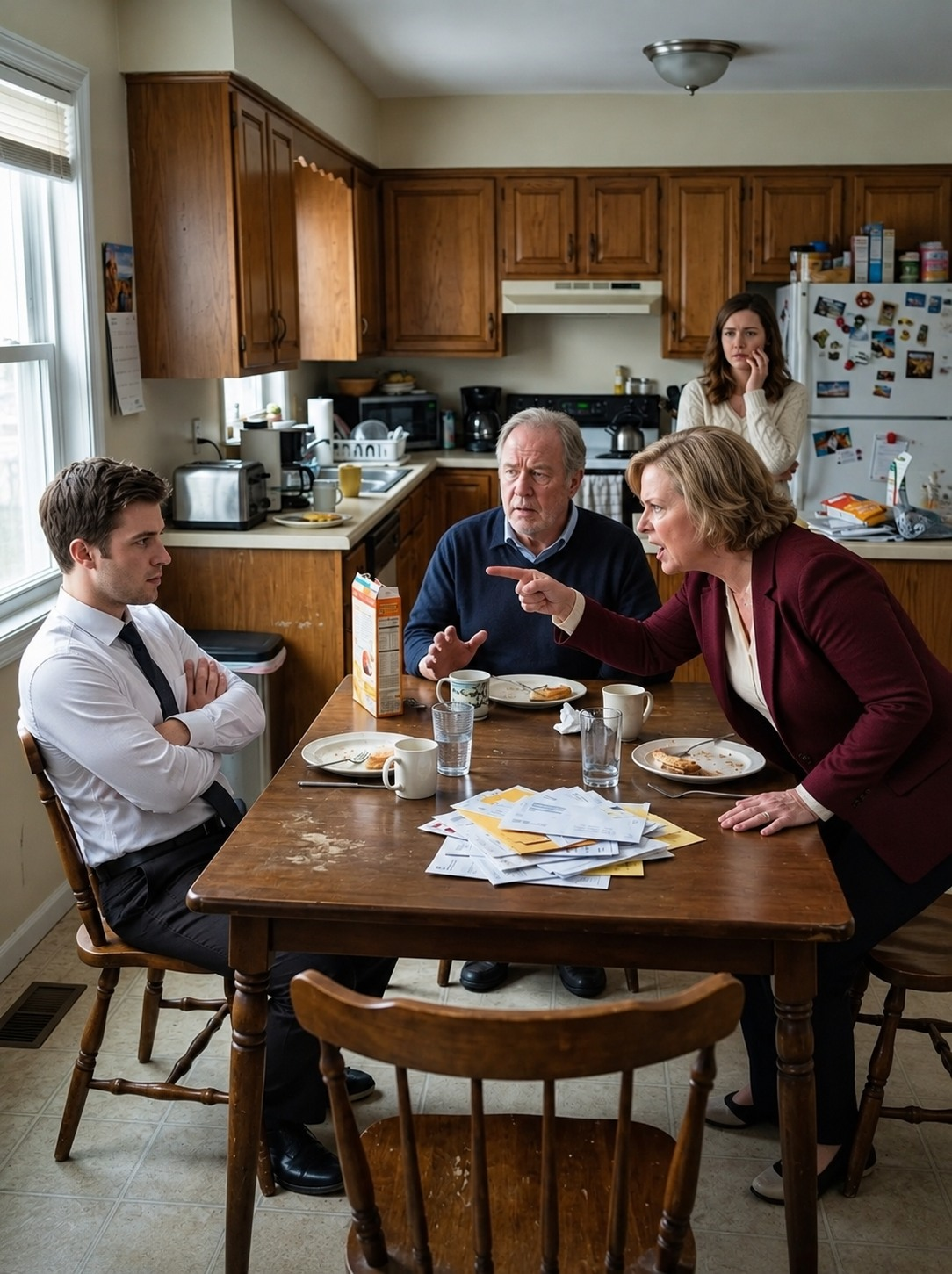
"She's on her way to the bank. And she's carrying your identification documents."
My father's words made me stand so quickly that my chair scraped across the kitchen floor.
"What bank?" I asked.
"I don't know."
"Dad, which documents?"
He hesitated.
"Copies of your old driver's license. Your military paperwork. Some forms from the filing cabinet."
I closed my eyes.
"How do you know?"
"She took the blue folder out of the garage."
"Did you see her leave?"
"Yes."
"Was Britney with her?"
"No."
I looked at the clock.
It was after eight in the evening.
Most bank branches were closed.
Whatever Mom intended to do, I doubted she was walking into an ordinary branch to speak with a teller.
"Dad, did she say where she was going?"
He paused.
"She said she had to fix this before tomorrow."
My stomach tightened.
"Fix what?"
"She wouldn't tell me."
I took a breath.
"Listen carefully. Don't follow her. Don't try to take the documents from her. I'm going to contact the institution through its verified fraud line."
Dad was quiet.
Then he said, "Son, I'm scared."
I closed my eyes.
My father had spent most of his life pretending that difficult things would disappear if everyone stayed calm.
Hearing him admit fear was almost as unsettling as the financial records.
"I know," I said. "But we need to handle this properly."
After we hung up, I opened the email about the new account activity.
The message appeared to come from a financial services company whose name I didn't recognize.
It described a pending transaction.
The amount was substantial.
And the account holder's name was mine.
I didn't click the embedded links.
I copied the institution's name into a separate search, found its official contact information, and called the number listed on its website.
A representative answered after several minutes.
I explained that I had received an account notification but had never knowingly opened an account with the company.
She asked me to verify limited identifying information.
Then she placed me on hold.
I stared at my laptop while the music played.
Five minutes passed.
Then seven.
When she returned, her tone was careful.
"Mr. Carter, we have located an account associated with your identifying information."
My stomach tightened.
"Did I open it?"
"I can't determine that from this call."
"I never applied for one."
"I understand. We can begin an identity-theft review."
I took a breath.
"Is there a transaction pending?"
"An outgoing transfer request has been flagged for additional verification."
I closed my eyes.
"Can it be stopped?"
"The request is currently restricted pending review. I can document that you're disputing the account and the transfer."
"Please do."
She gave me a case number.
I wrote it down.
Then I asked whether anyone had recently attempted to update the account's authorized representative.
There was a pause.
"I can confirm that account-access changes are among the activities under review."
I looked at the photograph Britney had sent.
Full authority granted indefinitely.
"Can you tell me who requested those changes?"
"Not until the review is complete."
I understood.
But the uncertainty was exhausting.
I thanked her, requested written confirmation, and ended the call.
Then I contacted Rachel Bennett through the verified channel I'd used before.
I left a message explaining that another institution had identified an account associated with my information and a pending transfer I hadn't authorized.
I provided the new case number.
I didn't assume the accounts were connected.
But I wanted the investigators to know what I'd found.
By the time I finished, my hands were trembling.
I placed the phone on the counter.
Then I walked to the bathroom.
The burn on my cheek was healing.
The redness had faded slightly.
But the skin still felt tight when I moved my jaw.
I looked at myself in the mirror.
Nine days earlier, I had been looking forward to visiting my family.
Now I was trying to stop someone from moving money through an account I hadn't opened.
I splashed cool water on my hands.
Then returned to the kitchen.
My phone buzzed.
A message from Britney.
You called them, didn't you?
I stared at it.
Then another.
Mom was trying to fix it.
I typed:
Fix what?
She replied immediately.
The account.
Which account?
No answer.
I waited.
Then she sent:
You really don't remember anything, do you?
I frowned.
Remember what?
The three little dots appeared.
Disappeared.
Then another message arrived.
The paperwork you signed before deployment.
I sat down.
I hadn't signed any debt-consolidation application before deployment.
I knew that.
But Britney was trying to make the story sound as though I'd forgotten something.
I opened my documentation folder.
Found the deployment-related authorization.
Read it again.
It was limited to specific administrative tasks.
There was nothing about borrowing money.
Nothing about opening investment accounts.
Nothing about authorizing my sister to act on my behalf.
I saved another copy.
Then I replied:
I have the original authorization. It does not permit any of the transactions being investigated.
Britney didn't answer.
For nearly ten minutes, my phone stayed quiet.
Then she sent a message that made me stop breathing.
You don't have the original.
I stared at the screen.
Another message followed.
Mom threw those papers away years ago.
I looked toward my desk.
A small black external hard drive sat beside my laptop.
I hadn't used it in months.
But I knew exactly what was on it.
Before every deployment, I backed up important records.
Financial statements.
Insurance documents.
Tax returns.
Vehicle registrations.
Administrative forms.
Scanned copies of signed paperwork.
I had been doing it for years.
It was a habit I'd developed after losing a folder of documents during a move early in my military career.
Britney apparently thought that because Mom had discarded the paper copies, the records no longer existed.
She was wrong.
I connected the drive.
The familiar folder structure appeared.
I opened the archive from the year before my deployment.
There it was.
Personal Documents — Final.
I clicked it.
Inside were dozens of files.
Some I'd forgotten about.
An old lease.
A vehicle insurance renewal.
A copy of my passport identification page.
And the limited authorization I'd given Mom.
I opened the original scanned document.
Every page was there.
The date.
The signature.
The restrictions.
The expiration provision.
I leaned back.
For the first time all evening, I felt something close to relief.
Not because the problem was solved.
Because I had proof of what I'd actually signed.
I opened Britney's conversation.
Typed:
I have a complete scanned copy of the original document.
Then I stopped.
I deleted the message.
Rachel had advised me not to discuss specific evidence with people who might have been involved.
She was right.
Britney didn't need to know what records I possessed.
The investigators did.
I uploaded the original scan through the secure portal.
Then I checked the file's metadata and the surrounding archived records to establish when the copy had been created.
The scan had been saved before my deployment.
Long before the disputed account.
That mattered.
I wrote it down.
Then I continued searching the archive.
I found something else.
A folder labeled Family Assistance.
I'd almost forgotten it existed.
Inside were records of money I'd sent home over the years.
Transfers to Britney.
Payments I'd made directly to utility companies.
A car insurance bill.
A phone bill.
And the four-thousand-dollar transfer from 2019.
I opened the confirmation.
The recipient account was Britney's.
The amount was exactly four thousand dollars.
The date matched my notes.
Then I opened the messages I'd saved alongside it.
Britney had written:
Thank you. I swear I'll pay you back.
A few days later:
The landlord is off my back now.
I stared at that sentence.
Mom had admitted Britney only owed about twelve hundred dollars in rent.
The rest had gone somewhere else.
I opened another file.
A spreadsheet I'd made years earlier.
It listed every payment I'd sent Britney.
I hadn't created it to punish her.
I'd created it because I was trying to understand why she always needed money.
I scrolled down.
The total made me pause.
Over several years, I'd sent her more than eleven thousand dollars.
Not including gifts.
Not including the phone plan.
Not including the times I'd paid for groceries or gas.
Eleven thousand dollars.
I sat back.
I remembered each payment as a separate emergency.
A flat tire.
A late bill.
A medical expense.
A job transition.
But together, they told a different story.
Britney hadn't been experiencing one temporary crisis.
She'd been living in a permanent cycle of financial emergencies.
And I had been one of the people keeping that cycle going.
I closed the spreadsheet.
Then I noticed a folder I'd created during my last deployment.
Banking Correspondence.
I opened it.
Inside were monthly statements, security notifications, and emails from my primary bank.
Most were routine.
But one message caught my attention.
It was a security alert from nearly two years earlier.
New Device Sign-In Attempt.
I opened it.
The message described an attempt to access my online banking profile from an unfamiliar device.
The location was listed as Denver.
I stared at the date.
It was the same week the older debt-consolidation account had been opened.
My stomach tightened.
I remembered receiving the alert.
I had been overseas.
I'd changed my password immediately.
Enabled additional security measures.
And assumed someone had mistyped a username or attempted a common credential attack.
I hadn't connected it to my family.
Why would I?
At the time, I had no reason to suspect anyone close to me.
I opened the next email.
Password Reset Requested.
Then another.
Security Verification Failed.
I sat perfectly still.
Three attempts.
All within forty-eight hours.
I had saved the emails but never investigated further because the account hadn't been accessed successfully.
Now I wondered whether those attempts were related to the disputed financial activity.
I couldn't prove it.
But the timing was significant.
I added the records to my evidence folder.
Then I checked my old messages from the same period.
Britney had texted me.
Hey, did you change your bank password?
I stared at the screen.
I had replied:
Yes. Why?
She'd answered:
Mom was trying to check something for you.
I remembered the exchange.
At the time, I'd been irritated.
I'd told Britney that nobody should attempt to access my bank account without asking.
She'd apologized.
Then changed the subject.
I scrolled down.
There was another message.
Mom says sorry. She thought she was helping.
I stared at it.
For nearly two years, I'd believed that was the end of the matter.
Now it looked very different.
I saved the conversation.
Then I called Mom.
She answered after several rings.
"Honey?"
"Mom, did you try to log into my bank account while I was deployed?"
Silence.
Then she said, "Why are you asking?"
"Because I found the security alerts."
She took a shaky breath.
"I don't remember."
I closed my eyes.
"Mom, Britney texted me about it."
Another pause.
Then she whispered, "She was trying to check whether the loan payment had gone through."
My stomach dropped.
"What loan payment?"
"The consolidation payment."
I stared at the wall.
"Mom, why would that require logging into my bank account?"
She didn't answer.
I waited.
Then she said, "Britney thought the account was connected."
I closed my eyes.
"Connected how?"
"I don't know."
"Mom."
"I really don't."
I took a slow breath.
"Did you know she was trying to access my bank account?"
"Yes."
"Did you give her my password?"
"No."
"Did you give her anything else?"
She hesitated.
"An old email address."
I rubbed my forehead.
"Mom, you need to stop giving her my personal information."
"I know."
"Did you tell Dad?"
"No."
I stared at the wall.
Of course not.
Dad had apparently spent years living in the same house as two people who were making financial decisions involving his son without telling him.
I wondered how much of his confusion was genuine.
And how much came from not wanting to see what was happening.
"Mom, where are you right now?"
She hesitated.
"Why?"
"Dad said you left with my documents."
She went quiet.
Then she said, "I'm trying to fix things."
"Where?"
"At an office."
"What office?"
She didn't answer.
I closed my eyes.
"Mom, please don't sign anything on my behalf."
"I won't."
"Don't submit any documents using my identity."
"I won't."
"Don't tell anyone I authorized something I didn't."
Her voice broke.
"Honey, I'm not trying to hurt you."
I swallowed.
"Then stop making decisions about me without asking."
She began crying.
"I just want this to be over."
"So do I."
For a moment, neither of us spoke.
Then she whispered, "Britney said if I didn't help her, they'd come after the house."
I sat straighter.
"Who would?"
She hesitated.
"The people she owes."
I felt my chest tighten.
"Which people?"
"I don't know."
"Mom, is she being threatened?"
"I don't know."
I rubbed my forehead.
"Then why would she say that?"
Mom began crying harder.
"She said we could lose everything."
I stared at the wall.
The same phrase.
Again.
Lose everything.
It had been used to justify the four-thousand-dollar transfer.
The debt-consolidation application.
The mortgage payment.
The forged signatures.
Every time Britney needed money, the consequences supposedly threatened the entire family.
And every time, somebody else was expected to rescue her.
"Mom, go home," I said.
She sniffed.
"I can't."
"Why not?"
"Because I already made an appointment."
My stomach tightened.
"With who?"
She hesitated.
"Someone who handles financial documents."
I closed my eyes.
"Mom, don't sign anything."
"I told you I won't."
"Then leave."
She started crying again.
"I can't."
"Why?"
There was a long silence.
Then she whispered, "Because Britney is already here."
I sat perfectly still.
Dad had said Mom left alone.
But Britney had apparently gone separately.
"Mom, what are you doing?"
She didn't answer.
Then I heard another voice in the background.
A woman.
Professional.
Calm.
"Mrs. Carter, we're ready for you."
My mother whispered, "I have to go."
"Mom—"
The call ended.
I stared at the phone.
Then I called Dad.
He answered immediately.
"Son?"
"Mom's with Britney."
He sighed.
"I figured."
"Do you know where?"
"No."
I explained what Mom had said.
The appointment.
The financial documents.
The woman calling her inside.
Dad was quiet for a moment.
Then he said, "There's something you should know."
I closed my eyes.
"What?"
"Britney came home this afternoon and asked where I kept the old mortgage paperwork."
My stomach tightened.
"Did you give it to her?"
"No."
"Good."
He hesitated.
"She said she needed it to prove the house was still in our names."
I sat up.
"Why would she need to prove that?"
"I don't know."
I stared at the wall.
The house.
The loan.
The old account.
The unauthorized transfers.
Everything kept circling back to the property my parents had owned for more than twenty years.
"Dad, please don't sign anything related to the house until you've had it independently reviewed."
"I won't."
"Promise me."
"I promise."
Then he said, "Son, I found another folder."
I closed my eyes.
"Where?"
"In the garage."
"What was in it?"
"Copies of old bank statements."
I waited.
"One of them has your name on it."
My stomach tightened.
"Another account?"
"I think so."
"Send me a picture."
He did.
I opened the image.
The statement showed an account number I didn't recognize.
My name appeared at the top.
But the mailing address was my parents' house.
I stared at it.
The account had been active during my deployment.
There were deposits.
Withdrawals.
Transfers.
And one recurring payment.
Every month, the same amount left the account.
I enlarged the transaction description.
It was labeled as a payment to a mortgage servicing company.
I felt cold.
" Dad," I said, "do you recognize this company?"
He looked at the statement.
Then answered.
"That's our mortgage servicer."
I stared at the screen.
For nearly two years, an account bearing my name had apparently been making payments toward my parents' mortgage.
I hadn't opened the account.
I hadn't authorized those payments.
And I had never known it existed.
I checked the dates.
The payments began shortly after the older debt-consolidation application.
They continued for months.
Then stopped.
I scrolled down.
The final payment had been made six months earlier.
The same period when the bank had rejected the account closure request.
I sat back.
Suddenly, Mom's earlier admission made more sense.
She hadn't simply used one loan payment to catch up on the mortgage.
There had been an ongoing arrangement.
One that involved an account in my name.
One that had apparently supported my parents' household for a significant period.
I took a screenshot.
Then another.
I saved everything.
Dad was still on the phone.
"Son?"
"I'm here."
"Is it bad?"
I looked at the statement.
"I don't know yet."
He sighed.
"I wish I'd known."
I swallowed.
"So do I."
After we hung up, I opened the archived records again.
I searched for the unfamiliar account number.
Nothing.
Then I searched for the financial company's name.
One result appeared.
An old email.
It had been filtered into a folder I'd created for suspicious messages.
I opened it.
The subject line read:
Account Opening Confirmation.
My stomach tightened.
The email was dated nearly two years earlier.
It had been sent to an address that looked similar to mine.
But one character was different.
I leaned closer.
Someone had created an email address that resembled my own.
Not identical.
Close enough that a hurried employee might not notice.
I stared at the screen.
Then I checked the archived security alerts.
The same alternate email address appeared in one of the password reset attempts.
My pulse quickened.
I saved the message.
Then I opened the account confirmation.
It contained a reference number.
A partial account identifier.
And a contact telephone number.
I recognized the last four digits.
Britney's old phone number.
The one she'd used before changing carriers.
I sat perfectly still.
She had changed that number about a year earlier.
At the time, she'd said she was tired of collection calls.
I hadn't thought much about it.
Now I wondered whether she'd changed it because the accounts were becoming difficult to manage.
I opened my old phone backups.
Found the number.
Confirmed the match.
Then I saved the evidence.
My phone buzzed.
Rachel Bennett.
I answered immediately.
"Hello?"
"Mr. Carter, we've reviewed the additional records you submitted."
I sat straighter.
"Okay."
"The archived authorization document is helpful."
I let out a breath.
"Good."
She continued.
"We also located a discrepancy in the contact information associated with the older application."
I looked at the alternate email address.
"An email address?"
"Yes."
"I found one too."
There was a pause.
"Can you explain?"
I told her about the archived confirmation.
The altered email address.
The old phone number.
The security alerts.
She listened carefully.
Then asked me to upload the records.
I agreed.
Before hanging up, she said, "There's one more matter we need to discuss."
I sat forward.
"What?"
"We've identified a person who may have been responsible for submitting some of the account information."
My stomach tightened.
"Who?"
"I can't give you a final conclusion yet. But we're arranging additional verification."
I closed my eyes.
"All right."
Then she asked, "Do you still have the original records from your deployment?"
"Yes."
"All of them?"
"As far as I know."
She paused.
"Please don't delete anything."
"I won't."
After the call, I uploaded the archived emails and phone records.
Then I sat quietly.
For the first time, I understood why Britney had been so confident that I'd never discover the older account.
She thought the documents were gone.
She thought the email trail had disappeared.
She thought my deployment meant I wouldn't notice.
But she hadn't known about the backups.
She hadn't known I kept old records.
And she hadn't known how carefully I documented things.
My phone buzzed again.
A message from Britney.
Mom says you're digging through old files.
I didn't answer.
Another message.
Those records don't prove anything.
I stared at it.
Then:
You should have deleted them when I told you to.
I sat perfectly still.
I remembered that conversation.
Years earlier, Britney had complained that I kept too many old documents.
She'd told me to clear out my computer.
Said I was paranoid.
Said nobody needed records from five years ago.
At the time, I'd laughed.
Now I understood why she'd cared.
I saved the message.
Then I turned off notifications.
It was nearly midnight.
I needed sleep.
But before I could close the laptop, a new email arrived from the second financial institution.
The subject line read:
Identity Verification Review — Additional Information.
I opened it.
The message stated that the pending transfer remained restricted.
Then it asked me to review a document associated with the account's original opening.
I clicked the attachment.
A scanned application appeared.
My name.
My old address.
My date of birth.
And a signature I hadn't written.
I scrolled down.
The application listed an authorized representative.
Britney.
But beneath her name was another section.
Additional Authorized Individual.
I leaned closer.
The name was partially obscured by a scanning error.
I enlarged the image.
The first name was visible.
Linda.
My mother.
I stared at the screen.
Then I noticed a small handwritten note beside her name.
Access confirmed by account holder.
I had never confirmed anything.
I opened the next page.
It contained a verification record.
A date.
A time.
And a reference to a telephone call.
I checked the date.
It was during my deployment.
I couldn't have received that call on my personal number.
I scrolled farther.
The verification record listed the number used.
Britney's old number.
I sat back.
Someone had apparently answered a call intended for me.
Someone had claimed to verify my identity.
And someone had authorized access to an account in my name.
I reached for my phone.
But before I could call Rachel, another email arrived.
This one was marked urgent.
The subject line read:
Original Verification Audio Located.
I opened it.
The message contained a secure link to a recording available for review through the institution's verified portal.
I logged in.
A short audio file appeared.
The date matched the application.
The time matched the verification record.
I pressed play.
A woman's voice spoke first.
"Thank you for calling. Can you confirm that you are the account holder?"
There was a pause.
Then a second voice answered.
"Yes."
I stopped breathing.
The voice sounded familiar.
Not identical to mine.
Not even close.
It was a woman's voice.
And I knew exactly whose voice it was.
I reached for the volume control.
Then the recording continued.
The representative asked:
"Can you confirm your full name?"
The woman answered.
She gave my name.
My full name.
Then the representative asked:
"Are you authorizing Linda Carter and Britney Carter to access this account?"
The woman replied:
"Yes. They have my permission."
I stared at the screen.
My hands went cold.
Because the voice wasn't Britney's.
It wasn't Mom's.
And it wasn't a stranger's.
It belonged to someone I had trusted for years.
Someone who had helped me prepare for deployment.
Someone who had handled my paperwork.
Someone who had been standing beside me when I signed the original authorization.
I reached for my phone.
Then another notification appeared.
A message from Dad.
Son, I found the original phone records.
I opened it.
A photograph loaded.
It showed a handwritten list of calls.
Dates.
Times.
Names.
And beside the verification call was a single name.
I leaned closer.
Then my phone rang.
It was Rachel.
I answered.
"Mr. Carter," she said, "we need to discuss the voice on that recording."
I swallowed.
"I know who it is."
She paused.
Then said:
"Before you tell me, there's something you need to understand."
I gripped the phone.
"What?"
Her voice lowered.
"The person who answered that call wasn't pretending to be you."
I stared at the screen.
"Then what were they doing?"
She hesitated.
"They were using an authorization that had already been entered into the bank's system."
My chest tightened.
"What authorization?"
A pause.
Then Rachel said:
"One that was supposedly signed by you six months earlier."
I looked at the archived documents.
The dates.
The signatures.
The phone records.
And suddenly I realized the oldest document I'd found wasn't the beginning.
There was something before it.
Something I'd never seen.
Rachel continued.
"We've requested the original authorization file."
I waited.
Then she said:
"And according to the bank's records, the person who witnessed your signature was—"






Comments 0