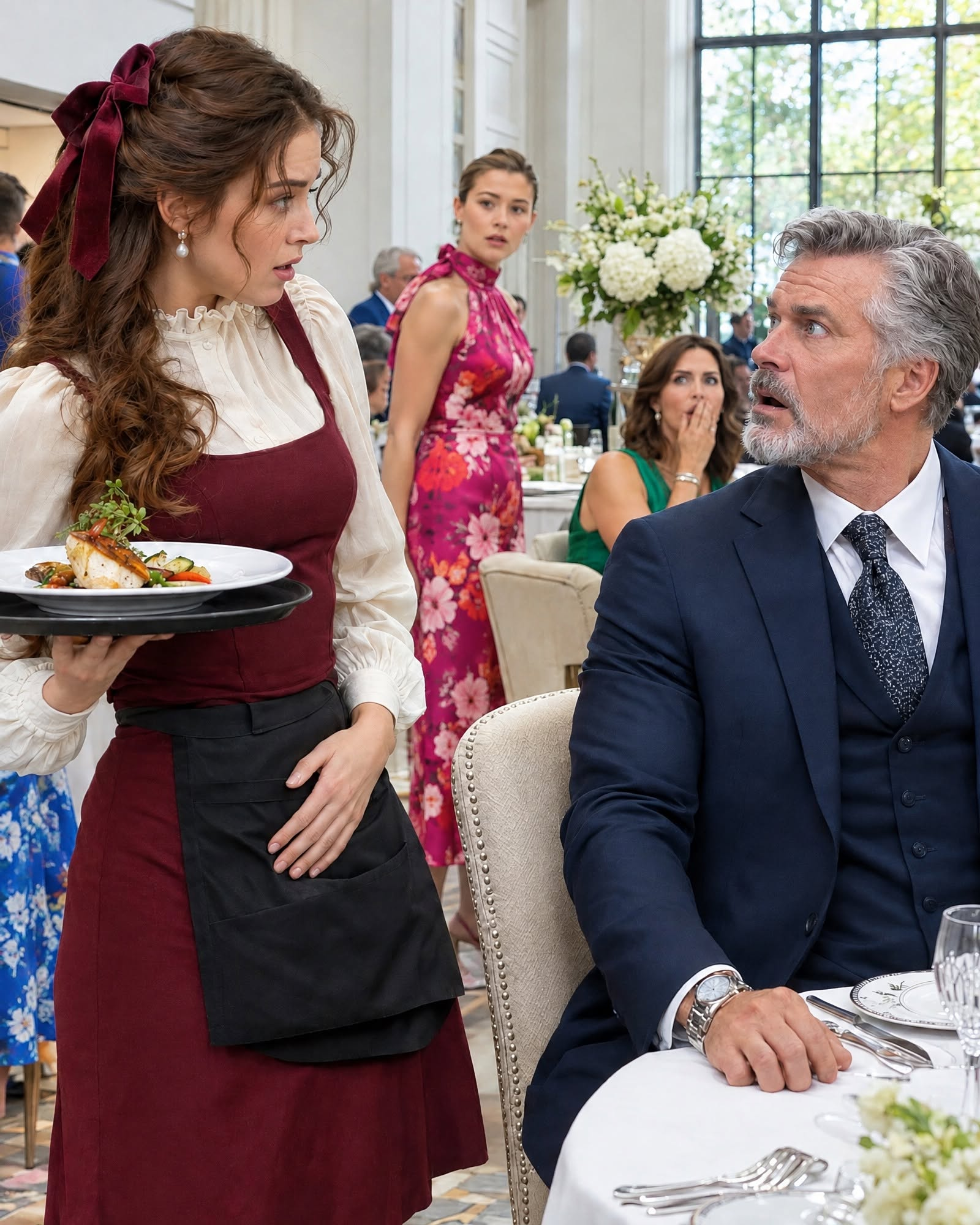
The scream came through the telephone so sharply that Lucía grabbed my arm.
Then we heard Detective Ríos shout.
"Everybody out of the room! Now!"
A crash followed.
Someone was crying.
Then the line went dead.
I stared at the phone in Jorge's hand.
"Call her back."
He was already dialing.
No answer.
"Again."
He tried.
Nothing.
My heart hammered against my ribs.
Arturo Vega was alive. We had heard his voice.
He was sitting inside a hidden room behind the archives of my own company, and someone had opened a cabinet he was terrified of.
Now the police weren't answering.
I pushed the blanket aside.
"Get my clothes."
Jorge turned toward me.
"Ernesto, absolutely not."
"That's my building."
"And you're in a hospital."
"Arturo could be dying!"
Lucía stepped between us.
"Don Ernesto, please."
Her voice stopped me.
She was pale, exhausted, and holding her stomach.
I looked at her, then at the hospital bracelet around my wrist.
For one irrational second, I wanted to tear it off.
I had spent my entire life solving problems by going directly to them.
Now my body wouldn't let me.
And the worst problems I had ever faced were happening in places I owned, involving people I loved, while I lay helpless in a hospital bed.
Jorge's phone rang.
He answered immediately.
"Detective?"
I leaned forward.
Ríos's voice came through, strained but steady.
"Everyone is safe."
I closed my eyes.
"Thank God."
"There was a woman inside the adjoining storage area. She screamed when one of our officers opened the cabinet."
I frowned.
"A woman?"
"Yes."
"Who?"
"We're confirming her identity."
"What was in the cabinet?"
A pause.
"Recording equipment and several containers. We're treating the area as potential evidence."
I looked at Jorge.
He understood the significance immediately.
"Was Arturo hurt?" I asked.
"He's conscious. He appears to have injuries consistent with an assault. Medical personnel are examining him."
"Can I speak to him?"
"Not yet."
I gripped the bedrail.
"Detective, he's been trying to warn me for days."
"I understand. But we need to establish what happened in that room."
"Was he being held there?"
"We're investigating that."
I swallowed.
"And the woman?"
Ríos hesitated.
"She says she was brought there against her will."
A cold sensation moved through my chest.
"By whom?"
"We're working on that."
I almost shouted.
Instead, I forced myself to breathe.
"Please keep them safe."
"We will."
The call ended.
I looked at Jorge.
He looked back at me.
Neither of us spoke.
Then Lucía whispered, "Adrián did this."
I wanted to deny it.
I wanted to say that my son could be dishonest, selfish, even cruel, but that he would never have people imprisoned inside a hidden room.
Yet the words wouldn't come.
Because I no longer knew where my son's cruelty ended.
The next morning, I woke to the sound of my phone vibrating against the bedside table.
For a moment, I forgot where I was.
I reached toward the familiar sound, expecting to hear Elena moving around our bedroom.
Then I saw the hospital curtains.
The medical monitor.
The water bottle Jorge had opened for me.
And I remembered everything.
The phone was still vibrating.
Adrián.
I stared at his name.
My son had called eleven times during the night.
He had sent seven messages.
The newest was only four words.
Breakfast tomorrow. Just us.
I sat upright.
Another message appeared.
Eight o'clock. Our usual table.
I felt my stomach tighten.
Our usual table.
For years, Adrián and I had breakfast every Thursday at a quiet restaurant near the company headquarters.
We always sat beside the window.
He ordered scrambled eggs and black coffee.
I ordered chilaquiles and coffee with a little milk.
It had been our ritual since he joined the business.
Even when we argued, we kept that breakfast appointment.
Sometimes we discussed contracts.
Sometimes football.
Sometimes Elena.
I had believed those mornings were proof that our relationship was strong.
Now I wondered whether they had simply given Adrián another opportunity to watch me drink whatever he placed in front of me.
My phone vibrated again.
Papá, we need to settle this before things get worse.
I read the words twice.
Then another message arrived.
You know I would never hurt you.
I stared at the screen.
For the first time, I didn't feel anger.
I felt grief.
Because there had been a time when I would have believed that sentence without hesitation.
Dr. Robles arrived shortly after seven.
She examined me, reviewed my latest results, and asked how I was feeling.
"Better," I admitted.
"Any dizziness?"
"Some."
"Tremors?"
I held out my hands.
They were still shaking, but less severely than before.
She nodded.
"Your condition is showing signs of improvement, although we still need to monitor you."
I looked at her.
"Does that mean whatever was making me sick is leaving my body?"
"Your improvement is encouraging, but we can't draw that conclusion from symptoms alone."
I nodded.
She sat beside the bed.
"Ernesto, there's something else."
My stomach tightened.
"What?"
"The toxicology team has identified findings consistent with exposure to a harmful substance."
I stared at her.
"Which one?"
She explained that the laboratory had detected an abnormal exposure marker requiring confirmation and further interpretation.
The results were being reviewed alongside my kidney and neurological findings.
She was careful not to claim more than the evidence supported.
But I understood the importance.
For six months, I had been told I was simply exhausted.
Now there was objective medical evidence that something else might have been happening.
"Could it have come from my coffee?" I asked.
"That's one possibility investigators will need to examine."
"Could it have been the tablets?"
"Also possible."
I looked down.
"Can you prove who gave it to me?"
"No."
Her answer was immediate.
"Medical tests can help identify exposure. They cannot establish who caused it."
I nodded.
I had expected that.
But hearing it still hurt.
She leaned forward.
"You're making progress, Ernesto. Focus on your recovery."
I looked at her.
"My son wants to meet me for breakfast."
Her expression changed.
"Do you intend to go?"
"I don't know."
She studied me.
"Given what you've told us, I strongly advise against meeting him privately."
I nodded.
"That's what everyone keeps saying."
"Because your safety matters."
I looked away.
For years, Adrián had told me that same thing.
Your safety matters, Papá.
He had used those words to persuade me to stop driving.
To reduce my work hours.
To let him handle my appointments.
To accept medication without questioning it.
I had trusted him because he was my son.
Now a stranger was telling me to protect myself from him.
And I didn't know how to live with that.
Jorge arrived with Valeria at eight-thirty.
They brought documents, a laptop, and expressions that told me they hadn't slept.
Valeria sat beside the bed.
"We have updates."
I sighed.
"Good or bad?"
"Both."
"Start with the good."
She opened her folder.
"Your independent medical evaluation supports your ability to understand and make decisions."
I exhaled.
"Thank God."
"Adrián's attempt to portray you as incompetent is being challenged."
I nodded.
"And the bad?"
She hesitated.
"He's escalating."
I looked at her.
"How?"
"He has contacted several major clients, claiming the company is experiencing a leadership crisis."
Jorge shook his head.
"He's trying to scare them into accepting his authority."
I felt anger rising.
"What about the twelve-million-peso contract?"
Valeria opened another document.
"The buyer has suspended further payments pending clarification."
I nodded.
"Good."
"But the three-million-peso advance remains unaccounted for."
I looked at Jorge.
"Horizonte Advisory?"
He nodded.
"Yes."
Valeria continued.
"We're tracing the account records. But the ownership structure is complicated."
"Because Mendoza is involved."
"His name appears in the records. We're still establishing the extent of his role."
I leaned back.
"And the company shares?"
"The disputed transfer is under review. We've requested urgent measures to prevent further unauthorized transactions."
I nodded.
Then Jorge said something that made me look up.
"Ernesto, the police found more records in the hidden room."
My heart pounded.
"What kind?"
"Payment schedules. Internal correspondence. Copies of agreements."
"Anything useful?"
He hesitated.
"Very."
I sat forward.
"Tell me."
Jorge opened his laptop.
He showed me a photograph of a spreadsheet.
At first, it looked ordinary.
Dates.
Amounts.
Account references.
Then I noticed a column labeled Medical Consultation.
I stared at it.
"What is that?"
Jorge's expression darkened.
"Payments associated with Horizonte Advisory."
I looked at the dates.
They began almost six months earlier.
The same period when my symptoms started.
My stomach turned.
"How much?"
"Several payments. Some small, some substantial."
I stared at the screen.
"And the recipient?"
Jorge hesitated.
"One account appears connected to Mendoza's professional practice."
I closed my eyes.
I thought about the doctor's confession.
The medication sample.
The financial misconduct.
His failure to warn me.
Now the money trail was beginning to support the suspicion that he had been paid to remain silent.
I opened my eyes.
"Does Adrián know the police found this?"
"Not from us," Jorge replied.
I nodded.
"Then keep it that way."
Lucía arrived shortly afterward with Clara.
She wore a loose cream-colored dress that Clara had bought for her.
Her dark hair was tied back.
She looked tired, but healthier than she had at the restaurant.
I smiled when I saw her.
"Good morning, hija."
She smiled faintly.
"Good morning."
I noticed she was carrying a small paper bag.
"What's that?"
She looked embarrassed.
"Breakfast."
I stared at her.
She opened the bag.
Inside was a warm bread roll and a small container of fruit.
"Clara said you might be hungry."
I felt tears sting my eyes.
My son had spent months bringing me coffee that I now feared had been contaminated.
And the woman he had accused of stealing from us was bringing me breakfast because she worried I hadn't eaten.
"Thank you," I whispered.
Lucía sat beside me.
For a moment, we simply shared the fruit.
It was the first peaceful moment I'd experienced in days.
Then she looked at my phone.
"Has Adrián contacted you?"
I nodded.
"He wants to meet."
Her expression changed.
"Where?"
"Our usual breakfast restaurant."
She shook her head immediately.
"No."
"Lucía—"
"Please don't go."
I looked at her.
"He says he wants to talk."
"He always says that."
Her voice tightened.
"Before he threw me out, he asked me to have breakfast with him."
I froze.
"What?"
She looked down.
"He said we needed to talk calmly."
My stomach tightened.
"What happened?"
"He made coffee."
I stared at her.
She swallowed.
"I didn't drink it."
"Why not?"
"Because he was watching me."
I felt a cold sensation move down my spine.
She continued.
"He kept asking whether I liked the taste. Whether I wanted more sugar."
I closed my eyes.
"And then?"
"I told him I felt sick."
Her voice weakened.
"He smiled and said I was probably nervous."
I looked at her.
"Did he insist?"
She nodded.
"He told me not to waste it."
I felt sick.
"What did you do?"
"I pretended to take a sip. Then I poured it into the sink when he left the room."
My hands began trembling.
"Did you keep any of it?"
She shook her head.
"No."
I looked away.
She rested a hand on my arm.
"Don Ernesto, I don't know what was in that cup. But I know how he looked at me."
I turned toward her.
"How?"
"Like he was waiting for something."
The words made my stomach twist.
Because I knew exactly what she meant.
At eleven, Detective Ríos arrived.
She looked exhausted.
But her expression was determined.
"Señor Salazar, we have some developments."
I sat upright.
"Arturo?"
"He's receiving medical care. His injuries are not life-threatening."
I exhaled.
"Thank God."
"He's agreed to provide a formal statement."
I nodded.
"And the woman?"
Ríos hesitated.
"Her name is Daniela Cruz."
I frowned.
"Do I know her?"
"She previously worked in your company's accounting department."
I stared at her.
"Daniela?"
The name stirred a memory.
A young woman with glasses.
Quiet.
Efficient.
She had worked under Arturo for several years.
Then she disappeared from the company.
Adrián told me she'd moved to another city.
Another employee who had supposedly left voluntarily.
"Why was she in that room?" I asked.
Ríos's expression hardened.
"She says she was brought there after refusing to alter financial records."
My stomach tightened.
"By Adrián?"
"She identified men associated with him."
I closed my eyes.
Dear God.
Ríos continued.
"She says she was threatened and prevented from leaving for a period of time."
I stared at her.
"How long?"
"We're still establishing the timeline."
I looked at Jorge.
He looked equally horrified.
I had built that company from nothing.
I had promised my employees fair treatment.
And somewhere inside the building, people may have been imprisoned because they refused to help my son commit fraud.
I felt physically ill.
"Detective," I whispered, "I want to cooperate fully."
She nodded.
"We'll need your help identifying certain records and personnel."
"Anything."
She studied me.
Then said, "There's another matter."
My stomach tightened.
"What?"
"We've obtained information suggesting Adrián may be preparing to leave Monterrey."
I stared at her.
"Leave?"
"Possibly."
"Where would he go?"
"We don't know."
I looked toward Jorge.
"He can't just disappear."
Ríos remained calm.
"We're taking appropriate steps, but I can't discuss every detail of the investigation."
I nodded.
Then I remembered the breakfast invitation.
"Detective, my son wants to meet me tomorrow morning."
Her expression sharpened.
"Where?"
I told her.
She considered it.
"Have you agreed?"
"No."
"Don't make any arrangements without speaking to us first."
I nodded.
Then she added, "And don't assume that because he's your son, the meeting would be safe."
I looked away.
That was the hardest sentence of all.
After Ríos left, I sat silently for a long time.
Lucía remained beside me.
She didn't try to fill the silence.
I appreciated that.
Finally, I said, "I keep thinking about when Adrián was little."
She looked at me.
"He used to wake me up every Sunday morning."
I smiled sadly.
"He'd climb onto my bed and ask whether we could go get breakfast."
Lucía listened.
"He always ordered pancakes. He never finished them."
I looked down at my hands.
"Elena used to laugh because he'd insist he was hungry enough to eat ten."
My voice cracked.
"Then he'd fall asleep in the car on the way home."
Lucía reached for my hand.
I swallowed.
"I don't understand how that little boy became this man."
She looked at me for a long moment.
Then said quietly, "Maybe you don't have to understand everything about him to stop him."
I stared at her.
She continued.
"You can love the boy he was and still protect yourself from the man he is."
I closed my eyes.
The words hurt.
Because they were true.
I had spent years confusing love with permission.
Every time Adrián crossed a line, I moved the line.
Every time he hurt someone, I found an explanation.
Every time he lied, I believed the version that made him look better.
And now I was lying in a hospital bed, afraid of what my son might do next.
At two in the afternoon, Valeria returned with another update.
She had obtained copies of several documents recovered from the hidden archive room.
Among them was a draft agreement concerning the twelve-million-peso construction contract.
I looked at it carefully.
The project description was familiar.
A commercial development outside Monterrey.
We had negotiated it for months.
But the payment instructions were wrong.
The advance was supposed to go into our company's operating account.
Instead, the document directed funds to Horizonte Advisory.
I looked at Valeria.
"This isn't the agreement I approved."
She nodded.
"That's important."
I pointed to the signature.
"And this isn't mine."
"We'll have it examined."
I leaned back.
"Adrián was using the contract to move money."
"That's one possibility the records support."
Jorge stepped closer.
"There's more."
He showed me another document.
It listed consulting payments.
Several were connected to Horizonte Advisory.
Others went to Grupo Altamira Holdings.
I frowned.
"Elena's trust?"
Jorge shook his head.
"Not directly. Someone appears to have used a similar company name in the paperwork."
I stared at him.
"What?"
"Grupo Altamira Holdings is not the same legal entity as the protective trust."
My stomach tightened.
"Then who owns it?"
Valeria hesitated.
"We're still tracing the controlling interests."
I closed my eyes.
Another shell company.
Another false trail.
Another name designed to make the money difficult to follow.
Then I noticed a familiar signature on one of the documents.
Not mine.
Not Adrián's.
Dr. Mendoza's.
I pointed to it.
"Why is he signing construction consulting agreements?"
Jorge shook his head.
"He shouldn't be."
I looked at Valeria.
"Can you prove the payments were connected to my illness?"
"Not yet."
I nodded.
But the pattern was becoming impossible to ignore.
Money left my company.
Some of it appeared connected to Mendoza.
My health declined.
My son gained authority.
And now he was trying to declare me incompetent.
I looked toward the window.
For the first time, I wondered whether Adrián had been planning this for years.
At four-thirty, my phone rang.
Adrián.
I stared at the screen.
Jorge looked up.
"Don't answer."
I hesitated.
Then I said, "I need to hear his voice."
Valeria frowned.
"Ernesto—"
"I'm not agreeing to anything."
I answered.
"Hello, Adrián."
"Papá."
His voice sounded relieved.
"Thank God. I've been trying to reach you."
"I'm aware."
"Where are you?"
"Somewhere safe."
A pause.
Then he laughed softly.
"What's that supposed to mean?"
"It means I'm resting."
"Are you in the hospital?"
I said nothing.
His voice changed.
"Papá, why didn't you tell me?"
"Because I didn't want visitors."
"I'm your son."
"I know."
The words hung between us.
Then he said, "We need to talk."
"About what?"
"Everything."
I looked toward Lucía.
She was watching me anxiously.
Adrián continued.
"People are telling lies about me."
"Who?"
"Lucía. Jorge. Maybe even Clara."
My stomach tightened.
"Clara?"
"Yes."
"Why would Clara lie?"
"Because she's been manipulating you."
I closed my eyes.
There it was again.
The same pattern.
Everyone else was dishonest.
Everyone else was dangerous.
Only Adrián could be trusted.
"Papá," he said gently, "I know you're confused."
I opened my eyes.
"I'm not confused."
"You're sick."
"I'm receiving treatment."
"And that's why you need me."
I stared at the wall.
"No, Adrián."
Silence.
"What?"
"I need the truth."
He exhaled.
"That's exactly what I'm trying to give you."
"Then tell me about Horizonte Advisory."
The line went silent.
I waited.
Finally, he said, "What about it?"
"Why did company money go there?"
"Consulting fees."
"Who authorized them?"
"Papá, we've discussed this."
"Answer me."
His voice hardened.
"You're not thinking clearly."
I felt anger rise.
"Don't say that to me again."
A long silence followed.
Then he spoke very softly.
"Papá, you're making a mistake."
I stared at the phone.
"Am I?"
"Yes."
"Then explain why Dr. Mendoza's name appears in the payment records."
Another silence.
This one lasted longer.
Then Adrián laughed.
A short, humorless sound.
"So that's what this is about."
"What?"
"Rafael."
I said nothing.
Adrián continued.
"He's been talking, hasn't he?"
I felt my stomach tighten.
"Should he have something to talk about?"
My son exhaled.
"Papá, you don't understand how complicated things have become."
"Then help me understand."
He paused.
Then said, "Meet me tomorrow morning."
I looked toward Jorge.
He shook his head.
Adrián continued.
"Eight o'clock. Our usual table."
"No."
His voice sharpened.
"Papá."
"I'm not meeting you alone."
Another silence.
Then he said something that made my blood run cold.
"I didn't say you'd be alone."
I sat upright.
"What does that mean?"
He ignored the question.
"Come to breakfast."
"Adrián—"
"I have something you need to see."
"What?"
"Something Mom left behind."
My heart stopped.
"Your mother?"
"Yes."
I stared at the wall.
"What are you talking about?"
He lowered his voice.
"There's a recording."
I felt my stomach tighten.
"A recording of what?"
"Mom."
I closed my eyes.
For seven years, I had wished I could hear Elena's voice again.
Now my son was offering it to me.
And I didn't know whether it was a gift or a trap.
"Where did you get it?" I asked.
"From her things."
"Why haven't you told me before?"
"Because I didn't think you were ready."
I felt sick.
He had used those words before.
When he told me Lucía had betrayed us.
When he convinced me to let him manage my appointments.
When he persuaded me to reduce my responsibilities.
You're not ready, Papá.
I opened my eyes.
"Send it to me."
"No."
"Why?"
"Because you need to hear it in person."
I looked toward Lucía.
She was shaking her head.
Adrián continued.
"Eight o'clock. Breakfast."
I took a slow breath.
"I'll think about it."
His voice softened.
"Good."
Then he added, "And Papá?"
"Yes?"
"Don't bring Jorge."
The line went dead.
I lowered the phone.
Nobody spoke.
Then Jorge said, "Absolutely not."
I nodded.
"I know."
Valeria leaned forward.
"He may be trying to lure you somewhere."
"I know."
Lucía reached for my hand.
"Please don't go."
I looked at her.
"I won't go alone."
She shook her head.
"Don't go at all."
I wanted to agree.
But the mention of Elena's recording had unsettled me.
What if Adrián really had something my wife left behind?
What if it contained information about the trust?
What if it explained why she had been so worried about him?
Or what if it was simply another lie designed to pull me back under his control?
I looked at Valeria.
"Can we tell Detective Ríos?"
"Of course."
"Then tell her everything."
She nodded.
Jorge leaned forward.
"Ernesto, whatever Adrián has, we can obtain it another way."
I wanted to believe him.
But I knew my son.
He didn't offer information unless he expected something in return.
And he had never sounded more determined than he did during that call.
That evening, Lucía stayed beside my bed while Clara arranged a safer place for her to live after discharge.
Jorge worked with Valeria to protect the company records.
The police continued interviewing Arturo and Daniela.
And I lay awake thinking about breakfast.
The smell of coffee.
The familiar table.
The way Adrián used to smile when I arrived.
I remembered teaching him to shake hands properly.
To look people in the eye.
To keep his promises.
I remembered telling him that a man's reputation was worth more than his bank account.
And I wondered whether he had heard any of it.
At nine-thirty, my phone vibrated.
A message from an unknown number.
Señor Salazar, this is Detective Ríos. Please call me.
I immediately dialed.
She answered.
"Ernesto, I need to discuss tomorrow's breakfast."
My heart pounded.
"Go ahead."
"We've reviewed your son's invitation."
"And?"
"We believe he may be trying to obtain something from you."
"What?"
"Possibly your signature or access to financial accounts."
I nodded.
"That makes sense."
She hesitated.
"There's another concern."
My stomach tightened.
"What?"
"We recovered a message from one of the phones associated with the men who entered Jorge's building."
I stared at the wall.
"What did it say?"
She paused.
Then answered.
"It referred to a final meeting."
I felt cold.
"What meeting?"
"We believe it may be tomorrow's breakfast."
I closed my eyes.
"Detective, what exactly did the message say?"
She hesitated.
Then read it aloud.
If the old man refuses again, finish it at breakfast.
For several seconds, I couldn't speak.
Then I whispered, "Finish what?"
Ríos's voice was quiet.
"That's what we're trying to determine."
I barely slept.
At six in the morning, I woke to a message from Adrián.
Good morning, Papá.
Then another.
I hope you slept well.
I stared at the screen.
A third message arrived.
I've already ordered your favorite coffee.
My hands began trembling.
I looked toward the hospital window.
The city was waking.
Cars moved along the streets.
People were going to work.
Families were preparing breakfast.
Somewhere, my son was sitting at our usual table, waiting for me.
I thought about the warning.
If the old man refuses again, finish it at breakfast.
I reached for my phone.
Before I could call Detective Ríos, another message appeared.
This one contained a photograph.
I opened it.
My heart stopped.
It showed our usual restaurant.
The familiar table beside the window.
Two cups of coffee.
And a small silver bracelet resting beside one of them.
Lucía's bracelet.
The one I had given her on her wedding day.
The one engraved with the initials E.S.A.
I stared at the photograph.
Then another message arrived.
Come alone, Papá.
A second photograph followed.
This one showed a woman sitting across from Adrián.
Her head was lowered.
Her hands were folded over her pregnant belly.
I couldn't see her face.
But I recognized the cream-colored dress.
Lucía.
My phone began ringing.
Adrián.
I answered immediately.
"Where is she?"
My son laughed softly.
"Good morning, Papá."
"Adrián, where is Lucía?"
"She's right here."
My heart hammered.
"Let me speak to her."
"Of course."
I heard movement.
A chair scraping.
Then a frightened voice whispered:
"Don Ernesto?"
I stopped breathing.
"Lucía?"
"Please don't come."
The line crackled.
Then Adrián spoke again.
"Eight o'clock, Papá."
I looked at the clock.
Seven forty-six.
Fourteen minutes.
"Adrián—"
"Don't be late."
The call ended.
I stared at the screen.
Then I looked toward the chair where Lucía had been sitting the night before.
It was empty.
Her cardigan was gone.
Her phone was lying on the bedside table.
I reached for it.
The screen lit up.
A message had arrived from an unknown number.
It contained only one sentence.
The woman in the photograph isn't Lucía.
I stared at the words.
Then another message appeared.
Your real daughter-in-law is still inside the hospital.
I slowly turned toward the bathroom door.
It was closed.
From the other side, someone whispered my name.






Comments 0