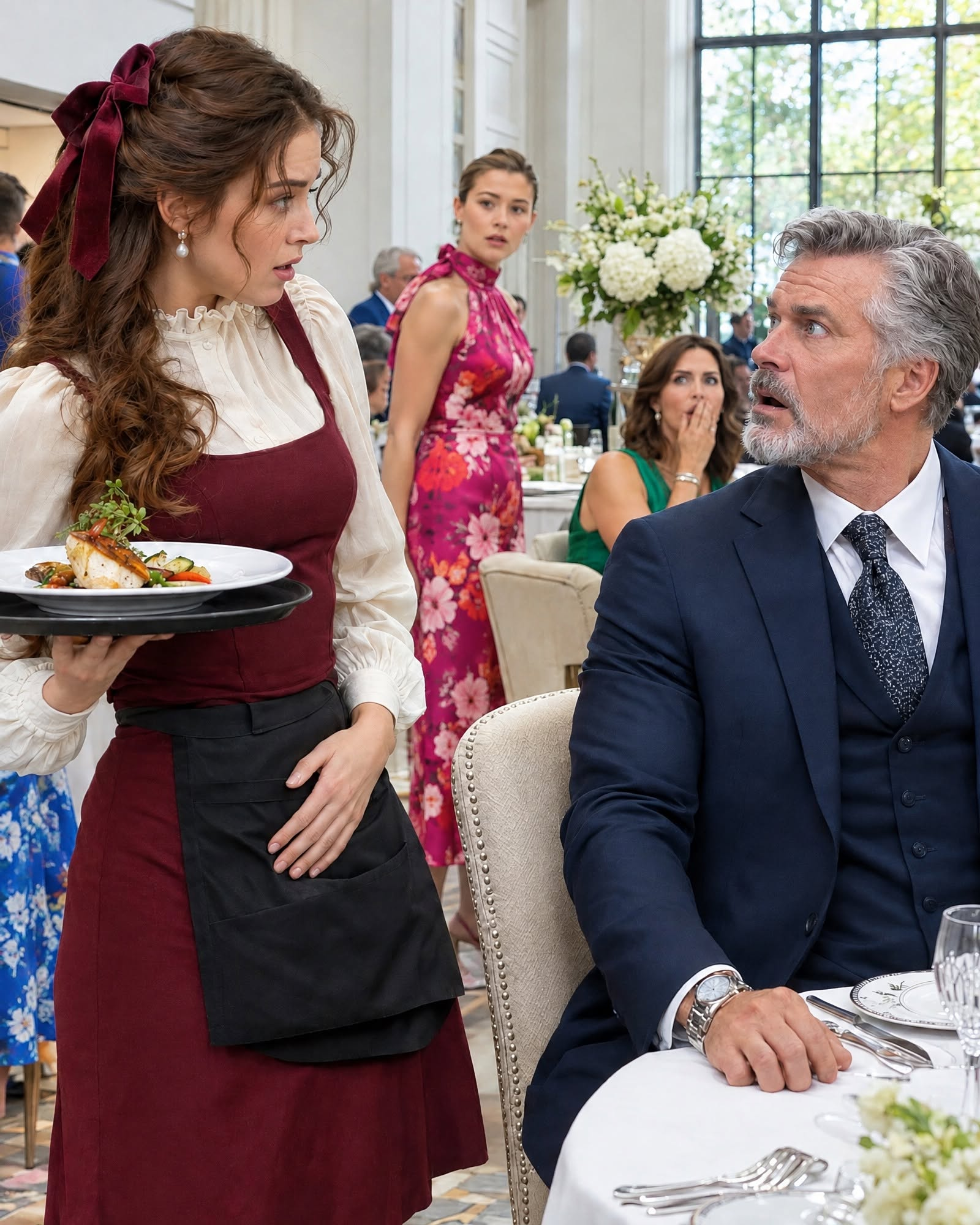
"Ernesto, I can explain."
Dr. Rafael Mendoza stood between two police officers, wearing hospital scrubs stained with blood.
For fifteen years, that man had treated my family.
He had been beside Elena during her final illness.
He had attended Adrián's wedding.
He had sat across from me at our dining table, laughing over coffee while my son poured another cup.
And now he was standing outside my hospital room, accused of trying to harm the woman carrying my grandson.
I stared at him.
"No."
My voice sounded unfamiliar.
"No more explanations."
Mendoza lowered his head.
Detective Mariana Ríos stepped forward.
"Señor Salazar, he's being taken for further questioning."
I looked at her.
"What did he do?"
She hesitated.
"He entered the maternity department using professional credentials that should no longer have been active. Staff reported that he attempted to interfere with Lucía's treatment."
My heart hammered.
"Did he hurt her?"
"An obstetric nurse stopped him before he could carry out the action investigators believe he intended."
I gripped the bedrail.
"What action?"
"We're examining the medication and equipment involved. I don't want to give you an inaccurate account."
I looked at Mendoza.
He was trembling.
"You knew she was pregnant."
He didn't answer.
"You knew she was frightened."
His eyes filled.
"Ernesto—"
"You knew what Adrián had done to her."
Mendoza looked away.
I felt tears running down my face.
"And you still went near her."
He whispered, "Ricardo threatened my family."
I stared at him.
"Then you should have gone to the police."
"I was afraid."
"So was Lucía."
My voice broke.
"She was afraid every day for eight months. But she still found the courage to tell the truth."
Mendoza began crying.
I couldn't bear to look at him anymore.
"Take him away."
The officers escorted him down the corridor.
I turned toward Dr. Robles.
"Please tell me about Lucía."
Her expression softened.
"She's in surgery. The obstetric team is working to deliver the baby safely."
I swallowed.
"Is she going to survive?"
"We're doing everything medically possible. Her condition is serious, but the team is responding quickly."
I closed my eyes.
"And my grandson?"
"His heartbeat was present when they began the procedure."
I pressed my hands together.
For the first time in years, I prayed without asking for anything for myself.
Not my health.
Not my company.
Not my reputation.
Only Lucía.
And the little boy I had felt kicking beneath my hand.
The next forty minutes were the longest of my life.
Jorge arrived first.
Then Clara.
Valeria came shortly afterward.
Nobody spoke much.
Clara held Elena's letter.
Jorge stood near the window, his face pale.
I sat upright in bed, staring at the door.
Every time footsteps passed, my heart stopped.
At 3:17 a.m., Dr. Robles returned.
I knew immediately that something had changed.
She was smiling.
A tired, cautious smile.
"Ernesto."
I couldn't speak.
"Lucía has delivered a baby boy."
My hands began shaking.
"Is he alive?"
"Yes."
The word broke something inside me.
I covered my face.
Dr. Robles continued.
"He's receiving specialized care because he was born early, but he's breathing and responding to treatment."
I began crying.
"And Lucía?"
"She's out of surgery. The team controlled the complications, and she's stable. She'll need close monitoring and time to recover."
I stared at her.
"Both of them?"
She nodded.
"Both of them."
Clara began sobbing.
Jorge sat down heavily.
I pressed Elena's letter against my chest.
"Thank you," I whispered.
I wasn't sure whom I was thanking.
The doctors.
The nurses.
God.
Perhaps all of them.
Dr. Robles stepped closer.
"There's something else."
I looked up.
"Lucía asked us to tell you the baby's name."
My throat tightened.
"Mateo?"
She smiled.
"Mateo Gabriel Hernández."
I closed my eyes.
Gabriel.
The father whose reputation I had failed to defend.
The man whose daughter had somehow become the person who saved my life.
And now his name would belong to my grandson.
I cried harder.
Two days later, I met Mateo.
He was tiny.
Smaller than I had imagined.
He lay in a hospital bassinet, wrapped in a white blanket, his little hands curled beside his face.
A nurse explained that he was progressing well but would remain under observation until he was strong enough to go home.
I listened to every word.
Then she asked whether I wanted to hold him.
I looked toward Lucía.
She was sitting in a wheelchair beside the bassinet.
Her face was pale, but she was smiling.
"Go ahead, Don Ernesto."
My hands trembled.
"What if I hurt him?"
Lucía laughed softly.
"You won't."
The nurse helped position Mateo carefully in my arms.
I looked down.
His eyes were closed.
His nose was impossibly small.
His fingers moved against the blanket.
I felt my throat tighten.
"Hello, Mateo."
He stirred.
I smiled through my tears.
"I'm your grandfather."
Lucía watched us.
I looked at her.
"He's beautiful."
She nodded.
"He is."
I looked down again.
For months, Adrián had treated this child as a threat.
A problem.
An obstacle to controlling the family fortune.
But holding Mateo, I couldn't imagine anything less threatening.
He wanted nothing from us except warmth, food, safety, and love.
I kissed his forehead.
"Your grandmother Elena would have adored you."
His tiny hand opened.
One finger curled around mine.
And I remembered the first time Adrián had done the same thing.
The memory hurt.
But I didn't turn away from it.
I had loved my son from the moment he was born.
That love had been real.
The mistakes I'd made afterward were real too.
I looked at Mateo.
This time, I promised myself, love would never become an excuse for ignoring cruelty.
The investigation continued while Lucía recovered.
Detective Ríos visited us regularly.
She was careful about what she could disclose, but the evidence was finally beginning to form a clear picture.
Mendoza had been identified as the person who entered the maternity department without authorization.
Hospital records, witness statements, and surveillance footage helped establish his movements.
The nurse who stopped him, Patricia León, had noticed that his presence did not match Lucía's care plan.
She challenged him.
When he refused to leave, she called security.
The resulting confrontation caused a disturbance just as Lucía's medical condition worsened.
The doctors later explained that Lucía's premature delivery had involved genuine obstetric complications. They could not establish that Mendoza had caused those complications.
But they had prevented him from interfering further with her care.
I asked to meet Patricia.
She came to my room after her shift.
She was a small woman with tired eyes and a gentle voice.
I stood with assistance when she entered.
"Thank you."
She shook her head.
"I was doing my job."
I looked at her.
"You protected my daughter-in-law."
She smiled.
"She had a whole team protecting her."
I nodded.
"Then please thank them all."
Patricia looked toward the photograph of Mateo on my bedside table.
"He's a strong little boy."
I smiled.
"Just like his mother."
The financial investigation took longer.
There were bank records to examine.
Signatures to compare.
Contracts to authenticate.
Witnesses to interview.
But the truth no longer depended on one frightened person's word.
Arturo Vega and Daniela Cruz provided records showing how company funds had been diverted.
Independent handwriting examination supported the conclusion that several signatures attributed to me and Lucía were not genuine.
The twelve-million-peso construction contract had been altered without proper authorization.
The three-million-peso advance had been routed through Horizonte Advisory.
Additional payments were traced to companies associated with Ricardo Fuentes.
The twenty-five-million-peso personal guarantee was challenged and ultimately declared unenforceable against me.
The fraudulent transfer purporting to give Lucía fifty-one percent of Salazar Construcciones was set aside.
Her name was cleared in the company's records.
The forty-million-peso insurance policy was also examined, and the disputed authorization was invalidated before any claim could be made.
I had spent months fearing that my entire life had been stolen through paperwork.
Now, document by document, we were taking it back.
The police and prosecutors also examined the medical evidence.
The confirmed laboratory findings, treatment records, witness statements, and communications between Adrián, Mendoza, and Ricardo established that my illness had not simply been the result of age or exhaustion.
Investigators concluded that I had been deliberately exposed to a harmful substance over time.
Mendoza eventually admitted that he had facilitated access to medication and concealed information he knew was dangerous.
Adrián admitted helping arrange the circumstances that allowed the exposure to continue.
Ricardo had coordinated the broader scheme.
The recorded confession Lucía preserved became part of the evidence, alongside the financial records and statements.
I remember the day Detective Ríos told me prosecutors had filed formal charges.
I sat quietly for a long time.
Then I asked one question.
"Will Lucía have to face Adrián alone?"
Ríos shook her head.
"No. She'll have legal representation and appropriate protection."
I nodded.
That mattered more to me than anything else.
Jorge's situation was painful in a different way.
He gave investigators a complete statement about the old fraud involving Gabriel Navarro.
He admitted accepting money from Ricardo twenty years earlier.
He provided bank records and correspondence that supported his account.
He also stepped down from his executive responsibilities while the matter was reviewed.
One afternoon, he visited me at home.
It was the first time I'd returned to my house since the hospital.
We sat in the garden where Elena used to grow roses.
Jorge looked at the flowers.
"She always loved this place."
I nodded.
"Yes."
For a while, neither of us spoke.
Then he said, "I don't expect things to go back to the way they were."
I looked at him.
"They can't."
He nodded.
"I know."
I studied his face.
For thirty years, Jorge had been my closest friend.
He had stood beside me through Elena's illness.
He had helped save Lucía.
He had protected me when Adrián tried to isolate me.
But he had also concealed a terrible wrong.
Both things were true.
"Jorge," I said, "I don't want to spend the rest of my life pretending your mistake didn't happen."
His eyes filled.
"I wouldn't ask you to."
"But I also don't want to pretend the good you've done since then means nothing."
He looked up.
I took a slow breath.
"Forgiveness will take time."
He nodded.
"Whatever time you need."
I looked toward Elena's roses.
"And the truth about Gabriel must remain public."
"Agreed."
Jorge stood to leave.
At the garden gate, he turned.
"Ernesto?"
"Yes?"
"I'm sorry."
This time, I believed him.
"Goodbye, Jorge."
He nodded.
"Goodbye."
We would never return to the friendship we'd once had.
But we had finally stopped building it on silence.
Six months later, the first major criminal proceedings concluded.
Ricardo Fuentes was convicted of financial crimes connected to the company scheme, along with offenses arising from his coordination of threats and the deliberate harm done to me.
Dr. Mendoza was convicted for his participation in the medical misconduct and related criminal acts.
Both received prison sentences.
Their convictions could not restore the years they had stolen.
But they ended their ability to hide behind professional titles and expensive suits.
Adrián's case was the hardest.
He entered guilty pleas to several charges involving fraud, conspiracy, and his participation in the scheme that harmed me.
He also admitted fabricating accusations against Lucía.
The court imposed a prison sentence.
I attended the sentencing.
Lucía chose not to.
I supported her decision.
Adrián stood before the judge wearing a plain shirt.
He looked thinner.
Older.
For the first time, he had no polished speech prepared.
No expensive suit.
No audience waiting to applaud him.
When the judge asked whether he wished to speak, Adrián looked toward me.
"Papá."
I held his gaze.
His voice shook.
"I know I don't deserve your forgiveness."
I said nothing.
"I told myself I was building something for our family."
He swallowed.
"But I was building it for myself."
Tears filled his eyes.
"I wanted you to be proud of me."
My chest tightened.
I remembered the little boy with the pancakes.
The teenager who wanted to work beside me.
The young man I had trusted with our company.
Adrián continued.
"Every time I did something wrong, I told myself I could fix it later."
His voice broke.
"Then I did something worse."
He lowered his head.
"I'm sorry."
I believed he was sorry in that moment.
But I also understood that an apology could not undo what he'd done.
When the hearing ended, I didn't rush toward him.
I didn't promise to rescue him.
I simply stood.
He looked at me one last time.
I said quietly, "I hope you become someone who never does this again."
Then I left.
Lucía's marriage to Adrián ended through divorce.
She retained full custody of Mateo, with his safety protected through the appropriate court orders.
Adrián was not permitted to use the child as a means of contacting or controlling her.
Lucía moved into a small house near mine.
Not because I insisted.
Because she chose to.
It had a garden.
A bright kitchen.
And a bedroom with pale blue walls for Mateo.
Clara helped her decorate.
I bought the crib.
Lucía insisted on assembling it herself.
I stood beside her holding the instructions upside down.
She laughed so hard she had to sit down.
"Don Ernesto, you're terrible at this."
I looked offended.
"I built half the buildings in Monterrey."
She grinned.
"Then why can't you build a crib?"
I studied the wooden pieces.
"Because buildings don't come with forty-seven tiny screws."
She laughed again.
And I realized how long it had been since I'd heard her laugh without fear.
Salazar Construcciones survived.
It wasn't easy.
We lost clients.
Some projects were delayed.
The company underwent a complete independent audit.
Several executives resigned.
New safeguards were established.
No single person could authorize large transfers without independent review.
Employees received confidential channels to report misconduct.
And the board appointed professional leadership rather than allowing the company to remain dependent on one family.
I remained involved as chairman for a time, but gradually stepped away from daily operations.
For the first time in my adult life, I discovered that the company could function without me controlling every decision.
That was both humbling and wonderful.
We also established the Gabriel Navarro Integrity Scholarship.
It funded education for children of construction workers and supported training in accounting and professional ethics.
At the dedication ceremony, Lucía stood beside me holding Mateo.
I looked out at the employees gathered in the courtyard.
Some had worked for me for decades.
Others were young enough to be my grandchildren.
I spoke about Gabriel.
About his honesty.
About the documents he had tried to show me.
About my refusal to listen.
I didn't make excuses.
I told them I had been wrong.
Then I unveiled a small plaque.
It read:
GABRIEL NAVARRO
For the courage to tell the truth when silence would have been easier.
Lucía began crying.
I put my arm around her.
"Your father deserved better," I whispered.
She nodded.
"Yes."
Then she looked at the plaque.
"But now people will know who he was."
I smiled through my tears.
"Yes."
They would.
The protective trust Elena created was finally reviewed in full.
Its purpose became clear.
She had established safeguards to prevent fraudulent transfers of certain family assets and to protect future descendants from financial coercion.
The provision Adrián feared did not automatically hand an infant control of a construction company.
Instead, it created an independent protective interest for future grandchildren, administered by qualified trustees under strict conditions.
Lucía's signature on the old document was genuine.
She had signed a beneficiary acknowledgment years earlier when Elena arranged educational support through the foundation.
Adrián had deliberately misrepresented that signature as evidence of a secret marriage arrangement.
The mysterious agreement Ricardo displayed had also been distorted.
Elena had signed a conditional document under pressure while simultaneously preserving records that would allow its validity to be challenged.
The courts ultimately rejected Ricardo's attempt to enforce it.
She had not betrayed Gabriel.
She had been trying to protect his daughter while gathering proof against the people who ruined him.
I kept Elena's letters in a wooden box beside my bed.
Sometimes I read them when the house was quiet.
I wished she had told me everything while she was alive.
But I also understood why she had feared I wouldn't listen.
That was a regret I would carry.
And a mistake I would never repeat.
One year after Mateo's birth, we celebrated his first birthday in my garden.
There were balloons tied to the chairs.
A small cake decorated with blue stars.
A table covered with photographs.
Clara brought flowers.
Valeria brought a picture book.
Arturo and Daniela attended with their families.
Even Jorge came for a short visit, at Lucía's invitation.
He stood quietly near the garden gate.
I approached him.
"Thank you for coming."
He nodded.
"Lucía said Mateo should know the people who helped protect him."
I looked toward the little boy sitting on a blanket.
He was laughing as Clara rolled a soft ball toward him.
"She's right."
Jorge smiled sadly.
"Elena would have loved this."
I nodded.
"She would."
We stood together for a moment.
Then he said, "I'm glad you're well."
I looked at him.
"So am I."
There was no dramatic reconciliation.
No promise that everything would return to the way it had been.
Just two older men acknowledging the truth.
Sometimes that was enough.
After the guests left, Lucía helped me carry plates into the kitchen.
Mateo was asleep in his stroller near the open patio doors.
The evening air smelled of roses.
I looked at Lucía.
"Are you happy?"
She paused.
Then smiled.
"Yes."
I studied her.
"Really?"
She laughed softly.
"Really."
I nodded.
"Good."
She placed a plate on the counter.
"Can I ask you something?"
"Anything."
"Do you ever wish things had happened differently?"
I looked toward the garden.
"Every day."
She nodded.
"Me too."
I turned back toward her.
"But I don't wish I'd never found you at that restaurant."
Her eyes softened.
"Neither do I."
I smiled.
"You frightened me that day."
She laughed.
"I was frightened too."
I remembered her standing beside the table in her waitress uniform.
Eight months pregnant.
Exhausted.
Terrified.
Telling me that my son had been waiting for me to die.
I had almost refused to believe her.
Almost.
"Lucía," I said, "thank you for telling me the truth."
Her eyes filled.
"Thank you for listening."
I reached for her hand.
For a moment, neither of us spoke.
Then Mateo made a sleepy sound from the stroller.
Lucía smiled.
"Someone wants his grandfather."
I laughed.
"Of course he does."
I walked toward him.
He opened his eyes when I lifted him.
Then he smiled.
A wide, delighted smile.
He reached toward my face with both hands.
"Abu," he said.
I froze.
Lucía gasped.
"Did you hear that?"
I stared at him.
"Mateo?"
He laughed.
"Abu!"
My throat tightened.
I looked toward Lucía.
Tears were running down her cheeks.
"He said it."
I nodded.
"He did."
I held him close.
"That's right, little one."
My voice broke.
"I'm Abuelo."
He rested his head against my shoulder.
And I stood there in the garden, holding the child my son had once wanted to keep from me.
The child who had brought truth into a family built on secrets.
The child who would grow up knowing that his mother was brave, his great-grandmother was kind, and his namesake had been an honest man.
I looked toward Elena's roses.
The evening sun touched the petals.
For a moment, I could almost imagine her standing beside me.
Smiling.
Watching our grandson.
I whispered, "We did it, Elena."
Then I looked down at Mateo.
He was already falling asleep.
I kissed his forehead.
Inside the house, Lucía began humming as she washed the birthday dishes.
Clara was laughing on the telephone.
The garden lights flickered on.
And for the first time in many years, my home felt exactly as Elena had always wanted it to feel.
Not like a monument to success.
Not like a place where everyone was expected to obey.
But like a home.
Filled with warmth.
Filled with laughter.
Filled with people who could tell the truth without being afraid.
I carried Mateo inside.
Lucía looked up.
"Everything okay, Don Ernesto?"
I smiled.
"Everything is wonderful."
She walked toward us and kissed her son's cheek.
Then she kissed mine.
"Happy birthday, Mateo."
I looked at the little boy sleeping peacefully between us.
"Happy birthday, my grandson."
And when Lucía reached for the light switch, I asked her to leave the garden lights on a little longer.
Elena had always loved seeing them through the windows.
So we sat together beneath their warm glow, watching Mateo sleep.
No threats.
No secrets.
No one waiting for permission to be happy.
Just the family we had fought so hard to save.






Comments 0