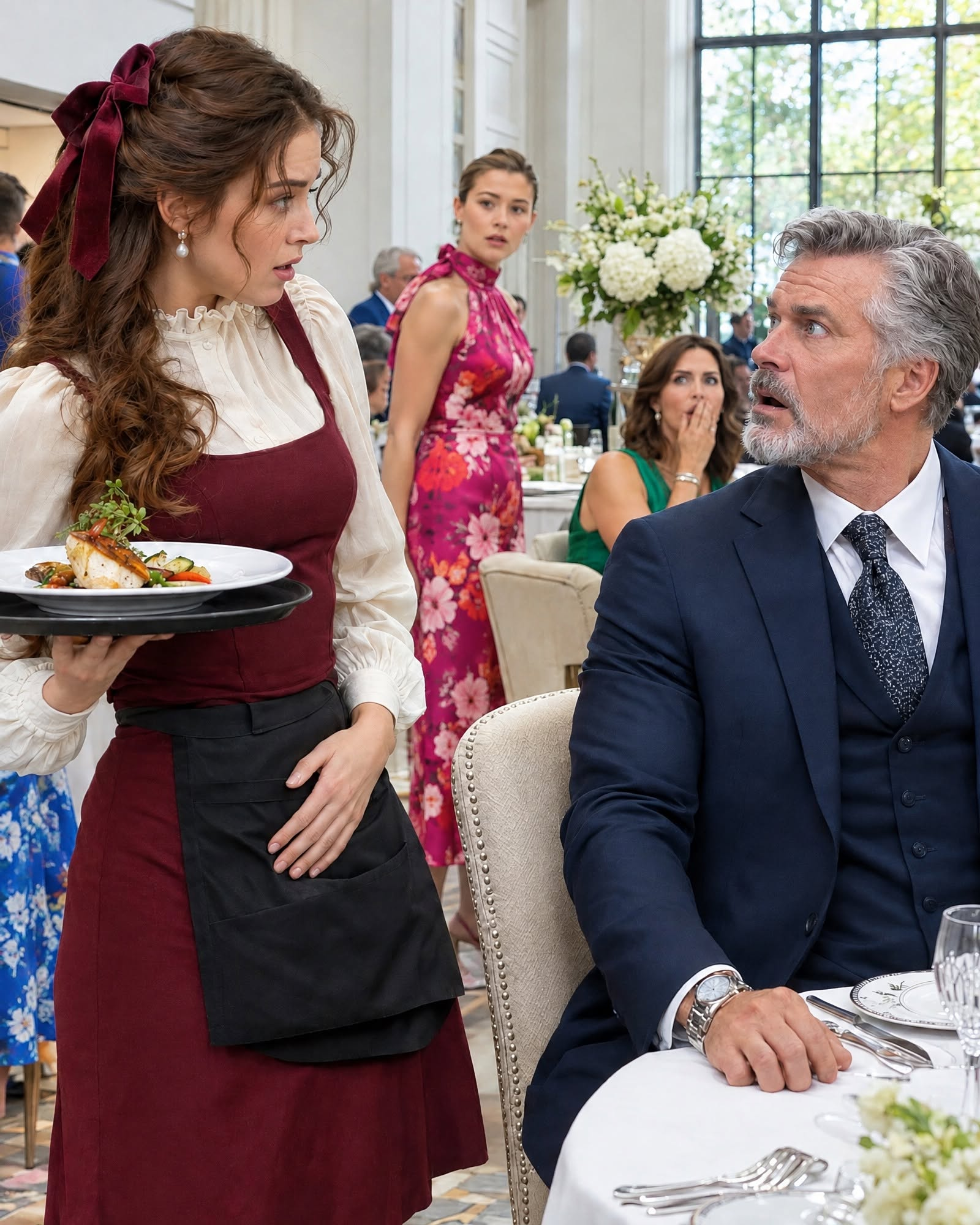
"Please don't tell your son you found me," the pregnant waitress whispered, gripping my trembling hand. "He'll destroy both of us."
I was sitting beside a twelve-million-peso construction contract when I noticed the small silver bracelet on her wrist.
Three letters were engraved on its underside.
E.S.A.
I had given her that bracelet on her wedding day.
My daughter-in-law hadn't run away.
Someone had made her disappear.
Eight months earlier, my only son had told me his wife was a thief.
He said she'd stolen money from our construction company, abandoned their marriage, and disappeared with another man.
I believed him.
God help me, I believed every word.
My name is Ernesto Salazar. I was sixty-three years old, and I had spent more than thirty years building one of the most respected privately owned construction companies in Monterrey, Mexico.
I had negotiated contracts with powerful businessmen, survived financial crises, and watched competitors lose everything because they trusted the wrong people.
I thought experience had taught me how to recognize a liar.
Apparently, I had never learned how to recognize one sitting at my own breakfast table.
That evening, I was having dinner with my longtime business partner, Jorge Ibarra, at an upscale restaurant in San Pedro Garza García.
We had been discussing a commercial development project worth twelve million pesos.
At least, Jorge had been discussing it.
I had been struggling to keep my hands from shaking.
"Ernesto, are you listening?"
I looked across the table.
Jorge was fifty-seven, a practical man who had worked beside me for nearly twenty years. His olive-gray suit was immaculate, his hair carefully combed, and his expression carried the familiar impatience of someone who hated repeating himself.
"Of course," I said.
"Then tell me what you think about the revised payment schedule."
I glanced at the papers.
The numbers seemed to shift.
I blinked.
For a moment, the restaurant lights appeared unusually bright.
"Seventy percent upon completion of the second phase," I answered.
Jorge frowned.
"That's the old schedule."
I rubbed my forehead.
"Sorry."
He closed the folder.
"You're doing it again."
"Doing what?"
"Pretending you're fine when you can barely concentrate."
I forced a smile.
"Maybe I'm getting old."
"You're sixty-three, Ernesto. Not ninety-three."
I reached for my water glass.
My fingers trembled.
The crystal tapped against the edge of my plate.
Jorge noticed.
He always noticed.
"Have you seen another doctor?"
"Three."
"And?"
"Exhaustion. Stress. Too much work."
"All three doctors said that?"
"More or less."
That was not entirely true.
One doctor had recommended additional neurological testing.
Another had suggested reviewing every medication and supplement I was taking.
I had postponed both recommendations.
There was always another meeting, another project, another problem that seemed more urgent than my health.
And besides, Adrián had been taking care of me.
My son had insisted I reduce my workload.
He brought me breakfast most mornings, made sure I took my vitamins, and personally prepared the strong coffee I had enjoyed for decades.
"You're not getting any younger, Papá," he would say with a smile. "Let me handle things."
I had considered that devotion.
I hadn't considered anything else.
Not until the waitress approached.
"Good evening, gentlemen. May I bring you anything else?"
I looked up.
And the world seemed to stop.
She was standing beside Jorge's chair, holding a black serving tray with one hand.
Her forest-green uniform was slightly wrinkled.
Her dark hair was tied back in a loose ponytail.
There were shadows beneath her eyes.
She looked thinner through the shoulders than I remembered.
But her stomach—
Dear God.
She was heavily pregnant.
For several seconds, I couldn't speak.
I knew that face.
I had seen it smiling across our Christmas table.
I had seen it glowing beneath a wedding veil.
I had seen it wet with tears when she told me how much she missed her own father.
"Lucía?"
The tray shifted in her hands.
Her eyes met mine.
Every trace of color drained from her face.
"I'm sorry, sir," she said. "You must have mistaken me for someone else."
Her voice was different.
Not because I had forgotten it.
Because she was terrified.
"Lucía Hernández."
She glanced toward the restaurant entrance.
"Please, sir."
"It's me. Ernesto."
Her lips trembled.
I stood up too quickly.
The room tilted.
I gripped the edge of the table.
Jorge rose halfway from his chair.
"Ernesto?"
But I barely heard him.
My attention was fixed on the young woman standing in front of me.
Eight months.
For eight months, I had believed she was living somewhere with another man, spending money stolen from my business.
And now she was carrying plates in a restaurant, wearing shoes so worn that the leather had split near one toe.
"Where have you been?" I asked.
Her eyes filled with tears.
"Please don't do this here."
I looked at her stomach.
"Are you—"
"Please."
The word came out so quietly that I almost missed it.
She placed the tray on a nearby service stand.
Her hand moved protectively over her belly.
Then she leaned closer.
"Don't tell Adrián."
I stared at her.
"What?"
"Please don't tell him you saw me."
"Lucía, he's your husband."
Her expression changed.
It wasn't anger.
It was something much worse.
It was the expression of someone realizing that the person standing before her still believed a dangerous lie.
"He's the reason I'm hiding," she whispered.
I felt something cold move through my chest.
Before I could answer, she stepped away.
"I have to get back to work."
"Wait."
She shook her head.
"Please."
Then she disappeared toward the service area.
I stood motionless.
Jorge came beside me.
"Ernesto, who was that?"
"My daughter-in-law."
He looked toward the doorway.
"The one Adrián said left him?"
I nodded.
Jorge's eyes narrowed.
"She's pregnant."
"I noticed."
"How pregnant?"
"I don't know."
"Ernesto."
I looked at him.
He lowered his voice.
"Adrián told everyone she left eight months ago."
The implication hit me.
If Lucía was eight months pregnant, she might have been carrying my grandchild when Adrián claimed she had abandoned him.
I felt sick.
"I'm going to speak to her."
"Then I'm coming with you."
"No."
"You're barely standing."
"I need to do this myself."
Jorge studied my face.
Then he placed a steadying hand on my shoulder.
"All right. But I'm staying here."
I walked toward the service corridor.
Every step felt heavier than the last.
A young employee carrying folded napkins pointed me toward a quiet alcove beside the dining room when I asked for the waitress.
I found Lucía standing near a narrow window.
Her back was against the wall.
One hand supported her lower back.
The other rested on her stomach.
She looked up when she heard me.
"You shouldn't have followed me."
"Lucía."
"Please, Don Ernesto."
"Tell me what's happening."
She closed her eyes.
For a moment, I thought she might collapse.
I moved toward her.
She immediately stepped back.
That frightened me more than anything else.
Lucía had never been afraid of me.
When she first married Adrián, she had hugged me so tightly that I joked she might break my ribs.
She called me Don Ernesto out of respect, but she had treated me like family.
Now she was looking at me as though I might be carrying a message from someone dangerous.
"Sit down," I said.
"I'm fine."
"You're shaking."
"So are you."
I glanced at my hands.
She was right.
I tried to hide them.
She noticed.
Something flickered across her face.
But she said nothing.
Instead, she lowered herself carefully into a chair beside the window.
I sat opposite her.
For a few seconds, neither of us spoke.
Then I asked the question that had haunted me since she appeared beside our table.
"Why did you leave Adrián?"
She stared at me.
"I didn't."
"Lucía—"
"He threw me out."
The words landed between us.
I shook my head.
"No."
"He changed the locks while I was at work."
"That's impossible."
"He canceled my bank cards. He blocked my phone. He told me that if I contacted you, he'd have me arrested."
I stared at her.
"Arrested for what?"
"For stealing from your company."
My stomach tightened.
"Adrián said you transferred money from one of our accounts."
"I never transferred anything."
"He showed me documents."
"Documents he controlled."
I leaned back.
I wanted to reject what she was saying.
I wanted to tell her that my son would never fabricate evidence against his own wife.
But something about her expression stopped me.
She wasn't trying to persuade me with dramatic accusations.
She was speaking like someone describing events she had replayed a thousand times.
"Why would he do that?" I asked.
Lucía looked down.
"Because I found something I wasn't supposed to find."
"What?"
She hesitated.
"I don't know how much I can tell you."
"You can tell me everything."
She gave a sad little shake of her head.
"That's what I thought eight months ago."
I frowned.
"What does that mean?"
"I trusted you, Don Ernesto. I really did."
"Then why didn't you come to me?"
"I tried."
I stared at her.
She swallowed.
"I called your office. Your secretary said you were unavailable. I sent messages. None were answered. I even went to your house."
"When?"
"Three days after Adrián locked me out."
I searched my memory.
Three days after Adrián had told me Lucía disappeared, I had been recovering from a severe dizzy spell.
He had insisted I remain home.
He had also told me not to answer business calls.
"She may try to contact you," he had warned. "Don't let her manipulate you, Papá."
I remembered feeling proud of his composure.
His marriage was collapsing, yet he was still thinking about protecting me.
Now the memory made my stomach turn.
"What happened when you came to the house?" I asked.
"Adrián answered the gate intercom."
"He was there?"
She nodded.
"He told me you didn't want to see me."
I stared at her.
"He said you'd read the financial report and decided I was no longer welcome in your family."
I couldn't breathe properly.
"I never said that."
"I know."
"Lucía, I swear—"
"I know now."
Her eyes filled.
"He told me that if I kept trying, he'd make sure no employer in Monterrey would hire me."
I looked at her uniform.
The worn shoes.
The exhausted face.
"How did you end up here?"
"A friend helped me find a room. I worked wherever I could. Cleaning offices. Packing food. Then the restaurant hired me."
"And the pregnancy?"
She rested both hands on her belly.
"I found out after he threw me out."
"Does Adrián know?"
"No."
"You're carrying his child?"
She nodded.
"A boy."
My eyes burned.
A grandson.
I had spent years imagining what it would feel like to become a grandfather.
I had pictured teaching a little boy how to hold a hammer, how to read construction drawings, how to understand that building something worthwhile required patience.
And here he was.
My grandson.
Growing inside a woman who was frightened of my own son.
"Why didn't you tell Adrián?" I asked.
Lucía looked at me with disbelief.
"Because he threatened to take any child I had."
I went still.
"What?"
"Before he threw me out, he told me that if I ever tried to leave him, he'd make sure everyone believed I was mentally unstable."
"Lucía—"
"He said his lawyers could prove anything."
I remembered Adrián boasting about our legal team.
I remembered how easily he spoke about influence.
I remembered dismissing it as confidence.
"He told me," Lucía continued, "that people like me don't win against families like yours."
I looked away.
My family.
My company.
My money.
All the things I had built to give my son security.
Had he been using them to frighten his wife?
"Why didn't you go to the police?"
"I was afraid."
"Of Adrián?"
"Of what he could make people believe."
I sat quietly.
For the first time in my life, I had no useful answer.
Then Lucía reached across the small table.
"Don Ernesto, there's something else."
Her voice had changed.
I looked up.
"What?"
She glanced toward my hands.
"How long have they been trembling?"
I frowned.
"What?"
"Your hands."
I tried to hold them still.
"Six months. Maybe a little longer."
"Do you get dizzy?"
I stared at her.
"Sometimes."
"Do your legs feel weak?"
"Yes."
She swallowed.
"Do you ever taste metal in your mouth?"
My heart began pounding.
"How do you know that?"
Lucía covered her mouth.
For several seconds, she said nothing.
Then she whispered, "Oh, God."
I leaned forward.
"Lucía."
She looked toward the dining room.
"Does Adrián still come to your house every morning?"
"Most mornings."
"Does he bring you breakfast?"
"Yes."
"Does he make your coffee?"
The question seemed absurd.
I almost laughed.
"Of course."
Her expression filled with horror.
"Does he insist on preparing it himself?"
I thought about it.
Adrián had started bringing me coffee around the time my health began declining.
At first, I had considered it a sweet gesture.
My son had always been busy.
He rarely made time for breakfast when he was younger.
But six months earlier, something changed.
He began arriving before eight.
Sometimes he brought pastries.
Sometimes fruit.
Always coffee.
He had even purchased a particular brand, claiming it was better for my digestion.
When our housekeeper offered to prepare it, he refused.
"Papá likes it my way," he would say.
I remembered the little ceramic cup.
The dark liquid.
The faint bitterness I had started noticing.
The metallic taste that lingered afterward.
"Lucía," I said slowly, "what are you suggesting?"
She didn't answer.
Instead, she asked another question.
"Have you been losing weight?"
"Yes."
"Have the doctors found anything?"
"Not yet."
She looked down at her hands.
Her breathing became uneven.
I felt a growing pressure in my chest.
"Tell me what you know."
She shook her head.
"I can't prove it."
"Prove what?"
"I saw something before Adrián threw me out."
My heart thudded.
"What did you see?"
She looked toward the corridor.
Then back at me.
"He had a small bottle in his office."
I waited.
"It wasn't labeled like ordinary medicine. I asked him about it."
"What did he say?"
"He told me it was a supplement."
"Then maybe it was."
She looked at me.
"Why would he hide a supplement inside a locked drawer?"
I had no answer.
"He became furious when he realized I'd seen it," she continued. "He accused me of spying. That was when everything started changing."
I rubbed my forehead.
"Lucía, that doesn't mean—"
"I know."
Her voice cracked.
"I know what you're thinking. I know how terrible this sounds."
She leaned closer.
"But I also know he started asking questions about your will."
I froze.
"What questions?"
"Whether you had changed it."
I stared at her.
"Whether the company would pass directly to him if something happened to you."
I remembered the conversations.
Adrián had been increasingly interested in succession planning.
He had asked me to sign documents.
He had insisted I transfer more authority to him.
He had argued that my declining health made the transition urgent.
I had considered it responsible.
Now I remembered the pressure.
The impatience.
The way he became irritated whenever I said I wanted to wait.
"That's normal business planning," I said weakly.
Lucía didn't argue.
She simply looked at me.
That silence was worse than an accusation.
I thought about the twelve-million-peso contract waiting on Jorge's table.
Adrián had pushed hard for that project.
He wanted the agreement signed immediately.
He had even prepared a revised authorization allowing him to approve payments without my signature.
I had refused.
He had smiled.
"Of course, Papá. Whatever makes you comfortable."
But I remembered his eyes.
They hadn't been smiling.
"Don Ernesto."
Lucía's voice brought me back.
"Please listen carefully."
I looked at her.
"Don't accuse him."
"Why?"
"Because if he thinks you know, he'll change everything."
I felt a chill.
"What exactly do you believe he's doing?"
She hesitated.
Then she said something that made the entire restaurant seem suddenly distant.
"I think Adrián has been waiting for you to die."
I stared at her.
For several seconds, I couldn't understand the words.
My son.
My only child.
The little boy I had carried on my shoulders through construction sites.
The teenager who cried when his mother died.
The young man I had trusted with my company's future.
Waiting for me to die?
"No," I whispered.
Lucía's eyes filled with tears.
"I wish I were wrong."
I shook my head.
"You don't understand. Adrián takes care of me."
"I know."
"He brings me food."
"I know."
"He makes sure I take my vitamins."
Her face tightened.
"That's what frightens me."
I looked down at my hands.
They were trembling again.
I remembered the coffee.
Every morning.
For six months.
I suddenly wanted to be sick.
"Why are you telling me this now?" I asked.
"Because I didn't know you were ill."
She wiped a tear from her cheek.
"I thought he was only trying to take the company. I didn't know anything had happened to your health."
I stared at her.
"And when I saw your hands..."
She couldn't finish.
I reached for my phone.
Lucía grabbed my wrist.
"Please don't call him."
"I'm calling my doctor."
She released me.
"Good."
I paused.
"You're right. I need tests."
She nodded quickly.
"And you need to stop accepting anything he prepares until you know what's happening."
I looked at her stomach.
"Lucía, you can't keep working like this."
"I don't have a choice."
"You do now."
She shook her head.
"Please don't make promises."
"I'm not making a promise. I'm telling you that you and my grandson will not be abandoned."
Her eyes widened.
"You believe me?"
I hesitated.
The truth was complicated.
I didn't know whether Adrián had harmed me.
I didn't know what had happened to the missing company money.
I didn't know whether the bottle Lucía described had anything to do with my symptoms.
But I knew one thing.
I had condemned her without hearing her side.
And I would not make that mistake again.
"I believe you deserve to be heard," I said. "And I believe you're afraid for a reason."
Her shoulders began trembling.
For the first time, she allowed herself to cry.
Quietly.
Without covering her face.
I waited.
Then I said, "I'm sorry."
She looked up.
"For what?"
"For believing everything Adrián told me."
Her lips trembled.
"I thought you hated me."
The words hurt more than I expected.
"No, hija."
I hadn't called her that in eight months.
Daughter.
She pressed her hand over her mouth.
"I never hated you."
For a moment, the fear between us softened.
Then my phone vibrated.
I glanced at the screen.
Adrián.
A message.
Papá, where are you? I stopped by the house. You weren't there.
I stared at it.
A second message arrived.
Did you forget we're having breakfast tomorrow? I bought your favorite coffee.
My hand began trembling so badly that I nearly dropped the phone.
Lucía saw the name.
Her face went white.
"Don't answer."
I turned the screen away.
"He doesn't know where I am."
"Are you sure?"
I frowned.
"Of course."
Then I remembered something.
Adrián had installed a location-sharing application on my phone after one of my dizzy spells.
"For emergencies," he'd said.
I had agreed without thinking.
I opened the settings.
The application was still active.
My location was being shared.
With Adrián.
I looked up at Lucía.
She understood immediately.
"Oh, no."
I disabled the sharing.
But the damage might already have been done.
I stood.
"We need to leave."
Lucía struggled to rise.
I offered my hand.
This time, she accepted it.
We stepped back toward the dining room.
Jorge was standing near our table.
He looked relieved when he saw me.
Then his expression changed.
"Ernesto."
Something in his voice stopped me.
"What?"
He looked toward the entrance.
"Your son just called me."
My blood went cold.
"What did he want?"
Jorge hesitated.
"He asked whether you were still at dinner."
I swallowed.
"What did you tell him?"
"That you were."
Lucía tightened her grip on my arm.
Jorge looked at her.
Then back at me.
"He said he was coming to join us."
I stared toward the restaurant entrance.
A black luxury sedan had stopped outside the tall windows.
The rear passenger door opened.
Lucía made a small, frightened sound.
"Don Ernesto..."
I turned toward her.
Her eyes were fixed on the man stepping out of the car.
She gripped my sleeve.
"There's something I haven't told you."
"What?"
She looked at the entrance again.
Then whispered:
"Adrián wasn't alone when he threw me out."
The restaurant door began to open.
Lucía's next words were barely audible.
"The other man was someone you trusted with your life."
And then I saw who was walking in beside my son.






Comments 0