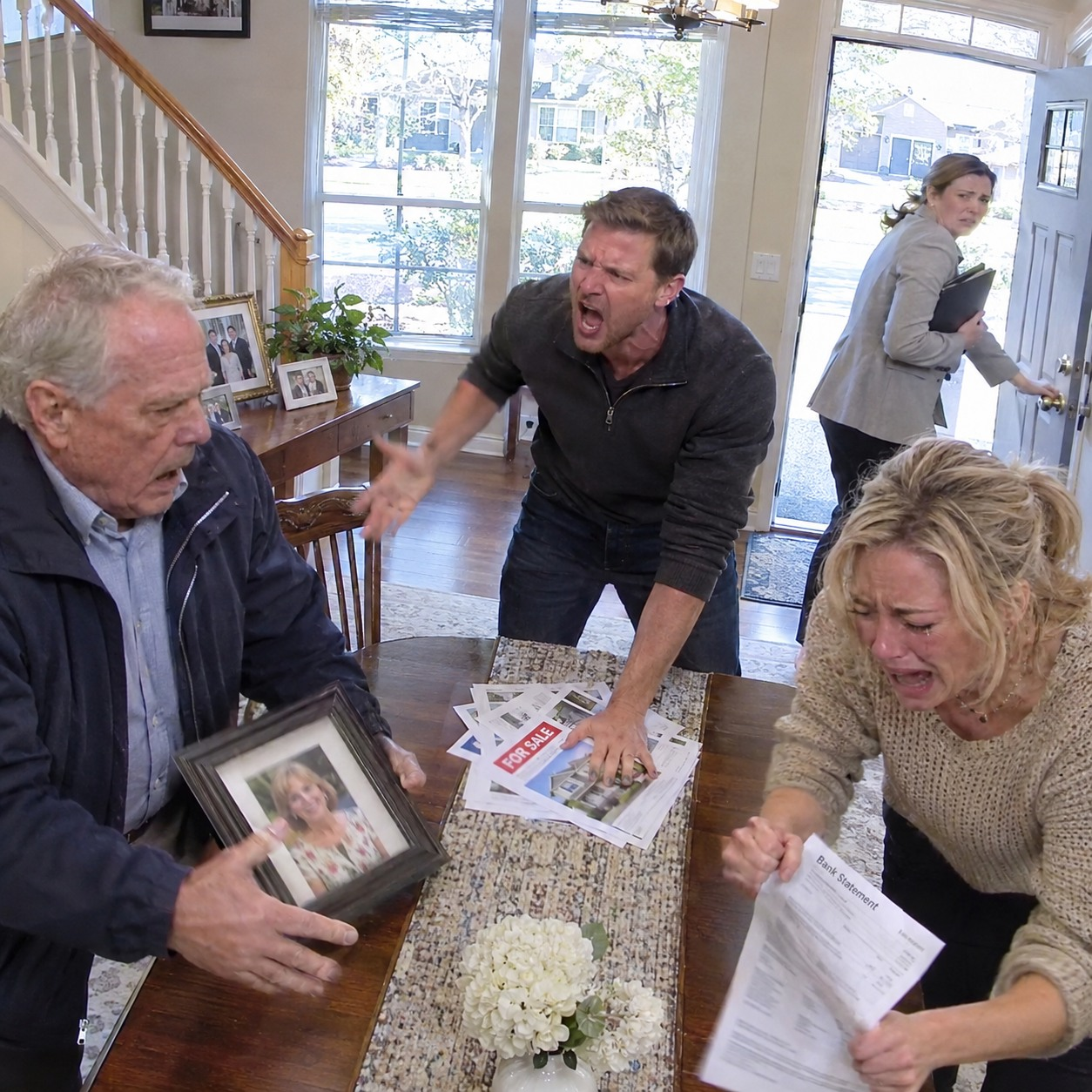
"Mr. Richard Bennett?"
The man standing on my porch held up the envelope.
"That's me."
"I have legal documents for you."
Chelsea stood behind me, still holding her phone.
The man handed me the envelope, confirmed my identity, and returned to his vehicle.
I closed the door.
For several seconds, I simply stared at the paperwork.
My son had actually done it.
He hadn't merely threatened to take control of my finances.
He had begun the legal process.
Chelsea ended her phone call after explaining that she had never signed a sworn statement.
Then she turned toward me.
"Richard, I swear I didn't know anything about this."
"I believe you."
I carried the envelope into the dining room and opened it.
The first page identified Mark as the petitioner.
The second described me as an elderly individual allegedly experiencing significant cognitive decline following the death of his spouse.
I read that sentence aloud.
Chelsea shook her head.
"This is unbelievable."
According to the petition, I had become incapable of making responsible financial decisions.
My relocation to Wyoming was described as impulsive.
My refusal to sell the family residence was presented as evidence of impaired judgment.
Even my decision to spend time alone was characterized as concerning behavior.
Everything I had done since Susan's death had been twisted into something sinister.
I turned another page.
Mark was requesting emergency authority over my financial affairs, including access to my accounts and the management of my real estate.
He claimed immediate intervention was necessary to prevent substantial financial losses.
I almost laughed.
The only substantial financial loss our family had suffered was the money he had taken from his mother.
And now he wanted legal authority to take more.
Chelsea reached for the attached statement bearing her name.
She read it silently.
Then she dropped into a chair.
"I never said any of this."
I looked over her shoulder.
The statement claimed she had personally witnessed me forgetting important conversations, neglecting household responsibilities, and becoming confused about the ownership of my properties.
It also claimed that I had expressed an intention to give away substantial portions of my retirement savings.
None of it was true.
At the bottom was a signature resembling hers.
Chelsea stared at it.
"He forged my signature."
Her voice was barely audible.
I called Elaine immediately.
She answered before the second ring.
"Richard?"
"The petition has been filed. Someone just delivered the documents."
"Send me photographs of every page."
I did.
Chelsea remained beside me while Elaine reviewed the paperwork.
Several minutes passed.
Finally, Elaine spoke.
"First, Richard, understand something important. This petition does not mean Mark has been granted control over your assets."
I felt some of the tension leave my shoulders.
"Not yet?"
"No. These are allegations. We have an opportunity to challenge them."
Chelsea leaned toward the phone.
"Elaine, my signature is on the statement, but I didn't sign it."
"Are you certain?"
"Absolutely."
"Then we'll need you to provide a formal statement explaining that."
"I will."
There was no hesitation in her voice.
Elaine continued.
"Richard, I want you to stay somewhere secure tonight. Tomorrow morning, we'll begin preparing your response."
I looked at the petition again.
"How could he do this?"
Elaine sighed.
"Desperate people sometimes convince themselves that anything is justified if it solves their immediate problems."
I thought about Mark's failing business.
His unpaid mortgage.
The missing savings.
The threatening messages.
He wasn't simply trying to inherit money anymore.
He was trying to survive the consequences of his own decisions.
And he had apparently decided that sacrificing his father's independence was an acceptable price.
After ending the call, Chelsea and I gathered our belongings.
She insisted on driving behind me until I reached a nearby hotel.
I agreed.
Before leaving the house, I took Susan's photograph from the sideboard.
I couldn't bear the thought of leaving it behind.
At the hotel, Chelsea helped me carry my briefcase upstairs.
Then she stood near the doorway.
"Are you sure you'll be okay?"
I smiled faintly.
"I'm seventy-two, Chelsea. I've survived worse accommodations than this."
She managed a small laugh.
It was the first genuine smile I had seen from her all afternoon.
Then her expression became serious again.
"I'm going to my sister's."
"Good."
"And tomorrow, I'll tell Elaine everything."
"Thank you."
She hugged me before leaving.
I locked the door and placed Susan's photograph beside the bed.
The room smelled of cleaning products and unfamiliar furniture.
I sat down.
For the first time in forty-one years, I felt like a stranger in my own life.
My wife was gone.
My son was trying to take control of everything we had built.
And I was hiding in a hotel because returning to my own house no longer felt safe.
I reached for Susan's photograph.
"You knew, didn't you?"
Her smiling face offered no answer.
Around nine that evening, my phone began ringing.
Mark.
I considered ignoring it.
Then I answered.
"What do you want?"
He sounded unusually calm.
"Dad, where are you?"
"Somewhere comfortable."
"You're not at the house."
"That's correct."
"Where's Chelsea?"
"Ask her."
He sighed.
"Look, things got out of hand today."
"Apparently."
"I think we should discuss this before everybody starts spending money on lawyers."
I stared at the court documents spread across the hotel desk.
"You filed a petition to take control of my finances."
"It's a precaution."
"A precaution against what?"
"Against you making decisions you're going to regret."
I shook my head.
"Like refusing to give you money?"
"That's not what this is about."
"Then withdraw the petition."
He remained silent.
I waited.
Finally, he spoke.
"I can do that."
Something about his tone made me uneasy.
"What's the condition?"
"Dad, come on."
"There's always a condition with you, Mark."
He exhaled sharply.
"If you help stabilize the business, there's no reason for us to continue fighting."
I closed my eyes.
There it was.
He was offering to return my independence in exchange for money.
"How much?"
"Two hundred thousand."
I opened my eyes.
"Two hundred thousand dollars?"
"It would cover the immediate obligations."
"And the money you took from your mother?"
"I'd repay that once things improved."
I looked at Susan's photograph.
"You're asking me to pay you to stop trying to take my life away."
"You're being dramatic."
"No. I'm being accurate."
He became irritated.
"You're going to spend a fortune fighting this. Why not use that money to help your family?"
"Because my family shouldn't be doing this to me."
He fell silent.
Then his voice changed.
"You don't understand how bad this could get."
"Explain it."
"People are going to start asking questions about you."
"Let them."
"Your medical history. Your behavior. Your mental health."
"I have nothing to hide."
"You've been depressed since Mom died."
"I've been grieving."
"That's not how everyone sees it."
I gripped the phone.
"What have you told people?"
He didn't answer directly.
"Several relatives are concerned."
"Which relatives?"
"You'll find out."
I realized he wanted me frightened.
He wanted me imagining family members whispering about my competence, doctors questioning my judgment, and strangers deciding whether I deserved control over my own life.
Months earlier, that strategy might have worked.
But Susan had prepared me.
"I'm not giving you money, Mark."
"You're making a terrible mistake."
"Good night."
I ended the call.
A few minutes later, messages began arriving.
The first came from my cousin Linda.
Richard, Mark told us you've been having a difficult time. Please call when you can.
Another came from an old family friend.
We're worried about you. Mark says you've been making some unusual decisions.
Then my younger sister, Margaret, called.
"Richard, what's going on?"
"What did Mark tell you?"
She hesitated.
"He said you've been confused since Susan passed away. He said you disappeared to Wyoming without telling anyone."
"I moved to Wyoming because Susan and I planned to retire there."
"He also said you're refusing medical treatment."
I sat upright.
"What medical treatment?"
"He didn't explain."
I rubbed my forehead.
"Margaret, there is no medical treatment I'm refusing."
"Are you sure you're all right?"
"I'm grieving my wife. That's what I'm doing."
Her voice softened.
"Oh, Richard."
I told her about the petition.
Then I explained the missing money and Susan's messages.
For a long time, Margaret said nothing.
Finally, she whispered, "He did that to Susan?"
"Yes."
"While she was sick?"
"Yes."
She began crying.
"I can't believe it."
Neither could I.
But disbelief no longer changed the facts.
Margaret promised to correct the misinformation Mark had been spreading.
After we finished talking, I forwarded his messages and described our telephone conversation to Elaine.
She replied shortly afterward.
Preserve everything. Do not negotiate with him.
I placed the phone on the nightstand.
Sleep didn't come easily.
Every time I closed my eyes, I remembered Mark as a little boy.
The first time he rode a bicycle.
The afternoon he graduated from high school.
The day he introduced us to Chelsea.
I remembered how proud Susan had been.
Somewhere between those memories and the man threatening me over the telephone, something had gone terribly wrong.
Shortly after midnight, my phone vibrated again.
I expected another message from Mark.
Instead, it was Chelsea.
Richard, are you awake?
I answered immediately.
Yes. Is everything okay?
Her response arrived moments later.
Mark called my sister. He told her I was having an emotional breakdown and shouldn't be trusted.
I stared at the screen.
He was doing to Chelsea exactly what he was doing to me.
Discrediting anyone who could expose him.
I called her.
"Don't believe anything he says about me," she whispered.
"I won't."
"There's something else. I remembered something tonight."
"What?"
"About two months before Susan died, Mark came home carrying a folder. He said Elaine was causing problems with the ranch."
I listened carefully.
"He was furious. He told me Susan had changed something without consulting him."
"Did he say what?"
"No. But he said there was another way to get what he needed."
I looked at the petition.
"Maybe this was what he meant."
"Maybe."
She hesitated.
"Richard, did Susan ever tell you about a man named Douglas Mercer?"
The name meant nothing to me.
"No."
"Mark had several meetings with him. I thought he was an investor."
"What makes you remember him now?"
"Because I saw his name on one of the documents in Mark's office."
"Which document?"
"The proposed ranch sale."
I sat forward.
Chelsea continued.
"I think Mark promised him something he couldn't deliver."
After ending the call, I sent the name to Elaine.
I expected her to respond the following morning.
Instead, my phone rang less than five minutes later.
"Richard, where did you hear that name?"
"Chelsea."
Elaine sounded alarmed.
"Did she explain his connection to Mark?"
"She thinks he's an investor."
"He's more than that."
I stood beside the hotel window.
"What do you mean?"
"Douglas Mercer contacted Susan shortly before she died."
My heart began pounding.
"Why?"
"Because Mark had made certain representations concerning the Wyoming property."
"What representations?"
Elaine paused.
"Richard, I need you in my office first thing tomorrow morning."
"Elaine, what aren't you telling me?"
I heard papers moving on the other end.
Then she spoke.
"Susan left me a sealed document with instructions concerning Douglas Mercer. I was supposed to open it if Mark ever attempted to challenge your independence."
I stared at Susan's photograph.
Elaine broke the silence.
"I'm opening it now."
I heard the envelope tear.
Then nothing.
"Elaine?"
Her breathing changed.
"Oh, Susan."
"What is it?"
She didn't answer immediately.
When she finally spoke, her voice was trembling.
"Richard, your son wasn't the only person your wife was trying to protect you from."






Comments 0