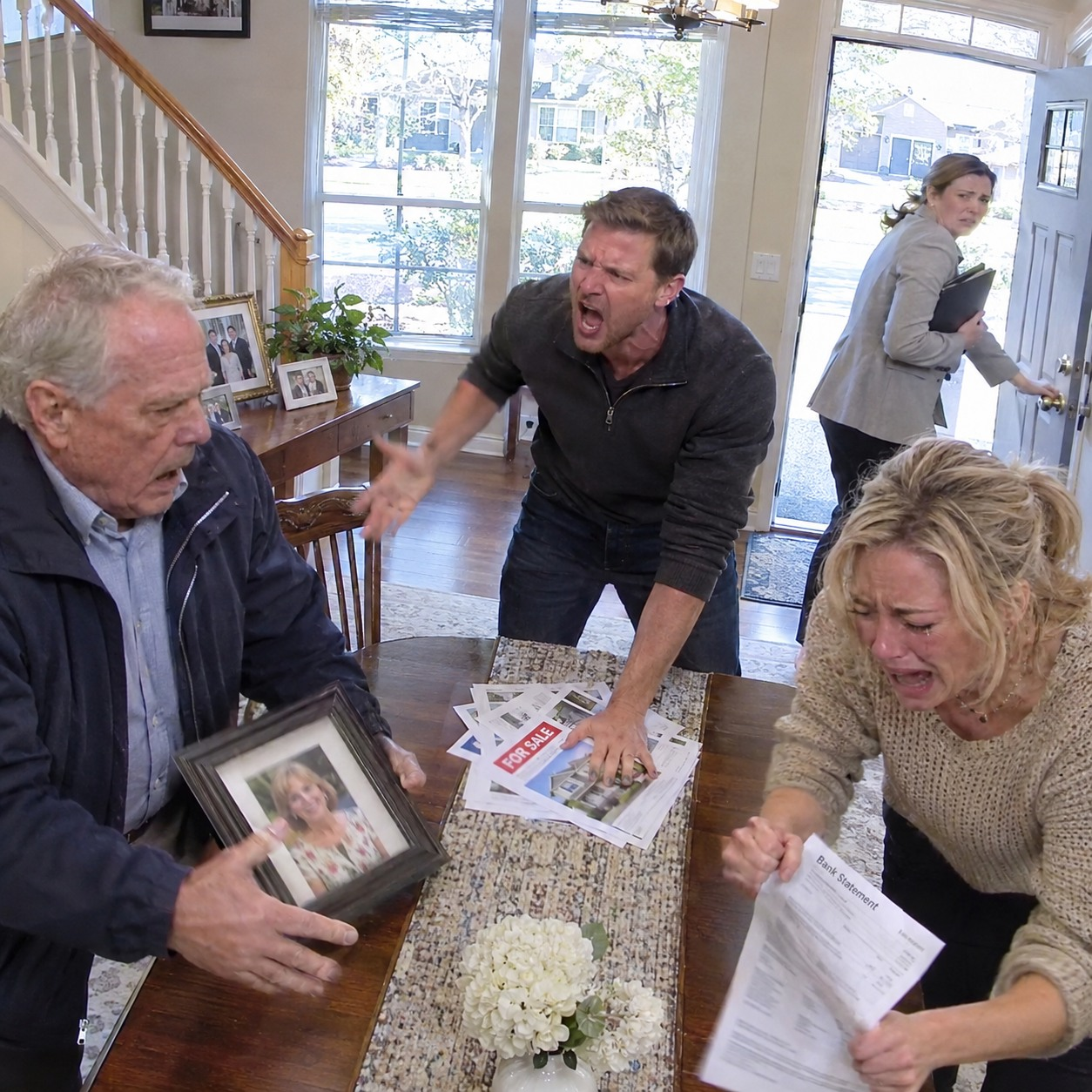
"That's not my signature."
I said the words slowly, staring at the document on my phone.
Mark stood across the table, his hands hanging awkwardly at his sides.
Chelsea leaned toward me.
"What signature?"
I enlarged the attachment.
Someone had submitted a formal request to the trustee overseeing Susan's Wyoming ranch. The document claimed that I wanted to explore the possibility of selling the property and distributing the proceeds among family members.
At the bottom was a convincing imitation of my signature.
Beside it was the name of a supposed witness.
The handwriting was difficult to distinguish on my phone's small screen, but the signature claiming to be mine was unmistakable.
Someone had tried to speak on my behalf.
Someone who knew exactly what the ranch was worth.
"Elaine," I said into the phone, "I never authorized this."
"I suspected as much."
"Can they sell the ranch?"
"No. The trust contains specific restrictions. The request was rejected before any action could be taken."
I breathed a little easier.
"However," she continued, "the trustee is concerned about how the request was submitted. We need to discuss that privately."
Mark suddenly stepped forward.
"Dad, this is getting ridiculous."
I looked at him.
"Is it?"
"You're letting a lawyer turn a family discussion into some kind of criminal investigation."
"I didn't submit this document."
"Maybe somebody misunderstood something."
"Somebody signed my name."
Chelsea stared at him.
"Did you know about this?"
"No."
His answer came too quickly.
She noticed.
"Mark."
"I said no."
Elaine heard the exchange.
"Richard, gather the documents and keep them somewhere secure. I'll arrange a meeting tomorrow morning."
"All right."
"And please remember what Susan asked you to do."
I looked toward my wife's photograph.
"I remember."
After ending the call, I placed my phone on the table.
For several seconds, the only sound in the room came from the clock above the kitchen doorway.
Susan had bought that clock at a flea market nearly thirty years earlier.
Mark had helped her carry it inside.
He was nine years old then.
I remembered him standing on a chair, proudly holding a screwdriver while I attached the clock to the wall.
Where had that little boy gone?
"Dad," Mark began, "you need to understand something about the ranch."
I folded my arms.
"Go ahead."
"It's not producing nearly as much income as it could."
"According to whom?"
"People who understand property development."
I stared at him.
"What people?"
He hesitated.
"Investors."
Chelsea turned toward him.
"You've been talking to investors?"
"It's just preliminary."
"About property you don't own?"
"Would you stop interrupting?"
She recoiled slightly.
I had never seen him speak to her with such contempt in front of me.
Perhaps he had simply stopped pretending.
"What did you tell these investors?" I asked.
"Nothing definite."
"Did you tell them the ranch was yours?"
"No."
"Did you tell them you could arrange a sale?"
He didn't answer.
That silence told me more than his words ever could.
Susan's ranch lay outside a small Wyoming town surrounded by open grassland, distant mountains, and miles of quiet country roads.
Her father, Harold, had purchased the original acreage when he was a young man.
Over the following decades, he expanded the property through careful saving and hard work.
He never became wealthy in the way Mark understood wealth.
He drove the same pickup truck for seventeen years.
He repaired his own fences.
He wore boots until the soles practically disappeared.
But he owned something increasingly rare.
Land that nobody could take from him simply because he owed them money.
Harold loved that ranch.
And Susan loved it because she loved him.
When Mark was young, we spent several weeks there every summer.
Harold taught him how to ride horses, repair gates, and recognize approaching storms by watching the mountains.
One afternoon, when Mark was twelve, he asked his grandfather how much the ranch was worth.
Harold smiled.
"Depends who's asking."
"What does that mean?"
"To a developer, it's acreage. To a banker, it's collateral. To me, it's home."
Mark had frowned.
"But everything has a price."
Harold looked at Susan.
Then he looked back at his grandson.
"Not everything should."
Years later, when Harold died, Susan inherited the property.
Mark immediately wanted to know whether she planned to sell.
She told him no.
He suggested subdividing it.
She refused.
He proposed using the land to secure financing for one of his businesses.
She refused again.
Eventually, he stopped asking.
At least when I was around.
I now wondered whether Susan had been fighting that battle alone for years.
"Your grandfather never intended for that property to become somebody's business opportunity," I told him.
Mark rolled his eyes.
"Grandpa's been dead for twelve years."
Chelsea stared at him.
I felt something inside me tighten.
"That doesn't make his wishes meaningless."
"It makes them outdated."
"Your mother's wishes aren't outdated."
He laughed bitterly.
"Mom put everything in a trust because she knew you'd never make a sensible decision."
"No. She put it in a trust because she wanted it protected."
"From what?"
I looked directly into his eyes.
"Apparently, from you."
His face reddened.
Chelsea lowered her head.
Mark grabbed the back of a dining chair.
"You know what? I'm tired of being treated like some irresponsible teenager."
"Then stop behaving like one."
"I'm running a company!"
"Then run it without taking money from your parents."
He opened his mouth.
Nothing came out.
I continued.
"The ranch generates income through agricultural leases. The expenses are managed. I have a place to live. Your mother made sure I would be comfortable for the rest of my life."
"And after that?"
There it was again.
The question he had been waiting to ask.
I studied him.
"After what?"
"After you're gone."
Chelsea whispered, "Oh, my God."
Mark ignored her.
"Who gets the ranch when you die?"
I couldn't believe what I was hearing.
He had already moved beyond his mother's death.
Now he was discussing mine.
"That's governed by the trust," I said.
"Am I the beneficiary?"
"I'm not discussing that with you."
"I'm your only child!"
"And I'm still alive."
The words came out sharper than I intended.
Mark stepped back.
For the first time that afternoon, he looked genuinely embarrassed.
But the embarrassment didn't last.
"You don't understand what you're doing to me."
"Then explain it."
He looked toward Chelsea.
She waited.
I waited.
Finally, he sat down.
"The company needs capital."
"How much?"
He rubbed his hands together.
"It's complicated."
"Give me a number."
"We have outstanding obligations."
"How much, Mark?"
He looked away.
Chelsea sat opposite him.
"You told me everything was under control."
"It was."
"When?"
"Before several contracts fell through."
"Which contracts?"
He shook his head.
"You wouldn't understand."
Her expression changed.
"I handle our household finances. I helped you with payroll when you started the company. Don't tell me I wouldn't understand."
He remained silent.
She leaned closer.
"How much money do you owe?"
He stared at the table.
I watched my daughter-in-law's confidence slowly collapse.
She had arrived believing she was helping an elderly widower make a sensible decision.
Now she was discovering that her husband might have brought her here under false pretenses.
"Did you bring me because you thought your father would listen to me?" she asked.
Mark looked up.
"What?"
"Was that the reason?"
"No."
"You told me Richard had already agreed to sell. You said he was having trouble maintaining the house."
"I thought he would agree."
"That's not what you told me."
He pushed his chair backward.
"Can we please stop making everything about what I said?"
Chelsea's eyes filled with tears.
"Then tell me something true."
I looked down at Elaine's envelope.
There were still documents inside.
Part of me didn't want to examine them in front of Chelsea.
Whatever Susan had discovered, I suspected it would hurt her as much as it hurt me.
But hiding the truth had already cost our family too much.
I removed another set of papers.
Mark noticed immediately.
"Dad, those are Mom's personal financial records."
"Yes."
"You shouldn't be going through them with Chelsea here."
Chelsea turned toward him.
"Why not?"
"Because they don't concern you."
"If you're asking your father for money to save our business, they absolutely concern me."
Mark stood.
"I'm leaving."
Nobody stopped him.
He took two steps toward the entrance.
Then I spoke.
"Your mother asked you to repay something, didn't she?"
He froze.
Chelsea looked at me.
"Repay what?"
I held up a short handwritten note that had been clipped to the financial documents.
Susan's handwriting was weaker than usual, but I recognized it immediately.
Richard, please understand that I gave him every opportunity to explain. I wanted to believe there was a reasonable explanation. Elaine has the records.
My throat tightened.
Susan had written those words while fighting for her life.
While I was worrying about whether she could finish a bowl of soup, she had been worrying about what our son might do after she died.
I read the note again.
Mark slowly turned around.
"She didn't understand the arrangement."
"What arrangement?"
"It was temporary."
Chelsea stood.
"What was temporary?"
He rubbed his forehead.
"I was going to put everything back."
The room became unbearably quiet.
Chelsea's lips parted.
I stared at him.
He seemed to realize what he had just admitted.
"Dad, listen. Whatever those documents say, there's context."
I lowered Susan's note.
"What did you take?"
"Nothing that wasn't going to be returned."
"From where?"
He glanced toward the envelope.
I removed the remaining stack of papers.
Several bank statements slid onto the table.
Chelsea reached for the nearest one.
Mark moved toward her.
"Don't."
She pulled the document away.
"Why?"
"Because you're not going to understand what you're looking at."
I examined the first page.
There were multiple transactions marked in yellow, each accompanied by a date and a destination account.
The dates corresponded to Susan's chemotherapy appointments.
I remembered those days clearly.
I remembered driving her home, helping her into bed, and thanking Mark for taking care of the medical bills.
My hands began to tremble.
Chelsea looked from one highlighted transaction to another.
Then she recognized the name printed beside a transfer.
Her husband's company.
She looked up at him.
"Mark?"
He said nothing.
I turned to the final page.
Elaine had prepared a separate summary of the transactions.
At the bottom was a single highlighted figure.
Mark reached across the table.
Chelsea caught his wrist.
I looked down at the total.
And suddenly understood why Susan had been afraid to leave me alone with our son.






Comments 0