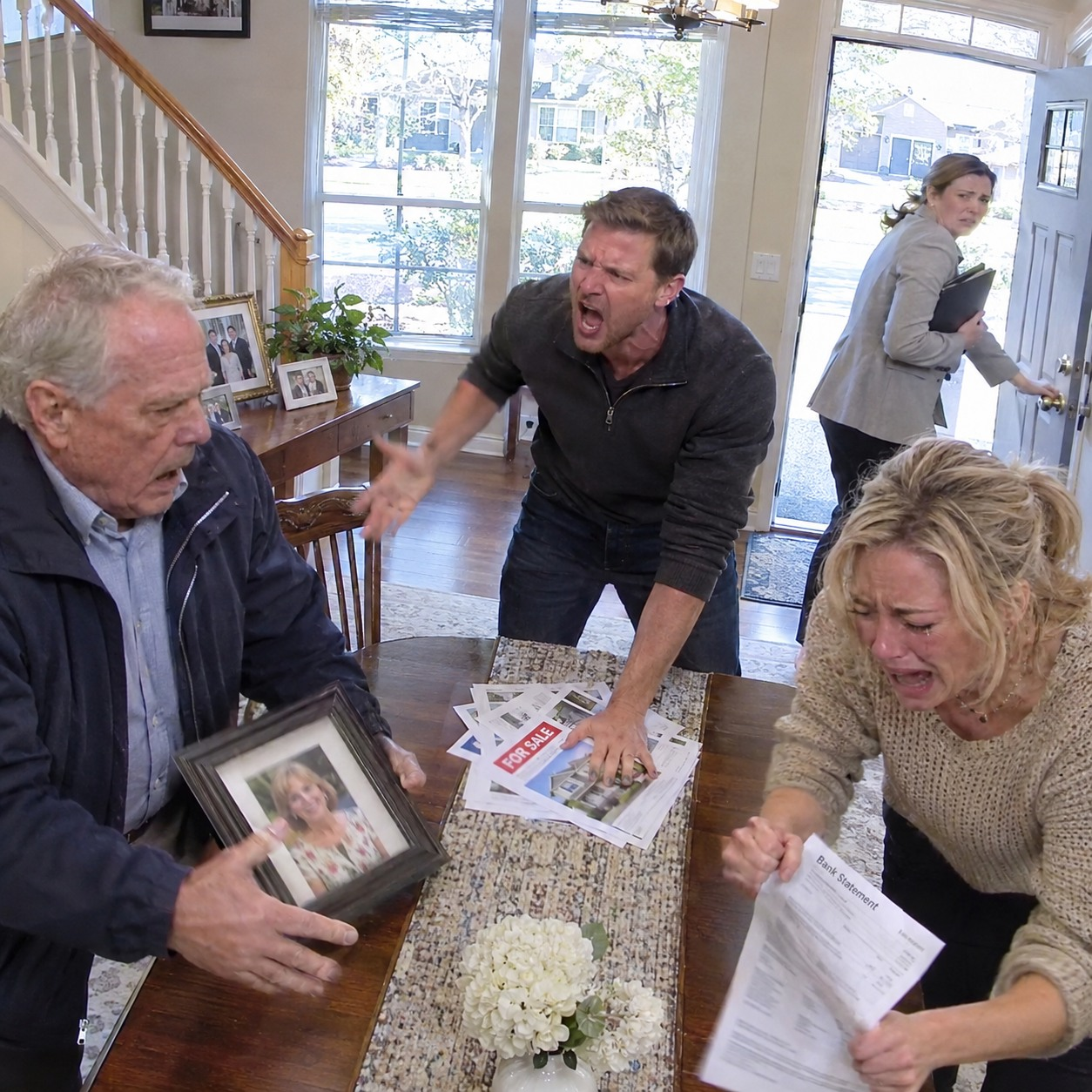
My son slammed a listing agreement onto the dining table and shouted, "You're selling this house, Dad!"
The real estate agent beside him opened her black folder.
My wife's photograph stood inches from the paperwork.
Someone had already written an asking price beneath our address.
They hadn't come to ask my permission.
They thought they already had it.
I looked at the listing agreement without touching it.
For forty-one years, Susan and I had lived in that house. We had raised our son there, celebrated birthdays around that dining table, and spent countless Sunday mornings drinking coffee beside the kitchen windows.
Now, twenty-three days after her funeral, our only child was standing where his mother used to arrange Christmas flowers, telling me it was time to sell.
Mark was thirty-nine years old.
Old enough to understand grief.
Old enough to know better.
Apparently, neither mattered.
"Dad, are you listening?"
I lifted my eyes.
"I'm listening."
"Then you understand why we're doing this."
"We?"
He glanced toward his wife, Chelsea, who stood near the staircase with her arms folded.
She offered an uncomfortable smile.
"We've been worried about you, Richard," she said. "It's a big house. You shouldn't have to take care of everything alone."
I studied her face.
Chelsea had always been polite to Susan. She remembered birthdays, brought casseroles when Susan started chemotherapy, and occasionally called to ask whether we needed groceries.
I wanted to believe she was genuinely concerned.
But concern didn't usually arrive with a real estate agent.
The woman standing beside Mark extended her hand.
"I'm Karen Mitchell. Your son contacted me about listing the property."
I shook her hand.
"Did he?"
She glanced between us.
"He mentioned that you'd discussed downsizing."
"That's interesting."
Mark sighed.
"Don't make this difficult, Dad."
I looked at the paperwork again.
The asking price was $685,000.
There were photographs of the exterior, a suggested marketing schedule, and several pages describing the commission arrangement.
They had done considerable work.
Without me.
Without a single conversation.
Without waiting for the flowers on Susan's grave to wilt.
"How long have you been planning this?" I asked.
Mark shrugged.
"A couple of weeks."
A couple of weeks.
While I was sorting through Susan's clothes, my son had apparently been calculating the value of our house.
While I was trying to sleep beside an empty pillow, he had been discussing commission rates.
I wondered whether he had ever understood what his mother meant to me.
Susan and I met when I was thirty-one. She was working at a small insurance office, and I was repairing industrial equipment for a manufacturing company.
We didn't have much money.
Our first apartment had a refrigerator that sounded like a lawn mower and a bedroom window that wouldn't close properly.
But Susan laughed at things that would have made other people miserable.
She called our apartment a starter palace.
When we bought the house seven years later, she stood in the empty living room and cried.
Not because it was particularly beautiful.
Because it belonged to us.
Every mortgage payment represented something we had earned together.
Every room held a memory.
Mark took his first steps near the fireplace. Susan measured his height against the kitchen doorway until he was sixteen.
The scratches on the dining table came from school projects, family dinners, and a particularly disastrous attempt to assemble a bicycle on Christmas Eve.
To Mark, those memories apparently had a market value.
"Dad," he continued, "you're seventy-two. You don't need four bedrooms and a huge backyard."
"I know how old I am."
"Then be reasonable."
I rested my hand against Susan's photograph.
"I've already moved."
Chelsea straightened.
"What?"
"I moved to Wyoming."
Mark stared at me.
"When?"
"Eleven days ago."
"Without telling us?"
"I didn't realize I needed permission."
He opened his mouth, closed it, and looked toward Chelsea.
For the first time since entering the house, he seemed uncertain.
"The ranch?" he asked.
"Yes."
Susan had inherited the Wyoming property from her father, Harold Bennett, nearly twelve years earlier.
It covered several hundred acres of rolling grassland, with a modest ranch house, two barns, and a creek that ran along the northern boundary.
Susan loved that place.
Whenever life became overwhelming, she talked about sitting on the porch and watching the mountains turn purple at sunset.
We had planned to retire there together.
Cancer had changed those plans.
But it hadn't changed her wishes.
Mark pulled out a chair and sat down.
"Okay," he said slowly. "That's actually better."
I waited.
"If you're living at the ranch, there's no reason to keep this place."
"I'm keeping it for now."
"Why?"
"Because I want to."
He laughed.
It wasn't the laugh I remembered from his childhood.
It was cold.
Dismissive.
"Dad, you're sitting on a fortune."
"I'm sitting in my dining room."
Chelsea looked down.
Karen quietly closed one side of her folder.
I suspected she was beginning to understand that the appointment Mark had arranged wasn't what he had described.
"Richard," she said carefully, "were you aware that I was coming today?"
"No."
Her expression changed.
"I apologize. I was under the impression that the family had already agreed."
"There is no agreement."
Mark stood abruptly.
"Can everybody stop acting like I'm doing something wrong?"
Nobody answered.
He turned toward me.
"I'm trying to help you manage your assets."
"My assets don't require your management."
"Fine. Sell the ranch instead."
Chelsea reached for his arm.
"Mark."
He pulled away.
"What? He doesn't need both."
I watched him closely.
There was something beneath his anger.
Something more urgent than greed.
Desperation.
I had seen it before.
When his first business failed, he called Susan and told her he needed money to protect his employees.
When his second business collapsed, he claimed his partner had stolen from him.
His third venture, a heating-and-cooling company, was supposedly different.
He had promised us that repeatedly.
Susan believed him longer than I did.
A mother often sees the child she raised even when the adult standing before her has become someone else.
"Your mother placed the ranch in a trust," I explained.
Mark frowned.
"What does that mean?"
"It means I have the right to live there and receive income from the property. You don't have the authority to sell it."
"Who does?"
"The trustee manages it according to the trust's terms."
"Who's the trustee?"
"That's not your concern."
He stared at me.
Then he said something that made Karen look away.
"Mom would've wanted me to get my share."
My share.
I had heard those words through three failed businesses, two emergency loans, and more financial crises than I cared to remember.
Susan hadn't even been gone a month.
Yet Mark was already dividing her life into assets.
"Your mother wanted many things," I replied.
"Exactly."
"Most of them had nothing to do with money."
His face reddened.
"Then give me my inheritance in cash."
Chelsea whispered his name again.
This time, her voice carried a warning.
I turned toward Karen.
"I'm sorry you've been brought into this. Susan and I owned this house with survivorship rights. Her interest passed to me when she died. I haven't authorized a listing, and I won't be signing anything."
Karen nodded immediately.
"I understand."
She gathered her paperwork.
Mark stepped toward her.
"Wait. We're not finished."
"I'm afraid we are."
She tucked the documents into her folder and looked at me.
"I'm very sorry for your loss, Mr. Bennett."
"Thank you."
She walked toward the front door.
Chelsea moved aside to let her pass.
The door opened, admitting a brief gust of cool afternoon air, then closed quietly behind her.
For several seconds, nobody spoke.
Mark looked at the empty doorway.
Then he turned toward me.
"You embarrassed me."
I almost laughed.
Instead, I picked up Susan's photograph.
"I think you've embarrassed yourself."
His fist struck the table.
The sudden impact rattled the flower vase and sent several papers sliding across the polished wood.
Susan's photograph tipped forward.
I caught it before it reached the floor.
"YOU TURNED HER AGAINST ME WHILE SHE WAS DYING!"
His voice echoed through the house.
Chelsea flinched.
I held the photograph against my chest.
There was Susan, smiling in the garden during our fortieth wedding anniversary.
She had been wearing her favorite floral blouse.
Two months after that photograph was taken, we learned that her cancer had returned.
I remembered the hospital appointments.
The sleepless nights.
The way she apologized whenever I helped her walk to the bathroom, as though loving her had somehow become an inconvenience.
I remembered holding her hand when she took her final breath.
And now our son was accusing me of turning her against him.
"No, Mark," I said quietly.
"You did that yourself."
His expression changed.
"What the hell is that supposed to mean?"
I placed Susan's photograph carefully on the sideboard, beyond his reach.
Then I returned to the table.
Three nights before Susan died, she had asked me to make her a promise.
At the time, I hadn't understood why she sounded frightened.
I understood now.
I reached inside my jacket and removed a thick cream-colored envelope.
Chelsea looked at it.
Mark went completely still.
Across the front, in neat black handwriting, was the name of Susan's attorney.
Elaine Porter.
Beneath it were six words Susan had instructed her to write.
For Richard, when Mark asks for money.
My son's eyes remained fixed on the envelope.
"Dad," he whispered.
I slipped my finger beneath the sealed flap.
He took a step toward me.
"Whatever she told Elaine, you need to hear my side first."
I hadn't opened the envelope yet.
And Mark was already asking me not to believe what was inside.






Comments 0