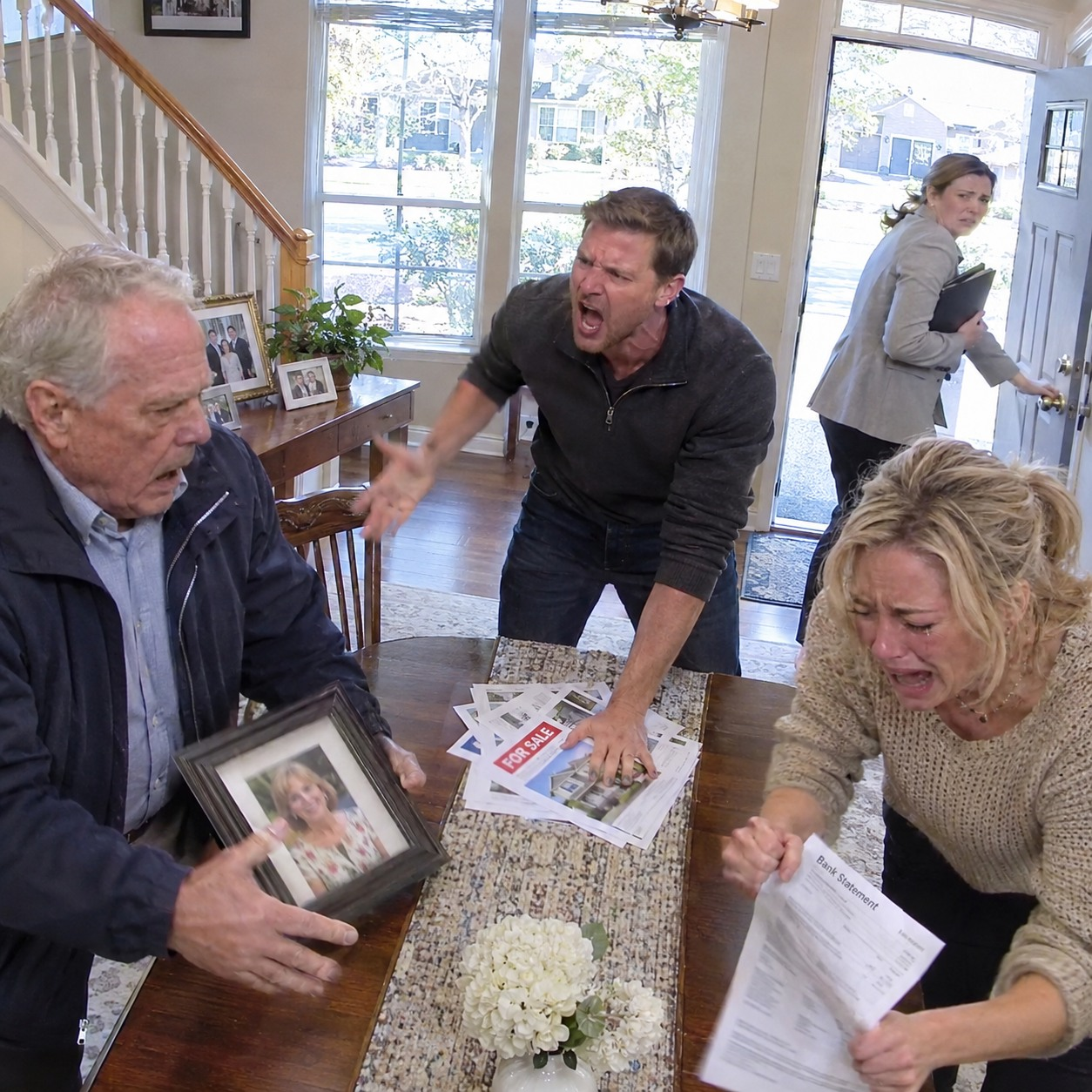
"One hundred eighteen thousand four hundred dollars."
I read the number aloud.
Chelsea released Mark's wrist.
He stepped backward.
Nobody spoke.
I looked at the figure again, hoping I had somehow misread it.
$118,400.
That was how much money had disappeared from Susan's accounts while she was receiving chemotherapy.
Not a few hundred dollars.
Not an accidental payment.
More than a hundred thousand dollars.
Money my wife had saved throughout our marriage.
Money she had intended to use for medical expenses, retirement, and whatever time we had left together.
My son had taken it.
"Those were loans!" Mark suddenly shouted.
I raised my eyes.
"Loans?"
"Yes."
"Where are the loan agreements?"
He shook his head.
"We didn't need agreements. We're family."
Chelsea stared at him.
"You borrowed that much money from your mother?"
"It wasn't all at once."
As though that made it better.
As though taking smaller amounts over several months somehow made the betrayal less significant.
I examined the individual transactions.
The first was for $8,500.
The second was for $12,000.
Several more followed.
Each transfer had occurred while Susan was undergoing treatment or recovering from another exhausting hospital visit.
I recognized one date immediately.
March 14.
Susan had been admitted to the hospital that morning after developing complications from chemotherapy.
I remembered sitting beside her bed, watching the nurse adjust her intravenous medication.
Mark had called around lunchtime.
He asked how his mother was feeling.
I told him she was frightened but stable.
He promised to visit that evening.
He never came.
According to the bank statement, he had transferred $17,500 from her account that afternoon.
I slowly lowered the document.
"March fourteenth."
Mark frowned.
"What?"
"Your mother was in the hospital."
He looked away.
"You transferred seventeen thousand five hundred dollars while she was lying in a hospital bed."
"Dad, I had payroll coming up."
I stared at him.
That was his explanation.
Payroll.
Not an apology.
Not an expression of regret.
Just another business expense.
"She asked for you that evening," I said.
He remained silent.
"She kept looking at the door because you promised to visit."
Chelsea covered her mouth.
I continued.
"She fell asleep waiting for you."
Mark rubbed his face.
"I was busy."
"Taking her money?"
His expression hardened.
"Keeping my company alive!"
The words echoed through the dining room.
I looked toward Susan's photograph.
For years, she had defended him.
Whenever I questioned his financial decisions, she reminded me that businesses were difficult to establish.
Whenever he needed help, she found a reason to give him another chance.
She believed persistence would eventually turn him into the responsible man she knew he could become.
And he had rewarded that faith by stealing from her during the most vulnerable months of her life.
Chelsea picked up another statement.
Her eyes moved across the page.
"Wait."
Mark turned toward her.
"What?"
"This account number."
He didn't answer.
She looked closer.
"This is the company's operating account."
"Chelsea, put that down."
"You told me the money came from a business loan."
He stepped toward her.
"We can discuss this at home."
She moved backward.
"No. We're discussing it here."
I watched her carefully.
Her entire understanding of their financial situation was beginning to unravel.
She had trusted him.
Just as Susan had.
"Last spring," Chelsea continued, "you told me the bank approved additional financing."
"It was complicated."
"You showed me the new equipment."
"Because we needed it."
"You said we finally had enough money to expand."
Mark clenched his jaw.
"Can you stop?"
She shook her head.
"Was that her money?"
He looked toward the front door.
Chelsea's voice became louder.
"Was the equipment purchased with your mother's money?"
"I was going to repay everything!"
She stared at him.
Then she asked the question I had been struggling to say aloud.
"Did you steal from your dying mother?"
Mark's mouth opened.
Nothing came out.
Chelsea waited.
He looked at me, then at the bank statements, then back at his wife.
Still, he said nothing.
That silence was the closest thing to a confession he had offered.
I pulled out a chair and sat down.
Suddenly, I felt every one of my seventy-two years.
My knees ached.
My chest felt heavy.
The room seemed smaller than it had an hour earlier.
I had come back from Wyoming to collect our wedding album.
That was all I had intended to do.
I wanted to take the photographs to the ranch, sit beside the fireplace, and remember the woman who had shared my life.
Instead, I was discovering what our son had done while she was dying.
I remembered a conversation Susan and I had shared several months earlier.
We were sitting in the hospital cafeteria.
She had ordered tea but barely touched it.
I was complaining about the cost of a medication that insurance wouldn't fully cover.
Susan listened quietly.
Then she suggested postponing the repairs we had planned for the ranch house.
"We might need to be a little careful with money," she said.
I told her not to worry.
We had savings.
We had planned responsibly.
We could afford whatever treatment she needed.
She smiled.
But something about that smile had bothered me.
Now I understood.
She already knew something was wrong.
While I was reassuring her about our finances, she was probably wondering how much of our savings remained.
"Did she ask you to return it?" I asked.
Mark leaned against the table.
"Eventually."
"When?"
"I don't remember."
I lifted the revocation of his financial power of attorney.
"Two months before she died?"
He stared at the document.
"Something like that."
"What did you tell her?"
"That I needed time."
"How much time?"
He sighed impatiently.
"Businesses don't generate money overnight."
"Neither do retirement accounts."
"Dad—"
"Your mother worked for thirty-four years."
He fell silent.
"She saved money when we could barely afford groceries. She drove an old car because she wanted us to have something put away. She brought lunch to work every day instead of eating out."
My voice began trembling.
"And you took it while she was too sick to stop you."
Chelsea wiped her eyes.
Mark shook his head.
"You're making me sound like a monster."
"I'm describing what you did."
"I never wanted to hurt her."
"Then why didn't you stop?"
He looked down.
I turned to another page.
It contained correspondence between Elaine and the bank.
Susan had contacted a bank representative after discovering several unexplained transfers.
She requested copies of her statements.
She asked for confirmation of the destination accounts.
Then she revoked Mark's financial authority.
But there was another entry.
A withdrawal request submitted after the revocation had taken effect.
The bank had rejected it.
I read the date.
My stomach turned.
"April twenty-second."
Mark closed his eyes.
Chelsea looked at me.
"What happened on April twenty-second?"
I remembered that day perfectly.
It was the afternoon Susan's oncologist told us there were no remaining treatment options likely to help her.
We had driven home without speaking.
Susan sat beside me, staring through the passenger window.
When we reached the house, she asked whether we could spend the evening together without discussing hospitals, doctors, or death.
I cooked her favorite soup.
We watched an old movie.
She fell asleep against my shoulder.
While we were trying to accept that our time together was ending, our son had attempted another withdrawal.
"She had already revoked your authority," I said.
Mark didn't respond.
"The bank recorded another attempted withdrawal."
Chelsea stared at him.
"You tried again?"
"It was a scheduled payment."
"The bank says it was a new request."
He looked at me sharply.
"Bank employees make mistakes."
"Did your mother make a mistake, too?"
He turned away.
I stood slowly.
Something had changed inside me.
For most of my life, I had believed that being a good father meant protecting my son from the worst consequences of his mistakes.
I had helped him repair his first car after he wrecked it.
I had paid overdue bills when he was struggling.
I had listened to explanations that became increasingly difficult to believe.
Susan and I had called it helping.
Perhaps, somewhere along the way, Mark had begun calling it something else.
An entitlement.
"You came here today because you need more money," I said.
He didn't deny it.
"You wanted me to sell the house because your mother stopped you from accessing her accounts."
"That's not true."
"And when I refused, you demanded the ranch."
"You're twisting everything."
"Then explain the timing."
He stared at me.
I waited.
Chelsea waited.
Finally, he sat down.
"The company might not survive."
His voice was quieter now.
For the first time, he sounded genuinely frightened.
"We have suppliers demanding payment. Customers canceled contracts. The equipment payments are behind. I've been trying to keep everything together."
Chelsea looked at him.
"How long?"
He swallowed.
"Almost a year."
She sank into a chair.
"A year?"
He nodded reluctantly.
"You told me we were doing better."
"I thought we would be."
"You let me believe everything was fine."
"I didn't want you worrying."
She laughed through her tears.
"That's what you're calling it?"
Mark reached toward her.
She moved her hand away.
I watched them sitting across from each other.
Two people who had arrived together and were now separated by a stack of bank statements.
Then I noticed the smaller envelope Elaine had included.
It remained unopened beside Susan's handwritten note.
My name appeared on the front.
Underneath it, Elaine had written a short instruction.
Read only after reviewing the financial records.
I picked it up.
Mark noticed immediately.
"What's that?"
"I don't know."
He stood.
"Dad, haven't we done enough?"
I looked at him.
"Your mother apparently didn't think so."
I opened the smaller envelope.
Inside was a folded sheet of paper and a brief handwritten note from Susan.
Richard,
I couldn't bring myself to show you this while I was alive. I know how much you love our son. Please understand that I loved him, too.
I stopped.
My eyes burned.
Even after everything Mark had done, Susan had still worried about protecting my feelings.
I unfolded the remaining page.
It was a printed conversation.
A series of messages between Susan and Mark.
The dates appeared near the top.
Chelsea rose from her chair and moved beside me.
Mark saw the document.
His face changed instantly.
"No."
He took a step forward.
"Dad, don't read that."
I lowered my eyes.
Chelsea leaned over my shoulder.
She read the first line before I did.
Her fingers tightened around the back of my chair.
Then she covered her mouth.
"Mark," she whispered, "please tell me you didn't write this."
He stood motionless.
I looked at the message.
And there, beneath my son's name, was something far worse than a confession about money.






Comments 0