"Samuel?"
The voice came from behind the western door again.
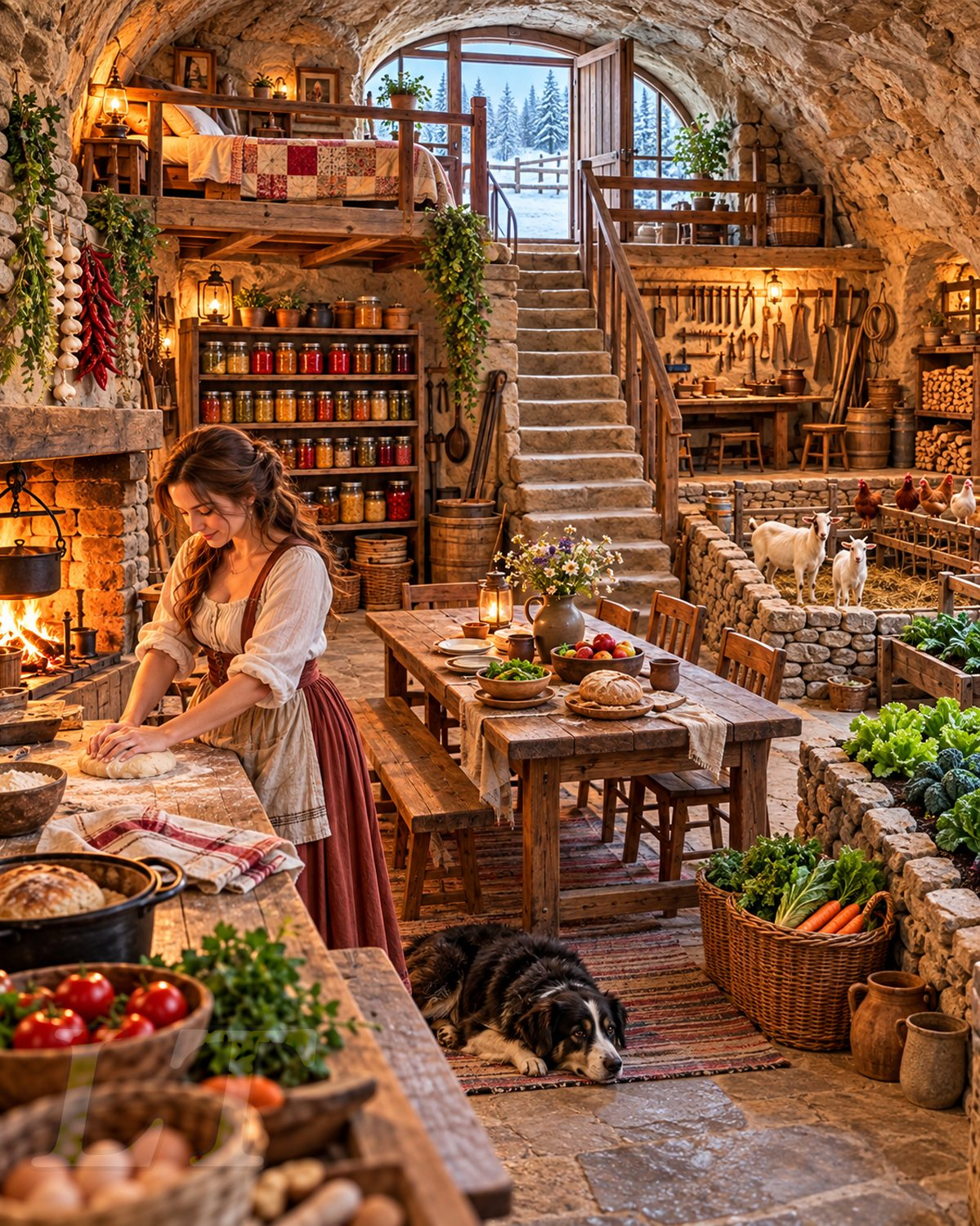
I stood motionless beside the wooden table, clutching the brass key my grandfather had left inside the hidden compartment.
The voice sounded old.
Weak.
Almost exhausted.
Then came three slow knocks.
"Samuel, are you there?"
I looked toward the fireplace.
The flames were moving strangely, bending toward the narrow ventilation opening.
A deep vibration traveled through the stone floor.
I swallowed.
"My name is Clara," I called. "Samuel was my grandfather. He died several months ago."
Silence.
For several seconds, nothing happened.
Then the voice returned.
"You're his granddaughter?"
"Yes."
Another pause.
"Did he leave you the key?"
I looked down at the brass key in my hand.
"Which key?"
The voice did not answer.
Instead, I heard something scrape against the other side of the door.
Then a heavy metallic click.
I stepped backward.
"Who are you?"
A faint sound followed.
It almost sounded like a sigh.
Then the voice whispered something that made my blood run cold.
"Tell him the northern water is rising."
I stared at the door.
"Who are you talking about?"
But there was no answer.
I approached cautiously and placed my ear against the metal.
Nothing.
I knocked twice.
No response.
I tried the handle.
It would not move.
The lock appeared to be engaged from the other side.
I stepped away.
My grandfather's warning returned to my mind.
If the northern ridge begins to rumble, leave the lower passage alone.
I looked toward the notebook on the table.
The northern water system.
The emergency drainage route.
The lower chamber.
And now a voice claiming that the water was rising.
I had no idea what was happening beneath the mountain.
But I knew one thing.
Whatever Samuel had built was still active.
And something inside it had just spoken to me.
I spent the next hour checking the cave.
The floor had stopped vibrating, but the goats remained restless.
Daisy stood near the back of her enclosure, occasionally stamping one hoof against the stone.
June was drinking unusually quickly.
The chickens had gathered beneath the wooden nesting shelves.
I checked the fireplace.
The fire was burning normally.
The ventilation shaft remained clear.
The drainage channels were functioning.
But when I reached the western side of the cave, I noticed a thin line of moisture beneath the concealed door.
I knelt.
The water was cold.
I touched it with my fingertips.
It smelled faintly of earth and iron.
I took a small lantern and examined the lower edge of the door.
A narrow gap ran beneath the metal frame.
Water was seeping through it.
Not much.
Just enough to form a thin line across the stone floor.
I remembered the instructions in Samuel's notebook.
Never allow anyone to damage the drainage system.
I returned to the dining table and searched through his drawings.
There were several illustrations of the northern passage.
One showed a large underground reservoir.
Another showed three drainage channels connecting the mountain's natural water sources to a lower collection chamber.
The system was complicated.
But the purpose seemed simple.
The mountain collected water.
The cave redirected it.
If the drainage channels became blocked, water could accumulate beneath the structure.
That might explain the warning on the western door.
I turned another page.
There was a handwritten note.
Inspect the lower chamber after every major rainfall. Never allow the water level to reach the second marker.
I looked at the illustration.
Two horizontal lines had been drawn on a stone wall.
The upper one was labeled SECOND MARKER.
Below it was another warning.
If the water reaches this point, evacuate the lower passage immediately.
I closed the notebook.
I did not know how much water was beneath the mountain.
I did not know whether the system was damaged.
And I certainly did not intend to open a dangerous passage without understanding what I was doing.
Instead, I decided to prepare the upper chamber.
Whatever was happening below, I needed the main cave to remain safe.
The following morning, I woke before sunrise.
The wind had become stronger.
Snow covered the window, and the forest beyond it looked almost colorless.
I climbed down from the loft and added wood to the fireplace.
Then I prepared breakfast.
The goats received fresh hay.
The chickens received grain.
I checked the water barrels and filled two additional containers.
My grandfather's preparations suddenly seemed less excessive.
Every small detail mattered.
I counted the food supplies again.
There were thirty-seven jars of preserved vegetables.
Four large barrels of dried beans.
Three sacks of flour.
Two barrels of salted meat.
Several containers of dried fruit.
There were also enough candles, lamp oil, blankets, and firewood to last considerably longer than I had expected.
I wrote everything down.
Then I inspected the sleeping loft.
The old bed was comfortable, but it would not accommodate many people.
The cave's central floor had enough room for several additional sleeping arrangements.
I could move the wooden table closer to the fireplace.
There were spare mattresses in the eastern storage chamber.
And the lower shelves contained folded blankets.
My grandfather had thought of people who might arrive without anything.
I found myself wondering how many people he had expected.
Twenty?
Thirty?
Sixty?
I remembered the list in his notebook.
More than sixty names and locations.
It was difficult to imagine so many people inside the cave.
But perhaps that was exactly why he had built such a large chamber.
I continued organizing supplies until late morning.
Then I noticed something on the table.
A small piece of paper had been placed beside the brass key.
I was certain it had not been there when I went to sleep.
I unfolded it.
There were only five words.
DO NOT TRUST THE SURVEYOR.
My stomach tightened.
Thomas Reed.
The young man who had visited with Harold and Daniel.
I looked toward the entrance.
Nobody was there.
I checked the loft.
The hidden storage chamber.
The kitchen.
Nothing appeared disturbed.
But the paper had not been there before.
Someone had entered the cave.
Or someone had found a way to leave a message without opening the main door.
I picked up the paper and examined its edges.
The handwriting was unfamiliar.
Not Samuel's.
Not Daniel's.
Not mine.
I folded it and placed it inside my apron pocket.
Then I returned to the western door.
The thin line of water had grown slightly wider.
I watched it for a moment.
Then I heard another knock.
This time, it came from somewhere deeper beneath the mountain.
Three slow strikes.
A pause.
Then three more.
I stepped backward.
The voice did not return.
At noon, I decided to go into town.
I needed more lamp oil, salt, and several medical supplies.
I also wanted to hear the weather report myself.
Before leaving, I secured the livestock enclosure and checked the fire.
I placed an additional stack of logs beside the hearth.
Then I locked the entrance and began walking down the trail.
The snow was deeper than the previous day.
My boots sank several inches with each step.
By the time I reached the valley, the wind had become uncomfortable.
The town looked unusually busy.
Wagons were moving along the main street.
People were carrying sacks of flour and firewood.
Several shopkeepers had placed extra supplies near their doors.
The general store was crowded.
Mrs. Pike spotted me immediately.
"Clara!"
She hurried toward me.
"I was hoping you'd come down."
"What's happening?"
She looked toward the northern mountains.
"The county has issued another warning."
"How serious?"
"Very serious."
She led me toward the counter.
A small radio was playing.
The announcer's voice sounded tense.
"...residents are advised to prepare for an extended period of severe winter weather. Heavy snowfall, high winds, and dangerous road conditions are expected throughout the region. Travelers should avoid unnecessary mountain roads..."
I listened carefully.
The announcer continued.
"...current projections suggest that some isolated communities may experience prolonged transportation disruptions..."
Mrs. Pike turned down the volume.
"They're saying the storm could last a week."
I felt my stomach tighten.
Seven days.
The words from Samuel's notebook returned to me.
SEVEN-DAY EVENT.
I looked at Mrs. Pike.
"Have they warned the ranches?"
"Yes. Most of them."
"What about Harold?"
She gave me a troubled look.
"He's organizing people at the store."
I followed her gaze.
At the far end of the room, Harold stood beside Daniel.
Thomas Reed was there too.
Several ranchers surrounded them.
A large map had been spread across a wooden table.
Harold was pointing toward the southern ridge.
My ridge.
I approached quietly.
"...and if the reports are accurate, this section could become inaccessible," Harold was saying.
Daniel tapped the map.
"Grandpa built something underneath the mountain. We need to know what it is before the storm reaches us."
One of the ranchers raised his hand.
"Why does that matter?"
Harold straightened.
"Because there may be a water reservoir beneath the cave."
Another man leaned forward.
"How much water?"
"Enough to supply the entire valley, potentially."
I frowned.
That was not what the documents showed.
The cave contained a water collection system, but I had seen no evidence of an enormous reservoir.
Harold continued.
"If Samuel built something that valuable, it shouldn't belong to one person."
I stepped closer.
"Then perhaps you should have thought of that before laughing at my inheritance."
Every head turned.
Daniel's expression changed.
"Clara."
I looked at the map.
"You're discussing my property without permission."
Harold smiled.
"Nobody is taking anything from you."
"Then why is my property marked on your map?"
Thomas stepped forward.
"We're simply trying to understand the underground structures."
I looked directly at him.
"Who gave you the original survey?"
He hesitated.
"Daniel."
"Where did he get it?"
"From your grandfather's workshop."
I turned toward Daniel.
"That workshop was locked."
He shrugged.
"Grandpa's property belongs to the family."
"Not the property he left to me."
His jaw tightened.
Harold interrupted.
"Enough. We have more important things to worry about."
I looked at the weather map.
A dark mass of storm activity was moving toward the valley.
It covered an enormous area.
"How much time do we have?" I asked.
Thomas studied the map.
"Three or four days before the worst conditions arrive."
"Are you certain?"
"No."
That was the first honest answer I had heard from him.
I looked at the ranchers.
"Then everyone should prepare as though the storm could arrive tomorrow."
Harold laughed.
"Listen to her. She thinks she's the mountain expert now."
I ignored him.
"Stock food. Check your heating systems. Keep extra fuel inside your homes. Make sure your animals have shelter."
One of the older ranchers nodded.
"That's sensible advice."
Harold looked irritated.
"We've survived Montana winters for generations."
"Then you know how quickly things can change."
He stepped closer.
"Your grandfather made people nervous with all his ridiculous preparations. I'm not going to let you do the same thing."
I looked at him.
"Your opinion won't stop the snow."
Nobody spoke.
Then Mrs. Pike touched my arm.
"Come on, Clara. Let's get your supplies."
I followed her toward the counter.
Behind me, Harold continued speaking.
But I noticed something.
Daniel was no longer looking at the map.
He was watching me.
And his expression suggested that he knew something I did not.
Mrs. Pike helped me gather the supplies.
I purchased flour, salt, lamp oil, bandages, and several small medical items.
She also gave me a packet of dried herbs.
"Your grandfather always liked these," she said.
"Thank you."
She looked toward the door.
"Clara, there's something I've been meaning to tell you."
I turned.
"What?"
"About the winter of 1952."
I remembered our earlier conversation.
Samuel's brother Thomas had died during that terrible storm.
"Yes?"
"Your grandfather wasn't the only person who survived because of the mountain shelter."
I looked at her.
"Who else?"
She lowered her voice.
"Several families."
"Do you know how many?"
"Six, perhaps seven. My mother was among them."
I stared at her.
"Your mother stayed in the cave?"
"Not your cave. The original shelter Elias Blackwood built."
I thought of the name on the key.
Elias Blackwood.
"Who was he?"
Mrs. Pike smiled sadly.
"He was the man who taught your grandfather how to work with stone."
"Was he related to the Blackwood family who owned the northern ridge?"
She nodded.
"His family had lived in the mountains for generations. Elias knew every stream, every rock formation, and every natural passage beneath those hills."
I remembered the survey map.
The underground structures.
The lower chamber.
"Did he help Samuel build this cave?"
Mrs. Pike hesitated.
"Yes. But there was more to it than that."
"What do you mean?"
"Samuel and Elias had a disagreement near the end."
"About what?"
"I don't know. Your grandfather stopped speaking about him."
She looked toward the window.
"But I remember hearing my mother say that Elias had warned Samuel never to trust the people who wanted to own the mountain."
I felt a chill.
"Did Elias die?"
Mrs. Pike did not answer immediately.
Then she shook her head.
"Nobody ever found out what happened to him."
I looked down at the brass key in my hand.
The name Elias Blackwood suddenly seemed much more important.
By midafternoon, I had finished shopping.
I loaded my supplies into the small wagon and began the climb toward the cave.
The wind was stronger now.
Snow was drifting across the trail.
I stopped several times to rest.
Near the upper ridge, I noticed fresh wagon tracks.
They led toward the cave entrance.
My heart began beating faster.
I hurried forward.
When I reached the clearing, I found the entrance door closed.
But the iron latch had been disturbed.
I checked it.
The lock was still secure.
Then I noticed something beside the wooden steps.
A small metal box.
It was partially buried beneath the snow.
I brushed it clean.
There was no name on the lid.
Only the bird symbol.
I carried it inside.
After securing the entrance, I placed the box on the dining table.
It was heavier than it looked.
The lid was locked.
I tried the small brass key.
It fitted.
The lock opened.
Inside were several folded papers, an old photograph, and a narrow leather notebook.
I picked up the photograph first.
It showed three men standing outside a stone entrance.
One was Samuel.
The second was much younger than the man I remembered from the old photographs.
The third was unfamiliar.
On the back, somebody had written:
Samuel Whitcomb. Elias Blackwood. Thomas Whitcomb.
I stared at the names.
My grandfather.
Elias.
And his younger brother.
The same Thomas who had died during the 1952 winter.
I turned the photograph over again.
All three men were standing beside an enormous iron door.
Behind them was a wooden sign.
LOWER MOUNTAIN ACCESS — PRIVATE PROPERTY.
I opened the leather notebook.
The first pages contained construction notes.
Then I found a letter.
It was dated nearly thirty years earlier.
The handwriting belonged to Elias Blackwood.
Samuel, you must understand that the water beneath the ridge is not ordinary groundwater. The mountain channels it through several natural passages. If the upper entrance is blocked, the pressure will move toward the lower chamber.
I stopped reading.
The warning sounded familiar.
I continued.
The system is safe only while the southern drain remains open. If someone closes it to redirect the water, the lower chamber will flood.
My hands became cold.
I remembered the water beneath the western door.
The drainage system.
The rumbling.
The voice.
Then I read the final paragraph.
There is one person in the valley who knows about the second entrance. Do not tell him the chamber still exists.
I searched the page for a name.
But the bottom section had been torn away.
I examined the remaining paper.
There was a faint impression of handwriting on the page beneath it.
I tilted it toward the lantern.
Slowly, the letters became visible.
HAROLD BRIGGS.
I stared at the name.
Harold knew about the lower chamber.
He had known about it for decades.
And he had been trying to gain access to the mountain.
That evening, I checked the drainage channels again.
The water beneath the western door had increased.
I placed a small wooden marker beside the wet area.
Then I checked it an hour later.
The water had moved several inches farther across the floor.
I opened Samuel's notebook.
The instructions were clear.
The lower passage must remain closed if the water reached the second marker.
I found the drawing and compared it with the western chamber.
There were two marks on the metal door.
The lower one was barely visible.
The upper one was nearly level with the handle.
I could not see the water level behind the door.
But I could hear it.
A faint rushing sound.
Like a stream flowing through a narrow tunnel.
I stepped away.
The storm was getting closer.
I had less than four days, perhaps less, before the valley became isolated.
I needed to understand the lower system before that happened.
But I also needed help.
I thought of Mrs. Pike.
She knew the history.
She trusted my grandfather.
Perhaps she could help me understand Elias's plans.
I decided to visit her again the following morning.
For now, I prepared the cave.
I moved the dining table closer to the center of the room.
I arranged the spare blankets.
I checked the lanterns.
I counted the food.
Then I placed the old photograph beside the fireplace.
Samuel, Elias, and Thomas.
Three men who had built something together.
Three men who had kept a secret from the valley.
I looked at the photograph for a long time.
Then I noticed something I had missed.
The iron door behind them had a small circular marking near the lower hinge.
The same circle with three short lines.
The symbol on the brass key.
I turned the key over.
The little bird was on one side.
The three lines were on the other.
Suddenly, I understood that the key was not meant for the western door.
It was meant for the lower mountain entrance.
I returned to the notebook.
The last page contained a rough drawing of a tunnel.
It began beneath the cave.
It extended toward the northern ridge.
And at its end was a small chamber marked:
ELIAS'S ROOM.
I leaned closer.
Below the drawing, Samuel had written one sentence.
If the storm lasts seven days, the truth must finally be revealed.
I was still reading when the entrance door shook.
A heavy blow struck the wood.
Then another.
I grabbed the lantern.
Someone was outside.
I approached the viewing hatch.
Harold Briggs stood in the snow.
Daniel was beside him.
Thomas Reed stood behind them, holding a metal instrument.
But there was someone else.
An elderly man I had never seen before.
He was wearing a long gray coat and holding a walking stick.
Harold looked directly into the viewing hatch.
"Clara! Open this door!"
I did not move.
The elderly stranger stepped forward.
His eyes fixed on the brass key in my hand.
Then he spoke.
"Samuel's granddaughter?"
I nodded slowly.
The old man's face changed.
He looked frightened.
"Then it's already too late."
I tightened my grip on the lantern.
"What do you mean?"
He pointed toward the northern ridge.
"Look at the mountain."
I turned toward the window.
A massive cloud had formed above the trees.
It was moving toward the valley with terrifying speed.
Then the elderly man spoke again.
"That isn't an ordinary snowstorm, Clara."
He lifted his walking stick and pointed toward the ground beneath my feet.
"Something has broken inside the mountain."
At that exact moment, a violent rumble shook the cave.
The lantern swung.
The goats screamed.
And water suddenly burst through the bottom of the western door.
The old man stared at me.
Then he shouted the words my grandfather had spent decades trying to prevent anyone from hearing.
"THE NORTHERN DAM HAS JUST COLLAPSED!"






Comments 0