I heard the knocking again.
Three slow strikes.
Then silence.
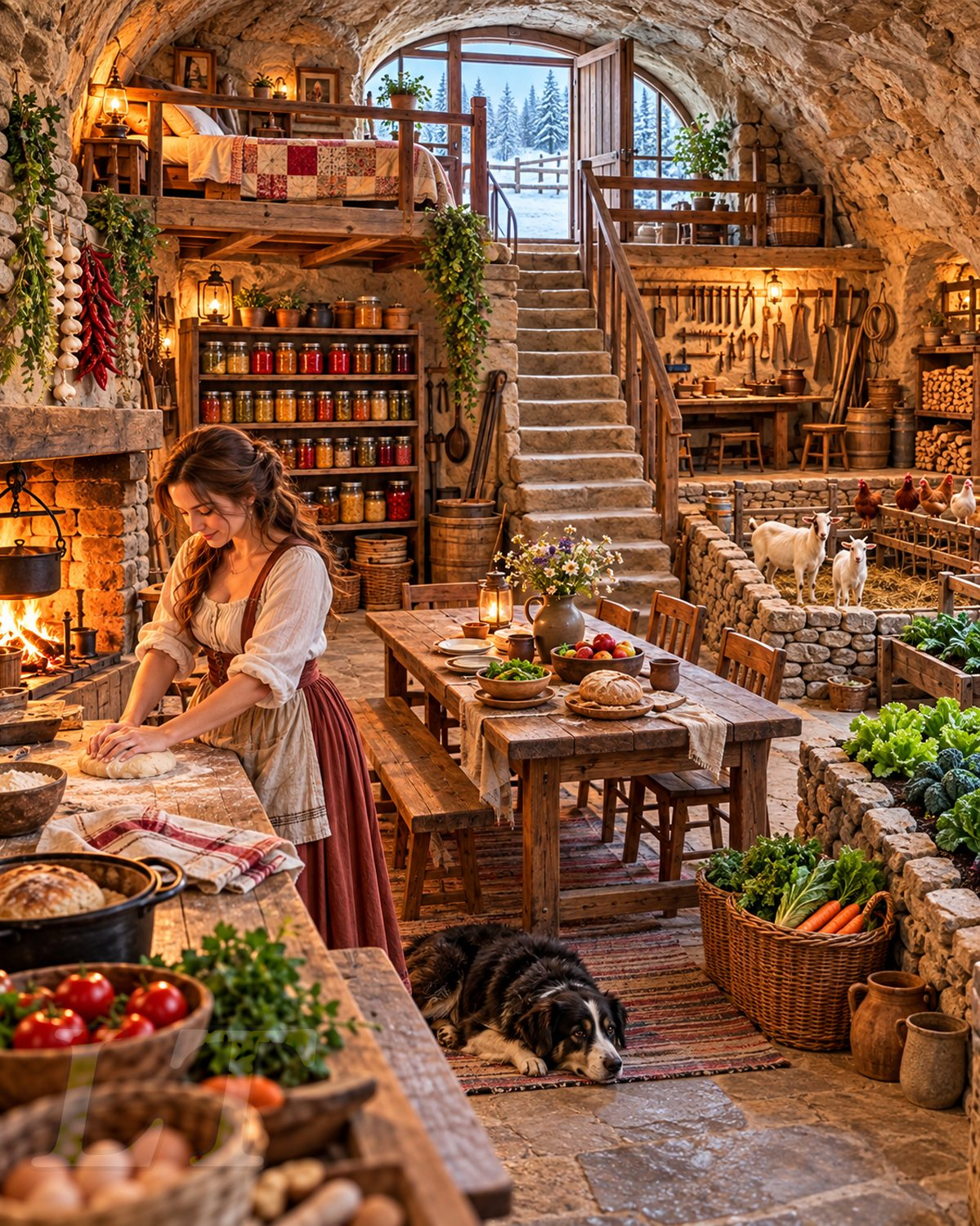
I stood beside the livestock enclosure, staring at the low stone wall.
For several seconds, I considered the possibility that something had fallen inside the mountain.
Perhaps a loose stone.
Perhaps an old wooden beam.
But the sound had been too deliberate.
Three knocks.
A pause.
Then another three.
I reached for the lantern hanging beside the fireplace.
Its warm light illuminated the rough limestone walls as I approached the enclosure.
The iron ring was still moving slightly.
I pulled it again.
Nothing happened.
Then I remembered the notebook.
When the mountain grows quiet, open what I left beneath the eastern wall.
I returned to the wooden table and spread the notebook open.
The final drawing showed the stone wall from above.
There were several small marks beside the illustration.
At first, they looked like ordinary measurements.
But when I turned the notebook sideways, I noticed something strange.
The marks were not measurements.
They were instructions.
Three stones had been marked with tiny circles.
One near the bottom.
One in the middle.
And one near the upper corner.
I returned to the wall.
Using the lantern, I located the first mark.
It was barely visible beneath a thin layer of dust.
I pressed it.
A faint click echoed through the chamber.
The second stone moved slightly when I pushed against it.
Then I pressed the third.
A mechanical sound traveled through the wall.
Something released.
I stepped backward.
A narrow section of the stonework shifted inward.
The wall was not solid.
It was a concealed door.
I stared at the opening.
My grandfather had hidden an entire room behind it.
I pulled the iron ring.
The stone panel moved slowly, revealing a dark passage.
Cold air escaped from the opening.
I raised the lantern.
The passage was narrow but carefully constructed.
Its walls were lined with fitted limestone blocks, and the floor was perfectly level.
There were no signs of water damage.
No loose rocks.
No signs of collapse.
Someone had built this deliberately.
I hesitated before stepping inside.
Then I remembered my grandfather's final winter.
He had once asked me to bring him a small wooden box from his workshop.
When I returned, he had been looking at an old photograph of the mountain.
"Clara," he had said, "some things are worth protecting even when nobody understands why."
I had thought he was speaking about the family.
Now I wondered whether he had been speaking about this place.
I entered the passage.
The air became cooler as I moved deeper.
At the end stood another wooden door.
Unlike the entrance to the cave, this one had no iron handle.
Instead, there was a small brass latch.
I lifted it.
The door opened.
And I nearly dropped the lantern.
The room beyond was enormous.
It was not another natural chamber.
It was a carefully organized storage room.
Heavy wooden shelves covered three walls.
There were rows of sealed containers, stacks of blankets, boxes of candles, spare tools, preserved meat, and carefully wrapped bundles of clothing.
Along the far wall stood several large wooden barrels.
Each had a handwritten label.
WATER.
DRIED BEANS.
GRAIN.
SALT.
The shelves were arranged with such precision that I immediately understood something.
My grandfather had not been collecting random supplies.
He had been preparing for a prolonged emergency.
I moved closer to the shelves.
There were dozens of glass jars filled with vegetables.
Carrots.
Potatoes.
Beets.
Green beans.
Tomatoes.
Everything had been preserved and labeled.
Some jars carried dates from nearly twenty years earlier.
Others were much more recent.
I picked up one of the older jars.
The handwriting on its label belonged to Samuel.
I could almost picture him standing here, carefully writing each date while the rest of the valley slept.
Why had he done all this?
I continued exploring.
Behind the supplies, I discovered several folded wool blankets.
Beside them were thick sleeping pads and spare boots in different sizes.
There were even small wooden stools and a collection of children's blankets.
I stopped.
Children's blankets?
My grandfather had never mentioned expecting children to stay here.
I placed them carefully back on the shelf.
Then I noticed a large metal container beneath the table.
Its lid was secured with two metal clips.
I opened it.
Inside were old maps.
Not maps of the entire United States.
Maps of the Montana valley.
Several had been marked with colored pencil.
The main road.
The river.
The cattle properties.
The southern ridge.
And the homes scattered throughout the valley.
Some locations had small red crosses beside them.
Others had circles.
I recognized Harold Briggs's ranch.
Daniel's property.
The general store.
Mrs. Pike's boarding house.
My grandfather had marked nearly every important location in the valley.
I unfolded another map.
This one showed the mountain itself.
There were several lines drawn beneath the ridge.
One appeared to lead toward the cave.
Another extended farther into the limestone.
At the bottom, Samuel had written:
Emergency drainage route. Inspect every autumn.
I looked toward the floor.
The cave was much more complicated than I had imagined.
It was almost as if my grandfather had built an entire underground system.
I returned to the main chamber.
The fireplace was still burning gently from the wood I had added earlier.
The dog was not there.
I suddenly remembered that I had no dog.
The animal from the old photograph in my grandfather's notebook had belonged to his younger years.
I smiled faintly at the memory.
Then I looked toward the livestock enclosure.
Two goats stood behind the wooden barrier.
They had been left there by Samuel's neighbor, who had agreed to help care for the animals while the property was being settled.
Their names were Daisy and June.
Five chickens occupied the adjoining coop.
They were part of the inheritance too.
I had not understood why my grandfather had insisted that the animals remain on the property.
Now I began to understand.
The cave was not simply designed to shelter people.
It was designed to keep them alive.
I spent the next several hours inspecting the chamber.
I checked the fireplace.
I examined the ventilation opening.
I tested the wooden doors.
I counted the food supplies.
Then I returned to the notebook.
There were dozens of pages I had not yet examined.
Near the middle, I found a list written in Samuel's careful handwriting.
WINTER PREPARATIONS
Firewood: minimum six months.
Flour: minimum four months.
Dried beans: minimum four months.
Salted meat: adequate storage.
Water reserves: inspect monthly.
Livestock: sheltered and fed.
Ventilation: clear before first snowfall.
Southern entrance: inspect hinges.
Emergency passage: keep accessible.
I read the list twice.
Then I noticed a date.
October 17.
The year was twenty-two years earlier.
My grandfather had been preparing this cave long before I was born.
I sat down at the wooden table.
The fire crackled.
The mountain remained silent.
And suddenly I remembered something my grandfather had told me when I was a little girl.
We had been sitting beside the fireplace in his farmhouse.
I had asked him why he kept so much food in the pantry.
He had laughed.
"Because, little bird, a full pantry is worth more than a full wallet when the road disappears."
I had never understood that sentence.
Now I did.
I looked toward the window.
The sky had turned a deep gray.
The first thin flakes of snow were drifting past the glass.
It was only October.
Snow was not unusual in the Montana mountains.
But something about the way the clouds were gathering made me uncomfortable.
I closed the notebook.
Tomorrow, I would inspect the exterior entrance and make certain the drainage channels were clear.
I would also need more firewood.
If I intended to live here through the winter, I had work to do.
I stood and began preparing supper.
The goats shifted in their enclosure.
The chickens settled into their nesting area.
I heated a small pot of beans and cut a piece of bread.
For the first time in months, I ate without feeling that I was being watched or judged.
Nobody was laughing.
Nobody was asking why I had not married.
Nobody was telling me that I had wasted my life caring for an old man.
There was only the mountain.
And the strange feeling that my grandfather was somehow still guiding me.
After supper, I climbed the stone staircase to the sleeping loft.
The bed was simple but comfortable.
A thick wool blanket lay folded at its foot.
Beside it was a small wooden chest.
I opened the chest.
Inside were several old photographs.
One showed Samuel as a young man standing outside the cave entrance.
Another showed him beside a woman I recognized as my grandmother.
But the third photograph made me stop.
It showed my grandfather standing in front of the cave with three other men.
They were all dressed in heavy winter clothing.
Behind them, the mountain was covered in snow.
The photograph had been taken decades earlier.
On its reverse side, Samuel had written:
The winter we learned what the mountain could endure.
I turned the photograph over again.
One of the men was holding a newspaper.
The headline was partially visible.
MONTANA VALLEY CUT OFF BY RECORD SNOWFALL.
I stared at it.
A sudden feeling of unease settled over me.
My grandfather had lived through a terrible winter.
Perhaps that explained everything.
Perhaps he had built the cave because he knew what happened when the valley became isolated.
I placed the photograph beside the bed.
Then I noticed something written in the corner of the chest.
A small envelope had been tucked beneath the wooden lining.
My name was written across it.
FOR CLARA. OPEN BEFORE THE FIRST GREAT STORM.
I stopped breathing for a moment.
My hands trembled slightly as I lifted the envelope.
The paper was old.
The handwriting was unmistakably Samuel's.
I opened it carefully.
Inside was a single folded letter.
The first sentence made my stomach tighten.
My dearest Clara, if you are reading this, then you have finally entered the place your cousins will never understand.
I sat on the edge of the bed.
The firelight from below flickered across the wooden beams.
I unfolded the remaining pages.
There were four more paragraphs.
But before I could read them, something struck the cave entrance.
Hard.
Once.
Twice.
Then a man's voice echoed through the wooden door.
"Clara Whitcomb! Open up!"
I recognized the voice immediately.
It was Harold Briggs.
But he was not laughing anymore.
And when I looked toward the window, I saw that he had not come alone.
There were two other men standing behind him.
One was carrying a shovel.
The other was holding something wrapped in a heavy blanket.
Then Harold shouted again.
"Clara! We need to talk about what's inside that mountain!"
Hết phần 1: Chapter 1–2.
Để bảo đảm mỗi chương có đủ độ dài và giữ nguyên mạch truyện, tác phẩm sẽ được triển khai lần lượt theo các phần, không tóm tắt thay cho nội dung chương.






Comments 0