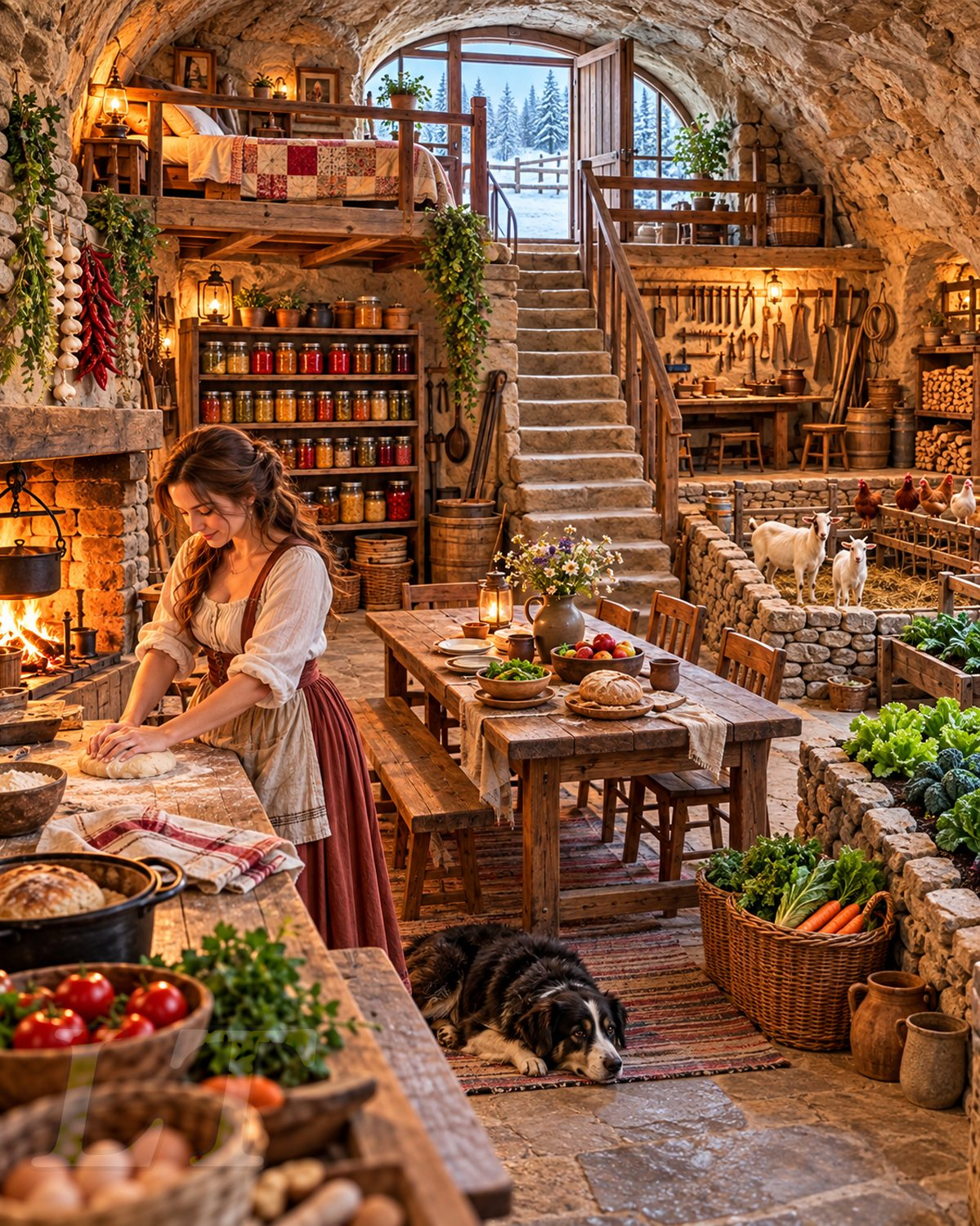
The hidden cabinet moved another inch.
I stood frozen in the middle of the cave, holding the lantern so tightly that my fingers began to ache.
Behind me, Daniel was still pounding on the entrance.
"Clara! Open the door!"
But I barely heard him.
My attention was fixed on the narrow darkness behind the cabinet.
Something had released the mechanism.
And whatever my grandfather had hidden behind that wall had remained untouched for decades.
I took one cautious step forward.
The cabinet shifted again.
A faint metallic groan traveled through the stone chamber.
Then it stopped.
I raised the lantern.
Behind the cabinet was a narrow wooden door, almost perfectly concealed by the surrounding limestone.
It was not like the other doors in the cave.
This one had been reinforced with thick iron brackets.
A small brass plate was attached near the handle.
There were words engraved on it.
WESTERN EMERGENCY CHAMBER.
I felt my stomach tighten.
My grandfather had specifically warned me about this passage.
The note inside his notebook had been clear.
If anyone asks about the western passage, tell them there is nothing beyond the stone.
Why would he hide an entire chamber?
And why had Daniel suddenly discovered a survey map mentioning a room beneath the mountain?
Another pounding sound interrupted my thoughts.
"Clara!"
I turned toward the entrance.
"Stop shouting! I can hear you!"
"Then open the door!"
"Not until you tell me what you found."
Daniel hesitated.
I heard him speaking quietly to Harold.
Then he answered.
"We found an old survey document in Grandpa's farmhouse. It shows a structure beneath the cave."
"What kind of structure?"
"We don't know."
"Then why are you here?"
Harold's voice suddenly cut through the conversation.
"Because your grandfather may have built something on our property boundary, and we have a right to know what it is!"
I almost laughed.
"Our property boundary?"
"The northern section of the ridge borders my grazing land."
"Grandpa's deed clearly includes the cave and the surrounding mountain property."
"That isn't what I'm talking about!"
I looked toward the hidden western door.
There was something in Harold's voice that I had never heard before.
Not amusement.
Not arrogance.
Fear.
I moved closer to the entrance.
"Daniel, where did you find the map?"
"In Grandpa's farmhouse."
"Where?"
"In his old workshop."
I closed my eyes briefly.
The workshop had been locked since the funeral.
Nobody had permission to enter it.
"How did you get inside?"
Daniel did not answer immediately.
Then Harold spoke.
"We have business that concerns the entire family. Stop wasting time and open this door."
I decided I had heard enough.
I returned to the hidden cabinet and examined the mechanism.
A small iron lever was attached to the lower frame.
It had been pulled outward.
I pushed it back into place.
The cabinet stopped moving.
Then I heard a sound from behind the western door.
A low, hollow thud.
Something had fallen inside.
I stepped away.
Whatever was hidden there could wait.
First, I needed to deal with the people outside.
I unlocked the viewing hatch.
Daniel stood closest to the entrance.
His dark hair was wet with melting snow, and his expression was unusually serious.
Harold stood behind him.
Warren Pike was beside the younger man I had seen the previous evening.
The younger man was no longer carrying the blanket-wrapped object.
Instead, he held a rolled document.
Daniel lifted it.
"Look."
He pushed the paper toward the viewing hatch.
I could see a faded drawing of the southern ridge.
There were several lines beneath the mountain.
A thick black circle marked the location of the cave.
Below it, somebody had drawn a second chamber.
A handwritten note appeared near the bottom.
LOWER STRUCTURE — PRIVATE ACCESS — SEE ORIGINAL CONSTRUCTION RECORDS.
I stared at the document.
"Where did you find this?"
"Grandpa's workshop," Daniel repeated.
"Who opened the workshop?"
"I did."
"Without permission?"
He frowned.
"Don't start."
I looked at him.
"You had no right to enter his private property."
Daniel's expression hardened.
"That property belongs to the family."
"No. The cave belongs to me."
He shook his head.
"Clara, this is bigger than your inheritance."
Harold stepped closer.
"We're not interested in your personal feelings. There's a possibility that your grandfather built an underground water system extending beyond the property line."
I looked at the document again.
The words PRIVATE ACCESS were clearly visible.
"Why would that concern you?"
Harold glanced toward the younger man.
The man finally spoke.
"My name is Thomas Reed. I work as a surveyor."
I recognized the name.
Thomas had recently arrived in the valley to inspect several properties for the county.
"What are you doing here?"
He looked uncomfortable.
"I was asked to examine the original land documents."
"By whom?"
Harold answered for him.
"Me."
I folded my arms.
"And what exactly did you discover?"
Thomas hesitated.
"The survey indicates that your grandfather may have constructed a system of underground chambers beneath the southern ridge."
I felt my pulse quicken.
"How many?"
"We can't tell from this document alone."
"Then you don't know what's there."
"No," he admitted.
"But there's something else."
He unrolled the document farther.
A small symbol appeared near the lower corner.
A bird.
The same bird carved above the cave entrance.
I stared at it.
"Where did that come from?"
Thomas looked directly at me.
"It appears on several of Samuel's construction plans."
Harold interrupted.
"Which means we need to inspect the place."
I shook my head.
"You don't have permission."
Daniel stepped forward.
"Clara, please. We're family."
I looked at him for several seconds.
Then I closed the viewing hatch.
I did not care how angry they became.
This cave was mine.
And I was beginning to understand that my grandfather had hidden things for a reason.
The men eventually left.
At least, that was what I thought.
I watched through the narrow window as they descended the trail.
Harold walked ahead.
Daniel followed.
Thomas remained behind for a moment, looking back toward the entrance.
He seemed to be studying the stonework.
Then he turned and disappeared between the pine trees.
I waited another fifteen minutes before moving away from the door.
The snowfall had become heavier.
The mountainside was almost entirely white.
I returned to the dining table and spread the survey map beside Samuel's notebook.
The two documents contained similar drawings.
But there was an important difference.
The survey map showed a lower chamber beneath the mountain.
My grandfather's notebook showed something else.
A long passage extending toward the western side of the ridge.
The passage appeared to connect several underground structures.
I traced the line with my finger.
It ended at a small square marked with a symbol.
A circle surrounded by three short lines.
I had seen that symbol before.
It was engraved on the brass tag attached to the unmarked key.
I took the key from my pocket.
The little bird was on one side.
The other side carried the same circle and three lines.
I turned the key over repeatedly.
What had my grandfather intended me to open?
I returned to the western cabinet.
This time, I moved it completely aside.
The concealed door was now fully visible.
I examined the lock.
There was no ordinary keyhole.
Instead, a small circular opening was positioned beneath the brass plate.
I brought the key closer.
It fitted.
A faint metallic click followed.
The door did not open.
I tried turning the key.
Nothing happened.
Then I noticed a second mechanism beneath the handle.
Three small metal buttons.
I examined the notebook.
On one of the drawings, Samuel had marked three circles in a particular order.
Upper.
Lower.
Middle.
I pressed them accordingly.
The lock released.
The door opened slowly.
Cold air flowed into the chamber.
I raised the lantern.
Beyond the entrance was a narrow staircase descending into darkness.
The stone steps were old but solid.
Iron handrails had been fixed along both sides.
I leaned forward.
The passage extended much farther than I expected.
At the bottom, I could see a faint reflection of metal.
I wanted to investigate.
But something stopped me.
A small warning had been carved into the stone beside the entrance.
DO NOT ENTER DURING HEAVY RAIN OR RAPID THAW.
I looked down.
The lowest steps appeared slightly damp.
A thin line of water was running along the edge of the floor.
I stepped back immediately.
My grandfather had built this passage for a purpose.
And he had left instructions for its use.
I closed the door.
Then I carefully locked it.
I was beginning to understand that the mountain was not simply a shelter.
It contained systems that needed to be maintained.
And if I made one mistake, the consequences might be serious.
That afternoon, I decided to inspect the exterior.
I put on my charcoal shawl, leather apron, and winter boots.
Then I took a lantern, a small shovel, and Samuel's notebook.
The entrance door opened with some resistance.
Cold air rushed inside.
Outside, the world had changed.
Snow covered the rocks and pine branches.
The trail was still visible, but the upper ridge had disappeared behind low clouds.
I stepped outside.
The air smelled of frozen earth and pine.
I checked the wooden door hinges.
They were strong.
The iron brackets showed no signs of damage.
Then I inspected the drainage channel running along the southern side of the entrance.
It was partly covered by leaves.
I cleared them with the shovel.
Water began moving freely through the narrow stone channel.
I remembered the warning on the western passage.
The mountain's drainage system had to remain clear.
That explained why Samuel had insisted on inspecting it every autumn.
I followed the channel around the side of the cave.
Several feet beyond the entrance, I found a small stone opening concealed beneath a wooden cover.
The cover had been secured with two iron bolts.
I removed them.
Inside was a narrow drainage shaft.
Water was flowing through it.
I watched for several minutes.
Everything seemed normal.
Then I noticed something strange.
A small piece of cloth was caught between two stones.
I reached down and pulled it free.
It was dark blue.
Thick wool.
And it was not old.
The fabric looked recently torn.
I examined it.
There was a small embroidered letter near the edge.
H.
Harold.
My stomach tightened.
Had he been here before?
I looked toward the trail.
Nobody was visible.
I placed the cloth in my pocket.
Then I returned to the entrance.
As I reached the wooden door, I noticed fresh boot prints in the snow.
They were not mine.
They approached from the direction of the northern ridge.
Then they disappeared beside the cave wall.
Someone had been walking around the property.
Someone who knew where the entrance was.
I followed the tracks for several yards.
They led toward a cluster of pine trees.
Beyond them stood a large limestone outcrop.
I had seen it from the window.
It was positioned almost directly above the hidden western chamber.
The tracks ended there.
I looked down.
A narrow metal plate had been placed between two rocks.
I brushed away the snow.
Beneath it was a small iron ring.
I pulled.
Nothing moved.
I examined the surrounding stones.
One was loose.
I pressed it.
A faint metallic sound came from beneath the ground.
Then I heard a distant rumble.
I stepped backward.
The sound lasted only a few seconds.
But it was unmistakably coming from somewhere inside the mountain.
I decided not to investigate further.
Instead, I returned to the cave and secured the entrance.
I had discovered enough for one day.
That evening, I prepared supper and sat beside the fireplace with Samuel's letter.
There were still several paragraphs I had not read.
I unfolded the final section.
Clara, if you have reached this part of the letter, then you must understand that I did not build the cave because I was afraid of winter.
I built it because I knew winter could take everything from a person before they had time to understand what was happening.
The mountain has water, stone, warmth, and shelter. But it must be respected.
Never allow anyone to damage the drainage system.
Never close the ventilation shaft.
And if the northern ridge begins to rumble, leave the lower passage alone.
I stopped.
The northern ridge.
I thought about the sound I had heard near the limestone outcrop.
A distant rumble.
Perhaps it was nothing.
Perhaps the mountain was settling.
But my grandfather had specifically mentioned it.
I continued reading.
There will come a time when people who laughed at this place will ask you to open its door.
Do not turn them away simply because they were cruel.
But do not let them take control of what they do not understand.
I lowered the letter.
My grandfather had known this might happen.
He had expected the same people who dismissed his work to eventually need it.
The thought made me uncomfortable.
I did not know whether I could forgive Harold.
I did not know whether Daniel deserved my trust.
But I knew that if the cave was ever needed, I could not allow personal anger to endanger innocent people.
I folded the letter and placed it beside the notebook.
Then I looked toward the window.
Snow was falling steadily.
The sky had become darker than it should have been at that hour.
I checked the clock.
It was barely six in the evening.
The storm seemed to be arriving early.
The following morning, I woke to the sound of someone knocking.
Not on the entrance door.
On the window.
I climbed down from the sleeping loft.
A small branch had broken from a nearby pine tree and was tapping against the glass.
Beyond it, the mountainside was covered in fresh snow.
I opened the shutters slightly.
The wind was stronger.
A dark band of clouds stretched across the northern horizon.
I had seen storms before.
But this one looked different.
It was moving quickly.
I prepared breakfast, fed the animals, and checked the water supply.
Then I began inspecting the ventilation shaft.
I climbed a small wooden ladder near the fireplace.
The opening was clear.
There was no visible obstruction.
I checked the airflow by holding a small strip of cloth near the vent.
It moved gently upward.
Good.
Then I inspected the southern drainage system.
The channels were functioning.
The water was flowing.
Everything appeared normal.
I returned to the table and opened Samuel's notebook.
Several pages near the end contained weather observations.
Dates.
Temperatures.
Wind directions.
Snowfall measurements.
My grandfather had kept records for nearly forty years.
One entry caught my attention.
NOVEMBER 14 — NORTHERN PRESSURE DROP.
Below it:
Storm formation unusually rapid. Prepare lower chamber. Warn valley residents.
Another entry appeared three years later.
NOVEMBER 19 — EXTREME SNOWFALL.
Roads closed within six hours. Southern entrance remained accessible. Lower chamber remained dry.
I turned another page.
The final entry was written in darker ink.
SEVEN-DAY EVENT — DO NOT WAIT FOR THE FIRST ROAD CLOSURE.
I stared at the words.
Seven-day event.
My grandfather had not simply prepared for ordinary winter weather.
He had anticipated a storm lasting an entire week.
I read the page again.
Beneath the warning was a list of locations.
Harold Briggs Ranch.
Whitcomb Farm.
General Store.
Pike Boarding House.
North Valley School.
Each location had a number beside it.
The numbers appeared to indicate how many people lived there.
I counted them.
The total was more than sixty.
My grandfather had been preparing supplies for over sixty people.
I sat down slowly.
Sixty people.
I looked around the cave.
The blankets.
The food.
The additional boots.
The livestock stalls.
The sleeping loft.
Everything suddenly made sense.
This place had never been intended for one person.
It was designed to shelter an entire community.
I was still studying the list when someone knocked on the entrance.
This time, it was a gentle knock.
Three times.
I opened the viewing hatch.
Mrs. Pike stood outside.
Her face was pale.
"Clara, I need to speak with you."
I opened the door.
She stepped inside quickly, brushing snow from her coat.
"Something happened in town."
"What?"
She looked toward the window.
"The weather station sent a warning this morning."
I felt my stomach tighten.
"What kind of warning?"
"A major winter system is moving toward the valley."
"How serious?"
She swallowed.
"They're saying it could be the worst storm we've seen in decades."
I glanced at Samuel's notebook.
"How long?"
"Possibly five days. Maybe longer."
I looked at the seven-day entry.
Mrs. Pike continued.
"The county is advising everyone to stock up on food and fuel. They've already warned the ranchers that the northern road may become impassable."
I walked toward the window.
Outside, the clouds had become almost black.
"Did they say when it would arrive?"
"Within the next few days."
She paused.
"There's something else."
I turned.
"Harold has been telling people that your cave contains a private water supply."
I stared at her.
"How does he know that?"
"He doesn't. But he's convinced your grandfather built a reservoir beneath the mountain."
I remembered the northern passage.
The emergency water system.
The lower chamber.
"Has anyone else heard this?"
"Almost everyone."
Mrs. Pike looked genuinely worried.
"Daniel has been telling people that the cave should be inspected before the storm arrives."
I shook my head.
"They have no idea what they're talking about."
"I know."
She lowered her voice.
"Clara, Harold is organizing a meeting at the general store tomorrow. He wants the county to investigate your property."
I looked toward the entrance.
For a moment, I considered telling her everything.
But I did not know enough yet.
And my grandfather had warned me not to let anyone take control of the cave.
"I'll handle it," I said.
Mrs. Pike studied my face.
"Your grandfather trusted you for a reason."
I nodded.
After she left, I returned to the notebook.
I counted the supplies again.
Then I examined the map.
The storm was approaching.
The valley had no idea how dangerous it might become.
And the people who had laughed at my inheritance were already trying to claim a piece of it.
By late afternoon, the snowfall had become heavy enough to obscure the trail.
I secured the shutters and checked the entrance.
Then I carried additional firewood toward the fireplace.
The goats were restless.
The chickens had gathered close together.
I filled their feeding containers and checked the water again.
Everything needed to be ready.
As I returned to the table, I noticed a folded paper beneath the notebook.
I had not seen it before.
It was smaller than Samuel's letter.
The paper had been folded several times and secured with a thin piece of string.
I opened it.
Inside was a handwritten message.
CLARA — IF THE COUNTY EVER COMES TO INSPECT THE CAVE, SHOW THEM THE SOUTHERN DEED. NEVER SHOW THEM THE SECOND DOCUMENT.
I stared at the words.
Second document?
I turned the paper over.
On the back, Samuel had written:
The original ownership of the lower mountain is not what the family believes.
I read the sentence repeatedly.
What did that mean?
Had my grandfather owned more land than the family knew?
Had he purchased something secretly?
Or had the cave been built on property that legally belonged to somebody else?
I looked toward the storage room.
The old survey map.
The concealed western chamber.
The northern water system.
The hidden keys.
There were too many unanswered questions.
I decided to search the old chest again.
Perhaps the second document was among the papers.
I climbed the staircase and opened the wooden chest.
Photographs.
Old letters.
Construction sketches.
A few receipts.
Nothing that looked like an original deed.
I searched beneath the lining.
Then I noticed a narrow compartment at the back.
It was secured with a small brass latch.
I reached for the unmarked key.
It fitted.
The compartment opened.
Inside lay a thick envelope wrapped in oilcloth.
My name was written across the front.
CLARA WHITCOMB — TO BE OPENED ONLY WHEN THE VALLEY IS IN DANGER.
My hands became cold.
I removed the envelope.
There was something heavy inside.
Something made of metal.
I carefully opened the wrapping.
A small brass key fell into my palm.
Beneath it was a single sheet of paper.
The handwriting was my grandfather's.
The people who mocked this cave will come when the roads disappear. Let them come. But before you open the lower chamber, you must know who built it with me.
I stared at the sentence.
Then I noticed a name written beneath it.
A name I had never heard before.
ELIAS BLACKWOOD.
Suddenly, a loud metallic crash echoed from somewhere beneath the cave.
The fireplace trembled.
Dust fell from the ceiling.
The lantern flickered.
Then a deep rumbling sound traveled through the stone floor.
I grabbed the edge of the table.
The goats began bleating.
The chickens erupted into frantic movement.
And from behind the locked western door, somebody struck the metal three times.
Then a man's voice came through the stone.
"Samuel?"
I stopped breathing.
The voice spoke again.
"Is that you?"
But my grandfather had been dead for months.
And whatever was beneath the mountain had just called his name.






Comments 0