"Clara! Open this door!"
Harold Briggs struck the wooden entrance again.
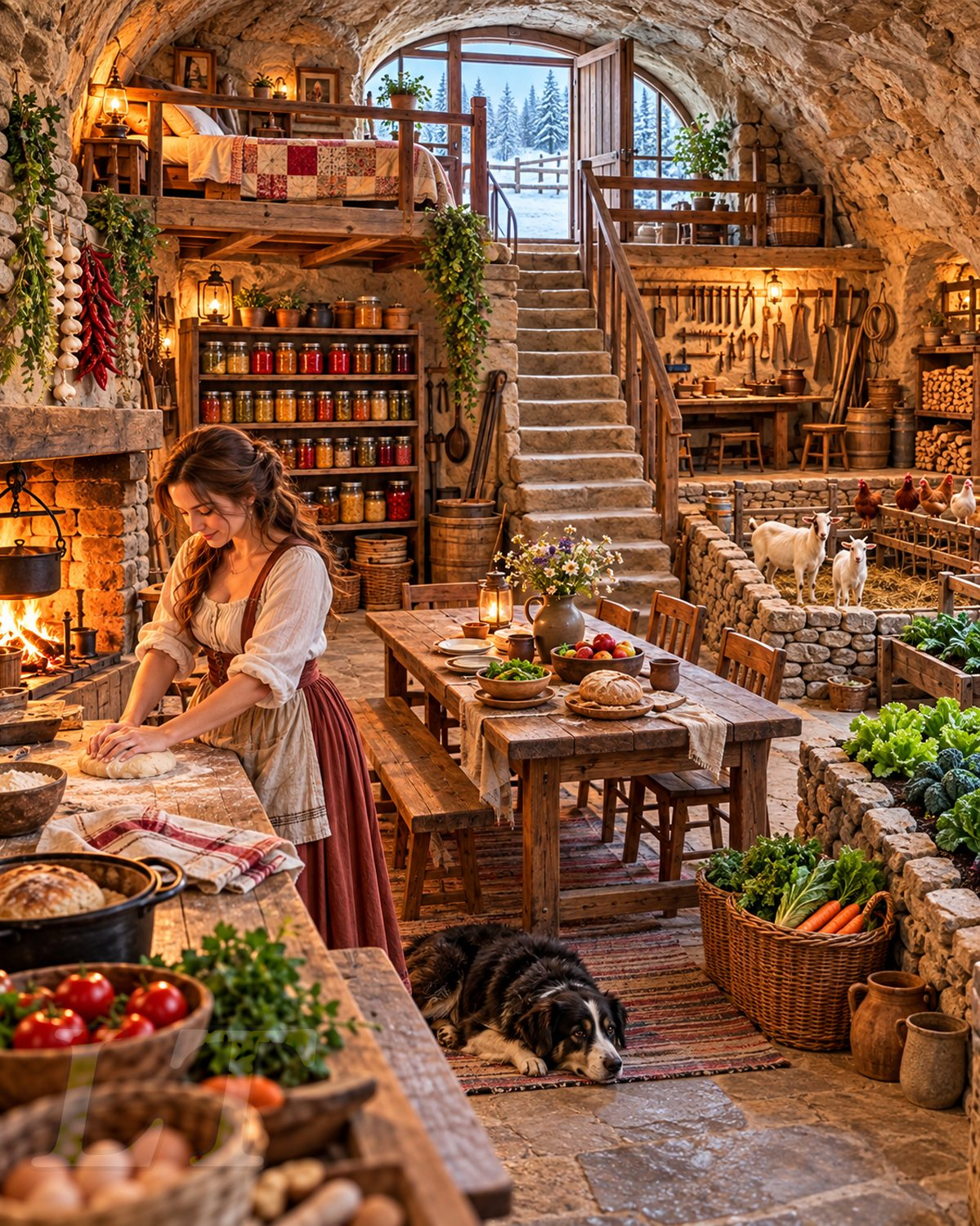
I stood halfway down the stone staircase, Samuel's letter trembling slightly in my hand.
For several seconds, I simply watched the heavy wooden door.
Harold had never visited my grandfather's cave before. Not once in all the years Samuel had owned it. He had always considered the place worthless, an eyesore on the mountainside that prevented him from expanding his grazing property.
So why was he standing outside my door now?
And why had he brought two other men?
I folded the letter and slipped it into the pocket of my wool dress.
Then I picked up the lantern and walked toward the entrance.
"Who is it?" I called.
"It's Harold! You know perfectly well who's standing here!"
"I know your voice. What do you want?"
There was a brief silence.
Then another man spoke.
"Just open the door, Clara. It's getting cold out here."
I recognized him too.
Warren Pike, a ranch hand who had worked for Harold for nearly fifteen years.
The third man remained silent.
I approached the wooden entrance and lifted the small viewing hatch Samuel had installed near eye level.
Harold's face appeared immediately.
His cheeks were red from the cold, and his hat was covered with tiny snowflakes.
Behind him stood Warren, holding a shovel.
The third man was younger, perhaps in his early thirties. He carried a large blanket-wrapped object against his chest.
"What happened?" I asked.
Harold looked past me, trying to see inside.
"First, let us come in."
"Why?"
"Because we have business to discuss."
"Then discuss it from there."
His expression hardened.
"Don't make this difficult, Clara."
I almost laughed.
Only yesterday, this same man had been standing outside the general store, making jokes about my inheritance.
Now he was asking me to open my grandfather's door.
I kept my hand on the viewing hatch.
"Tell me why you're here."
Harold glanced at Warren.
Then he lowered his voice.
"We heard you've found something inside."
I looked at him carefully.
"What makes you think that?"
"People talk."
"People also laugh."
His jaw tightened.
"Listen, girl. I'm not interested in arguing with you. We need to inspect the property."
"No."
The answer came so quickly that he blinked.
"What?"
"I said no."
Harold stared at me as though he had never imagined hearing that word from my mouth.
Then Warren stepped forward.
"Clara, there's no reason to be difficult. We're only trying to help."
I looked at the shovel in his hands.
"Why did you bring that?"
Warren glanced down.
"There's some snow blocking the trail."
I looked past him.
The trail was perfectly visible.
There was hardly enough snow to cover the tops of the stones.
Something was wrong.
The younger man shifted the object in his arms.
A faint metallic sound came from beneath the blanket.
I narrowed my eyes.
"What are you carrying?"
He hesitated.
Harold turned toward him.
"Nothing that concerns her."
That answer told me more than he intended.
I closed the viewing hatch.
"Go home, Harold."
His fist struck the door.
"You're making a serious mistake!"
I stepped away from the entrance.
For several seconds, I heard nothing but the wind moving through the trees.
Then their footsteps began retreating down the trail.
I waited until the sounds disappeared.
Only then did I return to the wooden table.
Samuel's letter was still in my pocket.
I took it out and unfolded it beneath the lantern.
The first paragraph had already unsettled me.
My dearest Clara, if you are reading this, then you have finally entered the place your cousins will never understand.
I continued.
You may have discovered the storage chamber behind the eastern wall. If you have, then you already know that this place is much more than a dwelling.
I built it because I once watched an entire valley become helpless beneath the weight of winter.
I stopped reading.
The photograph in the sleeping loft suddenly came back to mind.
The newspaper headline.
The record snowfall.
I continued.
People think winter arrives slowly. They believe they will have time to prepare when the first serious storm appears. They believe roads will remain open, stores will remain supplied, and neighbors will always be able to reach one another.
They are wrong.
I sat down.
The letter continued for several pages.
My grandfather described a winter from his younger years, when he had been working as a ranch hand in the northern part of Montana.
A storm had arrived unexpectedly.
Snow buried the roads.
Telephone lines failed.
The river froze.
Several families became trapped in their homes without sufficient food or firewood.
Samuel had survived because an older rancher named Elias had taken him into a stone shelter built into the mountainside.
That shelter had saved their lives.
But not everyone had been fortunate.
My grandfather wrote about families who had been forced to abandon their homes.
He described children sleeping beneath blankets in freezing barns.
He remembered men walking through waist-deep snow to reach neighbors who had run out of supplies.
And he remembered the helplessness of watching the storm continue while the valley slowly disappeared.
The letter ended that section with one sentence.
I promised myself that if I ever had the means, I would build a place where nobody would have to beg the mountain for mercy.
I lowered the paper.
The fireplace crackled behind me.
For a long moment, I simply stared at the stone wall.
My grandfather had spent decades building this shelter because he had experienced something terrible.
But why had he never told the family?
Why had he never explained the true purpose of the cave?
I returned to the letter.
The next paragraph contained a list.
There are three things you must understand.
First, the cave is designed to maintain warmth even when the outside temperature falls far below freezing.
Second, the ventilation system must remain clear. Never seal the upper shaft, even during a storm.
Third, the eastern storage chamber contains supplies intended for more than one household.
I read the final sentence twice.
More than one household.
That explained the blankets.
The extra boots.
The children's bedding.
My grandfather had not been preparing for himself.
He had been preparing for other people.
I looked toward the window.
The snowfall had become heavier.
The pine trees outside were beginning to disappear behind a thin white curtain.
I folded the letter.
Tomorrow, I decided, I would inspect every part of the cave.
If Samuel had left me instructions, I needed to understand them before winter became dangerous.
But first, I had to know why Harold had come.
I slept poorly that night.
Every small noise seemed louder than usual.
The occasional movement of the goats.
The faint crackle of the fireplace.
The wind brushing against the entrance door.
At some point, I woke to find the fire had burned lower than I expected.
I climbed down from the sleeping loft and added two pieces of wood.
The warmth returned slowly.
While waiting, I examined the fireplace more carefully.
My grandfather had constructed a remarkable system.
The hearth was wide enough to accommodate several logs, and the stone surrounding it appeared unusually thick.
Beneath the fireplace was a small metal access door.
I opened it.
Inside was a collection of tools and a narrow metal lever.
The lever was connected to a mechanical assembly built into the stonework.
I compared it with the drawing in Samuel's notebook.
It appeared to control the airflow.
I did not touch it.
Instead, I closed the access door and continued inspecting the room.
The cave was full of details I had never noticed.
Small drainage channels ran along the lower edges of the walls.
The floor sloped slightly toward a recessed stone opening.
Wooden shutters covered several narrow windows.
The staircase had been carved directly into the limestone, but Samuel had reinforced the edges with timber.
Everything had been designed to withstand years of use.
I began to understand why the cave had taken so long to build.
It had not been an ordinary construction project.
It had been my grandfather's life's work.
By sunrise, I had made a list of everything that needed inspection.
Food.
Water.
Firewood.
Ventilation.
Doors.
Drainage.
Livestock.
I placed the list beside his notebook.
Then I heard the goats moving.
Daisy and June were standing near the enclosure gate.
I checked their water and filled their feeding troughs.
The chickens were already awake.
Their soft clucking echoed through the stone chamber.
I scattered grain across their feeding area.
As I worked, I noticed that one of the storage barrels had been moved slightly.
It was positioned beside the eastern wall, close to the hidden passage.
I pushed it aside.
Beneath it was a small wooden hatch.
I knelt and examined the hinges.
They were clean.
Recently maintained.
My grandfather had clearly wanted this opening to remain accessible.
I lifted the hatch.
A narrow compartment appeared beneath the floor.
Inside were several metal containers and a small leather pouch.
I removed the pouch.
It contained three keys.
Each was marked with a small brass tag.
The first said:
WATER.
The second said:
NORTH.
The third had no label.
I turned it over.
On the back was a tiny engraved bird.
The same symbol above the cave entrance.
I placed the keys in my pocket.
Then I examined the metal containers.
They were sealed.
One held spare lamp oil.
Another contained medical supplies.
The third held neatly wrapped bundles of matches.
I smiled faintly.
Samuel had thought of everything.
But I was beginning to wonder whether I had only discovered the smallest part of what he had built.
Around midday, I heard footsteps outside.
This time, they were slower.
A single person approached the entrance.
I opened the viewing hatch.
Mrs. Eleanor Pike stood outside, holding a basket covered with a wool cloth.
She looked surprised when I opened the hatch.
"Clara? I was hoping you were here."
I smiled.
"Come in, Mrs. Pike."
She stepped inside and looked around.
For several seconds, she said nothing.
Her eyes traveled from the fireplace to the shelves, then toward the staircase.
"Oh, my goodness."
I helped her remove her coat.
"I know. I had no idea either."
She walked toward the dining table.
"Samuel never let anyone see the whole place."
"Did you know about the storage room?"
Her expression changed.
"Storage room?"
I showed her the hidden passage.
She stared into the darkness.
"Good heavens. He really did build another room."
I nodded.
Mrs. Pike placed her basket on the table.
"I brought you some fresh bread and a little butter. I thought you might need something besides dried beans."
"Thank you. That's very kind."
She sat down while I prepared coffee.
For a while, we spoke about ordinary things.
The general store.
The condition of the road.
The recent changes in the weather.
Then she mentioned Harold.
"He's been asking questions about this property."
I stopped pouring the coffee.
"What kind of questions?"
"He wanted to know whether Samuel had ever mentioned underground storage."
I turned toward her.
"Underground storage?"
She nodded.
"He came into the store this morning. He asked whether your grandfather had purchased large quantities of construction materials."
"What did you tell him?"
"That Samuel bought whatever he needed."
She hesitated.
"Then Harold asked whether I had ever seen him carrying iron equipment up the mountain."
I remembered the metallic object beneath the blanket.
"Did you?"
Mrs. Pike lowered her voice.
"Once. Many years ago. Samuel had two men helping him unload something from a wagon. It was heavy, and they covered it with a canvas sheet."
"What was it?"
"I don't know."
She looked toward the entrance.
"But I remember one thing."
"What?"
"Samuel told them to make sure nobody in town knew what they were building."
A chill moved across my shoulders.
"Why?"
Mrs. Pike shook her head.
"He never explained."
I looked toward the notebook.
There were several references to the northern section of the cave.
Perhaps the answer was there.
"Mrs. Pike, did my grandfather ever talk about a terrible winter?"
Her face became serious.
"Yes."
She placed her cup down.
"Your grandfather lost a brother during the winter of 1952."
I stared at her.
"I didn't know he had a brother."
"Most people didn't. His name was Thomas. He was only twenty-six when the storm came."
She paused.
"Samuel never spoke about him much."
"What happened?"
"Thomas had been helping another family. Their house was buried beneath a snowdrift, and he went out to bring them supplies. The weather turned worse before he could return."
I felt my stomach tighten.
"Did they find him?"
"Not until the spring."
Neither of us spoke for a moment.
Then Mrs. Pike reached across the table and touched my hand.
"Your grandfather never wanted another family to experience that kind of loss."
I looked toward the fireplace.
Suddenly, the cave felt different.
It was no longer just a collection of stone walls and supplies.
It was a promise.
A promise made by a man who had lost someone he loved.
And he had spent the rest of his life making certain that others would have a chance to survive.
After Mrs. Pike left, I returned to the sleeping loft.
I opened Samuel's notebook again.
This time, I focused on the northern section.
There were several pages filled with measurements.
One drawing showed a long narrow passage leading toward a separate chamber.
Another showed a series of iron supports embedded in the mountain.
I recognized the symbol beside the drawing.
It was the same symbol engraved on the unmarked key.
The little bird.
Below it, Samuel had written:
The northern chamber is not to be opened until the first serious snowfall.
I stared at the sentence.
The first serious snowfall.
Outside, snow was beginning to accumulate on the branches.
It was not yet a blizzard, but the mountainside had become noticeably whiter.
I returned to the key pouch.
The key marked NORTH seemed to fit the description.
I looked around the cave.
There was a narrow wooden door behind the staircase, partially concealed by hanging bundles of dried herbs.
I had assumed it was a small storage cupboard.
Now I noticed a metal lock.
I approached it.
The key fitted perfectly.
I turned it.
The mechanism released with a heavy click.
The door opened only a few inches before stopping.
Something was blocking it from the other side.
I pushed gently.
A faint metallic scrape echoed through the passage.
Then the obstruction shifted.
The door opened farther.
Beyond it was a narrow stone corridor.
Unlike the hidden storage room, this passage extended downward.
A line of iron hooks had been fixed into the walls.
Several old lanterns hung from them.
At the far end, I could see another door.
This one was made of heavy metal.
I raised the lantern.
There were markings carved into its surface.
Not measurements.
Not construction instructions.
Words.
I moved closer.
The first line read:
EMERGENCY WATER SYSTEM.
The second line was smaller.
DO NOT OPERATE WITHOUT CHECKING THE SOUTHERN DRAIN.
I took out the notebook.
The drawing matched the door exactly.
Beneath it, Samuel had written a warning.
If the northern system is blocked, the entire mountain may become unsafe.
I felt a sudden rush of concern.
Why would a water system threaten the stability of the mountain?
I did not know.
But I understood enough not to touch anything.
I closed the door and locked it again.
Then I returned to the main chamber.
The snowfall had intensified.
The window was now covered with a thin layer of frost around its edges.
I checked the weather through the narrow opening.
Dark clouds were gathering over the valley.
The wind had changed direction.
I remembered Mrs. Pike's warning.
I also remembered Harold standing outside my entrance.
Something was happening in the valley.
And my grandfather had anticipated it.
That evening, I prepared a proper meal.
I cooked potatoes, beans, and preserved vegetables.
The fire burned steadily.
The goats settled down.
The chickens became quiet.
I sat at the wooden table with Samuel's notebook and began making a more detailed inventory.
I counted the jars.
There were enough preserved vegetables to feed several people for months.
The flour supply was larger than I had first realized.
There were barrels of dried beans, sacks of grain, salt, coffee, and preserved meat.
The eastern storage room contained additional supplies.
There were even spare cooking pots, blankets, and tools.
My grandfather had prepared for a household much larger than his own.
Perhaps ten people.
Perhaps twenty.
I could not be certain.
I was writing down the number of blankets when I noticed something strange.
One page in the notebook had been carefully cut out.
The remaining edges were clean.
Someone had deliberately removed it.
I examined the binding.
The page had been taken out recently enough that the paper fibers were still visible.
I turned the notebook over.
There was a small handwritten note inside the back cover.
If anyone asks about the western passage, tell them there is nothing beyond the stone.
I read it again.
The western passage.
I looked toward the cave walls.
There was no obvious passage on the western side.
Only shelves, tools, and a large wooden cabinet.
I walked toward the cabinet.
It was old and heavy.
My grandfather had kept cooking equipment inside it.
I opened the doors.
Pots.
Pans.
Wooden bowls.
Nothing unusual.
Then I noticed a small gap between the cabinet and the stone wall.
A narrow line of darkness.
I pushed against the cabinet.
It did not move.
I tried again.
A faint scraping sound came from behind it.
I stepped back.
There was something hidden there.
I examined the cabinet more carefully.
Near the bottom, I found a small wooden knob.
It looked like an ordinary decorative feature.
I pulled it.
A section of the cabinet moved outward.
A hidden hinge.
My grandfather had concealed another door.
I reached for the lantern.
Then I heard a loud crash from outside.
The sound echoed through the entrance.
I froze.
Someone was striking the wooden door.
Hard.
Three times.
Then a voice shouted.
"Clara! We know you're in there!"
It was Daniel.
My cousin.
I hurried toward the entrance.
Before I reached it, another voice spoke.
Harold.
"Tell her what you found!"
There was a pause.
Then Daniel shouted something that made my blood run cold.
"Clara, Grandpa didn't just leave you a cave!"
I stopped walking.
My eyes moved toward the concealed cabinet.
Then back toward the entrance.
Daniel struck the door again.
"We found the original survey map!"
I gripped the lantern.
"What map?" I called.
Daniel's answer came immediately.
"The one Grandpa hid from the family!"
I heard paper rustling outside.
Then he spoke again.
"And Clara, there's something written on it about a room beneath your cave."
I stared toward the western wall.
The hidden cabinet stood slightly open.
Behind it, a narrow darkness stretched into the mountain.
Then Daniel said four words.
"There's someone buried here."
I could not move.
Outside, the wind howled against the entrance.
And behind the cabinet, something metallic suddenly clicked.
A lock had just opened.
I turned toward the hidden passage.
The door began moving by itself.






Comments 0