"Your father should have destroyed that ledger when he had the chance."
Edward Langford's voice came through Detective Brooks's phone.
Then the line went dead.
I stood outside the storage facility, staring at my screen while Megan watched me with growing alarm.
"Sarah? What happened?"
I tried calling Detective Brooks again.
No answer.
I called a second time.
Straight to voicemail.
"Edward Langford has her phone," I said.
Megan's face went pale.
"How?"
"I don't know."
"Is she hurt?"
"I don't know that either."
I called the county investigation office and explained what had happened. The dispatcher took the information and told me officers were being sent to the farm.
I wanted to drive there immediately.
Instead, I stood beside my car, listening to the traffic moving along the highway, trying to understand how the situation had become so dangerous.
A year earlier, I had been a forty-six-year-old woman looking for a fresh start after losing her father.
I had spent nineteen years purchasing ingredients for natural-food businesses. I understood supplier contracts, quality requirements, and the difference between a promising sample and a dependable commercial operation.
I thought those skills would help me build a small specialty-herb farm.
I had never imagined that a box of my father's old financial records would bring a former property owner back to my door.
Megan touched my shoulder.
"We need to wait until the police tell us it's safe."
I nodded.
Then my phone rang.
Detective Brooks.
I answered immediately.
"Detective?"
"Sarah, are you somewhere safe?"
"Yes. What happened?"
"Edward Langford approached me at the farm. He became agitated when he saw the ledger."
"Did he take your phone?"
"He grabbed it briefly while I was speaking with you. Another officer intervened."
"Are you all right?"
"I'm fine."
I closed my eyes.
"Thank God."
Her voice became more serious.
"Edward has been taken in for questioning about the incident. I need you to stay away from him and from anyone representing Franklin Agricultural Holdings."
"I will."
"And Sarah?"
"Yes?"
"The ledger may be the evidence we've been missing."
By the time Megan and I returned to the farm, two police vehicles were parked near the packing barn.
The sealed package from my father's storage archive had been documented, and the ledger was being preserved for examination.
Detective Brooks met us beside the farmhouse.
She looked tired but composed.
"Edward was attempting to recover the package," she explained. "He claimed the records belonged to him."
"They belonged to my father."
"That's one of the issues we're establishing."
I looked toward the barn.
"Did he know what was inside?"
"He certainly appeared to."
Megan folded her arms.
"Then why did he sell Sarah the farm in the first place?"
Detective Brooks glanced at her notes.
"That question is becoming increasingly important."
She explained that investigators had reviewed the documents Patricia Vaughn provided.
The records suggested that the original agricultural supplier had paid substantial sums to businesses connected to Edward Langford.
Some payments were described as storage fees.
Others were recorded as consulting expenses.
But the ledger contained additional entries that had never appeared in the official accounting statements.
I looked at her.
"Payments to conceal the buried chemicals?"
"That's one possibility. The financial investigators will determine what the records establish."
"And the northern eight acres?"
She paused.
"Your father's documents refer to a trust arrangement. But we need the original recorded instruments and a title attorney's review before anyone can determine what rights that trust actually holds."
I nodded.
I had learned enough about documents over the past few weeks to understand the difference between a claim and proof.
Still, I couldn't stop thinking about Dad.
He had known this property.
He had challenged a questionable land transaction.
And years later, without realizing it, I had bought the same farm.
I looked toward the northern woods.
"Did Edward know about the trust?"
"We believe he knew the records existed."
"Then why offer to buy the farm back?"
Detective Brooks looked at me.
"Possibly because the current investigation threatens to expose something he thought was settled."
That evening, I sat at the kitchen table with Megan and reviewed the farm's finances again.
The numbers hadn't improved.
The environmental investigation had consumed much of my remaining cash.
The first wholesale shipment was still suspended.
And the next harvest was approaching.
But something had changed.
I now had three buyers who had expressed serious interest in my herbs.
Caroline Foster wanted lemon balm for her tea room.
The soap manufacturer still wanted calendula, pending final clearance.
And Rebecca Stone, the regional tea blender, had asked for updated production estimates.
I opened my black binder.
On the first page were the words I had written months earlier.
GROW FOR BUYERS.
Megan looked at the spreadsheet.
"How much calendula do we have ready?"
"Enough for the original trial order, assuming the product testing and release requirements are satisfied."
"And the next harvest?"
I checked my estimates.
"If the weather holds, we could produce another meaningful batch within the next few weeks."
She nodded.
"What about the lemon balm?"
"Strong growth. But we need to be careful about drying capacity."
Megan leaned back.
"Then let's make a plan."
I looked at her.
"For what?"
"For selling what we can legally and safely sell."
I smiled faintly.
"That would be a good start."
She pointed toward the binder.
"Sarah, you spent months learning what buyers wanted. Don't let Edward Langford become the only thing you think about."
I looked down at the figures.
She was right.
The investigation mattered.
The land records mattered.
But so did the farm.
And I wasn't going to abandon the business while other people decided what had happened twenty years earlier.
The next morning, Robert Hayes arrived with Laura Mitchell.
They had completed another stage of the environmental assessment.
I invited them into the kitchen.
Laura placed a folder on the table.
"Sarah, we have an important update."
I sat down.
She explained that the investigation had identified a localized area of historical contamination near the old storage structure.
Additional testing had helped define the affected zone.
The production fields sampled outside that area had not shown concerning levels of the substances included in the investigation.
The findings were encouraging.
But Laura was careful.
"The results don't mean the entire property has been declared free of every possible contaminant," she said. "They mean the evidence supports a defined area of concern, with further controls and remediation required."
I nodded.
"What happens next?"
"The restricted area remains closed. We'll develop a remediation plan and identify any additional monitoring requirements."
"And the crops?"
"Your buyers may require product testing and documentation before accepting shipments. The current findings support moving forward with that process for the unaffected production areas."
I felt my shoulders relax.
"Then we can start testing the finished batches?"
"Yes, using the appropriate laboratory and sampling procedures."
Robert smiled.
"That's progress."
I looked at the folder.
For weeks, every document had seemed to bring another problem.
This one finally offered a path forward.
I thanked them.
Then I asked the question I had been afraid to ask.
"How much will remediation cost?"
Laura gave me a preliminary estimate.
It was substantial.
More than I could comfortably pay.
But she also explained that the historical responsibility for the contamination remained under investigation.
I would need legal advice before accepting responsibility for expenses connected to activities that predated my ownership.
I nodded.
"Then that's my next call."
I contacted an environmental attorney named Margaret Ellis.
She had experience with agricultural property transactions and historical contamination disputes.
We spoke for nearly an hour.
I explained the purchase agreement, the altered disclosure, the buried containers, and the old financial records.
She listened carefully.
Then she asked me to send copies of everything.
"Sarah, don't sign any settlement, responsibility agreement, or property transfer document without legal review."
"I won't."
"And don't assume that owning the property automatically resolves who is legally responsible for the historical contamination."
"I understand."
She paused.
"Do you still have the original closing documents?"
"Yes."
"Good. Preserve them."
I told her about the forged authorization.
Her voice became firmer.
"That needs to be examined carefully."
I looked toward the barn.
"Do you think I can keep operating the farm?"
"That depends on the environmental findings, the buyer requirements, and the legal restrictions affecting the property. But nothing you've described means you should automatically abandon the business."
I thanked her.
When the call ended, I felt something I hadn't experienced in weeks.
A little control.
Not over the investigation.
Not over Edward Langford.
But over the decisions I could still make.
Three days later, the independent product laboratory confirmed receipt of our calendula and lemon balm samples.
I had arranged for representative samples from the documented batches.
The laboratory would test them against the requirements agreed upon with the buyers.
I checked the shipment tracking information twice.
Megan caught me doing it.
"Sarah, staring at the tracking page won't make the results come faster."
"I know."
"Then come help me with the drying racks."
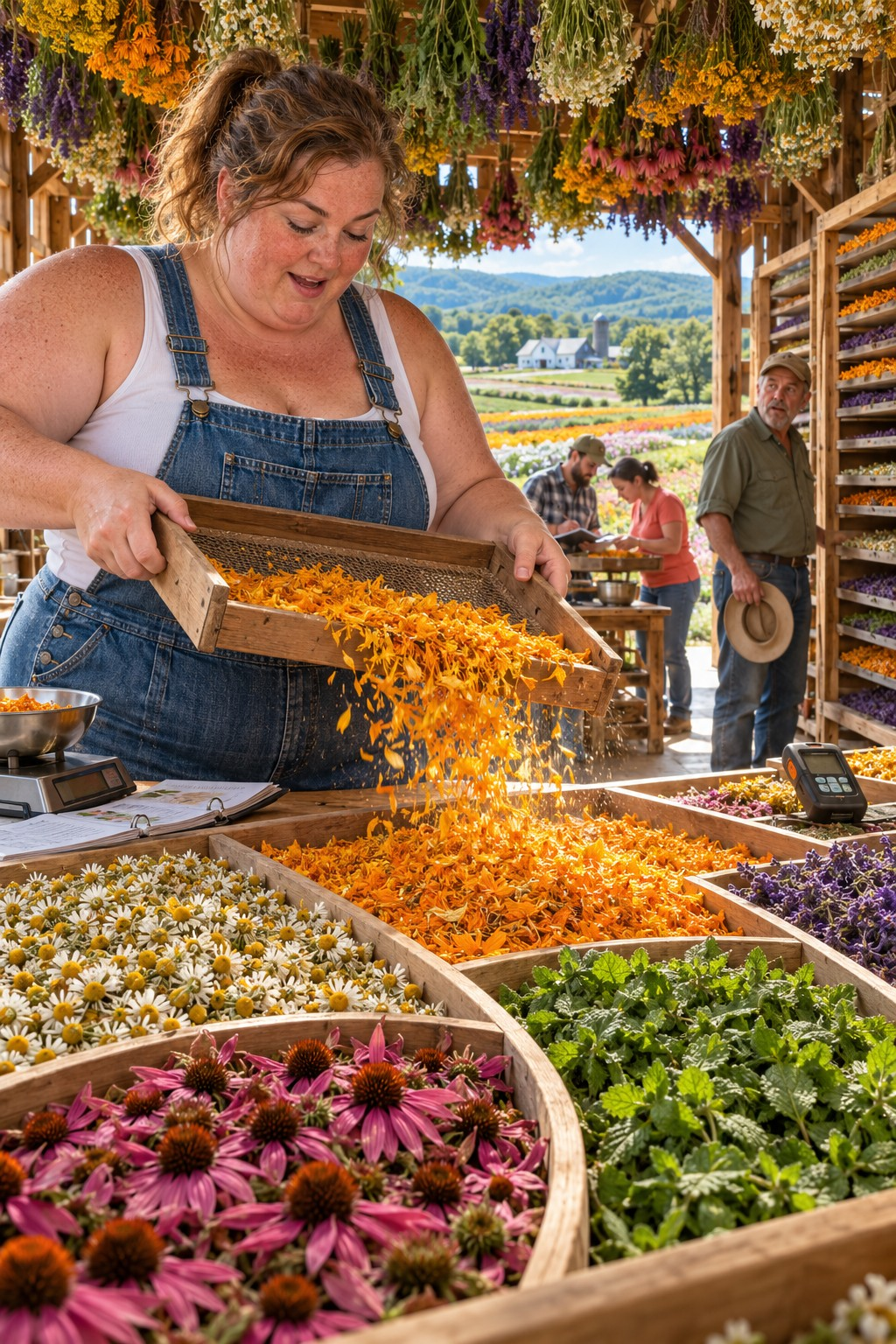
I followed her into the barn.
The afternoon sunlight streamed through the windows.
The stainless-steel tables were clean.
The shelves were labeled.
The air smelled faintly of dried flowers.
I looked around.
This was the part of the farm I loved.
Not the paperwork.
Not the legal disputes.
The work.
The careful sorting.
The measurements.
The satisfaction of turning something grown in the soil into an ingredient another business could rely on.
Megan handed me a tray.
"These need another inspection."
I examined the calendula petals.
Their color was bright.
The texture was consistent.
There was very little broken material.
I smiled.
"These are excellent."
She looked pleased.
"Better than the first batch?"
"Definitely."
We worked for another hour.
Then my phone rang.
It was Rebecca Stone.
"Sarah, I have a question."
"Of course."
"Are you still expecting the laboratory results this week?"
"Yes."
"Good. Because our purchasing team reviewed your production records."
I felt my heartbeat quicken.
"And?"
"They're impressed."
I looked toward Megan.
She stopped working.
Rebecca continued.
"We're considering a larger seasonal arrangement than we originally discussed."
I sat down.
"How much larger?"
She gave me a figure.
I stared at my notebook.
It was nearly three times the volume of the tentative order.
"Rebecca, I need to be clear. I can't promise that quantity immediately."
"I know."
"I'd need additional drying capacity and a realistic harvest schedule."
"That's why I'm calling."
She explained that the company was willing to consider a phased purchasing agreement.
The first shipment would be small.
Later deliveries could increase if the quality remained consistent.
I felt a surge of excitement.
"That could work."
"Good. Send me your updated capacity estimates."
"I will."
"And Sarah?"
"Yes?"
"Don't overpromise. We want a supplier we can keep working with."
I smiled.
"Neither do I."
The next morning, the soap manufacturer's purchasing manager called.
Her name was Elaine Porter.
She had reviewed the updated environmental documentation.
The company still required final product testing and formal release of the supplier hold.
But the technical team remained interested in the calendula.
I explained the expected harvest volumes.
Elaine listened.
Then she said, "We may need more than the original trial quantity."
I frowned.
"How much more?"
She gave me a number.
It was larger than Rebecca's initial request.
I stared at the wall.
"Elaine, I can't supply that immediately."
"We understand. We're discussing future capacity."
I took a breath.
"Then we can discuss a staged contract."
"That's what I hoped you'd say."
After ending the call, I sat motionless.
Megan looked at me.
"What?"
"Another buyer wants more calendula."
She blinked.
"More than the original order?"
"Much more."
She slowly smiled.
"Sarah."
"I know."
"Sarah!"
I laughed.
For the first time in weeks, I actually laughed.
Then my phone rang again.
This time it was Caroline Foster.
She wanted to introduce me to a small regional cosmetics producer looking for traceable botanical ingredients.
I listened.
Took notes.
Asked about specifications.
And promised to send information once the relevant testing was complete.
When I ended the call, Megan was staring at me.
"What now?"
"Another possible buyer."
She laughed.
"You're kidding."
I shook my head.
"No."
She looked toward the rows outside.
"Remember when Tom said nobody would buy flowers from a field?"
I smiled.
"I remember."
By Friday afternoon, I had four serious purchasing conversations underway.
None was a completed sale.
Every buyer still required documentation.
And I still had to prove that the farm could deliver consistent quality.
But the interest was real.
I created a new section in the binder.
BUYER DEMAND — PROPOSED VOLUMES.
Then I began comparing the requests.
The numbers were startling.
If every buyer purchased the quantities under discussion, demand would exceed what my farm could produce.
I checked the calculations twice.
Then a third time.
Megan leaned over my shoulder.
"Is that right?"
"Yes."
"How much more do they want?"
"More than we can grow this season."
She stared at the spreadsheet.
"That's a good problem."
"It can become a bad problem if we promise too much."
I drew a line beneath the totals.
"We need to allocate capacity carefully."
"How?"
"By confirmed contracts, realistic harvest estimates, and processing limits."
Megan nodded.
"Sounds like purchasing."
I smiled.
"Exactly."
For nineteen years, I had sat on the other side of the table.
Now I was the supplier.
And I finally understood how much responsibility came with that position.
The laboratory results arrived on Monday morning.
I opened the report with shaking hands.
The tested calendula and lemon balm batches met the specified screening criteria for the substances examined.
The moisture readings were within the agreed ranges.
The microbiological results were acceptable for the buyers' stated requirements.
I read the report twice.
Then I called Robert.
He reviewed the results and reminded me that the final supplier release would still depend on the buyers' approval and the environmental documentation.
I understood.
But this was the evidence I had been waiting for.
I sent the reports to the purchasing manager.
Then to Rebecca.
Then to Elaine.
Within hours, the responses began arriving.
Rebecca wanted to schedule a contract discussion.
Elaine requested a revised delivery proposal.
Caroline confirmed that she was ready to proceed with a small local order once the remaining documentation was accepted.
I sat at the kitchen table, watching the emails appear.
For months, I had been trying to convince buyers that a small Pennsylvania herb farm could produce dependable ingredients.
Now the buyers were asking how much I could supply.
That evening, Tom Keller stopped by.
He stood in the barn doorway, looking at the trays of calendula.
"Busy?"
"Getting there."
He stepped inside.
"I heard you might have some buyers."
I smiled.
"A few."
He looked at the labeled containers.
"How many?"
"Four serious conversations."
His eyebrows rose.
"Four?"
"Yes."
He gave a low whistle.
"Well, I'll be."
I laughed.
"That's one way to put it."
He examined the drying racks.
"Never thought I'd see this place running again."
I looked around.
"Neither did I, some days."
He nodded.
Then he said, "You know, my wife has been telling me I was wrong about your herb garden."
I looked at him.
"Was she?"
He smiled reluctantly.
"Apparently."
For a moment, we stood quietly.
Then Tom looked toward the northern woods.
"Any news about the old property records?"
"Still being reviewed."
He nodded.
"Hope it works out."
"Me too."
As he turned to leave, he paused.
"Sarah?"
"Yes?"
"If you ever need help with field preparation or equipment, let me know."
I smiled.
"Thank you, Tom."
He nodded once and walked out.
I watched him cross the driveway.
A year earlier, he had laughed at my plan.
Now he was offering to help.
I wasn't sure which felt more surprising.
The following morning, Margaret Ellis called with an update on the northern eight acres.
The trust documents appeared to be genuine, but the ownership question required a full title review.
She explained that the trust might have retained a legal interest in the wooded parcel, depending on the recorded instruments and subsequent transactions.
I listened carefully.
"Does that mean the land is mine?"
"Not automatically. You're named as a beneficiary, but we need to determine what property the trust actually holds."
I nodded.
"And Edward?"
"His claimed ownership may be affected if the earlier transfer was defective."
I looked toward the northern tree line.
"How long will the review take?"
"Several weeks, possibly longer."
I sighed.
She continued.
"Sarah, there's something encouraging."
"What?"
"The records your father preserved may help establish the original transaction history."
I closed my eyes.
For the first time, I felt that Dad's careful recordkeeping might finally make a difference.
Not because he had left me money.
Not because he had planned my future.
But because he had refused to ignore something he believed was wrong.
By Wednesday, the purchasing company's compliance director had completed the next stage of my supplier review.
The trial order was reinstated, subject to final shipment documentation.
I stared at the email.
Then I read it aloud to Megan.
She screamed.
Actually screamed.
I laughed so hard I had to sit down.
The order wasn't enormous.
It wouldn't solve every financial problem.
But it was real.
A commercial purchase order.
For herbs grown on my farm.
I printed it.
Then I placed it inside the black binder.
For a long moment, I simply looked at the page.
The price.
The quantity.
The delivery requirements.
The buyer's name.
Everything I had worked toward was finally beginning to happen.
Megan sat beside me.
"Dad would have framed that."
I smiled.
"He probably would have checked the math first."
She laughed.
Then her eyes filled with tears.
Mine did too.
The next day, Rebecca arrived for a second visit.
This time she brought her company's operations manager.
They examined the drying room, reviewed the laboratory results, and discussed the production schedule.
I explained exactly how much I could supply.
No exaggeration.
No impossible promises.
Just realistic numbers.
Rebecca listened carefully.
Then she placed a document on the table.
It was a proposed seasonal purchasing agreement.
The price was higher than I had expected.
I looked at her.
"Why?"
She smiled.
"Because we value traceability, consistent handling, and reliable records."
I examined the figures.
The proposed contract would provide meaningful revenue if I could meet the delivery schedule.
But before I could respond, my phone rang.
Elaine Porter.
I excused myself.
She sounded excited.
"Sarah, our product development team has approved the latest calendula sample."
"That's wonderful."
"We'd like to discuss a larger purchase."
I looked at Rebecca through the barn window.
She was reviewing the drying racks.
"How much larger?"
Elaine gave me a figure.
I stared at the notebook in my hand.
It exceeded the quantity Rebecca had just proposed.
Then Elaine added:
"And we're prepared to offer a premium for the first available compliant batches."
I felt my heartbeat quicken.
Two buyers.
Both wanted the same limited harvest.
Both were offering serious money.
And I couldn't supply both in full.
I thanked Elaine and told her I would review the proposal.
Then I returned to the table.
Rebecca looked up.
"Everything all right?"
I hesitated.
"Another buyer has made an offer."
She raised an eyebrow.
"For calendula?"
"Yes."
She smiled slowly.
"Then I suppose we should make sure our proposal is competitive."
I looked at her.
"Rebecca, I want long-term relationships, not a bidding war."
She nodded.
"So do we."
Then she opened her folder.
"Let's discuss what that relationship is worth."
By late afternoon, I had two revised offers.
Both were serious.
Both were contingent on meeting the agreed specifications and delivery requirements.
And both were more favorable than the prices I had originally expected.
Megan stared at the figures.
"Sarah, this is unbelievable."
I shook my head.
"It's business."
"Business?"
"Yes. Buyers need dependable ingredients. We have a limited supply. They're competing for access."
She smiled.
"That's a bidding war."
I looked at the documents.
"Maybe."
Then another email arrived.
A regional cosmetics producer wanted to discuss a future supply agreement for calendula and lemon balm.
I opened the message.
The proposed volumes were significant.
I leaned back.
Megan laughed.
"Another one?"
"Another one."
She shook her head.
"Tom is never going to believe this."
I smiled.
"Neither am I."
At 6:15 that evening, Detective Brooks called.
Her voice was serious.
"Sarah, we have an update on Edward Langford."
I sat down.
"What happened?"
"The financial investigation has identified several transactions that appear to connect his businesses to the historical storage operation."
I looked at the old ledger.
"Does that mean charges?"
"Not yet. The investigation is ongoing."
I nodded.
"Has Patricia been cooperating?"
"Yes."
"And Richard?"
"He's provided additional records."
I stared at the phone.
"Richard is cooperating?"
"Apparently."
I thought about the man who had inspected my barn.
The man who had suspended my order.
The man who had warned me not to open the metal case.
For weeks, I had assumed he was trying to protect himself.
Now I wasn't so sure.
Detective Brooks continued.
"Sarah, there's something else."
I waited.
"Edward's attorney has contacted us about a proposed resolution involving the property."
My stomach tightened.
"What kind of resolution?"
"A financial settlement."
I looked toward the fields.
"Does it involve selling the farm?"
"That's what we need to discuss."
I felt anger rise.
"I've already said I'm not selling."
"I understand."
"Then why are they still trying?"
She paused.
"Because the settlement proposal includes something you haven't seen before."
I frowned.
"What?"
"A document concerning the northern eight acres."
I looked toward the woods.
"The trust?"
"Yes."
"What does it say?"
"Sarah, I think you should come to the office tomorrow morning."
I stared at the phone.
"Why?"
"Because the document appears to contain a condition attached to the original land transfer."
I felt my heartbeat quicken.
"What condition?"
She hesitated.
Then she said:
"If the condition is valid, it could affect the ownership of the entire property."
I couldn't speak.
The entire property.
Not just the northern woods.
Not just the old storage area.
Everything.
My farmhouse.
My barn.
My fields.
My herb business.
I looked toward Megan.
She was watching my expression.
Then Detective Brooks added:
"And Sarah, there's one more thing."
"What?"
"The document contains a signature."
I closed my eyes.
"Whose?"
She took a breath.
"Your father's."
I stared at the wall.
Then my phone vibrated.
An email had arrived from Margaret Ellis.
The subject line read:
URGENT — ORIGINAL TRUST DOCUMENT LOCATED.
I opened it.
The message contained one attachment.
A scanned legal document.
I clicked it.
The first page described the northern eight acres.
The second outlined the trust.
The third contained the condition Detective Brooks had mentioned.
I read it once.
Then again.
My hands began trembling.
The condition stated that if the original agricultural storage obligations were concealed during a subsequent sale, certain property rights could revert under the trust arrangement, subject to legal review.
I looked at the final page.
There was my father's signature.
And beneath it was another name.
A name I had never seen in the trust documents before.
I leaned closer.
The second signature belonged to someone who had been involved in the farm's sale.
Someone who had known about the buried containers.
Someone who had been present when the forged disclosure was prepared.
Then I heard a vehicle outside.
I looked through the window.
A black SUV had stopped in the driveway.
A man stepped out.
He was carrying a thick envelope.
I recognized him immediately.
Edward Langford.
He walked toward the farmhouse.
Then he stopped beneath the porch light.
My phone rang.
It was Margaret Ellis.
I answered.
"Sarah, do not sign anything Edward gives you."
I stared through the window.
"He's here."
Her voice sharpened.
"Then listen carefully. We just discovered that the trust document has an additional page."
My stomach dropped.
"What page?"
She took a breath.
"The page that explains why your father named you as the beneficiary."
I looked toward Edward.
He was standing at my front door.
Then Margaret said:
"Sarah, the trust wasn't created to protect the land from Edward Langford."
I stopped breathing.
"It was created to protect the land from someone else."
I gripped the phone.
"Who?"
There was a pause.
Then she whispered:
"Your father knew exactly who would come looking for that property."
The doorbell rang.
Once.
Twice.
Then Edward's voice came through the door.
"Sarah, open up. There's something about your father you need to know."
I looked at the envelope in his hand.
Across the front were four words written in my father's handwriting.
FOR SARAH — WHEN READY.
And then Edward said:
"Your father didn't just leave you the northern eight acres. He left you the evidence that could take everything away from me."
The door handle began to turn.






Comments 0