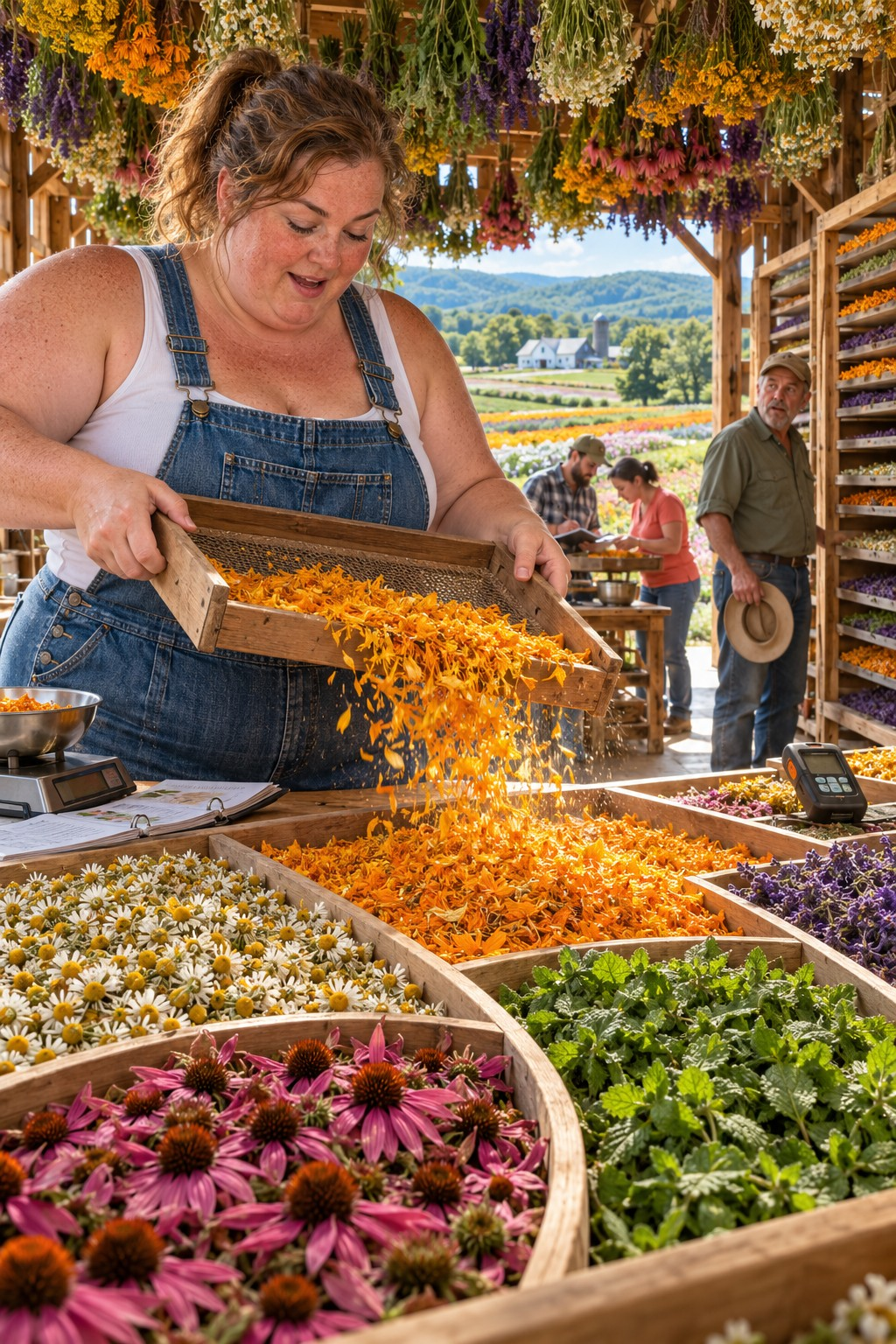
A delivery driver dropped six heavy boxes beside my muddy barn door.
"You're seriously planting all of this?" Tom Keller called from across the road.
I looked up from the shipping labels.
He was holding a paper coffee cup and staring at the boxes as though someone had just delivered a collection of expensive mistakes.
Inside the largest box were packets of calendula seeds.
The second contained chamomile.
The others held lemon balm, echinacea, turmeric, and American ginseng.
Tom shook his head.
"You're turning this whole place into a giant herb garden."
I looked at him for a moment.
Then I picked up the next box.
He laughed.
I didn't.
What Tom didn't know was that I had spent four months studying the specialty herb market before I ever signed the paperwork for the property. He didn't know about the conversations with tea companies, soap manufacturers, independent retailers, or the six letters of interest I had collected.
And he certainly didn't know what was written on the first page of the black binder sitting inside my barn.
GROW FOR BUYERS.
Not for hope.
Not for trends.
Not because something looked beautiful in a catalog.
For buyers.
That was the difference between my plan and the disaster everyone believed I was creating.
But before I explain how a woman with no farming experience ended up risking nearly everything on thirty-eight acres of exhausted Pennsylvania soil, I need to take you back to the beginning.
Four months earlier, I had been sitting across from a real estate agent in a small office outside Chambersburg.
His name was Daniel Price.
He had a folder open in front of him, and he kept looking at me as if he expected me to change my mind.
"Let me make sure we're discussing the same property," he said.
"I believe we are."
"Thirty-eight acres."
"Correct."
"One small house. A deteriorating packing barn. An equipment shed that needs structural attention. A shallow well. Eight acres of mixed woods."
"I've read the listing."
He turned another page.
"The cropland has been rented to the same farmer for almost twenty years. The soil needs improvement. The drainage system is in poor condition. Three potential buyers have already walked away."
"I know."
He leaned back.
"Then I have to ask you something. Why this property?"
I looked through the office window.
Beyond the parking lot, the afternoon sun was disappearing behind a row of bare trees.
I had been asking myself the same question for months.
The truth was that I hadn't fallen in love with the farmhouse, the barn, or the fields.
I had fallen in love with an opportunity.
For nineteen years, I had worked in purchasing for a regional chain of natural food stores.
My job was not particularly glamorous.
I compared supplier quotations, negotiated contracts, reviewed product specifications, and monitored inventory.
I spent more time studying spreadsheets than standing in grocery aisles.
But I learned something important.
People often paid premium prices for products without understanding where their ingredients came from.
A small jar of herbal tea might sell for fifteen or twenty dollars. A bottle of infused skin oil could cost even more.
The packaging promised purity, traceability, and responsible sourcing.
Yet when I asked suppliers where the actual herbs were grown, the answers were often vague.
Sometimes the ingredients had traveled thousands of miles before reaching the manufacturers who eventually sold them to customers in Pennsylvania.
I started paying attention.
I noticed which ingredients were consistently difficult to source.
I noticed which companies complained about inconsistent color, moisture levels, and delivery schedules.
And I noticed that buyers were increasingly interested in suppliers who could explain exactly how their crops had been grown, harvested, dried, and stored.
At first, it was simply professional curiosity.
Then my father became ill.
For two years, I helped care for him.
I won't pretend those years were easy.
There were hospital appointments, difficult conversations, long evenings, and mornings when I arrived at work after barely sleeping.
My father had always loved plants.
He wasn't a commercial grower, but he knew more about his garden than most people knew about their own kitchens.
He could recognize a plant by its leaves and explain why one variety thrived in a particular corner while another struggled.
When he became too weak to spend much time outside, I started bringing small pots of herbs into his room.
We talked about growing conditions, soil, drying methods, and the differences between plants that looked similar but behaved differently.
He never claimed herbs could cure everything.
Neither did I.
What interested me was the quality of the ingredients.
A beautiful flower could become a worthless commercial ingredient if it was harvested too late, dried too slowly, or stored in a room with excessive moisture.
A shipment could be rejected because the color was dull.
A tea company could refuse an entire order because the flowers contained too many damaged pieces.
A soap manufacturer might want whole calendula petals rather than crushed powder.
Those details stayed with me.
After my father died, I returned to work.
But the office felt different.
The fluorescent lights seemed harsher.
The weekly purchasing reports seemed less important.
I still did my job well, but something inside me had changed.
I wanted to build something that had a beginning, a process, and a result I could actually see.
Six months later, I found the listing for the farm outside Chambersburg.
The price was low.
Not suspiciously low.
Desperately low.
The property had been struggling for years.
The previous agricultural tenant had planted conventional crops, but the last corn harvest had barely covered the cost of seed.
The barn needed repairs.
The drainage ditch along the southern boundary had deteriorated.
The equipment shed leaned noticeably to one side.
And the soil was tired.
The county extension agent, a practical man named Robert Hayes, agreed to walk the property with me.
He carried a soil probe and a clipboard.
I carried a notebook.
He pushed the probe into the ground and examined the sample.
"You're looking at a significant amount of work," he said.
"I expected that."
"The drainage needs attention. Some areas will need organic matter added. You'll want to improve the soil structure before expecting consistent production."
"Understood."
He looked at me.
"Have you ever operated a farm?"
"No."
"Driven a tractor?"
"Not independently."
He stopped writing.
"Then I want you to understand something. Specialty herbs aren't necessarily easier than corn or soybeans."
"I know."
"They can be labor-intensive. Harvest timing matters. Drying conditions matter. Storage matters. And finding reliable buyers can be difficult."
I nodded.
He looked almost disappointed that I wasn't arguing.
"Most people come here wanting me to tell them their idea will work."
"I'm not asking you to promise me that."
"What are you asking?"
"Show me where it could fail."
For the first time, he smiled.
That conversation changed how he approached the project.
Instead of treating me like someone who had watched a few gardening videos and developed an expensive hobby, he began discussing the actual agricultural requirements.
He explained the drainage problems.
He showed me where the soil held water.
He recommended cover crops for sections that would not immediately enter production.
He also warned me against planting too many specialty varieties at once.
I wrote everything down.
But the most important work happened before I made an offer.
I spent four months talking to buyers.
Not neighbors.
Not gardening enthusiasts.
Actual businesses that purchased herbs.
I called tea companies.
I contacted soap manufacturers.
I spoke with small herbal product businesses, market managers, independent retailers, and local distributors.
Most conversations went nowhere.
Some people never returned my calls.
Others told me they already had established suppliers.
One purchasing manager listened for nearly fifteen minutes before saying they weren't interested in taking a chance on an unproven farm.
I thanked him anyway.
Then I called the next number.
Eventually, I found people willing to explain what they actually needed.
One tea company wanted whole chamomile flowers with strong natural color and low moisture.
A soap manufacturer wanted dried calendula petals, not crushed powder.
A local tea room preferred lemon balm harvested before flowering because they wanted a particular flavor profile.
A small herbal company was interested in Pennsylvania-grown echinacea root, but only if I could provide cleaning and drying records.
Each conversation gave me another piece of the puzzle.
I began building a spreadsheet.
Crop.
Harvest window.
Processing requirements.
Expected volume.
Packaging specifications.
Potential price.
Delivery schedule.
Buyer contact.
I didn't assume every interested company would eventually place an order.
A letter of interest was not a contract.
I knew that.
But by the time I made my offer, I had six letters of interest, three possible wholesale accounts, and a much clearer understanding of what the market wanted.
The farm would have three production layers.
The first would generate relatively quick income.
Calendula, chamomile, lemon balm, and culinary herbs could be harvested during the first season and sold fresh or dried.
The second layer would involve processing.
I planned to dry, sort, and package part of the harvest myself so that the business would not depend entirely on selling fresh crops during a narrow window.
The third layer would take patience.
Under the eight acres of mixed woods, I wanted to establish small experimental plots of American ginseng and goldenseal.
Those plants would require years of careful management.
They would not pay my bills during the first season.
But if they succeeded, they could become some of the most valuable parts of the property.
I understood the risks.
I also understood that the farm would not become profitable simply because I had a good idea.
I would have to execute it.
When I finally signed the purchase agreement, my hands were steady.
My bank account was not.
The farm had consumed almost all my available savings.
I kept enough money for personal expenses and emergencies, but there was no comfortable financial cushion waiting for me.
There would be no corporate paycheck if I failed.
No purchasing department to negotiate a better deal.
No maintenance team to repair broken equipment.
Every decision would belong to me.
When I told my younger sister, Megan, that I had closed on the property, she was silent for several seconds.
Then she said, "You actually did it."
"I did."
"Are you excited?"
I looked at the papers spread across my kitchen table.
"Ask me again after the first harvest."
Megan laughed.
Unlike some people, she didn't immediately tell me I was making a mistake.
She had seen how unhappy I had become during the final months of my purchasing job.
She also knew how much time I had spent researching the market.
She didn't understand every part of the business, but she understood me.
She promised to help on weekends.
That meant more than she realized.
By late February, I was standing in front of my barn with the first seed delivery.
The boxes looked small compared with the enormous field behind them.
Tom Keller was watching from across the road.
I knew who he was before we formally met.
He had farmed conventional crops in the area for more than thirty years.
He understood local soil conditions, weather patterns, machinery, and seasonal labor better than I ever could.
He was respected.
He was experienced.
And he had no reason to believe that my plan would succeed.
When he finally crossed the road, he looked at the seed boxes again.
"Calendula?" he asked.
"Yes."
"Chamomile?"
"Yes."
He pointed toward another box.
"What's that one?"
"Echinacea."
He laughed.
"You're going to need a lot of flowers to pay for thirty-eight acres."
"I know."
"How are you planning to harvest all of it?"
"By hand, where necessary."
He stared at me.
"That's an enormous amount of work."
"It is."
He seemed to be waiting for me to defend the decision.
I didn't.
I picked up the next box and carried it into the barn.
Inside, the packing area was still unfinished.
The roof had three places where daylight came through.
The floor was dusty.
An old wooden workbench leaned against the wall.
But I had already measured the space for the drying room.
I had purchased used shelving.
I had ordered washable worktables.
And I had started collecting the equipment needed to monitor temperature and moisture.
I placed the seed boxes beside a folding table.
Then I opened my black binder.
The first page contained the words I had written weeks earlier.
GROW FOR BUYERS.
Underneath were the specifications from the six interested companies.
I read them again.
Strong color.
Whole flowers.
Low moisture.
Clean roots.
Consistent batches.
Traceable production.
Those requirements were more important than the opinions of people who had never intended to purchase anything from me.
In early March, I began preparing the ground.
The first sections would receive cover crops.
The production beds needed compost.
The southern drainage ditch needed to be reopened.
The drip irrigation system would have to be installed gradually because I couldn't afford to do everything at once.
For the first few weeks, the farm looked worse rather than better.
There were no beautiful flower fields.
No colorful harvest baskets.
No customers walking through the barn.
There was only mud, compost, pipe, string, and me moving between the rows with a notebook in one hand and a soil probe in the other.
Megan came on weekends.
Together, we repaired sections of the packing barn.
We cleaned the work area.
We built shelves.
We installed fans and dehumidifiers in the small drying room.
I purchased a commercial moisture meter after comparing several models.
It was more expensive than I wanted, but I knew the drying process could determine whether a shipment was accepted or rejected.
One Saturday afternoon, Tom stopped by again.
He looked at the newly installed irrigation lines.
Then he looked at the narrow planting beds.
"You know you could rent this ground out and make money without doing all this," he said.
I was kneeling beside a row of seedlings.
"I know."
He glanced at the barn.
"Most people would have planted corn again."
"Probably."
"And you're going to pick those flowers by hand?"
"Most of them."
He shook his head.
"That's a lot of work, Sarah."
I stood up and wiped the soil from my gloves.
"Yes, it is."
He looked at me for another moment.
Then he climbed into his truck and drove away.
Megan watched him disappear down the road.
"Does he ever say anything encouraging?"
I smiled faintly.
"Not yet."
"Does that bother you?"
I looked at the rows.
"No."
She handed me another tray of seedlings.
We continued working.
By the middle of April, the first chamomile plants were beginning to establish themselves.
The calendula beds were developing.
The lemon balm was showing new growth.
For the first time, I could look across part of the property and see the beginning of what I had imagined.
I wasn't foolish enough to believe the hardest part was over.
I had read enough agricultural reports to understand that a good planting could still become a bad harvest.
Weather didn't care about business plans.
Plants didn't care about my savings.
And buyers didn't care how much work I had invested if the product failed to meet their specifications.
Still, I felt something I hadn't felt in years.
Purpose.
Then the rain came.
It started late on a Thursday evening.
By Friday morning, the southern fields were saturated.
By Saturday, the drainage ditch was overflowing.
I walked outside wearing my old waterproof jacket and watched water collect between the newly prepared beds.
At first, I thought the damage would be manageable.
Then I saw the chamomile seedlings.
Some had been washed out completely.
Others were bent beneath the standing water.
Several rows had turned yellow.
I moved from bed to bed, trying to determine how much had survived.
The answer was worse than I expected.
Nearly half of my first chamomile planting was lost.
I stood in the muddy field, staring at the empty sections.
There was no supervisor to call.
No company department that could absorb the expense.
No salary arriving at the end of the month.
Every lost seedling represented money I had already spent.
Every damaged bed meant more labor.
Every delay threatened the harvest schedule I had discussed with potential buyers.
Megan arrived that afternoon.
She stepped out of her car, looked at the field, and immediately understood.
"Sarah?"
I didn't answer.
She walked toward me.
"How bad is it?"
I pointed toward the southern beds.
"Almost half the chamomile."
She looked across the field.
"Oh, no."
I crouched and examined a damaged plant.
Its roots had loosened in the wet soil.
I tried to lift it gently, but the stem came away in my fingers.
For the first time since buying the property, I couldn't immediately think of the next practical step.
I had planned for poor germination.
I had planned for labor shortages.
I had planned for buyers changing their requirements.
I had not expected so much of the first crop to disappear before it had a chance to grow.
That evening, after Megan left, I returned to the barn.
The black binder was still on the folding table.
The six letters of interest were inside.
The production schedule was clipped to the front.
I opened the binder and looked at the estimated harvest quantities.
Then I looked at the damaged field through the barn doorway.
I took out a pen.
For several minutes, I considered crossing out the entire chamomile section.
Then I considered selling the equipment I had purchased.
Then I considered calling Daniel Price and asking whether he knew anyone interested in buying the property.
I had spent almost everything to get there.
And now, barely weeks into the growing season, I was wondering whether I had made the biggest mistake of my life.
At 9:17 that night, my phone vibrated on the worktable.
A message appeared from Robert Hayes, the county extension agent.
It contained a photograph of the southern drainage map.
And beneath it was one sentence:
"Sarah, I need you to come look at something tomorrow morning. The damage may not be the only problem with that field."
I stared at the message.
Then another notification appeared.
This time, it was an email from one of the companies that had sent me a letter of interest.
The subject line read:
URGENT — CHANGES TO OUR SPRING HERB PURCHASING REQUIREMENTS.
I opened it.
And the first sentence made my stomach drop.






Comments 0