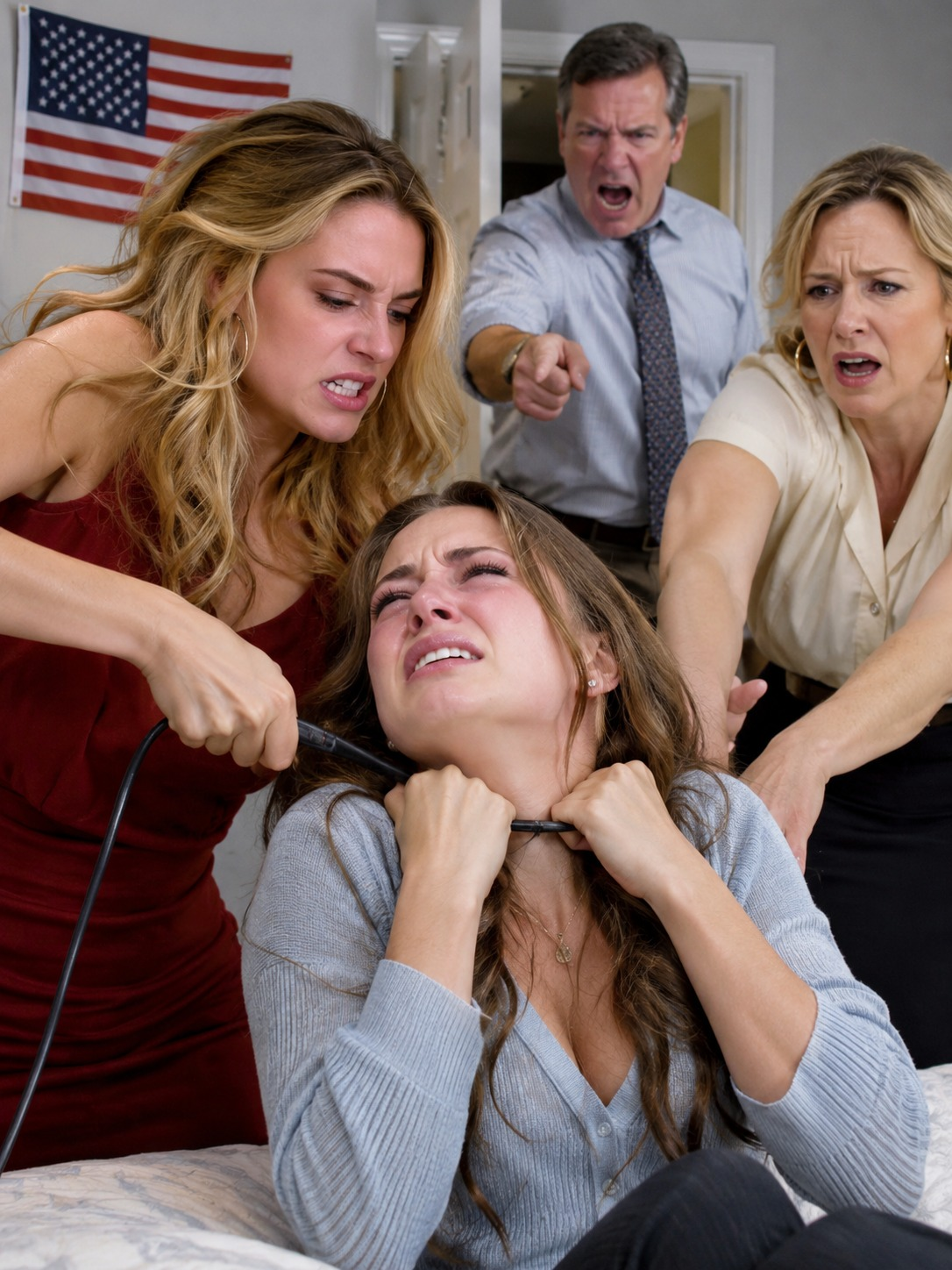
"Don't move your head, Elena," the nurse said, gently lifting my hair away from my left ear.
Another nurse stepped into the emergency room, carrying a small medical flashlight.
Dana Ellis pointed toward a narrow mark hidden beneath my hair.
"Look at the pattern," she said.
The second nurse leaned closer.
Neither woman spoke for several seconds.
I lay on the hospital bed, watching their expressions, wondering what they had discovered that my own family had been so determined not to see.
"Is something wrong?" I whispered.
Dana lowered the flashlight.
"We're documenting your injuries carefully. That's all you need to worry about right now."
I wanted to believe her.
But something about the way she'd said carefully made my stomach tighten.
Three hours earlier, my father had watched my sister attack me and ordered me to apologize.
Now two strangers were examining the evidence he'd ignored.
I didn't know which part hurt more.
The nurse asked permission to take another photograph. I nodded, and she carefully moved my hair aside again.
The camera made a quiet clicking sound.
It was such a small noise.
I had no idea how important it would become.
"Does it hurt when you swallow?" Dana asked.
"Yes."
"Has your voice changed?"
I tried to answer normally.
What came out was a rough whisper.
Dana nodded.
"Okay. We're going to make sure the doctor knows."
She adjusted my pillow and checked the monitor beside my bed.
Then she asked a question that nearly made me cry.
"Is there someone you trust who can come sit with you?"
I thought about my mother.
For one ridiculous second, I almost said her name.
That was how deeply the habit had been planted.
Even after everything that had happened, some part of me still wanted my mother.
Not the woman who had rushed past me to comfort Camille.
The mother I'd spent twenty-two years hoping she might become.
I swallowed.
"My boyfriend."
"Would you like to call him?"
I nodded.
Dana handed me my phone.
Gideon answered on the second ring.
"Hey, beautiful. Everything okay?"
I opened my mouth.
Nothing came out.
"Elena?"
I tried again.
"I'm at the hospital."
His tone changed immediately.
"What happened?"
"My sister..."
I couldn't finish.
"Which hospital?"
I told him.
"I'm coming."
"Gideon, it's late."
"I don't care."
The call ended.
I stared at the screen.
He hadn't asked whether I had provoked Camille.
He hadn't demanded an explanation before deciding whether I deserved help.
He'd simply said he was coming.
I turned my face toward the wall.
And cried.
Not loudly.
My throat hurt too much for that.
The tears just kept coming.
Dana returned a few minutes later and found me wiping my cheeks with the edge of the blanket.
She didn't tell me to calm down.
She didn't say that families fought sometimes.
She pulled a chair closer.
"Elena, I'm going to ask you something important."
I looked at her.
"Has anyone in your family hurt you before?"
The question should have been easy.
No, I wanted to say.
Camille had never done anything quite like this before.
But the longer I thought about it, the harder the answer became.
Because violence doesn't always begin with someone putting their hands around your neck.
Sometimes it begins with years of being taught that your pain is inconvenient.
Sometimes it begins when everyone in the room knows you're being treated unfairly, but nobody says anything.
And sometimes it begins so early that you don't recognize it as anything unusual.
"I don't know," I whispered.
Dana didn't look surprised.
"That's okay."
But I wasn't sure it was.
Because lying in that hospital bed, I started remembering things I hadn't thought about in years.
Things I'd convinced myself were normal.
Things my parents had taught me to forget.
The first memory was a birthday cake.
I was sixteen.
Camille was twenty.
Mom had invited a few relatives over for dinner, which was already more attention than I expected.
I remember walking into the kitchen and seeing a small white cake on the counter.
Pink frosting.
Plastic candles.
My name written across the top.
Except it wasn't my name.
It said Happy Birthday, Elaine.
I stood there for a moment, staring at the letters.
Then I laughed awkwardly.
"Mom, they spelled my name wrong."
She looked up from the sink.
"What?"
"The cake."
She glanced over.
"Oh."
I waited.
She shrugged.
"Well, they got close."
"It's Elena."
"I know your name."
"Could we fix it?"
Mom turned off the faucet.
"Are you seriously going to complain about a birthday cake?"
I looked down.
"No."
"Because I spent money on that cake, and I don't appreciate the attitude."
Camille walked into the kitchen carrying her phone.
"What's happening?"
"Your sister is upset because the bakery made a little mistake," Mom said.
Camille looked at the cake.
Then at me.
She laughed.
"Maybe they forgot you existed."
Mom smiled.
I didn't.
That evening, everyone sang happy birthday using my actual name.
Nobody mentioned the frosting.
I blew out the candles and pretended not to care.
A month later, Camille celebrated her twenty-first birthday.
My parents rented a private room at a restaurant, ordered a custom three-tier cake, and hired a photographer.
Mom spent two weeks choosing the decorations.
Dad bought Camille a gold bracelet.
When I asked why they were spending so much, Mom gave me a look.
"Twenty-one is a milestone."
Apparently, sixteen wasn't.
Neither was eighteen.
Neither was graduating near the top of my high school class.
I learned to stop expecting milestones.
It made disappointment easier to manage.
Or at least that was what I told myself.
Another memory came from eighth grade.
I'd spent six weeks building a science fair project about water filtration.
I used recycled bottles, sand, gravel, charcoal, and several homemade testing methods.
My science teacher helped me improve the presentation.
I practiced explaining my results in front of the bathroom mirror.
The morning of the competition, I came downstairs wearing my nicest jeans and a blue sweater.
Dad was reading something on his phone.
"Are you coming today?" I asked.
He didn't look up.
"Coming where?"
"The science fair."
"Oh. Right."
Mom was packing a bag for Camille.
"Your sister has her cheerleading competition."
"I know, but the science fair starts earlier."
"We can't be in two places at once," Mom said.
"You could come for the first hour."
Dad sighed.
"Elena, don't make this difficult."
I nodded.
"Okay."
At school, I stood beside my project while other students' parents took pictures.
One boy's father brought flowers.
Another girl's mother cried when she won second place.
I won first.
The judge handed me a blue ribbon and shook my hand.
My teacher took a photograph.
I smiled so hard my cheeks hurt.
For a few minutes, I forgot my parents weren't there.
Then the awards ceremony ended.
Families gathered around their children.
I stood beside the empty display table, holding my ribbon.
Dad arrived forty minutes later.
"Sorry," he said. "Traffic."
I climbed into the passenger seat.
"Guess what?"
"What?"
I held up the ribbon.
"I won."
He glanced at it.
"Nice."
I waited for another question.
There wasn't one.
He started the car.
"Did you remember to get Camille's birthday present?"
I looked down at the ribbon.
"No."
"Elena."
"I've been busy with the project."
"You knew her birthday was coming."
I stared out the window.
"I'll get something tomorrow."
"Good."
He turned on the radio.
I folded the ribbon carefully and put it in my backpack.
That night, Camille complained that I hadn't congratulated her on her cheerleading performance.
Mom told me I should be more supportive.
Nobody asked where I'd placed in the science fair.
I eventually stopped mentioning it.
The hospital monitor beeped beside me.
I blinked.
For a moment, I'd forgotten where I was.
Dana was checking my blood pressure.
"You're doing okay," she said.
I almost laughed.
I wasn't doing okay.
My sister had attacked me.
My father had blamed me.
My mother had comforted the person who hurt me.
And I was lying in an emergency room remembering a birthday cake from six years earlier.
But Dana was talking about my medical condition.
I understood that.
I was a nursing student.
I knew the difference between being emotionally shattered and medically unstable.
I also knew that neck injuries could be dangerous even when the visible marks seemed minor.
That knowledge frightened me more than I wanted to admit.
"Will I be able to go back to school?" I asked.
"We'll let the doctor guide you on recovery."
"I have clinical rotations."
"Those can wait."
I shook my head.
"You don't understand. I can't afford to fall behind."
Dana rested her hand lightly on the bedrail.
"Elena, your health comes first."
It was such an ordinary sentence.
I had heard instructors say similar things countless times.
But hearing someone say it about me felt unfamiliar.
My health came first.
Not Camille's vacation.
Not my parents' reputation.
Not whether the neighbors found out.
Mine.
I turned my face away before Dana could see my eyes fill again.
The next memory came from when I was ten.
I had been sick all afternoon.
At first, Mom thought I was pretending to avoid helping with chores.
Then my fever climbed.
I remember lying beneath my blankets, shaking even though my skin felt hot.
"Mom," I called.
She appeared in the doorway wearing a dress she'd bought for Camille's dance recital.
"What is it?"
"I feel really bad."
She pressed her hand against my forehead.
"You're warm."
"Can we go to the doctor?"
"Camille's recital starts in an hour."
I stared at her.
"But I'm sick."
"Drink some water."
"My head hurts."
"Elena, I can't cancel everything because you have a fever."
She placed a glass of water on the nightstand.
Then she left.
I heard Dad calling from downstairs.
"We're going to be late!"
Mom shouted back that she was coming.
The front door closed.
Their car pulled away.
I remember looking at the water.
It was close enough to reach.
But I felt too weak to sit up.
I don't know how long I stayed like that.
Eventually, the telephone rang.
I answered because it kept ringing.
"Hello?"
"Hey, sweetheart."
Grandpa Harlon.
I started crying.
He heard it immediately.
"Elena? What's wrong?"
"I'm sick."
"Where's your mom?"
"Camille's recital."
There was a pause.
"Is your dad home?"
"No."
Another pause.
Then his voice became very steady.
"Listen to me. I'm coming over."
He arrived in less than fifteen minutes.
I remember hearing his truck outside.
Then his footsteps on the stairs.
He entered my bedroom carrying his old flannel jacket.
"Good grief, kiddo."
He helped me sit up.
His hands were rough from years of repairing furniture.
But he was gentle.
He wrapped the jacket around my shoulders and took me to urgent care.
Afterward, we sat in his truck beneath the parking lot lights.
He called my father.
I could hear Dad's voice through the phone, though I couldn't make out the words.
Grandpa's expression hardened.
"Your ten-year-old was sick enough to need a doctor, Richard. Where the hell were you?"
Dad said something.
Grandpa shook his head.
"That's not an answer."
He ended the call.
I stared at him.
"Are you mad at me?"
His face changed.
"What?"
"For making you leave your house."
He looked genuinely confused.
Then he reached across the truck and squeezed my shoulder.
"Elena, you didn't make me do anything."
"But you were busy."
"I was fixing a chair."
I looked down.
"Sorry."
He was quiet for a moment.
Then he said something I've never forgotten.
"Sweetheart, a chair can wait. A child shouldn't have to."
I didn't understand why those words made me cry.
Not then.
I do now.
Grandpa was the only person who ever made me feel like my needs weren't an inconvenience.
He lived three streets away in a small brick house with a garage full of old tools.
Every Saturday morning, he worked on furniture.
Sometimes neighbors brought him broken chairs.
Sometimes he repaired tables people had abandoned.
He said most things deserved a second chance if you were willing to put in the work.
I used to sit on a stool beside him and draw while he sanded wood.
He never complained that I was distracting him.
He asked about school.
He listened to my answers.
He remembered the names of my teachers.
When I told him I wanted to become a nurse, he put down his screwdriver.
"You'll be good at that."
I smiled.
"How do you know?"
"Because you notice when people need help."
I was fourteen.
Nobody had ever said anything like that to me.
Two years later, Grandpa died of a heart attack.
I remember standing at his funeral, staring at the closed casket.
Camille stood beside Mom, complaining quietly about the service running late.
Afterward, she asked Dad whether Grandpa had left anything valuable.
"He had all those tools," she said. "Couldn't we sell them?"
Dad told her they'd look into it.
I walked outside before they could see me cry.
For months afterward, I kept expecting Grandpa to call on Saturdays.
Sometimes I'd pick up my phone before remembering.
Sometimes I'd drive past his street on purpose.
His house was eventually sold.
The garage was emptied.
And the one place where I'd always felt welcome belonged to strangers.
I started working more after that.
At seventeen, I washed dishes at a diner off Cleveland Avenue.
I babysat for neighbors.
During the summer, I stocked shelves at a pharmacy.
I saved nearly every dollar.
Mom said I was becoming antisocial.
Dad said I spent too much time worrying about money.
Camille said I was boring.
Nobody asked why I was working so much.
They simply assumed I enjoyed missing family outings.
The truth was that money represented something I couldn't get from my parents.
Security.
Choice.
A way out.
When Camille overdrew her checking account, Dad transferred money.
When she wanted new clothes, Mom took her shopping.
When her car needed repairs, my parents handled the bill.
When I needed a laptop for college, Dad suggested buying a used one.
I did.
It had a cracked corner and a battery that barely lasted an hour.
I carried the charger everywhere.
I was proud of that laptop.
Not because it was impressive.
Because I'd bought it myself.
Still, a small part of me kept waiting.
Waiting for my parents to notice how hard I worked.
Waiting for them to tell me they were proud.
Waiting for them to treat me like I belonged in the family photographs instead of being the person asked to take them.
By the time I graduated high school, I'd earned scholarships that helped me attend Ohio State.
My parents didn't attend the ceremony.
Camille had arranged a weekend trip with friends.
Mom said they'd celebrate later.
They never did.
I remember standing outside the school in my cap and gown, surrounded by families taking pictures.
My friend Madison's mother hugged me.
"Your parents must be so proud."
I smiled.
"Yeah."
It was easier than explaining.
I moved to Columbus that fall.
For the first time, I lived somewhere nobody compared me to Camille.
My professors cared whether I understood the material.
My classmates asked for my opinions.
My supervisors noticed when I worked hard.
I met Gideon in the university library when he accidentally spilled coffee on a stack of his own notes.
He stared at the mess.
Then he looked at me.
"On the bright side, my handwriting was already unreadable."
I laughed.
He bought me coffee the next afternoon.
Then the next.
Eventually, we started dating.
Gideon didn't understand my family at first.
Not because he thought I was exaggerating.
Because he'd grown up in a home where disagreements didn't automatically mean someone had to be humiliated.
The first time I told him my parents had skipped my graduation, he stared at me.
"Both of them?"
"Camille had plans."
"Elena, it was your graduation."
"I know."
He shook his head.
"That's awful."
I shrugged.
"I'm used to it."
He looked at me for a long moment.
"That doesn't make it okay."
I didn't know what to say.
It was the first time someone had challenged the way I'd learned to explain my childhood.
The hospital room door opened.
I turned.
Gideon stood there wearing jeans, sneakers, and the gray sweatshirt he always wore when he studied late.
His hair was messy.
His face was pale.
He looked at the monitor.
Then at my neck.
Then at me.
"Oh, Elena."
He crossed the room.
I tried to smile.
It didn't work.
He stopped beside the bed.
"Can I hug you?"
I nodded.
He leaned forward carefully, avoiding my injured side.
The moment his arms touched me, I started crying again.
"I'm sorry," I whispered.
He pulled back slightly.
"For what?"
"For making you come all the way here."
His expression broke my heart.
"Elena."
I looked at him.
"You don't have to apologize for needing me."
I wanted to believe him.
I really did.
But twenty-two years of being told I was too sensitive, too demanding, too selfish, and too difficult didn't disappear because one good man said something kind.
They stayed inside you.
They shaped how you asked for help.
They made you feel guilty for taking up space.
And sometimes they made you hesitate even when your life was in danger.
Gideon sat beside my bed while I told him what happened.
I didn't tell the story well.
I stopped several times.
My voice hurt.
My side ached.
At one point, I couldn't remember whether Camille had dropped the cord before or after Mom entered the room.
Gideon didn't interrupt.
When I finished, he stared at the floor.
Then he asked quietly, "Your father actually saw her holding it?"
I nodded.
"And he told you to apologize?"
Another nod.
Gideon rubbed his hands over his face.
For several seconds, he said nothing.
Then he reached for my hand.
"You're not going back there."
I looked at him.
"My textbooks are still there."
"We'll figure that out."
"My clothes—"
"Elena."
He waited until I met his eyes.
"You're not going back there alone."
I squeezed his hand.
A little later, the doctor returned with the results of my imaging.
Two fractured ribs.
Neck injuries requiring careful follow-up.
Instructions to seek urgent medical attention if certain symptoms developed.
I listened like a nursing student.
I asked questions.
I repeated the warning signs.
I tried to focus on medical facts because facts were easier than feelings.
Then a hospital social worker came in.
She asked where I planned to stay after discharge.
I looked at Gideon.
He nodded.
"With me," he said.
The social worker turned toward me.
"Is that what you want, Elena?"
For a moment, I couldn't answer.
I wasn't used to being asked what I wanted.
Not without someone immediately explaining why it was unreasonable.
"Yes," I whispered.
She smiled gently.
"Then we'll work with that."
After she left, Gideon went to find something to drink.
I lay back against the pillow.
My phone was on the bedside table.
It had been vibrating occasionally, but I hadn't checked it.
I expected messages from Mom.
Maybe Dad.
Probably Camille.
I wasn't ready to read them.
Then the screen lit up again.
This time, I glanced at it.
A message from my father.
You have caused enough trouble tonight. We need to talk before you tell anyone else your version of what happened.
I stared at the words.
Your version.
As though there were two equally reasonable explanations for why I'd arrived at the hospital with injuries around my neck and fractured ribs.
Another message appeared.
Your mother is devastated.
I almost laughed.
Of course she was.
Mom was always devastated when the family looked bad.
Never when I was hurt.
I placed the phone facedown.
Then I remembered something.
Camille had been sending me messages for more than a week.
Messages demanding money.
Messages accusing me of disrespecting her.
Messages promising I'd regret embarrassing her.
I'd saved them because I was tired of being told I imagined things.
I reached for my phone again.
Opened the conversation.
Scrolled upward.
There they were.
Every demand.
Every insult.
Every threat.
My hands began shaking.
I hadn't understood their importance when I saved them.
Now, for the first time, I wondered whether those messages could prove what had happened.
I was still looking at the screen when a new notification appeared.
It wasn't from Camille.
It wasn't from Mom.
It was from a number I didn't recognize.
The message contained only six words.
Your grandfather wanted you to know.
I stared at it.
Grandpa had been dead for six years.
Before I could decide whether to reply, another message appeared.
There's something he left for you.
Then a photograph began loading beneath the text.
And when I saw the first recognizable object in the picture, my hand went completely still.






Comments 0