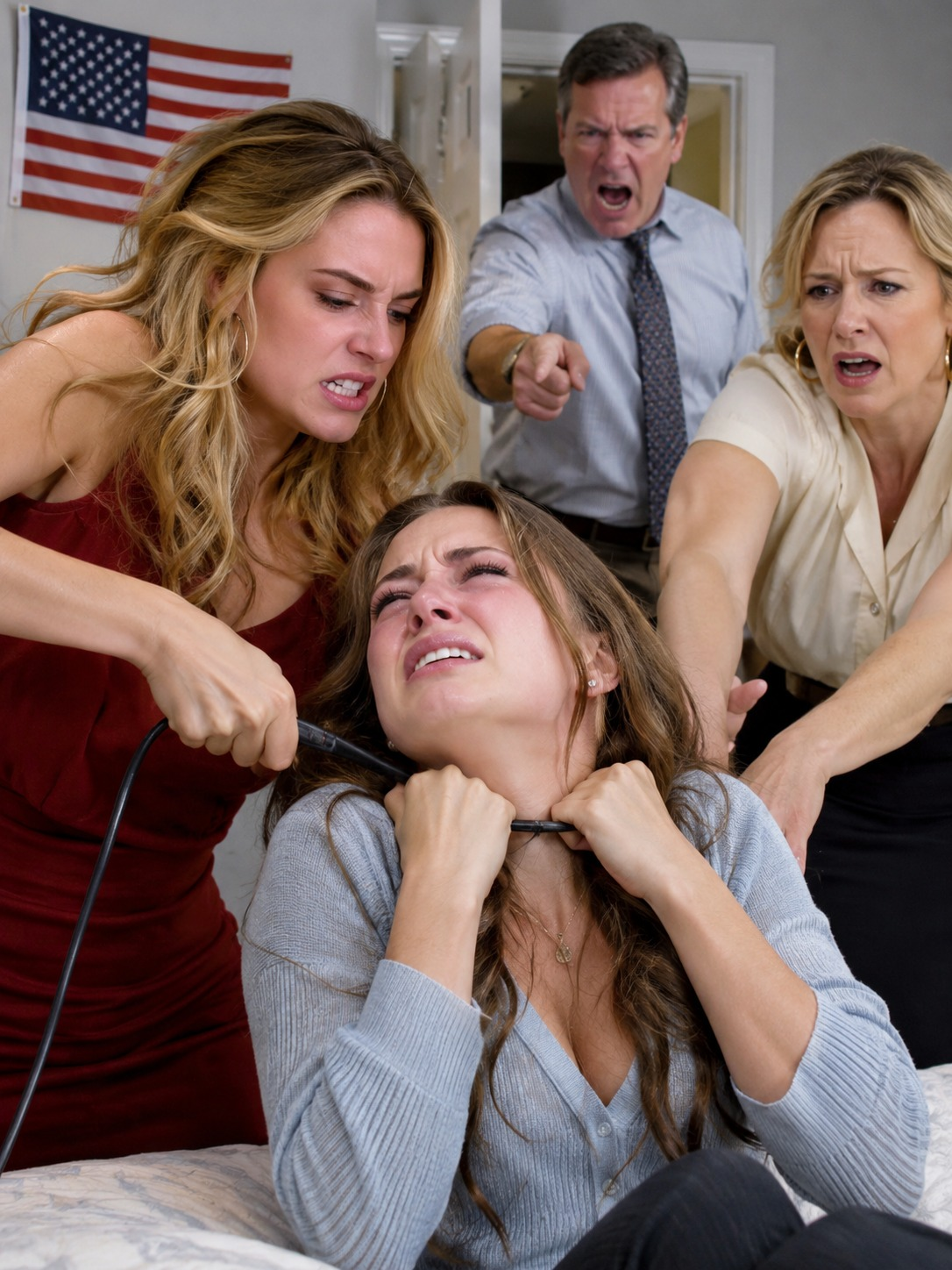
"Mr. Whitlock, would you like to explain why you're standing behind Camille in this picture, holding the electrical cord?"
The courtroom went silent.
My father stared at the photograph projected onto the monitor.
For twenty-two years, Richard Whitlock had always known what to say.
He could turn an accusation into a misunderstanding.
He could make an apology sound like an admission of guilt.
He could convince my mother that cruelty was discipline and persuade my sister that every consequence was someone else's fault.
But now he was sitting beneath the courtroom lights, looking at a photograph he hadn't known existed.
And for the first time in my life, my father had no immediate answer.
I gripped Gideon's hand.
The photograph showed my childhood bedroom.
The desk.
The bookshelf.
The blue curtains I'd chosen when I was fourteen.
And three people.
Camille stood near the desk, her body turned toward the doorway.
My father stood directly behind her.
A black electrical cord hung from his right hand.
The lamp was still upright.
Nothing had been broken yet.
I stared at the screen.
I didn't remember that moment.
I remembered Camille grabbing my phone.
I remembered being shoved backward.
I remembered the lamp crashing.
But I didn't remember my father holding the cord before any of that happened.
My stomach tightened.
The prosecutor waited.
"Mr. Whitlock?"
Dad cleared his throat.
"I don't know where that picture came from."
"That wasn't my question."
My father shifted.
His attorney stood.
"Your Honor, we object to the suggestion that this image has been authenticated. We haven't established who took it or when."
The judge looked toward the prosecutor.
"Counsel?"
The prosecutor nodded.
"We understand the foundation issue, Your Honor. We are asking the witness whether he recognizes the scene and his own actions."
The judge allowed a limited question.
The prosecutor turned back toward my father.
"Mr. Whitlock, is that you in the photograph?"
Dad looked at the monitor.
A long pause followed.
"Yes."
"Is that your daughter Camille?"
"Yes."
"Is that Elena's bedroom?"
"Yes."
The prosecutor leaned forward.
"And are you holding an electrical cord?"
My father swallowed.
"It appears so."
A strange pressure built behind my eyes.
It appears so.
He couldn't even admit what his own hand was doing.
The prosecutor continued.
"Earlier, you testified that you entered the bedroom after hearing shouting."
"That's correct."
"Yet this photograph shows you inside the bedroom before the lamp was broken."
Dad glanced toward his attorney.
"I don't know exactly when that photograph was taken."
"Do you recognize the lamp?"
"Yes."
"Was it the lamp that was later damaged?"
"I believe so."
The prosecutor paused.
"Then how did you come to be holding its cord while the lamp was still standing?"
My father looked at the photograph again.
His mouth opened.
Then he said, "I was trying to prevent an argument."
I felt Gideon's hand tighten around mine.
The prosecutor tilted his head.
"By holding an electrical cord?"
Dad's voice became sharper.
"I was removing something that could have been dangerous."
I stared at him.
Even now.
Even with the photograph in front of everyone.
He was trying to make himself the protector.
The prosecutor asked several more questions.
My father claimed he couldn't remember where he'd found the cord.
He suggested the lamp might already have been damaged.
He insisted the photograph showed only a moment taken out of context.
But every explanation created another problem.
If he'd been removing a dangerous object, why hadn't he mentioned it in his first statement?
If he'd entered after hearing the crash, how was he standing beside an intact lamp?
And if he had never seen Camille holding the cord, why had he told her in the recording to put it back around my neck?
The prosecutor asked about that recording next.
Dad's attorney objected to portions of the questioning.
The judge heard arguments about what could be considered during the hearing.
I barely understood the legal details.
I only understood the expression on my father's face.
He was angry.
Not frightened.
Not remorseful.
Angry that someone had taken away his ability to decide what everyone believed.
Then the prosecutor asked one question that made my stomach turn.
"Mr. Whitlock, did you know your wife was recording events that evening?"
Dad's jaw tightened.
"No."
"Did you later learn that recordings existed?"
"Yes."
"When?"
"I don't recall."
"Did you ask your wife to delete them?"
"No."
The prosecutor looked down at a document.
"Did you ask her to surrender the storage device containing those recordings?"
My father hesitated.
"I asked her what she'd done with it."
"Why?"
"Because private family matters were being shared without my consent."
I felt a wave of disbelief.
Private family matters.
That was what he called the night his daughter nearly strangled me.
The prosecutor continued.
"Did you report Elena for stealing that storage device?"
"Yes."
"Did you have evidence that she possessed it?"
Dad looked toward his attorney.
"I believed she had access to it."
"That wasn't my question."
My father said nothing.
The prosecutor waited.
Then Dad answered quietly.
"No."
I stared at him.
He'd sent police officers to Gideon's apartment.
He'd accused me of theft.
And he'd just admitted he had no evidence I possessed the drive.
The hearing paused shortly afterward.
Sarah Coleman guided Gideon and me into a quieter hallway.
I leaned against the wall.
My knees felt weak.
Gideon studied my face.
"Do you need to sit down?"
I nodded.
We found a bench near a window.
I sat carefully, trying to steady my breathing.
Sarah offered me water.
I accepted it.
For several minutes, I couldn't speak.
Then I asked, "Where did that photograph come from?"
Sarah hesitated.
"The prosecutor will explain what can be shared when the appropriate steps are complete."
I stared at her.
"Was it from Mom's recording?"
"I can't confirm the source right now."
I looked down.
The image had been taken from inside my bedroom.
Before the assault.
Before the lamp broke.
Before the moment my father claimed he'd arrived.
Someone had been watching.
Someone had taken a photograph.
And someone had kept it hidden.
I thought about the anonymous messages.
The missing drive.
The photographs of my father's laptop.
The original statement.
Every piece of evidence had arrived as though someone were slowly opening locked doors.
But I still didn't know who held the keys.
When the hearing resumed, my father's attorney questioned him.
His voice was calm.
Almost reassuring.
"Mr. Whitlock, you love both your daughters?"
"Of course."
"You were trying to prevent a family argument from becoming violent?"
"Yes."
"And when you saw an electrical cord, you attempted to remove it?"
"That's right."
I closed my eyes.
They were rebuilding the story.
Piece by piece.
My father hadn't threatened me.
He'd protected me.
He hadn't lied.
He'd been confused.
He hadn't helped Camille.
He'd tried to calm everyone down.
The attorney continued.
"Is it possible the photograph captures you in the process of removing the cord?"
"Yes."
"Is it possible that the photograph does not show what happened immediately before or after?"
"Absolutely."
I stared at the floor.
He was right about one thing.
A photograph didn't show everything.
But that was exactly why the other evidence mattered.
The video.
The hospital records.
The timestamps.
The messages.
The statements.
My father wanted each piece considered alone.
Because alone, every piece had a question he could exploit.
Together, they were becoming harder to explain away.
The prosecutor was permitted a brief follow-up.
He approached the witness stand with another document.
"Mr. Whitlock, you testified that you were removing the cord because you believed it was dangerous."
"Yes."
"Did you tell the responding officers that?"
"I don't remember."
"Did you tell Detective Mercer?"
"I don't recall."
"Did you mention it in either of your written statements?"
Dad's face tightened.
"I may have."
The prosecutor held up the documents.
"Would you like to identify where?"
My father stared at them.
The silence stretched.
Finally, he said, "I don't see it."
The prosecutor nodded.
"Thank you."
Then he asked, "Did you ever tell Camille to put the cord around Elena's neck?"
Dad's attorney stood immediately.
"Objection."
The lawyers argued briefly.
The judge directed the prosecutor to establish the basis for the question.
The prosecutor referred to the recorded statement already under review.
My father sat rigidly.
Then the prosecutor asked a narrower question.
"Mr. Whitlock, do you recognize your voice in the recording played earlier?"
Dad swallowed.
"Yes."
"And did you say the words attributed to you?"
My father's face darkened.
"I was speaking sarcastically."
I felt something inside me go cold.
Sarcastically.
He'd told Camille to put the cord back around my neck.
And now he was calling it sarcasm.
The prosecutor paused.
"Was Elena laughing?"
Dad didn't answer.
"Was Camille laughing?"
"No."
"Was your wife laughing?"
"No."
"Then what about the situation made that statement sarcastic?"
My father stared straight ahead.
For several seconds, nobody spoke.
Finally, Dad said, "You'd have to understand our family."
I nearly stood up.
Because I did understand our family.
Better than anyone in that courtroom.
I understood the way Camille cried whenever she wanted something.
The way Mom apologized for Dad's temper.
The way Dad called cruelty discipline.
The way I was expected to forgive everything because we shared a last name.
I understood all of it.
And I was tired of being told that understanding meant accepting it.
After the hearing, Sarah explained that the judge would issue decisions on the disputed matters through the appropriate process.
Nothing had been settled completely.
Camille's criminal case was still moving forward.
The evidence still needed to be examined.
And my father's testimony had raised new questions.
As we walked toward the courthouse exit, I saw Mom standing alone beside a vending machine.
She looked smaller than I remembered.
Her hair was neatly styled.
Her coat was buttoned.
But her face was pale.
When she saw me, she took one step forward.
"Elena."
I stopped.
Gideon remained beside me.
Mom looked at him.
Then back at me.
"Can we talk?"
I hesitated.
Sarah stood a short distance away.
I looked at Mom.
"About what?"
Her eyes filled with tears.
"Your father."
I felt my stomach tighten.
Of course.
Even now.
"Is he upset?" I asked.
Mom flinched.
"Elena, please."
I looked at her.
"Did you see the photograph?"
She nodded.
"Yes."
"Did you know it existed?"
Her eyes moved toward the courtroom doors.
Then back to me.
"I didn't know anyone still had it."
My heart began pounding.
"Still had it?"
Mom pressed her lips together.
I took a step closer.
"Mom, who took that picture?"
She shook her head.
"I can't."
"Can't what?"
"Talk about this here."
I stared at her.
"Then where?"
She looked frightened.
"Your father is waiting outside."
I felt Gideon move slightly closer.
Mom noticed.
She lowered her voice.
"Elena, I know you don't believe me, but I never wanted any of this."
I looked at her.
"You watched Camille hurt me."
Tears spilled down her cheeks.
"I know."
"You let Dad blame me."
She nodded.
"I know."
"You signed a statement that wasn't true."
Her face crumpled.
I waited.
She whispered, "He told me nobody would believe you anyway."
For a moment, I couldn't breathe.
Not because I was surprised.
Because hearing her say it aloud made something painfully clear.
My mother hadn't been confused.
She'd been afraid of contradicting him.
And she'd decided that protecting herself was worth leaving me alone.
I looked down.
"Mom, I need you to tell the truth."
She began crying harder.
"I don't know if I can."
I swallowed.
"Then I can't help you."
I turned away.
Behind me, she whispered my name.
I kept walking.
That evening, Detective Mercer called.
He wanted to discuss the photograph.
I sat at Gideon's kitchen table while he explained what investigators had established so far.
The image had been recovered from material provided to the investigation.
Its provenance was still being documented.
But the photograph showed details that were inconsistent with portions of my father's sworn testimony.
I swallowed.
"Do you know who took it?"
"That's part of what we're establishing."
I looked down.
"Was it my mother?"
There was a pause.
"Elena, I don't want to speculate."
I nodded.
Then he asked something unexpected.
"Do you remember a small camera in your bedroom?"
I frowned.
"A camera?"
"Yes."
I closed my eyes.
I pictured my desk.
The bookshelf.
The window.
The lamp.
Then I remembered something from years earlier.
Dad had installed a small security camera near the upstairs hallway after Camille claimed someone had stolen jewelry from her room.
He said it was temporary.
He said it would help keep everyone honest.
But I never knew whether he'd removed it.
"I remember one in the hallway."
"Did you ever see one inside your bedroom?"
I shook my head.
"No."
"All right."
I hesitated.
"Why?"
Mercer paused.
"Because the angle of the photograph suggests it may have been taken from a fixed position."
My stomach tightened.
"A fixed position?"
"Possibly."
I stared at the wall.
Someone might have installed a camera in my bedroom.
Without telling me.
I thought about my father's behavioral file.
The notes about my finances.
The accusations about my relationships.
The way he always seemed to know when I'd come home late.
A cold feeling spread through my chest.
"Detective," I whispered, "how long could it have been there?"
"We don't know yet."
I closed my eyes.
For years, I'd believed my father was controlling because he demanded answers.
Now I wondered whether he'd been collecting them without asking.
After the call, I opened Grandpa's wooden box.
I took out the small carved bird.
Its crooked wings rested against my palm.
I remembered being twelve, sitting in Grandpa's workshop while he taught me how to sand rough edges.
"Don't rush," he'd said.
"If you push too hard, you'll damage the wood."
I'd frowned.
"But I want it finished."
He'd smiled.
"Some things take longer because they're worth doing properly."
I stared at the bird.
I wished he were here.
I wished I could ask him whether he'd ever suspected how far Dad might go.
Then my phone vibrated.
The anonymous number.
I placed the bird down.
The message read:
You saw the photograph.
I typed:
Yes.
A reply appeared.
Your father thought it was destroyed.
My heart began pounding.
Who took it?
The typing indicator appeared.
Then disappeared.
Finally:
The camera took it automatically.
I stared at the screen.
What camera?
A pause.
Then:
The one he installed in your room.
My hands went cold.
I looked toward Gideon.
He was sitting on the couch.
I typed:
Why would he put a camera in my bedroom?
The reply came quickly.
He said it was for security.
I swallowed.
How long was it there?
A long pause.
Then:
Longer than you think.
I felt sick.
How long?
No answer.
I typed again.
Please tell me.
Finally, the sender replied:
Your father started saving footage when you were seventeen.
I stared at the screen.
Seventeen.
The year he'd called my guidance counselor.
The year he'd started telling people I had anger problems.
The year I'd stopped sharing details about my life with him.
My stomach twisted.
Then another message arrived.
He deleted most of it.
I swallowed.
Most?
The reply came immediately.
Not everything.
I sat upright.
What survived?
The typing indicator appeared.
Then a photograph loaded.
It showed a computer monitor.
An open video folder.
Several dated files.
The oldest was from five years earlier.
I enlarged the image.
One filename caught my eye.
ELENA_AGE17_COUNSELOR.
I stared at it.
Then another message arrived.
Your father recorded the conversation he had with your school counselor.
My heart began pounding.
Why?
The reply came after a long pause.
Because he wanted proof that people believed his version of you.
I felt tears gather.
Then the sender wrote:
But the recording captured something he didn't intend.
I stared at the screen.
What?
A video attachment appeared.
I hesitated.
Then pressed play.
The image showed my father's home office.
Five years earlier.
Dad sat at his desk, speaking on speakerphone.
I recognized Mrs. Avery's voice.
"Mr. Whitlock, Elena doesn't appear to have an anger problem."
My heart stopped.
Dad leaned forward.
"Then you aren't paying attention."
Mrs. Avery sounded firm.
"Actually, I'm concerned about the pressure she's under at home."
I covered my mouth.
The recording continued.
Dad's expression hardened.
"You're misunderstanding the situation."
Mrs. Avery replied, "I don't think I am."
Then she said something that made my eyes fill with tears.
"Your daughter is afraid of disappointing you. That isn't the same as being unstable."
I stared at the screen.
For five years, I'd believed my guidance counselor had accepted my father's story.
I'd carried that shame into adulthood.
And now I was hearing her defend me.
I began crying.
The video continued.
Dad leaned closer to the phone.
"Then perhaps you need to speak with my other daughter."
Mrs. Avery paused.
"Why?"
Dad smiled.
"Because Camille can tell you what Elena is really like."
The recording ended.
I sat frozen.
Then another message arrived.
There is one more recording.
I wiped my face.
Of what?
The reply came slowly.
The conversation your father had with Camille before she entered your bedroom.
My hands began shaking.
I typed:
Send it.
The typing indicator appeared.
Then disappeared.
A minute passed.
Finally:
I can't send the entire file yet.
I stared at the screen.
Why not?
The reply came immediately.
Because someone else is in it.
I swallowed.
Who?
No answer.
Then a final message appeared.
Someone your father has been protecting since the beginning.
A video thumbnail loaded.
I could see Camille standing in the hallway.
My father beside her.
And a third person, partly hidden behind the bedroom door.
I leaned closer.
The third person stepped into the light.
I recognized the face.
And before I could say the name, my phone rang.
Margaret Bell.






Comments 0