You need to see what your father wrote about you.
I stared at the message until the words seemed to blur.
The photograph above it showed a folder on my father's laptop.
ELENA — INCIDENT.
Inside were dozens of files.
Statements.
Photographs.
Documents.
And one file that had apparently been created three weeks before my sister attacked me.
Behavioral History.
I read the title again.
My father had been collecting information about me before the night I ended up in the hospital.
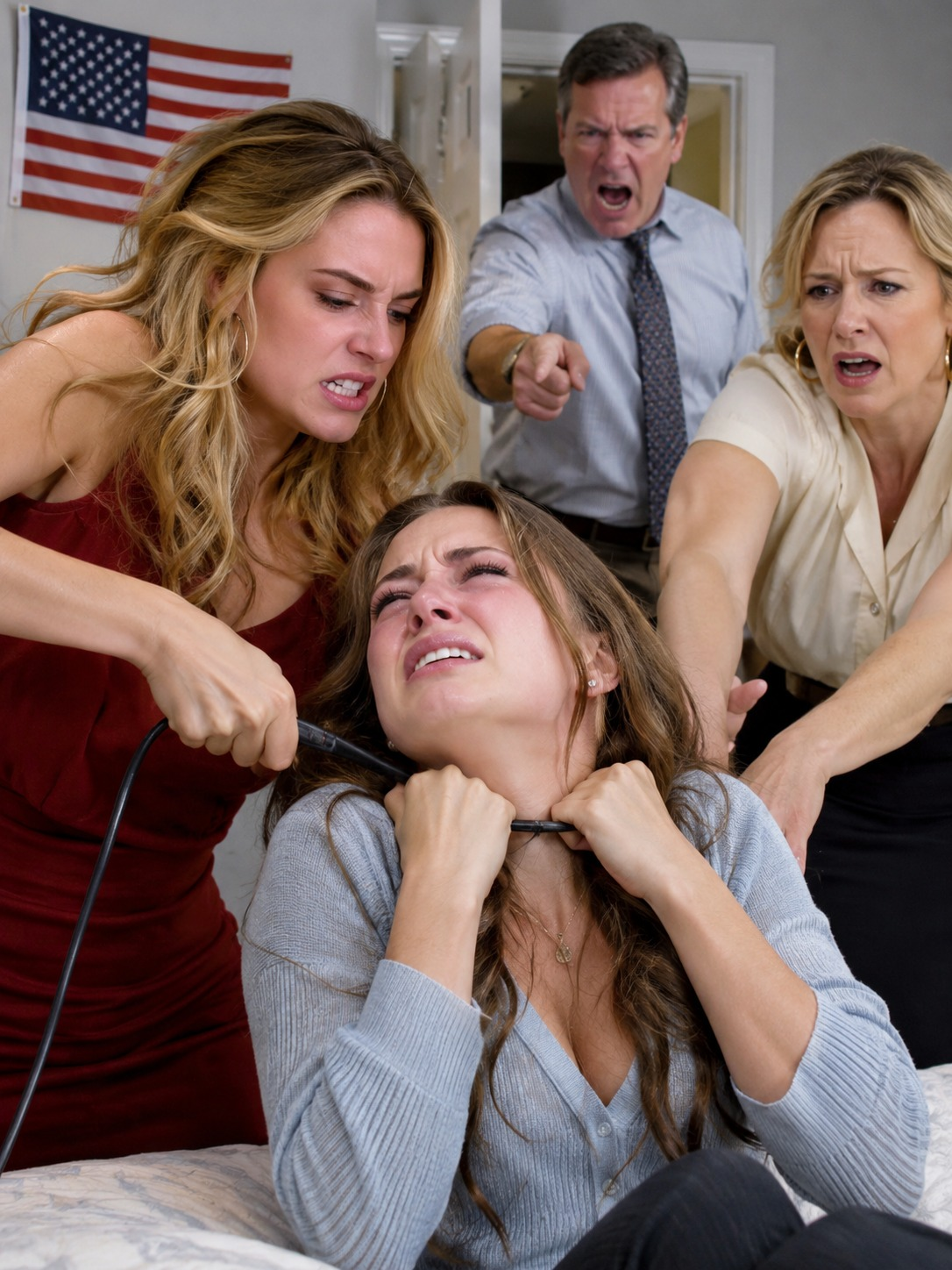
Before Camille wrapped an electrical cord around my neck.
Before he ordered me to stop fighting back.
I looked at Gideon.
"Why would he need a behavioral history?"
Gideon leaned closer to the screen.
"Maybe he's trying to make you look unreliable."
My stomach tightened.
"But he started it before the attack."
Neither of us spoke.
That was the part I couldn't understand.
My father had always described me as difficult whenever I challenged him. He'd called me emotional, ungrateful, stubborn, and disrespectful.
But those accusations had always been spoken.
Usually at the dinner table.
Usually when nobody outside the family was listening.
Now it appeared he'd been writing them down.
And saving them.
I typed a reply to the anonymous sender.
Can you send me the document?
The typing indicator appeared.
Then disappeared.
A minute passed.
Finally:
I only have photographs of some pages.
Another message followed.
I don't have access to the laptop anymore.
I swallowed.
Who are you?
No answer.
I tried again.
Please. I need to know who is helping me.
The reply came after a long pause.
If I tell you now, your father will know where the evidence came from.
I stared at the screen.
Then another message arrived.
Please let the detective handle it.
I looked at Gideon.
He nodded.
"That's probably the safest thing."
I typed:
Then send everything directly to Detective Mercer.
The sender replied:
I'm trying to arrange that.
I placed the phone on the table.
My hands were trembling.
For years, I'd wondered why my father never seemed surprised when Camille accused me of something.
He always had an explanation ready.
A reason I was wrong.
A reason Camille was innocent.
A reason everyone needed to stop listening to me.
I'd assumed it was favoritism.
Now I was beginning to wonder whether he'd been preparing for something more deliberate.
The next photograph arrived twelve minutes later.
It showed a page of text.
The heading read:
Elena Whitlock — Behavioral Concerns.
Underneath were several dated entries.
I enlarged the image.
The first entry was from almost a year earlier.
Elena became confrontational when asked to contribute toward household expenses.
I stared at it.
I remembered that argument.
Mom had asked me to pay part of Camille's overdue credit card bill.
I'd refused.
Dad had called me selfish.
Apparently, he'd recorded the incident as evidence of a behavioral problem.
The next entry was worse.
Elena demonstrates an increasing inability to accept family boundaries.
I felt my face grow hot.
Family boundaries.
That was what Dad called it when I wouldn't hand over my savings.
I scrolled down.
Elena has become secretive about her finances and personal relationships.
I looked at Gideon.
"Secretive?"
He read the line.
"Because you don't tell them everything?"
I nodded.
My parents had always expected access to my bank balance.
They wanted to know how much I earned.
How much I saved.
What I spent.
When I stopped answering those questions, Dad accused me of hiding things.
Now he'd written it down as though I were doing something suspicious.
I continued reading.
Elena frequently exaggerates minor disagreements and presents herself as the victim.
My throat tightened.
There it was.
The accusation that had followed me since childhood.
I was never hurt.
I was exaggerating.
I was never mistreated.
I was overreacting.
I was never defending myself.
I was creating trouble.
I lowered the phone.
Gideon watched me.
"Elena?"
I shook my head.
"I don't understand."
"What?"
"Why would he write this?"
Gideon looked at the screen.
"Because he wants other people to believe it."
I stared at him.
"But why start before the attack?"
He didn't answer.
And neither could I.
That afternoon, I called Detective Mercer.
I explained what the anonymous sender had shown me.
He listened carefully.
"Have you received the actual document?"
"No. Just photographs."
"Do the photographs show the full pages?"
"Some of them."
He paused.
"Please submit the images and the messages exactly as received."
I agreed.
Then I asked whether my father was allowed to keep a file about me.
Detective Mercer explained that keeping personal notes wasn't, by itself, evidence of a crime.
"But if the material was prepared or used to support false statements," he added, "we'll need to examine that in context."
I looked down.
"So it might not matter?"
"It may matter. We just need to establish what it is, who created it, and why."
I swallowed.
"Okay."
He continued.
"Elena, has your father ever suggested to anyone outside the family that you have a history of violence?"
I thought about the messages from relatives.
The accusations.
The way Mom had told Aunt Denise I'd attacked Camille.
Then I remembered something.
"Not violence exactly."
"What do you mean?"
"When I was in high school, he told one of my teachers I had trouble controlling my emotions."
There was a pause.
"Can you explain?"
I closed my eyes.
I hadn't thought about that afternoon in years.
But suddenly I remembered every detail.
I was seventeen when Dad was called to my school.
Camille had borrowed my laptop without permission and accidentally damaged the charging port.
When I confronted her, she laughed.
"It's just a computer."
I told her I needed it for school.
She said I was being dramatic.
Then she accused me of shouting at her.
Dad heard the argument.
He ordered me to apologize.
I refused.
For the first time in my life, I refused without crying.
I simply said, "No."
Dad stared at me.
"What did you say?"
"I didn't do anything wrong."
His face hardened.
"You're becoming impossible."
The next morning, my guidance counselor asked me to come to her office.
Her name was Mrs. Avery.
She was kind, patient, and usually cheerful.
That day, she looked concerned.
"Elena, your father called."
My stomach dropped.
"Why?"
"He said you've been having some difficulties at home."
I stared at her.
"What kind of difficulties?"
She hesitated.
"He mentioned anger."
I felt my face burn.
"Anger?"
"He said you've been having trouble managing your reactions."
I looked at the floor.
Mrs. Avery leaned forward.
"Elena, I'm not accusing you of anything. I just want to know how you're doing."
I wanted to tell her everything.
About Camille.
About the laptop.
About the money.
About the way Dad always took her side.
But I was afraid.
If I told the truth, Dad would find out.
And when Dad found out I'd discussed family matters with someone outside the house, he became furious.
So I shrugged.
"I'm fine."
Mrs. Avery studied me.
"Are you sure?"
I nodded.
She gave me a pamphlet about managing stress.
I carried it home in my backpack.
That evening, Dad asked whether I'd spoken to her.
I said yes.
He smiled.
"Good. Maybe you'll learn to control yourself."
I never told him how humiliated I'd felt.
I never told him that for weeks afterward, I wondered whether my teachers were watching me for signs of anger.
And I never told him that I'd started apologizing even when I knew I was right.
Because it was easier than being called unstable.
Back in Gideon's apartment, I finished telling Detective Mercer about Mrs. Avery.
He asked whether I remembered the school's name and the approximate date.
I gave him both.
He made a note.
Then he said, "Thank you. That's helpful background."
I swallowed.
"Detective, my father has been telling people I'm the problem for years."
"I understand that's your concern."
"No," I whispered. "I don't think you do."
There was a pause.
I closed my eyes.
"I'm sorry."
"You don't need to apologize for being upset."
My throat tightened.
I stared at the phone.
He continued.
"Elena, we're examining the assault. The statements surrounding it matter. Your family's history may help us understand those statements, but we still have to verify the evidence."
I nodded, even though he couldn't see me.
"I understand."
After we hung up, I sat quietly.
Gideon placed a glass of water beside me.
"How'd it go?"
I shrugged.
"He wants everything."
"Then we'll organize it."
I looked at him.
"You're not tired of this?"
He frowned.
"Of what?"
"Me. My family. All the drama."
Gideon sat across from me.
"Elena, your sister assaulted you. Your parents are trying to make you look responsible. That's not drama."
I stared at the table.
"It's a lot."
"Yes."
He reached for my hand.
"But you're not asking me to fix it. You're asking me to stand beside you while you deal with it."
I swallowed.
"Is that okay?"
He smiled sadly.
"Of course it is."
Two days later, my mother posted a photograph on Facebook.
It showed our family at Christmas.
Dad stood beside the tree.
Mom had her arm around Camille.
I stood slightly apart, holding a plate of cookies.
The caption read:
Family is everything. No matter how difficult life becomes, we must remember to honor the people who raised us.
I stared at it.
There were more than a hundred reactions.
People commented about forgiveness.
Respect.
Loyalty.
One woman wrote:
Children today don't appreciate what their parents sacrifice.
Mom liked the comment.
I felt sick.
She hadn't named me.
She didn't have to.
Then Camille shared the post.
She added:
Some people forget who was there for them before they became successful.
I looked at my nursing textbooks.
Successful.
I was twenty-two.
Still in school.
Working part-time.
Trying to pay rent and tuition.
I wasn't successful by any grand definition.
But I'd begun building a life outside my family's control.
Apparently, that was enough to make me ungrateful.
I closed Facebook.
Then I opened my messages.
Aunt Denise had written:
Please don't read what your mother is posting. She's trying to get a reaction.
I stared at the screen.
Then replied:
Too late.
She called immediately.
"Elena, honey, don't let them pull you into this."
I closed my eyes.
"They're telling everyone I'm terrible."
"I know."
"People believe them."
"Some people do."
I swallowed.
Aunt Denise sighed.
"Your mother has always been very concerned about appearances."
I looked down.
"She cares more about what people think than what happened to me."
There was a long pause.
Then Aunt Denise said quietly, "I think she's afraid of what people will think if they learn the truth."
I stared at the wall.
That sentence stayed with me long after we hung up.
The next week, I returned to campus for a meeting with my clinical coordinator.
I wasn't ready to resume full rotations.
My doctor had advised more recovery time.
But I wanted to understand how I could continue my program.
Mrs. Henderson met me outside the nursing building.
She smiled warmly.
"Elena. It's good to see you."
I tried to smile back.
"Thank you."
We walked slowly toward her office.
She noticed my careful movements.
"Take your time."
I nodded.
Inside, we discussed missed assignments, clinical requirements, and possible accommodations.
For the first time in days, I felt like a normal student.
We talked about schedules.
Deadlines.
Coursework.
Things I could understand and plan for.
Then Mrs. Henderson hesitated.
"Elena, there's something I should mention."
My stomach tightened.
"What?"
"Someone contacted the department."
I stared at her.
"Who?"
She looked uncomfortable.
"A family member."
My heart began pounding.
"What did they say?"
Mrs. Henderson folded her hands.
"They expressed concerns about your emotional stability and whether you should be participating in clinical training."
I felt the room tilt.
"What?"
She continued carefully.
"They suggested you were involved in a violent incident and might not be safe around patients."
I stared at her.
My father.
It had to be.
He'd been collecting notes about my behavior.
Telling relatives I was unstable.
And now someone had contacted my nursing program.
I felt tears gathering.
"Mrs. Henderson, I didn't attack anyone."
She leaned forward.
"Elena, listen to me."
I looked at her.
"An allegation from a family member is not a clinical evaluation."
I swallowed.
"We have procedures for assessing student fitness and safety. We don't simply accept anonymous or unsupported accusations."
I stared at her.
"Am I being removed from the program?"
"No."
I exhaled shakily.
She continued.
"We're addressing your medical accommodations separately from any concerns someone has raised. I wanted you to know about the contact because I thought it might be important."
My eyes filled with tears.
"Thank you."
She handed me a tissue.
"You're welcome."
I looked down.
"Do you know who called?"
She hesitated.
"I can't share every detail of the communication right now. But the person identified himself as your father."
I stopped breathing.
Richard Whitlock.
My father.
The man who'd watched me struggle to breathe.
The man who'd told Camille to put the cord back around my neck.
He was trying to interfere with my education.
The one thing I'd worked so hard to build without his help.
I left campus feeling numb.
Gideon picked me up outside the nursing building.
He knew something was wrong before I opened the car door.
"What happened?"
I sat down carefully.
"My father called the school."
Gideon stared at me.
"What?"
"He told them I might be dangerous around patients."
His expression hardened.
"Are you serious?"
I nodded.
"He said I was emotionally unstable."
Gideon gripped the steering wheel.
For a moment, he didn't speak.
Then he asked, "What did the school say?"
"They're not removing me."
He exhaled.
"Good."
"But he tried."
I looked out the window.
"He tried to take away nursing school."
My voice broke.
Gideon reached for my hand.
I let him hold it.
For years, Dad had told me I needed to be more grateful.
More respectful.
More obedient.
Now, when I refused to protect Camille, he was threatening the future I'd worked for.
I looked at Gideon.
"Why does he hate me?"
Gideon's face changed.
"Elena—"
"Why?"
He was quiet for a moment.
Then he said, "I don't know why your father treats you this way."
I stared at him.
"But I know it isn't because you deserve it."
I closed my eyes.
I wanted to believe him.
I was trying.
That evening, I sent Detective Mercer an update about the call to my nursing program.
He asked me to preserve any written information the school could provide and to avoid confronting my father.
I agreed.
Then I opened the anonymous messages again.
The sender hadn't contacted me in two days.
I typed:
My father called my nursing school.
A minute passed.
Then the typing indicator appeared.
I know.
My stomach tightened.
How?
The reply came quickly.
He was angry when he found out they wouldn't remove you.
I stared at the screen.
You were there?
No answer.
I typed again.
Please tell me who you are.
The typing indicator appeared.
Disappeared.
Then:
Not yet.
I felt frustration rise.
You keep sending me evidence, but I don't know whether I can trust you.
A long pause.
Then the sender replied:
You're right.
I stared at the screen.
Another message arrived.
You shouldn't trust anyone just because they say they're helping.
I swallowed.
Then:
That's why I want you to give everything to Detective Mercer.
I looked at Gideon.
He was sitting beside me, reading.
I typed:
What else do you have?
The reply came after several minutes.
Something your father doesn't know exists.
My heart began pounding.
What?
The sender answered:
The first version of his statement.
I sat upright.
What statement?
The one he wrote before he knew the hospital had photographed your injuries.
I stared at the screen.
Another message appeared.
He changed it after speaking to Camille.
My hands went cold.
How do you know?
A pause.
Then:
Because I saw both versions.
I swallowed.
Can you send them?
The typing indicator appeared.
Then disappeared.
Finally:
I can send one page.
A photograph began loading.
I leaned closer.
It showed a printed statement with my father's name at the top.
Richard Whitlock — Witness Account.
The date was the morning after the assault.
I enlarged the image.
The first paragraph described a disagreement between two sisters.
The second claimed I'd become aggressive.
The third said Camille had acted only to defend herself.
I felt sick.
Then I noticed something.
A handwritten correction in the margin.
A sentence crossed out.
And beneath it, in my father's handwriting, a new sentence.
I zoomed in.
The crossed-out line read:
I entered the room after hearing a loud crash.
The replacement read:
I entered the room when I heard Elena shouting threats.
I stared at the screen.
He hadn't merely remembered the incident differently.
He'd rewritten when he arrived.
Then another message appeared.
Look at the bottom of the page.
I scrolled down.
There was a handwritten note beside his signature.
Two words.
Ask Lorraine.
My stomach tightened.
Then the sender wrote:
Your mother refused to sign the first version.
I stared at the message.
Another followed.
Your father made her sign the second.
I looked toward Gideon.
Before I could speak, my phone began ringing.
The caller ID showed my mother's name.
I hesitated.
Then answered.
"Mom?"
For a moment, there was only breathing.
Then she whispered, "Elena, I need to tell you something."
My heart began pounding.
"What?"
Her voice shook.
"I found the original photograph."
I sat perfectly still.
"What photograph?"
"The one from the hospital."
I frowned.
"Mom, how would you have that?"
She began crying.
"Because your father has been trying to find out what the nurse photographed."
My stomach dropped.
"Why?"
There was a long silence.
Then Mom whispered:
"Because he knows what that mark means."
I stopped breathing.
"What does it mean?"
She took a shaky breath.
"Elena, the mark behind your left ear..."
A door opened on her end.
Mom gasped.
Then my father's voice came through the phone.
"Lorraine. Give me that."
The line went dead.
I stared at the screen.
A second later, a new message arrived from the anonymous number.
Your mother is in trouble.
Then another.
Your father just found the photographs.
And finally:
He's on his way to the hospital.






Comments 0