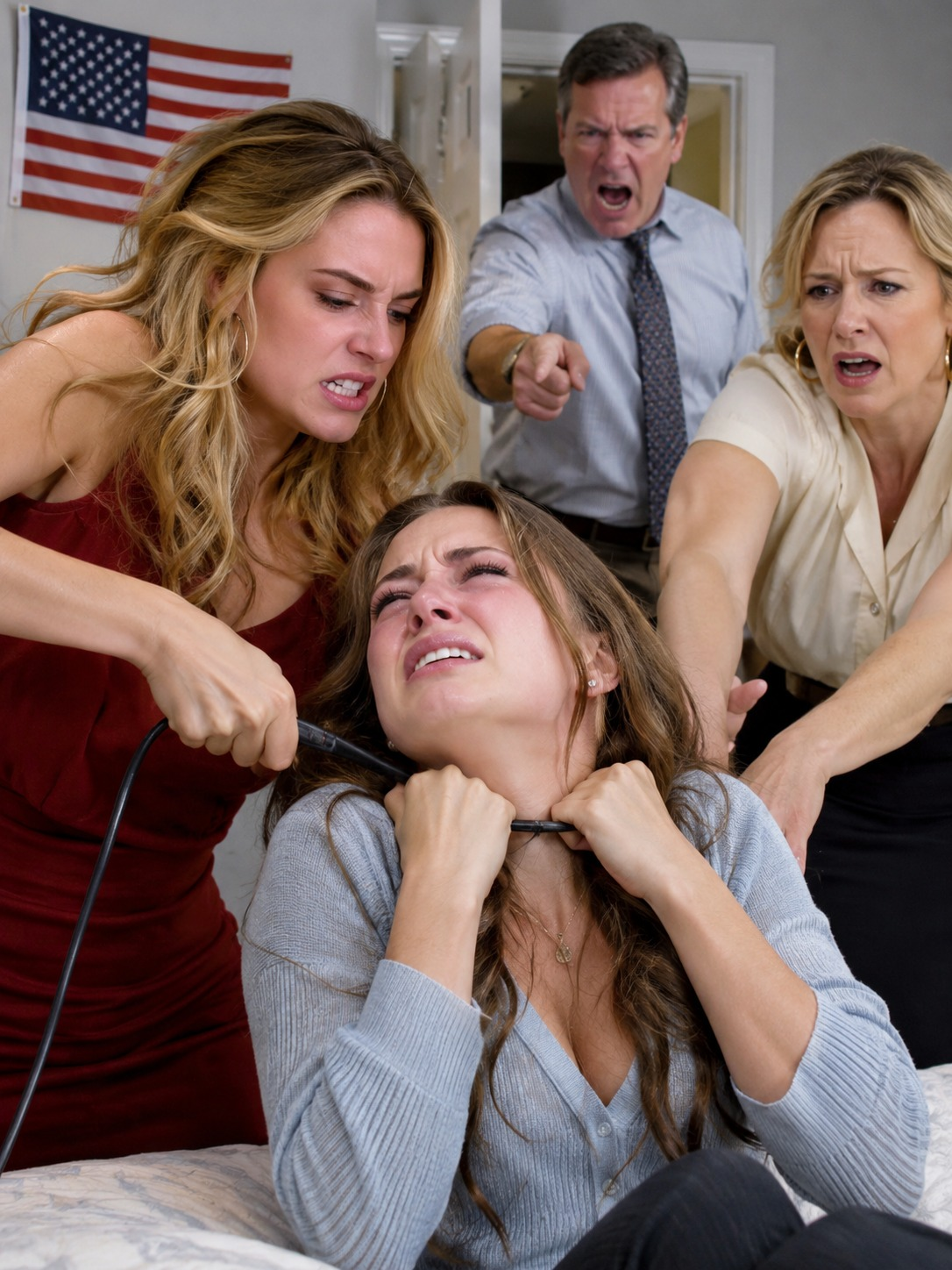
"He wants you to sign a statement saying your sister's assault never happened."
For a moment, I thought I'd misunderstood my attorney.
I stood in Gideon's kitchen, holding the phone against my ear, staring at the clock above the stove.
It was almost nine at night.
Outside, rain tapped against the windows.
The same kind of rain that had fallen the night I escaped my parents' house.
"Elena?" my attorney asked.
"I'm here."
"Do you understand what I'm telling you?"
I looked down at the papers spread across the kitchen table.
The trust documents.
My grandfather's letters.
The photographs.
The records that had taken months to gather.
My father was offering to settle the property dispute.
But only if I agreed to deny the assault that had nearly killed me.
I felt something unfamiliar settle inside my chest.
Not fear.
Not even anger.
Clarity.
"No," I said.
My attorney paused.
"No to the settlement?"
"No to the condition."
I looked toward Gideon.
He stood near the kitchen counter, watching me.
"I won't sign anything false."
"That's the appropriate decision," she said. "I also have serious concerns about the condition itself."
I swallowed.
"What happens now?"
"We reject the proposal. I'll preserve the correspondence and discuss whether it needs to be brought to the attention of the appropriate authorities."
I nodded.
"Okay."
"Your father's deadline doesn't require you to do anything tonight. He can't impose a legal obligation simply by demanding an answer."
I closed my eyes.
For twenty-two years, my father had controlled our family with deadlines.
Apologize before dinner.
Give Camille the money by Friday.
Come home before I get angry.
Do what I say, or face the consequences.
And now, even through an attorney, he was trying the same thing.
But this time, I had someone explaining the difference between a demand and an obligation.
"Thank you," I whispered.
After the call, Gideon approached me.
"What did you decide?"
I put my phone down.
"I'm not signing."
He nodded.
"Good."
I looked at him.
"Dad thinks he can still buy my silence."
Gideon took my hand.
I stared at our joined fingers.
For months, I'd imagined the day my father finally understood that I wasn't afraid of him anymore.
Now I realized something.
He didn't have to understand.
I only had to stop obeying.
The following morning, my attorney formally rejected the settlement proposal.
She also preserved the written demand and coordinated with the lawyers handling the criminal matters.
I didn't call Dad.
I didn't explain myself to Mom.
I didn't send Camille another message.
I went to class.
Mrs. Henderson had arranged for me to complete a clinical skills assessment I'd missed during my recovery.
I stood beside a hospital bed in the nursing laboratory, checking a simulated patient's vital signs.
My hands were steady.
When the assessment ended, Mrs. Henderson smiled.
"Well done, Elena."
I looked at her.
"Really?"
"Really."
I felt tears gathering.
She noticed.
"Are you all right?"
I laughed softly.
"Yes."
And for the first time in a long time, I meant it.
The legal proceedings didn't end overnight.
My father's attempt to exchange property rights for a false statement became part of the material reviewed by investigators.
The prosecutor's office examined the original recordings, the statements, and the evidence concerning his attempts to influence witnesses.
His attorney challenged several allegations.
My father denied wrongdoing.
But the evidence no longer depended on my word against his.
There were original digital files.
Hospital photographs.
Messages.
Witness accounts.
And the photograph that had changed everything.
The image of my father holding the electrical cord before the lamp broke.
Six months after the assault, that photograph had exposed the central lie in his testimony.
He hadn't entered the room after the confrontation began.
He'd been there before it.
He hadn't merely witnessed Camille holding the cord.
He'd handled it himself.
And he hadn't been trying to protect me.
The recording captured him telling Camille to put it around my neck.
I remembered looking at that photograph in the courtroom.
My father's face turning pale.
His carefully prepared explanations falling apart.
For years, he'd insisted that people believe him because he was my father.
The photograph forced everyone to look at what he'd actually done.
Several months later, my father entered a negotiated guilty plea to charges arising from his false statements and efforts to interfere with the investigation.
His attorney had spent weeks reviewing the evidence with him.
The agreement did not require me to forgive him.
It did not require me to speak on his behalf.
And it did not erase what had happened.
At the sentencing hearing, I sat beside Gideon and Sarah Coleman.
Dad wore a dark suit.
His hair had more gray in it than I remembered.
He looked older.
Smaller.
But when he glanced toward me, I recognized the expression.
The expectation that I would look away first.
I didn't.
The judge addressed the seriousness of providing false information and attempting to obstruct an investigation involving violence.
My father received a sentence that included a period of incarceration, followed by supervision and conditions restricting contact with me.
He was also ordered to comply with the court's requirements.
I listened quietly.
I had imagined this moment many times.
Sometimes I'd pictured myself crying.
Sometimes I'd imagined shouting at him.
Sometimes I'd thought I might feel guilty when I saw him standing before a judge.
Instead, I felt tired.
And strangely peaceful.
Because the judge wasn't asking me to decide whether Dad deserved consequences.
The court was addressing what he'd done.
That responsibility no longer belonged to me.
After the hearing, Mom approached me outside the courtroom.
She was wearing a blue coat.
Her hands were empty.
No purse clutched against her chest.
No phone ready to call Dad.
She stopped several feet away.
"Elena."
I looked at her.
"Hi, Mom."
Her eyes filled with tears.
"I know you probably don't want to talk to me."
I hesitated.
"I can talk for a few minutes."
She nodded.
"Thank you."
We stood near a window overlooking the courthouse steps.
For a while, neither of us spoke.
Then Mom said, "I've been seeing a counselor."
I looked at her.
"That's good."
She swallowed.
"I'm learning things about myself that I don't like."
I said nothing.
She continued.
"I spent years telling myself that Richard was difficult because he cared about us."
Her voice trembled.
"And I told myself Camille needed more help because she was sensitive."
I looked down.
"I know."
Mom wiped her eyes.
"I made you responsible for keeping everyone calm."
I swallowed.
"Yes."
"And when you couldn't, I blamed you."
I felt my throat tighten.
She looked directly at me.
"I was wrong."
For a moment, I couldn't speak.
I'd wanted those words since I was a little girl.
I'd wanted them after Camille broke my favorite necklace.
After Dad told my teacher I had anger problems.
After Mom made me apologize for refusing to give Camille money.
After I woke up in the hospital with bruises around my neck.
Now she was finally saying them.
And I discovered that hearing them didn't erase the years that came before.
"I'm glad you're telling the truth," I said.
Mom nodded.
"But I need time."
"I know."
"I don't know what our relationship will look like."
She began crying.
"I understand."
I looked at her.
"Mom, I can't be responsible for making you feel better about what happened."
She pressed her lips together.
Then nodded.
"You're right."
We stood quietly.
Finally, she said, "I love you, Elena."
I swallowed.
"I know you want to."
Her face crumpled.
I didn't say it to hurt her.
I said it because love had become a word my family used whenever they wanted me to forget what they'd done.
I needed something different now.
Consistency.
Honesty.
Respect.
Mom nodded slowly.
"I'll keep trying to show you."
I looked at her.
"That's all you can do."
Camille's sentence included supervised probation, mandatory counseling, and restrictions on contacting or approaching me without my consent.
She also had to comply with the court's other conditions.
Her guilty plea remained part of the public record.
For the first time, the consequences of her actions couldn't be erased by Dad's influence.
She wrote me one letter.
I didn't open it immediately.
It sat on my desk for almost two weeks.
Then one Sunday afternoon, I read it.
Elena,
I don't expect you to forgive me.
I used to think that if Dad defended me, I couldn't have done anything wrong.
I know now how terrible that was.
I hurt you because I was angry you wouldn't give me what I wanted.
I lied because I was afraid of what would happen if I told the truth.
You didn't deserve any of it.
I'm sorry.
I read the letter twice.
Then folded it carefully.
I didn't write back.
Not because I wanted to punish her.
Because I wasn't ready.
And for once, nobody was standing over me demanding an apology or an answer.
The property dispute took longer to resolve.
My attorney worked with the trust lawyer to examine the original documents, the recorded property interests, and the amendment Grandpa had signed before his death.
The amendment clarified his intentions and supported a larger beneficial interest than the original papers alone had suggested.
My father had received notice of the amendment years earlier.
He had never told me.
The trust's records also showed that he had failed to provide the accounting required of him.
After months of legal work, the parties reached a court-approved resolution.
My father's disputed administration of the trust was addressed.
The accounting was completed.
And my beneficial interest was recognized.
I didn't become the sole owner of the house.
I didn't suddenly become wealthy.
But I received a substantial settlement representing my interest in the property.
Enough to repay the legal expenses associated with the trust matter.
Enough to create a meaningful savings cushion.
Enough to reduce the financial pressure I'd carried throughout nursing school.
When my attorney told me the final amount, I sat silently.
"Elena?"
I swallowed.
"I'm here."
"Do you have any questions?"
I stared at the numbers.
Then whispered, "Grandpa really did this for me."
My attorney's voice softened.
"His documents made his intentions clear."
I closed my eyes.
I pictured Grandpa in his workshop.
His rough hands.
His warm smile.
The way he'd always saved the best piece of wood for whatever project I wanted to make.
He'd never been a wealthy man.
But he'd understood something my father hadn't.
Security wasn't about controlling someone.
It was about giving them room to make their own choices.
The house was eventually sold as part of the property resolution.
I didn't attend the sale.
I didn't walk through the rooms.
I didn't stand in my childhood bedroom one last time.
I didn't need to.
My memories were already there.
Some good.
Most complicated.
And one terrible enough to change my life.
I let the attorneys handle the paperwork.
When the transaction was complete, my attorney sent me a short message.
Everything is finalized.
I read it while sitting on Gideon's couch.
Then I put the phone down.
He looked at me.
"Is it done?"
I nodded.
"Yes."
He smiled.
"How do you feel?"
I thought about it.
"Free."
The word surprised me.
But it was the right one.
I finished nursing school the following spring.
Graduation day arrived bright and warm.
I stood in front of the mirror, adjusting my gown.
My hair was pinned back.
My cap sat slightly crooked.
Gideon appeared in the doorway.
"You look beautiful."
I laughed.
"I look like I'm wearing a square on my head."
He smiled.
"A very accomplished square."
I rolled my eyes.
Then looked at myself again.
For years, I'd imagined graduation as the day my parents would finally be proud of me.
I'd pictured Dad shaking my hand.
Mom crying in the audience.
Camille pretending not to be jealous.
But those weren't the people I needed to see.
When I walked across the stage, Gideon stood cheering.
Aunt Denise was beside him.
Margaret Bell waved a small handmade sign.
Mrs. Henderson smiled from the faculty section.
And several friends from my nursing program shouted my name.
I accepted my diploma.
Then turned toward the audience.
For one beautiful moment, I couldn't hear anything except applause.
Not Dad's voice.
Not Camille's accusations.
Not Mom telling me to apologize.
Just people celebrating something I'd earned.
When I stepped off the stage, tears were running down my face.
I didn't wipe them away.
After graduation, Margaret invited everyone to her house.
She'd decorated the living room with flowers.
There was cake on the dining table.
Aunt Denise brought homemade food.
Gideon had arranged photographs from my nursing school years in a small album.
I laughed when I saw the first picture.
Me asleep over a textbook.
"Where did you get that?"
Gideon grinned.
"I have sources."
I shook my head.
Then turned the page.
There were photographs from study sessions.
Clinical practice.
Coffee shops.
Walks around campus.
And one photograph of me sitting in Grandpa's workshop, holding the little wooden bird.
I stared at it.
Margaret came to stand beside me.
"He would have loved today."
My throat tightened.
"I know."
She reached into her pocket.
"I have something for you."
A small envelope.
I looked at her.
"Margaret..."
"Open it."
Inside was a photograph.
Grandpa and me.
I was about twelve.
We stood in his workshop.
I held the crooked wooden bird.
Grandpa had one arm around my shoulders.
We were both laughing.
On the back, in his handwriting, were six words.
Elena, you can build your own life.
I covered my mouth.
Margaret placed a hand on my shoulder.
"He asked me to give you that when you finished school."
I looked at her through tears.
"How did he know I would?"
She smiled.
"He never doubted it."
That summer, I accepted a nursing position at a hospital in Columbus.
My first day was terrifying.
I arrived early.
Checked my badge three times.
Reviewed my notes.
And tried not to look as nervous as I felt.
My supervisor was patient.
My coworkers were kind.
The work was demanding.
Some shifts left me exhausted.
Some patients frightened me because I wanted so badly to help them.
But every day, I learned.
And every day, I became a little more confident.
One evening, a young woman came into the department with bruises on her arms.
She kept apologizing.
For taking up time.
For asking questions.
For being frightened.
I recognized the way she looked toward the door whenever someone walked past.
I didn't know her story.
I didn't assume I did.
But I sat beside her and spoke gently.
"You don't need to apologize for asking for help."
She looked at me.
Her eyes filled with tears.
I handed her a tissue.
Then I listened.
And I remembered Dana Ellis.
The nurse who'd noticed the small injury behind my ear.
The nurse who'd documented what she saw.
The nurse who'd treated me like a person worth protecting.
I hoped I could do the same for someone else.
A year after the assault, Gideon and I moved into a small apartment of our own.
It wasn't luxurious.
The kitchen was narrow.
The bathroom faucet sometimes leaked.
The living room barely fit our couch.
But the windows let in afternoon sunlight.
And the front door had a lock only we controlled.
We painted the bedroom a soft green.
Gideon assembled the bookshelves.
I arranged my nursing textbooks beside a row of novels.
Then I placed Grandpa's wooden bird on the windowsill.
It looked ridiculous.
One wing was larger than the other.
Its beak pointed slightly downward.
Gideon studied it.
"You know," he said, "I think it's growing on me."
I laughed.
"Don't insult Grandpa's masterpiece."
He grinned.
"I wouldn't dare."
I looked around the room.
For the first time, I lived somewhere nobody could threaten to throw me out for saying no.
Nobody demanded access to my savings.
Nobody searched my phone.
Nobody told me I was difficult for wanting privacy.
It was just our home.
Small.
Imperfect.
Safe.
My relationship with Mom changed slowly.
We met for coffee occasionally.
She continued counseling.
She stopped asking me to excuse Dad's behavior.
She respected it when I didn't want to discuss Camille.
And when I told her I needed to leave, she let me go without making me feel guilty.
I didn't forget what she'd done.
I didn't pretend our relationship was healed.
But over time, I began to believe she was trying to become someone different.
Camille continued complying with the conditions of her sentence.
I heard occasional updates through Aunt Denise.
She was working.
Attending counseling.
Trying to rebuild her life.
I wished her well.
From a distance.
My father remained responsible for the consequences of his own decisions.
I didn't visit him.
I didn't answer his letters.
I didn't need one final confrontation.
I had already told the truth.
The courts had heard it.
The evidence had supported it.
And the people who mattered knew what had happened.
There was nothing left for me to prove to him.
One Saturday morning, Gideon and I drove to visit Grandpa's grave.
The sky was clear.
A gentle breeze moved through the trees.
I carried a small bouquet of white flowers.
We walked quietly along the path.
When we reached his headstone, I knelt beside it.
"Hi, Grandpa."
My voice trembled.
"I graduated."
I smiled through tears.
"And I got a job."
Gideon stood a few feet away, giving me space.
I placed the flowers carefully.
"I found your letters."
I swallowed.
"And the papers."
A breeze moved through the grass.
I looked at the name carved into the stone.
Harlon Whitlock.
The man who'd taught me how to hold a screwdriver.
How to measure twice.
How to sand rough wood without breaking it.
How to ask questions.
How to believe my own eyes.
"I wish you could see everything."
My voice broke.
"But I think you'd be happy."
I sat quietly for a while.
Then I reached into my bag.
I took out the photograph Margaret had given me.
Grandpa and me in the workshop.
Both laughing.
I looked at it one last time.
Then slipped it safely back into its protective sleeve.
I wasn't leaving it behind.
It belonged in my new home.
Beside the wooden bird.
Beside my diploma.
Beside the life I'd built.
That evening, Gideon and I sat on our little balcony.
The city lights glowed beyond the railing.
He handed me a cup of tea.
I smiled.
"Thank you."
He sat beside me.
For a while, we watched the sky darken.
Then he asked, "What are you thinking about?"
I looked toward the apartment.
Our books.
Our furniture.
The photographs on the wall.
The little wooden bird on the windowsill.
I thought about the girl I'd been.
The one who apologized whenever someone raised their voice.
The one who believed love had to be earned by obedience.
The one who thought her family would never let her leave.
Then I thought about the woman I'd become.
A nurse.
A friend.
A partner.
Someone who could say no without explaining herself.
Someone who knew that being loved shouldn't feel like being afraid.
I looked at Gideon.
"Home."
He smiled.
"What about it?"
I leaned against his shoulder.
"I finally know what it feels like."
He kissed the top of my head.
We sat quietly as the evening settled around us.
No shouting.
No threats.
No footsteps outside a locked bedroom door.
Just the soft sounds of the city and the warmth of someone who loved me without asking me to become smaller.
For most of my life, I'd believed my father's house was the only place I belonged.
But Grandpa had been right.
I could build my own life.
And I had.






Comments 0