Ezra Whitlo shoved my canvas sack onto the porch and shouted:
"Take your things and get off my property!"
Before I could answer, he pulled the farmhouse door shut.
My father's old hunting knife slipped halfway out of the sack, revealing two initials carved into its bone handle.
S. D.
Ezra never noticed.
But that small detail would eventually change everything.
I stood at the bottom of the porch steps, staring at the wooden door.
For a moment, I couldn't understand what had happened.
Six months earlier, I had buried my husband.
Now, the only home I had known for three years was being taken from me by the brother of the man I had loved.
My name was Clara Whitlo.
I was twenty-eight years old, and until that morning, I had believed that marriage meant something even after death.
Apparently, Ezra disagreed.
"Your marriage papers were never registered," he had told me less than ten minutes earlier. "You have no legal claim to this house. Caleb is dead, and you need to understand that his family doesn't owe you anything."
I had looked at him across the kitchen table.
The same table where Caleb and I had eaten breakfast every morning.
The same table where I had sat beside Caleb's sister, Margaret, during the final weeks of her illness.
The same table where Ezra had once thanked me for keeping the household running while his brother worked the fields.
I remembered all of it.
Ezra seemed to remember nothing.
"Where am I supposed to go?" I had asked.
He shrugged.
"That's not my concern."
I had waited for him to say something else.
Perhaps that he was angry.
Perhaps that he needed time.
Perhaps that I could stay until the roads cleared.
But he only glanced at the clock.
"Today, Clara. Not tomorrow."
And now I was outside.
The door was closed.
The snow was falling harder.
I looked down at my sack.
Half a loaf of bread.
Two jars of beans.
A thin blanket.
A spare blouse.
My father's hunting knife.
Everything I owned in the world.
I bent to retrieve the sack and brushed snow from its canvas surface.
My hands were already becoming numb.
The farmhouse chimney released a thin stream of smoke.
Somewhere inside, Ezra was probably returning to his breakfast.
That thought hurt more than I expected.
For three years, I had worked beside Caleb on that farm.
I had hauled water before sunrise, washed clothes in freezing weather, repaired torn shirts, cooked meals, and helped mend fences after winter storms.
When Caleb's sister Margaret became ill, I had spent countless nights beside her bed.
Ezra had rarely visited.
Margaret had been the one who held my hand when I married Caleb.
She had smiled at us in front of the stove and told me that I was no longer a stranger.
She was gone now.
And Ezra had decided that without her, I was nothing.
I tightened the rope around my sack.
Then I looked toward the road.
Twelve miles east lay Keller's Crossing, a small settlement where I might find a room, work, or at least a roof that did not belong to someone who wanted me dead from cold.
I had no money to rent a carriage.
No horse.
No one waiting for me.
But I had two legs.
For the moment, that would have to be enough.
I stepped away from the porch.
The wind struck my face.
Behind me, the farmhouse door remained closed.
I did not turn around again.
By the time I reached the wagon track, snow had already gathered along the edges of my coat.
The familiar road looked strangely different beneath the storm.
The wooden fence posts had become white shapes.
The bare branches of the cottonwoods bent under the weight of snow.
The distant mountain slopes had almost disappeared behind a gray curtain.
I kept walking.
One step.
Then another.
My left boot had been coming apart for weeks. Caleb had promised to repair it before the first heavy snowfall, but his illness had worsened before he could finish.
I had wrapped the damaged sole with leather cord.
It held well enough on dry ground.
Snow was another matter.
Every few minutes, I had to stop and press the loose leather back against the boot.
I thought about Caleb.
Not the last days.
Not the fever.
I thought about him laughing beside the stove when I accidentally burned a batch of biscuits.
I thought about his habit of leaving his gloves on the kitchen windowsill.
I thought about the way he always touched my shoulder when he passed behind my chair.
He had never been a wealthy man.
He had never promised me a grand house or a comfortable life.
But he had promised that I would never have to face the world alone.
I swallowed against the cold.
"Caleb," I whispered.
The wind swallowed his name.
I continued walking.
At noon, I stopped beneath a large pine tree and opened my sack.
The bread was slightly damp from the snow.
I broke off a small piece and ate it slowly.
I had to make it last.
The beans would be useful if I found somewhere to cook them.
I closed the sack and checked its contents.
That was when I noticed the knife.
Its bone handle was protruding from the cloth.
I pulled it out.
The blade was old but still sharp.
My father had given it to me when I was sixteen.
He had been a quiet man who rarely explained his decisions.
He taught me how to sharpen the blade, how to keep it dry, and how to hold it safely.
He had also told me never to sell it.
Not even if I became desperate.
I had asked him why.
He had simply answered, "Some things are worth more than their price."
I turned the handle in my hand.
The initials were still there.
S. D.
I had seen them hundreds of times.
I had always assumed they were the initials of the man who made it.
My father had never corrected me.
I wrapped the knife again and placed it inside the sack.
Then I started walking.
By two o'clock, the wagon tracks were almost impossible to follow.
The snow had become deeper.
My skirt dragged through it, and the wind seemed to find every opening in my clothing.
I could no longer feel the tips of my fingers.
I knew I needed to move faster.
But my body was becoming heavy.
My left boot slipped.
I caught myself against a fence post.
The wood was covered in ice.
I looked toward the east.
Nothing.
Only snow.
The settlement was still too far away.
I tried to remember how much daylight remained.
The sky had already turned a dull gray.
I could not make it.
The realization arrived quietly.
There was no dramatic moment.
No sudden panic.
Just a simple understanding that the road was no longer an option.
"I won't make it," I said.
My voice sounded unfamiliar.
The wind carried the words away.
I looked toward the north.
Beyond the wagon track, a wooded hillside rose above the farm road.
Tall hemlocks covered its lower slope.
Large stones broke through the frozen ground.
The trees might provide some protection from the wind.
Perhaps there was an abandoned shed.
Perhaps a hollow beneath the rocks.
Anything would be better than standing in the open.
I turned away from the road.
The first few steps were difficult.
Snow reached almost to my knees in places.
Branches caught my coat.
My sack struck against my hip.
I stopped twice to catch my breath.
Once, I slipped and fell against a dead branch.
The pain in my knee made my eyes water.
I stayed on the ground longer than I should have.
For one dangerous moment, the thought of simply lying there seemed comforting.
I imagined closing my eyes.
I imagined the cold becoming less painful.
Then I remembered Caleb's last words.
He had been weak and feverish.
His hand had barely been strong enough to hold mine.
But he had looked directly into my eyes.
"Promise me you'll keep going, Clara."
I had nodded.
At the time, I thought he meant after his death.
Now I understood that the promise was meant for days like this.
I pushed myself upright.
My knee hurt.
My fingers trembled.
But I continued.
The trees grew thicker as I climbed.
The wind became less violent, though the snow still fell steadily.
I searched the ground for anything that might offer shelter.
A fallen tree.
A shallow cave.
An old hunting blind.
Nothing appeared.
Then, at approximately 3:17, my left knee struck something beneath the snow.
The impact was hard.
Too hard to be earth.
I stopped.
I brushed away the snow with my glove.
A straight edge appeared.
I frowned.
It was stone.
Not an ordinary rock.
The edge was too even.
I moved more snow.
Another straight line emerged above it.
Then a corner.
My heart began beating faster.
I dropped my sack and used both hands to clear the frozen surface.
Snow fell away in thick clumps.
A rectangular shape slowly appeared.
At first, I thought it was the roof of an old cellar.
Then I noticed the wood.
Dark, weathered planks.
Iron bands.
A heavy hinge.
I leaned closer.
It was a door.
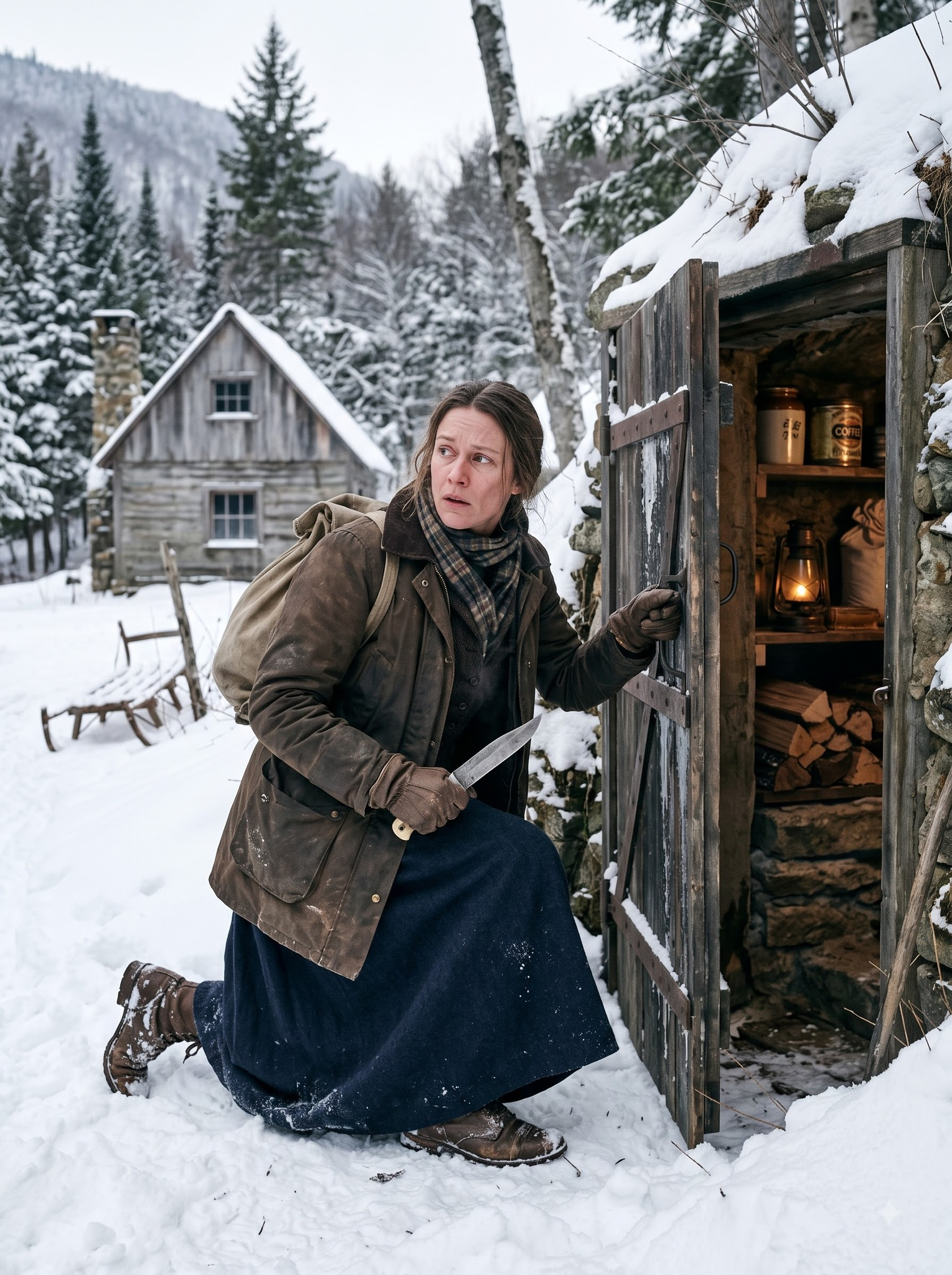
A wooden door built directly into the hillside.
I stared at it for several seconds.
Who would build a door in the middle of a mountain?
And why would someone cover it with so much earth and snow?
I looked around.
The trees stood silent.
There were no footprints.
No fresh tracks.
No sign that anyone had visited the place recently.
I returned my attention to the door.
The wood was old.
Very old.
But the iron handle was still attached.
I brushed snow away from it.
Something about the construction seemed familiar.
Not the door itself.
The ironwork.
My father had once repaired an old storage chest using iron bands with a similar pattern.
I pushed the thought aside.
I was freezing.
I needed shelter.
I grabbed the handle.
It did not move.
I pulled harder.
The frame groaned.
Nothing.
I placed both hands against the wood and pushed.
My boots slipped.
The damaged sole folded beneath my left foot.
I nearly fell backward.
I stopped to breathe.
Then I braced my shoulder against the door.
"Please," I whispered.
I pushed again.
A cracking sound came from somewhere inside the frame.
The door shifted.
Only an inch.
But it moved.
I pushed harder.
A second crack echoed through the trees.
The old hinges groaned as the door slowly opened inward.
Darkness appeared behind it.
A narrow stairway descended into the hillside.
I stepped back.
Cold air drifted upward from the opening.
It smelled of old wood, dust, dry earth, and something faintly metallic.
I could not see the bottom.
My first thought was that it might be an abandoned cellar.
My second was that someone could be living inside.
I listened.
Nothing.
No movement.
No voices.
Only the faint whistle of wind passing through the doorway.
I reached into my sack.
My fingers found the bone handle of my father's knife.
I drew it out.
For the first time that day, I felt that I might have found something capable of keeping me alive.
I held the knife loosely in my right hand.
Then I looked down the steps.
Three steps.
Four.
Five.
The darkness swallowed everything beyond them.
I hesitated.
The farmhouse was behind me.
The road was somewhere beneath the snow.
Night was approaching.
I had nowhere else to go.
I placed one boot on the first stone step.
It held.
I moved to the second.
Then the third.
Behind me, the gray daylight became a narrow rectangle.
I descended carefully.
At the bottom, my free hand touched a rough stone wall.
I felt along it until my fingers found a wooden shelf.
Something was resting there.
I moved closer.
My eyes slowly adjusted to the darkness.
The first thing I saw was a neat stack of firewood.
Beside it were two sealed metal tins.
A folded canvas flour sack rested beneath a flat stone.
Someone had arranged everything carefully.
This was not a forgotten hole in the mountain.
It was a shelter.
A real shelter.
And whoever had built it had expected someone to need it.
I lowered my knife.
My fingers touched the edge of an object on the shelf.
It was wrapped in oilcloth.
I pulled it closer.
A leather ledger.
The corners were worn.
The cover was dark brown, almost black with age.
I brushed away the dust.
There was no name on the front.
Only a small mark pressed into the leather.
Two letters.
S. D.
My breath caught.
I looked down at the knife.
Then back at the ledger.
The same initials.
I opened the cover.
The first page was filled with careful black handwriting.
I leaned closer, using the faint light from the entrance to read.
The first line contained a name.
A name I had not seen written in years.
My father's name.
Silas Danner.
My hands began to tremble.
I read it again.
Silas Danner.
There was no mistake.
My father had been dead for twelve years.
He had never mentioned this shelter.
He had never spoken about owning land in these mountains.
And yet his name was written inside a hidden room beneath the hillside.
I turned the page.
A second line appeared.
It contained a date.
Then a short sentence.
I brought the ledger closer to my face.
The words were difficult to read because the ink had faded.
But the final line was clear.
"If Clara Danner ever finds this place, she must never allow Ezra Whitlo to see what is written on the next page."
My blood ran cold.
Ezra.
My brother-in-law.
The man who had thrown me out that very morning.
I slowly raised my eyes toward the stone staircase.
For the first time, I understood that the secret beneath the mountain might have something to do with the man who had taken my home.
And then I heard something.
A faint sound from outside.
Not the wind.
Not a falling branch.
Footsteps.
Someone was approaching the hidden entrance.
I closed the ledger.
My father's knife felt suddenly heavier in my hand.
The footsteps stopped.
A shadow crossed the narrow rectangle of daylight above the stairs.
Then a man's voice came from outside.
"Clara?"
I stopped breathing.
I knew that voice.
And whoever was standing above me had no reason to know I was there.
The man had found me.






Comments 0