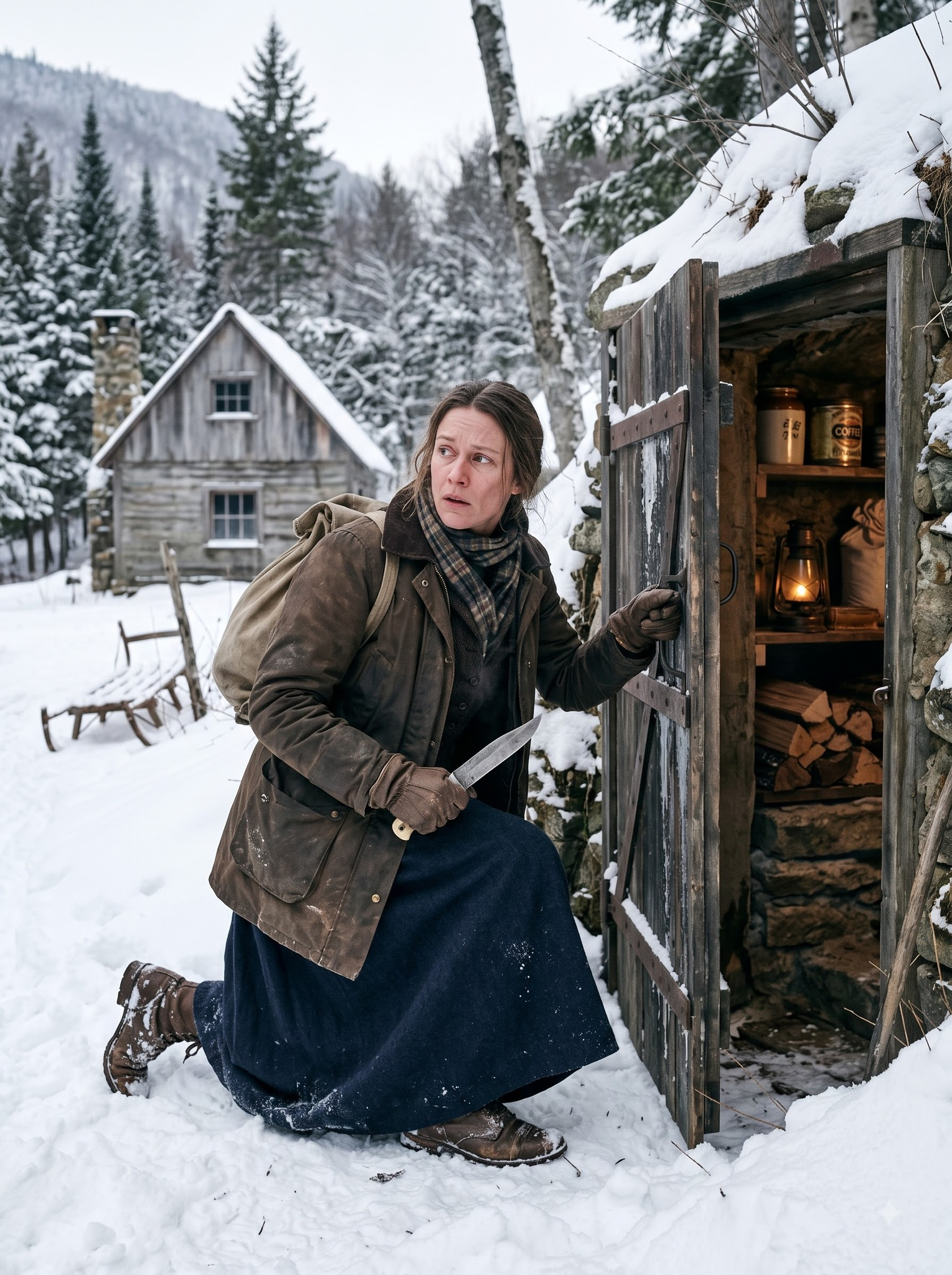
"Clara?"
The voice came again.
I stood at the bottom of the stone staircase, holding my father's knife.
For several seconds, I couldn't move.
Someone was standing outside the hidden shelter.
Someone who knew my name.
I lowered the ledger onto the shelf and moved closer to the wall.
"Clara, I know you're here."
It was a man's voice.
Older than Caleb's.
Deeper than Ezra's.
I tightened my grip on the knife.
"Who are you?" I called.
There was a pause.
Then the man answered.
"My name is Thomas Reed. I'm not here to hurt you."
I didn't believe him.
Not immediately.
I had learned that a man could speak gently while doing something cruel.
Ezra had proved that.
I took another step toward the stairs.
"How do you know my name?"
"I knew your father."
My fingers went cold.
The man continued.
"Silas Danner."
I looked down at the knife.
Then at the ledger.
The initials suddenly seemed less like a mysterious mark and more like a warning.
"How did you find this place?" I asked.
"I've been looking for the entrance for nearly twenty years."
I remained silent.
"Please," he said. "I can explain, but I need you to come outside."
I glanced toward the darkness behind me.
The shelter contained food.
Firewood.
A dry place to sleep.
It might be the only thing standing between me and death.
I wasn't about to leave it simply because a stranger had asked.
"Tell me something only someone who knew my father would know."
Another pause.
Then he answered.
"Your father carried a small brass watch. The glass was cracked near the number seven. He used to say it was the only thing his first wife had ever given him."
My heart tightened.
My father had indeed owned such a watch.
He had kept it in a wooden box beside his bed.
I had seen it countless times as a child.
But that didn't prove this man was telling the truth.
"Why are you looking for the shelter?" I asked.
"Because your father asked me to protect it."
"Protect it from whom?"
The man didn't answer immediately.
Then he said something that made my stomach tighten.
"From Ezra Whitlo."
I stepped back.
The knife slipped slightly in my glove.
Ezra.
Again.
I had known him for three years.
I had watched him eat at our table, work beside Caleb, and argue with Margaret about the farm.
I had never imagined that his name would appear in a conversation about my father's secret.
"Why would my father need protection from Ezra?"
"That's a longer story than we have time for."
"Then start telling it."
The man sighed.
"I can see you're frightened. You have every reason to be. But the storm is getting worse, and you need somewhere warm to sit."
I looked toward the shelves.
There was enough wood for a small fire.
There was food.
And there was the ledger.
I didn't need him.
At least, not yet.
"Go away," I said.
The man remained silent.
Then I heard his boots moving across the snow.
One step.
Another.
He stopped.
"Clara, there's something you should know."
I waited.
"Your father didn't build this shelter to hide from the weather."
I felt my heartbeat quicken.
"Why did he build it?"
"To keep something safe."
"What?"
He answered quietly.
"The original deed to the Whitlo property."
I stared at the staircase.
The deed?
The property Ezra had claimed as his own?
The land he had just thrown me off?
"That's impossible."
"No," Thomas replied. "It's the reason he wants you gone."
Before I could ask another question, the wind swept across the entrance.
Snow fell from the hillside.
The man moved away.
"Stay inside tonight," he called. "Don't open the door for anyone except me."
I took a step toward the stairs.
"How do I know you'll come back?"
"You don't."
His answer surprised me.
Then he added:
"But your father trusted me."
I listened as his footsteps faded.
Eventually, there was only silence.
I stood still for nearly a minute.
Then I returned to the shelf.
The ledger waited where I had left it.
I opened it again.
The first page contained my father's name, the warning about Ezra, and a date written in the upper corner.
October 14, 1887.
I recognized the year.
It was the year my father had disappeared for nearly three months.
He had told me he was working in a neighboring county.
I had been sixteen.
I remembered asking why he had returned with a new coat and a bag of money.
He had said he had been fortunate.
I had believed him.
Children usually believe the explanations their parents give them.
I turned the page.
A list of supplies appeared.
Flour.
Salt.
Beans.
Lamp oil.
Firewood.
Blankets.
The entries had been recorded regularly.
Some dates were separated by several weeks.
Others by months.
This was no temporary hiding place.
Someone had maintained this shelter for years.
I turned another page.
A small drawing showed the hillside entrance.
Beside it was a rough map of the surrounding property.
The farm appeared on the eastern side.
The wooded hill lay to the north.
A narrow line connected the hidden shelter to a marked stone near the old cottonwood fence.
I recognized that fence.
It stood behind the farmhouse.
Caleb and I had repaired it twice.
I leaned closer.
There was another mark.
A small circle around a letter.
C.
I traced it with my finger.
My name began with C.
But that could have been a coincidence.
I turned another page.
The handwriting changed.
It was not my father's.
This writing was smaller and more hurried.
The first sentence read:
"Silas has decided that the girl must know the truth before the Whitlos discover what was recorded."
I read it twice.
The girl.
Me?
I turned the page.
The next section had been torn out.
Only a rough strip remained near the binding.
Someone had deliberately removed it.
I ran my fingers over the damaged edge.
Whoever had done this had not been careless.
The paper had been cut cleanly.
I searched the remaining pages.
There were several more entries, but most concerned supplies, repairs, and measurements.
Then I found a second name.
Margaret Whitlo.
My breath caught.
Caleb's sister.
The woman who had loved me like family.
Her name appeared beside a date from eleven years earlier.
I read the sentence beneath it.
"Margaret has agreed to keep the eastern key until Clara comes of age."
I lowered the book.
Margaret had known about this place.
For eleven years.
She had never told me.
I remembered her hands.
Her gentle voice.
The way she used to sit with me by the kitchen stove and ask about my father.
Once, she had asked whether I still had his hunting knife.
I had said yes.
She had smiled strangely.
I had thought she was remembering something.
Now I wasn't sure.
I checked the shelf again.
Behind the flour sack, I found a small metal container.
It was rectangular, with a hinged lid.
I opened it.
Inside lay three objects.
A brass key.
A folded piece of paper.
And a small photograph.
I picked up the photograph first.
It showed three people standing outside a wooden building.
My father was on the left.
He looked younger than I remembered.
His hair was darker.
His shoulders were straight.
Beside him stood a man I did not recognize.
The third person was Margaret.
She appeared to be in her early twenties.
I turned the photograph over.
Three names were written on the back.
Silas Danner.
Thomas Reed.
Margaret Whitlo.
Below them, in different handwriting, were four words:
"Keep Clara out of it."
I stared at the sentence.
My hands began to shake.
Why would Margaret ask someone to keep me away from this place?
What had she been protecting me from?
I unfolded the paper.
It was a short note.
The handwriting was familiar.
I knew it immediately.
Margaret had written it.
"Silas,
If you are reading this, then the plan has failed. I have kept my promise for as long as I could. Caleb still knows nothing, and Ezra must never learn where the original documents are hidden.
Clara is a good girl. She deserves a life that does not belong to the mistakes of our fathers.
Please do not bring her into this unless there is no other choice.
Margaret."
I read the final sentence again.
The mistakes of our fathers.
My father.
Ezra's father.
What had happened between them?
And why had Margaret believed that Caleb should know nothing?
I sat on the lowest stone step.
For a long time, I couldn't think clearly.
The storm continued outside.
The shelter remained dry.
My stomach reminded me that I had barely eaten since morning.
I opened one of the tins.
Inside were preserved beans.
The lid had been sealed carefully.
I found a small iron pot beside the firewood and examined the old stove built into the wall.
It was simple but functional.
Someone had designed this place to survive winter.
I arranged several pieces of wood and lit a small fire using the matches I had found in the metal container.
The first flame flickered.
Then it grew.
Warmth slowly reached my hands.
I sat beside the stove and ate a little food.
For the first time since Ezra had thrown me out, I could feel my fingers again.
I wrapped the blanket around my shoulders.
Then I looked at the photograph.
Three people.
My father.
Margaret.
Thomas Reed.
And a secret that had apparently survived more than a decade.
I wanted to understand it.
But I also knew that I had to be careful.
Ezra had thrown me out because he believed I had no legal claim to the property.
If my father had hidden the original deed, perhaps Ezra was afraid I would discover it.
But why?
Was the deed really enough to change everything?
I returned to the ledger.
Near the back, several pages had been marked with narrow strips of faded cloth.
I turned to the first marked page.
A series of measurements appeared.
Then a list of names.
Some belonged to people I recognized from the county.
Others were unfamiliar.
One name appeared several times.
Ezra's father, Jonathan Whitlo.
Beside his name was a date.
December 3, 1879.
A note had been written beneath it.
"Payment received. Ownership disputed. Witnesses present."
I leaned closer.
Another sentence followed.
"Silas refused to sign."
The ink was darker here.
The writing had been pressed hard enough to leave marks on the page beneath.
I turned to the next marked section.
There was a small drawing of a farmhouse.
Not the current farmhouse.
An older building.
A boundary line had been drawn around the surrounding fields.
The same property.
The same hillside.
And beneath the drawing, someone had written:
"The Whitlo family holds the land in trust. No transfer can be considered valid without the consent of the original owner or his lawful heir."
I read the sentence slowly.
Then I looked at the first page again.
My father's name.
Silas Danner.
I had never known he had any connection to the Whitlo farm.
My father had lived in a small rented cottage when I was growing up.
He had worked as a carpenter.
He had never spoken about owning farmland.
Yet the ledger suggested something very different.
I closed the book.
My mind was beginning to race.
If my father had been the original owner, then why had the Whitlos lived on the property for so many years?
Why had Ezra believed he controlled everything?
And why had Margaret kept the secret from her own brother?
I needed answers.
But the first thing I needed was proof.
I took the brass key from the metal container.
It was heavier than an ordinary house key.
Its teeth were unusually long.
A small mark had been stamped into the bow.
The same symbol that appeared on the ledger cover.
I examined the walls.
There were several wooden cabinets.
One had a narrow lock.
I tried the key.
It fit.
But before I could turn it, something outside made me stop.
A branch snapped.
I looked toward the stairs.
Then came a second sound.
A boot striking stone.
Someone was climbing toward the entrance.
I stood.
The fire crackled behind me.
I grabbed the ledger and placed it inside my canvas sack.
Then I moved toward the wall beside the staircase.
A shadow appeared at the top.
Someone was standing in the doorway.
I held my breath.
A hand reached down.
It gripped the iron handle.
The door began to move.
Then a voice spoke.
Not Thomas Reed's.
It was a voice I knew better than almost anyone.
"Clara, I know you've found it."
Ezra Whitlo had come to the mountain.
And he was standing outside the hidden door.






Comments 0