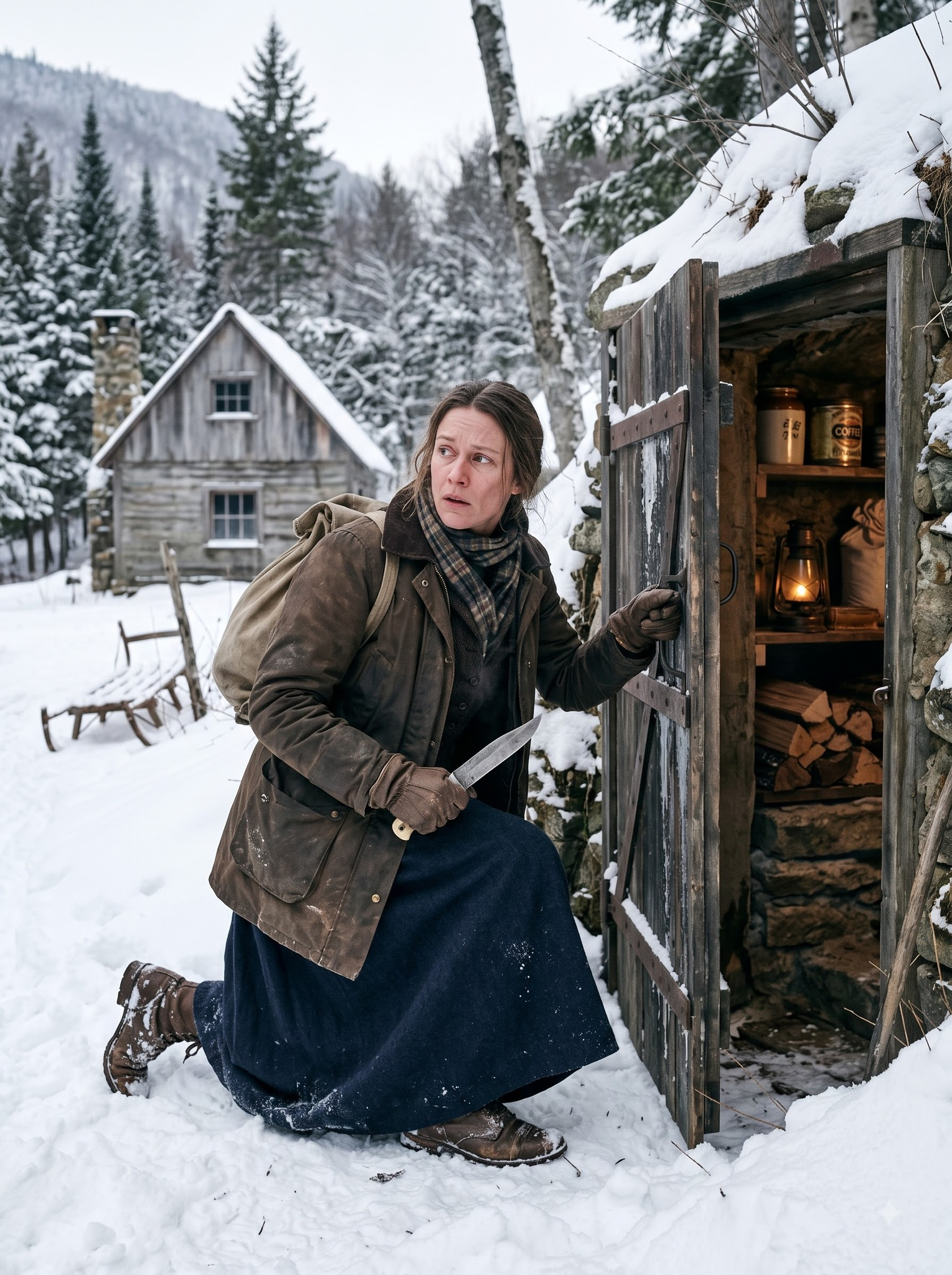
"Clara, I know you've found it."
Ezra Whitlo's voice came through the narrow opening above the stone staircase.
I stood perfectly still.
The fire crackled behind me. My father's ledger was hidden inside my canvas sack, and the old hunting knife rested against my palm.
Only a few hours earlier, Ezra had thrown me out of his farmhouse.
Now he had followed me into the mountain.
And somehow, he knew exactly what I had discovered.
"Come out, Clara."
I didn't answer.
His boots scraped against the frozen stones outside.
"I know you're down there. Don't make this difficult."
I looked toward the wooden cabinet beside the shelf.
The brass key was still in its lock.
I had been seconds away from opening it when Ezra arrived.
Whatever was inside might explain why my father's name appeared in the ledger.
But I couldn't investigate while Ezra stood at the entrance.
"Why are you here?" I finally asked.
There was a pause.
Then he laughed.
Not loudly.
Just enough to let me know he wasn't frightened.
"Why do you think? You wandered onto private property."
I almost laughed myself.
Private property.
That was all he seemed capable of saying.
"Your property?" I asked.
"Of course."
"Then why didn't you tell me about this place?"
The silence that followed was longer than I expected.
I heard him shift his weight.
"Tell you about what?"
"The shelter."
"Clara, you've been walking through a snowstorm for hours. You're cold. You're exhausted. I think you're confused."
His voice had changed.
He sounded almost concerned.
It was the same tone he had used when Margaret became too sick to leave her bed.
He had told her she was confused about the farm accounts.
He had told Caleb that her memory was failing.
At the time, I had believed him.
Now I wondered how many times Ezra had used that gentle voice to make someone doubt what they knew.
"I'm not confused," I said.
"Then come upstairs."
"Why?"
"Because I'm trying to help you."
I looked toward the fire.
Warmth had finally begun reaching the stone walls.
There was enough wood to last the night.
Food sat on the shelf.
My blanket was dry.
For the first time that day, I had shelter.
And Ezra wanted me to abandon it.
"You told me to leave," I said.
"That was before the storm became dangerous."
"The storm was already dangerous."
"Don't argue with me."
There it was.
The impatience.
The sharpness beneath his carefully chosen words.
I moved closer to the cabinet.
My hand found the brass key.
I turned it slowly.
A faint metallic click sounded.
Above me, Ezra stopped moving.
"What was that?"
"Nothing."
"Clara."
I opened the cabinet door.
Inside was a narrow wooden compartment lined with dark cloth.
I could barely see its contents.
A bundle of papers lay beneath a small leather pouch.
There was also a rectangular wooden box with a brass clasp.
I reached for the papers.
"Clara, answer me."
I slipped the bundle beneath my coat.
Then I closed the cabinet.
"I'm listening."
"You need to come out."
"Why?"
His next words were quiet.
"Because you have no idea what you're standing in."
I looked around the shelter.
Stone walls.
Old shelves.
A stove.
A place built carefully enough to survive decades.
"What am I standing in, Ezra?"
He didn't answer.
Instead, I heard the heavy door move.
The hinges groaned.
A strip of daylight narrowed across the stairs.
He was closing it.
"Ezra?"
The door moved another inch.
My heart began pounding.
"Don't close that door."
"You should have stayed on the road."
I hurried toward the staircase.
My damaged boot caught against the bottom step.
I stumbled, caught myself, and looked upward.
The opening was now barely wide enough for a person to pass through.
"Ezra!"
He stopped.
For one terrible second, I thought he was going to seal me inside.
Then he spoke.
"Did you find any papers?"
I froze.
He wasn't asking about food.
Or blankets.
Or whether I was injured.
He wanted papers.
"What papers?"
"Don't play games with me."
"I don't know what you're talking about."
His breathing grew louder.
"There's an old book down there. A ledger. It doesn't belong to you."
I felt the canvas sack against my hip.
The ledger was inside.
My father's name was written on its first page.
And Ezra knew it existed.
"How do you know about the ledger?"
Another pause.
"Because my family owns this land."
"That isn't an answer."
"Give me the book."
I said nothing.
"Clara, listen carefully. Whatever you've found down there is old business. It has nothing to do with you."
I remembered the warning written in my father's handwriting.
If Clara Danner ever finds this place, she must never allow Ezra Whitlo to see what is written on the next page.
Nothing to do with me.
That was an interesting choice of words.
"Then why do you want it?"
"Because it belongs to my family."
"Does it?"
His voice hardened.
"Don't test me."
I looked toward the papers beneath my coat.
I didn't know what they contained.
But Ezra's desperation told me they mattered.
"I haven't found anything worth giving you," I said.
"You're lying."
The accusation came so quickly that I knew he had been waiting to say it.
I took a slow breath.
"Then come down and look."
I regretted the words almost immediately.
Ezra could easily overpower me.
He was taller, heavier, and far less exhausted.
But I had noticed something.
He hadn't entered the shelter.
He had remained outside, speaking through the opening.
Perhaps the stairs were too narrow.
Perhaps he feared the old structure.
Or perhaps there was something inside he didn't want to face.
"No," he said.
The answer was immediate.
I looked upward.
"Why not?"
"Because I'm not crawling into some filthy hole after you."
But his voice lacked conviction.
I glanced at the wooden box inside the cabinet.
Something told me Ezra knew more about this place than he was willing to admit.
"Then leave me alone."
"Give me the ledger."
"I told you I don't have it."
He struck the door with his fist.
The sound echoed down the staircase.
I flinched before I could stop myself.
"Don't lie to me, Clara!"
For the first time, I heard genuine fear beneath his anger.
Not fear of me.
Fear of something I might discover.
I pressed my back against the stone wall.
My fingers tightened around the knife.
Then I remembered something Thomas Reed had said.
Your father didn't build this shelter to hide from the weather.
He built it to keep something safe.
The original deed to the Whitlo property.
I looked toward the cabinet again.
Could the deed be inside?
Had my father hidden proof that the land belonged to someone else?
And if so, why had Ezra waited until now to force me out?
A sudden gust pushed snow through the opening.
Ezra cursed.
Then I heard another sound.
A horse.
Its hooves struck frozen ground somewhere beyond the entrance.
Ezra had ridden here.
Of course he had.
He had a horse, a warm coat, and the security of a farmhouse.
I had been forced to walk twelve miles through a blizzard.
The unfairness of it struck me so sharply that I almost spoke.
But anger would not help me.
I needed to think.
"Ezra," I said quietly.
"What?"
"If I give you what you want, will you let me stay here tonight?"
He hesitated.
I could almost hear him calculating.
"Perhaps."
"That's not an answer."
"You can stay until morning."
"And then?"
"You leave the property."
I looked down at my damaged boot.
My skirt was still wet.
My knee throbbed from the fall.
I would not survive another night outside.
But Ezra was offering me nothing.
He wanted the ledger.
Once he had it, he could close the door and ride away.
"How do I know you'll keep your word?"
"Because I'm giving it."
I almost smiled.
Not because anything was funny.
Because I finally understood how little his promises were worth.
"You gave Caleb your word that I would always have a home."
Silence.
Then he said, "Caleb is dead."
The words struck harder than I expected.
For a moment, I saw my husband lying in bed.
His skin hot with fever.
His hands trembling.
His eyes searching mine.
I remembered the last morning he had been able to speak clearly.
He had asked whether Ezra had returned from town.
I had told him no.
Caleb had looked frightened.
At the time, I thought he was afraid of dying.
Now I wondered whether he had been afraid of something else.
"Did Caleb know about this shelter?" I asked.
Ezra didn't answer.
"Ezra?"
"Give me the book."
"Did he know?"
"Stop asking questions."
I stared toward the opening.
That was answer enough.
A strange calm settled over me.
I had spent six months mourning Caleb.
Six months believing his death had left me alone in the world.
Now I was standing inside a hidden room built by my father, holding papers that Ezra desperately wanted.
I had no idea what the truth was.
But for the first time, I understood that I might not be as powerless as Ezra believed.
"I'll bring you the book," I said.
His breathing changed.
"Good."
"But you have to open the door."
"It's open."
"Not enough."
I heard him shift outside.
The hinges groaned.
A wider strip of gray daylight appeared.
"Now come up."
I looked around the shelter.
I needed time.
I needed a way to protect the papers.
And I needed to know whether Ezra had come alone.
I moved toward the shelf.
There was an empty flour sack folded beneath the tins.
I opened my canvas bag and removed the ledger.
Its leather cover felt cold.
I looked at the first page one last time.
Silas Danner.
My father.
Then I slipped the ledger into the flour sack and placed it behind the stacked firewood.
I took the small wooden box from the cabinet.
It was roughly the same size as the ledger.
I wrapped it in the oilcloth that had protected the book.
From a distance, it might pass for the object Ezra wanted.
I tucked the bundle beneath my arm.
Then I started climbing.
Every step sent pain through my knee.
The stone staircase was narrow.
The walls smelled of damp earth.
At the top, I could see Ezra standing several feet away.
His dark wool coat was covered in snow.
His beard had collected ice.
He held the reins of a brown horse.
His expression changed when he saw the bundle.
"There it is."
I stopped on the second-to-last step.
"Promise me I can stay."
"Give it here."
"Promise."
His jaw tightened.
"Fine. You can stay until morning."
I looked directly at him.
"And you won't close the door?"
"Clara, for heaven's sake."
"Say it."
He stared at me.
Then he spoke through clenched teeth.
"I won't close the door."
I stepped onto the snow.
The cold struck my face immediately.
Ezra extended his hand.
I gave him the wrapped box.
He pulled away the oilcloth.
For a moment, he looked confused.
Then he opened the brass clasp.
Inside were several small metal tools and a folded piece of cloth.
His face darkened.
"What is this?"
I took a step backward.
"I found it in the cabinet."
"Where's the ledger?"
"I told you I didn't have it."
He looked at the box again.
Then at me.
His expression changed.
The anger disappeared.
In its place came something colder.
"You think you're clever."
I said nothing.
He took a step toward me.
I moved backward.
Snow crunched beneath my boots.
"Do you know what happens to women who wander around making accusations they can't prove?" he asked.
I stared at him.
"I haven't accused you of anything."
"Not yet."
The words settled between us.
I realized he wasn't simply angry about the ledger.
He was afraid I would speak to someone.
Perhaps Thomas Reed.
Perhaps a judge.
Perhaps anyone willing to listen.
"Why did you come looking for me?" I asked.
He glanced toward the trees.
"Because I saw your tracks."
"All the way from the farmhouse?"
"Yes."
"Through the storm?"
His eyes narrowed.
"What are you suggesting?"
I looked toward the horse.
Its saddle was dry beneath a heavy blanket.
The animal had not been ridden far.
There were no long stretches of ice on its legs.
Ezra hadn't followed my tracks for hours.
He had come directly to the hillside.
He already knew where the shelter was.
"You knew about this place," I said.
His expression did not change.
But his fingers tightened around the reins.
"Of course I knew there were old storage holes in these hills."
"Then why didn't you tell me?"
"Because they aren't safe."
"This one has food and firewood."
"Old supplies."
"Someone maintained them."
He looked away.
I remembered the photograph.
My father.
Thomas Reed.
Margaret.
Three people standing together.
And the words on the back.
Keep Clara out of it.
"Did Margaret know?" I asked.
Ezra's head turned sharply.
"What?"
"About the shelter."
He stared at me.
Then he said, "Margaret had a habit of involving herself in things that weren't her concern."
I felt something tighten in my chest.
Margaret had loved me.
She had cared for Caleb.
She had spent her final months in pain, still worrying about whether everyone else had enough to eat.
Hearing Ezra speak of her that way made me angrier than anything he had said about me.
"She was your sister."
"I know who she was."
"She was kind."
His mouth twisted.
"Kindness doesn't make a person wise."
I thought of the note she had written to my father.
She had known something.
Something Ezra wanted buried.
"Did she leave you anything before she died?" I asked.
He looked startled.
"Why?"
"She gave me a little sewing box. I wondered whether she left you something too."
His eyes moved toward my canvas sack.
"What sewing box?"
I hadn't meant to reveal that much.
The box was still at the farmhouse, in the small room Caleb and I had shared.
It contained needles, thread, scraps of cloth, and a few buttons.
At least, that was what I believed.
But Ezra's reaction made me wonder whether Margaret had hidden something inside it.
"Nothing important," I said.
He stepped closer.
"Where is it?"
"At the house."
"Where?"
"In my room."
His expression tightened.
Then he turned toward his horse.
I watched him place the wooden box inside a saddlebag.
He moved quickly now.
Too quickly.
"You're leaving?" I asked.
He climbed into the saddle.
"Stay here tonight."
I didn't trust the sudden change.
"What about the ledger?"
He looked down at me.
"Forget the ledger."
I almost couldn't believe what I was hearing.
Minutes earlier, he had been willing to close the shelter door with me inside.
Now he was telling me to forget the very object he had demanded.
He gathered the reins.
"Tomorrow morning, you leave this property."
I didn't answer.
He turned the horse toward the trees.
Then he stopped.
"One more thing, Clara."
I looked up.
"If anyone asks what you found here, tell them it was an empty cellar."
"Why?"
"Because people who dig into old family business usually regret it."
He didn't wait for my response.
The horse moved away.
Within moments, the falling snow began swallowing his tracks.
I remained standing beside the entrance.
My hands trembled.
Not from fear alone.
From the realization that Ezra had known about the shelter all along.
And that the mention of Margaret's sewing box had frightened him more than the ledger.
I returned inside.
The warmth from the stove met me at the bottom of the stairs.
I closed the door enough to keep out the worst of the wind, leaving it unlatched.
Then I retrieved the ledger from behind the firewood.
I placed it on the shelf.
My fingers moved across the cover.
Silas Danner.
Thomas Reed.
Margaret Whitlo.
Caleb Whitlo.
Ezra Whitlo.
Five names.
One farm.
And a secret that had apparently been waiting for years.
I opened the bundle of papers I had taken from the cabinet.
There were four documents.
The first was a survey map.
The second appeared to be a handwritten agreement.
The third was a list of payments.
The fourth was folded several times and sealed with a piece of dark red wax.
I examined the survey map.
It showed the Whitlo farm, the surrounding woods, and the hillside where I stood.
A boundary line ran through the eastern field.
Beside the farmhouse was a handwritten note.
"Original homestead parcel. Danner claim."
I stared at the words.
Danner.
My father's surname.
I unfolded the agreement.
The writing was difficult to read.
The paper had yellowed.
But several sentences remained clear.
The document described a temporary arrangement between Silas Danner and Jonathan Whitlo.
My father had allowed Jonathan Whitlo to occupy and maintain the farmhouse while a dispute over the land was being settled.
In return, Jonathan had agreed to preserve the property and make regular payments.
I read the agreement twice.
Then a third time.
It did not describe a sale.
It described an arrangement.
A temporary arrangement.
I looked toward the stove.
Ezra had told me that his family owned the land.
He had said Caleb inherited his share.
He had insisted that because our marriage papers were never registered, I had no claim to the farmhouse.
But what if the Whitlos had never owned the land outright?
What if the property had belonged to my father?
And what if Ezra knew it?
I reached for the payment list.
Several entries had been crossed out.
Others were marked with initials.
Near the bottom, one sentence had been underlined.
"All payments suspended pending resolution of the missing deed."
I felt my heartbeat quicken.
The missing deed.
Thomas Reed had mentioned it.
The original deed to the Whitlo property.
I unfolded the final document.
The red wax seal had already been broken.
Inside was a short letter.
The handwriting belonged to Margaret.
I recognized the careful way she formed her capital letters.
"Silas,
I am afraid Jonathan has decided not to honor the agreement. He believes the county records can be changed if the right people are persuaded.
Thomas says you must keep the original deed somewhere safe.
Do not trust the copy at the courthouse.
And please, for Clara's sake, do not tell Jonathan that you intend to return.
Margaret."
I lowered the letter.
My father had intended to return.
To this land.
To this farmhouse.
But he never had.
He had died twelve years earlier.
I had been told it was an accident.
A fall from a wagon while traveling between towns.
There had been no investigation.
No questions.
Only a coffin and a few belongings delivered to our rented cottage.
Among them had been the hunting knife.
I looked at it now.
The initials on the handle seemed different.
Not because they had changed.
Because I finally understood what they meant.
S. D.
Silas Danner.
My father had carved his own initials into the bone.
He hadn't given me an ordinary hunting knife.
He had given me something connected to this place.
But why?
I turned the knife over.
The handle was worn smooth from years of use.
Near the base, a thin dark line ran around the bone.
I had always assumed it was a natural crack.
Now I examined it more closely.
The line was too straight.
It formed a complete circle around the handle.
I held the knife near the firelight.
There was a tiny metal pin beside the initials.
I pressed it with my thumbnail.
Nothing happened.
I tried again.
The pin moved.
A faint click came from inside the handle.
I stopped breathing.
The bone grip shifted slightly.
I pulled gently.
A small section of the handle slid away.
Inside was a narrow hollow space.
And within it lay a tightly rolled strip of paper.
For several seconds, I could only stare.
My father had hidden something inside the knife.
Something I had carried for twelve years without knowing it existed.
I carefully removed the paper.
It was thin and brittle.
I unrolled it on the shelf.
There were only two lines.
The first contained a series of numbers.
The second contained a short instruction.
"Where the eastern wall meets the floor, count seven stones from the old stove."
I looked toward the stove.
Then toward the eastern wall.
My pulse quickened.
I counted the stones along the base.
One.
Two.
Three.
Four.
Five.
Six.
Seven.
The seventh stone looked no different from the others.
It was dark gray, roughly square, and fitted tightly between two larger blocks.
I knelt beside it.
My injured knee protested.
I ignored the pain.
I pressed against the stone.
Nothing.
I ran my fingers along its edges.
There was a narrow gap near the bottom.
I slipped the tip of the hunting knife into it.
The stone shifted.
I pulled carefully.
A small cloud of dust fell from the wall.
Then the stone came free.
Behind it was a hollow compartment.
I leaned closer.
Something metallic caught the firelight.
A small iron ring.
I reached inside.
The ring was attached to a flat wooden panel.
I pulled.
The panel moved toward me.
Behind it was a narrow passage.
Not large enough to stand in.
But wide enough for a person to crawl through.
I stared into the darkness.
The passage extended beyond the shelter wall.
I couldn't see where it ended.
My father had built a hidden compartment inside a hidden shelter.
And he had concealed the instructions inside the knife he gave me when I was sixteen.
I sat back on my heels.
My thoughts raced.
Had he expected me to find this place?
Had he known I would one day marry Caleb?
Had Margaret known about the knife?
And why had Thomas Reed waited so long to tell me the truth?
I looked toward the staircase.
The shelter door remained partly open.
Outside, the storm continued.
Ezra was gone.
At least, I hoped he was.
I returned to the shelf and found a small oil lamp.
There was still a little fuel inside.
I lit it from the stove.
The flame flickered.
I held the lamp toward the narrow passage.
Rough stone walls disappeared into darkness.
The floor sloped gently downward.
I could smell dry earth.
And something else.
Old paper.
I placed the lamp on the ground.
Then I wrapped the ledger in cloth and secured it inside my sack.
I wasn't leaving it behind again.
I took a slow breath.
My body was exhausted.
My knee hurt.
My hands were still sore from the cold.
But I couldn't stop now.
I lowered myself onto my hands and knees.
The passage was narrow.
My coat scraped against the stone.
The lamp cast long shadows ahead of me.
I crawled forward.
Five feet.
Ten.
Fifteen.
The air became cooler.
Then the passage widened slightly.
I could sit upright.
Ahead of me stood another wooden door.
This one was smaller.
Its surface was smooth beneath the dust.
A brass plate had been fastened near the handle.
I brought the lamp closer.
Words were engraved into the metal.
I brushed away the dirt.
Then I read them.
"For Clara, when the truth can no longer be hidden."
My father's words.
My name.
I reached for the handle.
Before I touched it, I noticed something else.
A thin line of light appeared beneath the door.
I stared.
The passage behind me was dark.
The shelter contained only one small fire.
There should have been no light beyond this door.
Then I heard a sound.
A chair scraping against stone.
Someone was moving on the other side.
I slowly raised the lamp.
A shadow passed beneath the door.
Then a woman's voice whispered my name.
"Clara Danner."
My blood turned cold.
The voice was familiar.
Impossible.
I had heard it every day during the final months of her life.
Margaret Whitlo.
The woman I had helped bury.
I reached toward the brass handle.
Before my fingers touched it, the lock clicked.
The handle turned from the other side.
And the door began to open.






Comments 0