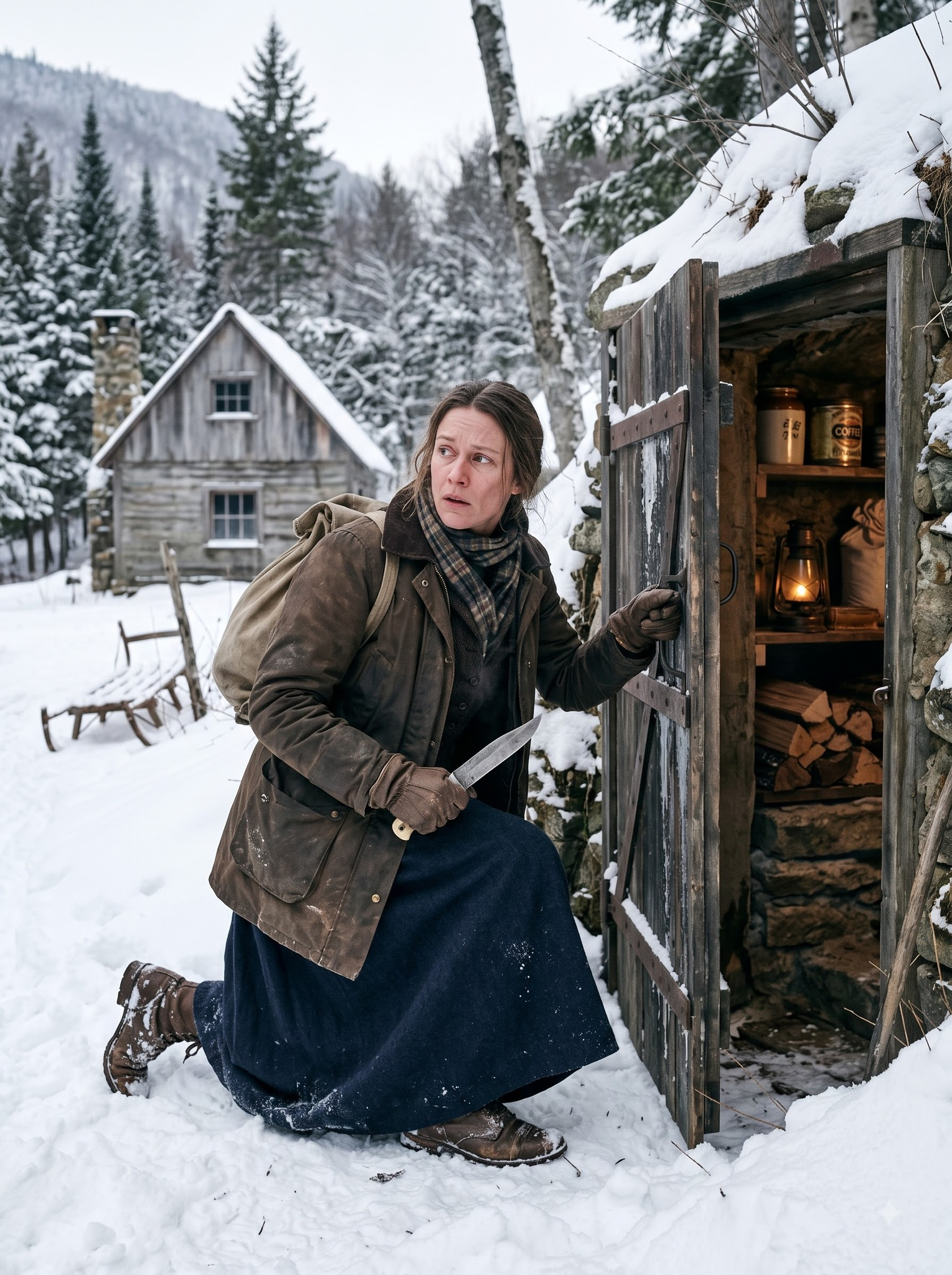
The stone door opened with a long, grinding sound.
Ezra Whitlo stood behind me with his revolver raised.
And on the other side of the doorway, a man was waiting.
He sat in a wooden chair beside a small iron stove. A wool blanket covered his knees. His hair had turned almost entirely white, and his face was thinner than the one I remembered.
But I knew his eyes.
I knew the way he held his shoulders.
And I knew the scar across his left hand, where a saw had slipped when I was eleven.
My father's scar.
"Clara," he whispered.
The hunting knife fell from my fingers.
"Papa?"
Silas Danner tried to stand.
His right leg trembled beneath him.
He gripped the chair for support.
Then he opened his arms.
I ran to him.
For twelve years, I had imagined seeing my father again.
Sometimes I dreamed he would walk through our cottage door carrying his carpenter's tools.
Sometimes I imagined him standing beside the road, smiling as though he had merely been away on business.
But I had never imagined this.
A hidden room beneath a mountain.
A dying fire.
A man who had survived twelve years of fear, injury, and silence.
I fell into his arms.
He held me so tightly that I could barely breathe.
"My girl," he whispered. "My brave girl."
I began to cry.
I cried for the sixteen-year-old who had stood beside an empty grave.
I cried for the years I had spent believing he had abandoned the world without saying goodbye.
I cried for Caleb.
For Margaret.
For the child I had been.
And for the woman I had become without him.
My father pressed his cheek against my hair.
"I'm sorry," he whispered.
I shook my head.
"You're alive."
"Yes."
"You're really alive."
He nodded.
I pulled away and touched his face.
His skin was warm.
His eyes filled with tears.
"Why didn't you come home?"
His expression changed.
Before he could answer, Ezra stepped into the doorway.
"That's enough."
I turned.
The revolver was still pointed toward us.
My father moved in front of me.
"Put it down, Ezra."
Ezra laughed bitterly.
"You've been giving orders from beneath this mountain for long enough."
My father looked at him.
"Your father is dead. You don't have to keep living his life."
Ezra's face tightened.
"Don't speak about my father."
Silas sighed.
"Jonathan used you."
"He gave me everything."
"He gave you his debts, his lies, and his fear of being discovered."
Ezra stepped closer.
"And he gave me the farm."
My father shook his head.
"No. He stole it from my family."
Ezra raised the revolver higher.
"That land belongs to me."
I stepped beside my father.
"No, Ezra. It doesn't."
He looked at me with hatred.
"You were nothing when Caleb brought you into that house."
I held his gaze.
"I was his wife."
"You were a burden."
"I worked that land. I cared for your brother. I cared for Margaret when she was dying. I kept your father's house standing while you spent your days counting money you hadn't earned."
His face reddened.
"Be quiet."
I took another step.
"You threw me into the snow because you were afraid."
Ezra's hand trembled.
"Afraid of you?"
"Afraid of what I might find."
For a moment, he said nothing.
Then he smiled.
"You still don't know what happened to Caleb."
My chest tightened.
My father touched my arm.
"Clara."
I looked at him.
He nodded toward the wooden table.
A thick book lay beside a sealed envelope.
"The final record," he said.
Ezra moved toward it.
"Don't touch that."
My father spoke calmly.
"It's too late."
Ezra frowned.
"What?"
Silas looked at him.
"The copies have already gone."
Ezra stopped.
"What copies?"
"The records of your father's payments. The forged deeds. The false death certificates. The medicine orders."
Ezra's face changed.
My father continued.
"I sent them to a lawyer outside the county months ago."
I stared at him.
"You did?"
He nodded.
"Caleb helped me."
My breath caught.
"Caleb?"
My father looked at me with sadness.
"Your husband found me before he died."
I could barely speak.
"He knew you were alive?"
"Yes."
I looked down.
For a moment, the room seemed to tilt.
Caleb had known.
He had found my father.
And he had never told me.
My father seemed to understand.
"He wanted to tell you, Clara. But he was afraid Ezra would use you to find this place."
I swallowed.
"Why didn't he trust me?"
"He trusted you more than anyone. He didn't trust the men watching you."
I looked toward Ezra.
He had gone very still.
My father continued.
"Caleb discovered that Jonathan had forged the land transfer. He found the records of Anna's disappearance. And he learned that Ezra had been helping Price keep the truth buried."
I felt my heart pounding.
"Then why did Caleb die?"
My father looked toward the sealed envelope.
"Because he confronted Ezra."
Ezra raised the revolver.
"That's a lie."
Silas shook his head.
"No. The lie is over."
I reached for the envelope.
Ezra shouted.
"Don't!"
But I had already broken the seal.
Inside was a letter written in Caleb's handwriting.
My hands began to shake.
I unfolded it.
"My dearest Clara,
If you are reading this, then I have failed to come home and tell you everything myself.
I found your father.
He is alive.
I wanted to bring him to you, but he begged me to wait until we had enough evidence to protect you both.
I have discovered that Ezra ordered medicine from Dr. Price.
The medicine was not intended to cure me.
I found the receipt in his desk.
I confronted him, and he admitted that he wanted me out of the way because I would never let him take your land.
I am keeping a copy of the receipt and a sample of the medicine.
If anything happens to me, Thomas Reed knows where to find them.
Please remember that I loved you.
I never wanted the farm for myself.
I wanted it to be yours.
Caleb."
The paper blurred.
I pressed it against my chest.
For six months, I had wondered whether I could have saved my husband.
Whether I should have called another doctor.
Whether I should have refused the medicine Ezra brought.
Whether I had somehow failed the man who loved me.
Now I knew Caleb had been trying to save me.
Even while he was dying.
I looked toward Ezra.
"You killed him."
Ezra shook his head.
"No."
"You ordered the medicine."
"I ordered what Price told me to order."
"You knew it would hurt him."
Ezra's face twisted.
"He wasn't supposed to die."
The words hung in the cold room.
My father closed his eyes.
I stared at Ezra.
"What?"
He looked toward the floor.
"He was supposed to become weak. Too weak to interfere."
My heart pounded.
"And then?"
Ezra swallowed.
"Price said he would recover once I stopped giving it to him."
I felt sick.
"You gave him poison."
Ezra looked up.
"I didn't know it would kill him."
My voice trembled.
"You watched him suffer."
He said nothing.
"You watched me sit beside his bed."
His expression changed.
"Clara—"
"You watched me bury him."
I could barely breathe.
"And then you threw me out of the house he wanted me to keep."
Ezra lowered his eyes.
For the first time, he looked smaller than the man who had stood over me in the snow.
But I felt no pity.
My father stepped forward.
"Price prepared the medicine. Ezra paid him. Caleb discovered the scheme and wrote his statement before he died."
I looked toward the book.
"Is there proof?"
Silas nodded.
"Receipts. Correspondence. Caleb's signed account. And the remaining medicine."
I remembered the blue bottle.
The second preparation.
The note on the back of the receipt.
My father continued.
"Caleb hid the first bottle. Thomas recovered it after his death. A physician outside the county examined the contents and wrote a report. The substances he identified could cause severe illness, and repeated doses could be fatal."
I closed my eyes.
The cup.
The bitter smell.
Caleb turning his face away.
I had given him the medicine because I believed it would help.
My father touched my shoulder.
"Clara, you didn't know."
I looked at him.
"He trusted me."
"And you cared for him."
Tears ran down my face.
"He died because I gave it to him."
My father shook his head firmly.
"No. He died because men deliberately deceived you both. The responsibility belongs to them."
I looked at Caleb's letter.
The words were still there.
Please remember that I loved you.
I pressed the paper against my heart.
Then Ezra moved.
He lunged toward the table.
My father shouted.
"Clara!"
Ezra seized the thick record book.
He threw it toward the stove.
I moved without thinking.
I caught the book before it reached the fire.
Ezra raised his revolver.
I dropped to my knees.
The shot struck the stone wall above me.
Dust fell from the ceiling.
My father grabbed Ezra's arm.
The two men struggled.
Ezra was younger and stronger.
But Silas held on.
"Run, Clara!"
I looked toward the doorway.
Then toward my father's knife lying on the floor.
I grabbed it.
Ezra struck my father across the face.
Silas stumbled.
The revolver swung toward him.
I lunged forward.
Not at Ezra.
At the leather strap holding the old iron lamp above the table.
I cut it.
The lamp fell.
Hot oil splashed across the floor.
Ezra jumped backward.
His foot slipped.
The revolver struck the stone.
It fired once.
The sound echoed through the chamber.
Then the gun slid beneath the table.
My father fell against the chair.
I rushed to him.
"Papa!"
He gripped my hand.
"I'm all right."
I looked toward Ezra.
He was crawling toward the revolver.
I seized the heavy iron poker beside the stove.
"Don't."
He stopped.
I held the poker with both hands.
My voice was steady now.
"Move away from the gun."
Ezra stared at me.
For a moment, I thought he would attack.
Then footsteps echoed from the passage.
A man's voice shouted.
"Clara!"
I turned.
Daniel appeared in the doorway.
Behind him stood Samuel Hart.
And behind Samuel came Deputy Harlan.
The deputy held his revolver.
"Ezra Whitlo," he said, "step away from the weapon."
Ezra stared at him.
"Harlan?"
The deputy's expression was hard.
"Do as I say."
Ezra looked toward Daniel.
Then toward me.
He seemed to understand that he had run out of places to hide.
Slowly, he raised his hands.
Harlan crossed the room and took the revolver.
Then he fastened iron cuffs around Ezra's wrists.
I watched in silence.
The man who had thrown me into the snow was finally powerless to hurt me.
But the truth was not finished.
We left the mountain before noon.
Daniel helped my father walk.
Samuel carried the records.
Deputy Harlan led Ezra through the passage.
I carried Caleb's letter, my father's watch, and the original deed.
When we reached the hidden shelter, Eleanor was waiting beside the stove.
She had come with Amos and a man from the northern farmhouse.
Amos's shoulder had been treated, and although he looked exhausted, he was alive.
Eleanor saw my father.
For a moment, she simply stared.
Then she crossed the room.
"Silas."
He smiled faintly.
"Eleanor."
She embraced him.
I looked toward Daniel.
He was watching them with tears in his eyes.
My father turned toward him.
"Daniel?"
My brother nodded.
"Yes, Papa."
Silas reached for him.
Daniel stepped into his arms.
I stood beside them, crying again.
The family Jonathan had scattered was finding its way back together.
Not all at once.
Not without pain.
But together.
My father looked at me.
"Where's Anna?"
I smiled through my tears.
"She's alive. She's with Thomas."
His face changed.
For a moment, he couldn't speak.
Then he whispered, "Anna."
I took his hand.
"She'll be waiting for us."
We reached Briar Glen late that afternoon.
Samuel had sent a rider ahead.
By the time we arrived, a physician was waiting to examine my father, Amos, and Thomas.
Thomas had survived the journey.
His wound was serious, but the doctor believed he would recover.
My mother was standing outside the physician's house when we arrived.
She saw my father step down from the wagon.
Then she stopped moving.
For a long moment, they stared at each other.
Twelve years had passed since they last stood together.
Twenty-two years had passed since Jonathan first separated them.
My father took one step.
"Anna."
My mother covered her mouth.
Then she ran to him.
He caught her in his arms.
They held each other without speaking.
I stood beside Daniel.
He slipped his hand into mine.
Neither of us said anything.
We simply watched.
For the first time in my life, I saw my parents together.
Not in a photograph.
Not in a story.
Not in a dream.
But standing beneath the pale winter sky.
Alive.
My father kissed my mother's forehead.
She touched his face.
Then she began to laugh through her tears.
"You stubborn man."
He smiled.
"You always said I'd come back."
She shook her head.
"I said you ought to."
He laughed softly.
And for a moment, the years seemed to loosen their grip on all of us.
The next morning, we went to the church in Briar Glen.
The minister was an elderly man named Reverend Collins.
He listened carefully while Samuel explained why we needed the original register.
Then he brought out a large leather-bound book.
The pages smelled of dust and old paper.
He opened it to April 12, 1878.
I leaned closer.
There was the entry.
A marriage recorded between Jonathan Whitlo and a woman named Beatrice Hale.
Ezra's mother.
Below it was a note showing that Beatrice had died several years later.
On another page was Jonathan's later marriage to Eleanor Vale.
But the record carried a correction.
The marriage had been declared invalid after evidence emerged that Jonathan had concealed an earlier marriage which had not been legally dissolved when he first married Eleanor.
Reverend Collins pointed to the next entry.
Eleanor had later married a man named Andrew Mercer.
I stared at the name.
"Mercer?"
Daniel looked up.
The same surname as the couple who had raised him.
Eleanor nodded.
"Andrew was Caleb's father."
I looked at her.
"And Margaret's?"
She shook her head.
"Margaret was Jonathan's daughter. Caleb was born after I left Jonathan and married Andrew."
I felt the final piece settle into place.
Caleb and Ezra had been raised as brothers.
But they were not brothers by blood.
Margaret was their half-sister through Eleanor and Jonathan.
And Caleb had no blood connection to my father.
The rumor that Silas had fathered Caleb had been another weapon Jonathan used to confuse and frighten the people around him.
Eleanor touched my arm.
"Your marriage to Caleb was valid, Clara. There was never any blood relationship between you."
I closed my eyes.
For months, every discovery had seemed to threaten the memories I cherished.
Now, at last, one truth had been restored.
Caleb had been my husband.
And our love had been exactly what I remembered.
Reverend Collins turned another page.
There was my marriage entry.
Clara Danner.
Caleb Whitlo.
Signed by the minister who had performed our ceremony.
Witnessed by Margaret Whitlo.
And properly recorded.
Ezra's claim that our marriage had never been registered was false.
I stared at the page.
Then I began to smile.
"Caleb made sure."
Eleanor nodded.
"He knew Ezra might challenge you. He checked the register himself."
I touched the edge of the page.
My husband had protected me in ways I had never known.
Even after his death, his care remained.
The legal proceedings began within the week.
They were not simple.
Ezra's family had controlled the county for years.
Several officials had accepted Jonathan's money.
Records had been altered.
Witnesses had been threatened.
But this time, the evidence was too strong to bury.
The lawyer my father had contacted arrived from the state capital.
His name was Edward Finch.
He brought copies of the documents Silas had sent him.
He also brought sworn statements from a physician who had examined Caleb's medicine.
The original deed was compared with the forged courthouse transfer.
The handwriting did not match.
The payment records showed no evidence that Jonathan had ever paid Silas the six hundred dollars claimed in the forged document.
Eleanor and Amos testified about the original agreement.
Thomas testified about the night Silas was taken.
He admitted that he had accepted money to drive the wagon.
He admitted that he had signed a false statement.
He also explained how he had helped Silas escape and why he had spent years protecting the hidden shelter.
His confession did not erase what he had done.
But it helped establish the truth.
Amos's earlier written statement confirmed his testimony.
The records from the mill showed payments to Judge Bell, the county clerk, and several other men.
The investigation spread beyond Ezra.
Judge Bell was arrested.
Harlan's brother was removed from the county office and charged in connection with the falsified records.
Dr. Nathaniel Price was captured three days later while attempting to cross the northern border.
He had carried a bag of money and several forged identity papers.
His letters to Jonathan and Ezra were entered into evidence.
So were Caleb's medicine receipts.
And the surviving bottles.
The physician testified that the preparations contained substances capable of causing severe illness and death when repeatedly administered.
Price had prepared them.
Ezra had ordered and delivered them.
And Caleb's written statement showed that he had discovered their purpose before he died.
Ezra's own words in the mountain chamber were reported by those who had heard them.
He had admitted that Caleb was meant to be made too weak to interfere.
The court found him responsible for the scheme that caused Caleb's death.
Price was convicted for his part in preparing and supplying the harmful medicines.
Both men received long prison sentences.
I attended the final hearing.
Ezra looked at me once.
He did not apologize.
I did not ask him to.
I had spent enough years waiting for other people to do what was right.
I no longer needed his permission to move forward.
The land case took longer.
But the original deed, the trust agreement, the witness statements, and the proof of forgery established the Danner claim.
The court declared Jonathan's transfer invalid.
The later claims based upon it were set aside.
The farmhouse and surrounding land were restored to the Danner family.
Because my father was alive, the legal title first returned to him.
He could have kept it.
No one would have blamed him.
He had lost years of his life fighting for that property.
But one evening, after the decision became final, he called me into the kitchen of Samuel's farmhouse.
My mother sat beside him.
Daniel stood near the stove.
Eleanor was pouring tea.
My father placed a folded document on the table.
"Clara."
I looked at him.
"What is it?"
He smiled.
"Read it."
I opened the paper.
It was a deed.
A new deed.
Transferring the farm from Silas Danner to Clara Danner Whitlo.
My hands began to shake.
"Papa."
He nodded.
"It's yours."
I stared at him.
"But it's your land."
He shook his head.
"It was my father's before it was mine. And I always intended it to be yours one day."
I looked down at the paper.
My name.
Written clearly.
Legally.
Without a false signature.
Without a hidden condition.
Without Ezra standing over me.
My father touched my hand.
"You don't have to live there if you don't want to. You can sell it. You can rent it. You can leave it empty until you're ready."
I looked at him.
"And you?"
He smiled.
"Your mother and I have lost enough time. We'll find a little place nearby. Somewhere I can build a workshop."
Daniel laughed.
"You'll be building furniture before spring."
My father grinned.
"Only if someone brings me decent wood."
I began to cry.
My mother stood and embraced me.
I held the deed against my chest.
For the first time since Caleb died, I felt something I had almost forgotten.
A future.
Not one borrowed from someone else.
Not one that depended on another person's kindness.
My own.
There were other truths to settle.
The little girl Jonathan had taken from the family who witnessed his fraud had not been my sister.
My father had learned that much before his disappearance.
With the records recovered from the Hollow, the lawyer traced her to a household in the northern territory.
Her name had been changed to Lucy Warren.
She had grown up believing the Warrens were her parents.
They had not known she was stolen.
By the time the truth emerged, Lucy was a grown woman with a husband and children of her own.
She came to Briar Glen to meet the surviving witnesses and learn about her birth family.
She was frightened at first.
Then relieved.
She told me she had always wondered why the story of her early childhood seemed incomplete.
I gave her copies of the records.
She thanked me.
We sat together for a long time.
Two women whose lives had been shaped by Jonathan's lies.
We were not sisters.
But we understood something about each other that few people could.
Lucy eventually returned north to her family, carrying the truth of her beginnings.
And the Hollow was closed.
The lower chamber beneath the mountain was emptied of its records.
The prison rooms were dismantled.
The iron doors were removed.
No one would be held there again.
Spring came slowly that year.
The snow melted from the fields.
Water ran through the old drainage ditches.
The cottonwood trees beside the eastern fence began to show small green buds.
I returned to the farmhouse on a clear morning in April.
Daniel came with me.
So did my father.
We stood in the yard for a long moment.
The house looked different without Ezra.
The windows were dark.
The porch needed repairs.
Several fence rails had fallen.
But the roof was sound.
The chimney stood straight.
And the land stretched beyond the barn toward the hills.
My father looked at me.
"Well?"
I took a breath.
"Let's go inside."
Daniel opened the door.
The kitchen smelled of dust and old wood.
I stepped across the threshold.
For a moment, I remembered the day Ezra threw me out.
His hand on the door.
The snow striking my face.
The terrible feeling of having nowhere to go.
I stood still.
Then I walked to the stove.
I touched the iron handle.
Caleb had stood here so many mornings.
He had warmed his hands beside the fire.
He had laughed when I burned the biscuits.
He had kissed my forehead before going to the fields.
I closed my eyes.
I could almost hear him.
Promise me you'll keep going, Clara.
I opened my eyes.
"I kept going," I whispered.
Daniel stood quietly beside the doorway.
My father placed a hand on my shoulder.
I looked at him.
"I want to stay."
He smiled.
"Then we'll make it a home again."
We worked through the spring.
My father repaired the porch.
Daniel rebuilt the eastern fence.
Samuel helped fix the barn doors.
Eleanor planted herbs beside the kitchen window.
My mother brought curtains she had sewn during the winter.
Thomas came when he was strong enough to travel.
He helped repair the old drainage channel.
He never asked me to forget what he had done.
And I never pretended it hadn't happened.
But I had seen him risk his life to protect me.
I had seen him confess the truth when silence would have been easier.
Forgiveness came slowly.
It did not erase the past.
It allowed us to build something better beside it.
Amos visited often.
His shoulder healed.
He brought stories about my father that made us laugh.
He told me how Silas once tried to repair a wagon wheel during a thunderstorm and ended up falling into a ditch.
My father protested.
Amos insisted every word was true.
My mother laughed until tears ran down her cheeks.
Daniel stayed nearby.
He rented a small house beside the northern road and began working with my father.
Sometimes I watched them in the workshop.
My father showed him how to measure a board.
Daniel pretended to know nothing.
Then he would make a perfect cut.
They laughed together.
I loved hearing that sound.
For so many years, our family had been separated by lies.
Now we were learning how to be together.
Not as the people we had once been.
But as the people we had become.
One afternoon, I opened Margaret's sewing box.
It had been returned with the belongings Ezra had taken from the farmhouse.
The carved flower on the lid was worn smooth.
I remembered Margaret holding it in her lap.
I remembered her quiet smile.
I remembered the way she had stood beside me on my wedding day.
Inside were needles, thread, and a folded piece of lace.
Beneath the lining was the photograph Ezra had found.
I lifted it carefully.
It showed my mother standing beside Jonathan.
But now I understood the image.
It had been taken during the years when Jonathan controlled the farm accounts.
My mother was holding a ledger.
Jonathan stood beside her, smiling for the camera.
On the back, Margaret had written:
"Anna Danner, before Jonathan made the world believe she was dead."
I sat beside the window.
Margaret had known.
She had tried to protect the truth.
And she had left me the photograph because she believed I would someday need it.
I touched the carved flower.
"Thank you," I whispered.
Then I placed the photograph with the other family records.
I would not hide them again.
That summer, I planted a garden behind the house.
My mother helped me choose the seeds.
We planted beans, carrots, onions, and rows of lavender beside the fence.
One evening, as the sun lowered over the hills, we sat on the porch.
My father was inside repairing an old chair.
Daniel had gone home.
The air smelled of warm earth and fresh grass.
My mother looked toward the fields.
"Your father always loved this place."
I nodded.
"So did Caleb."
She touched my hand.
"I wish I had known him."
I looked toward the barn.
"He would have liked you."
She smiled.
"I think I would have liked him too."
For a while, we sat in silence.
Then she asked, "Do you think you'll ever marry again?"
I looked at her.
I had not thought much about it.
For months, survival had filled every part of my life.
Then came the search for the truth.
The court hearings.
The repairs.
The work of making the farm livable again.
I thought about Caleb.
His kindness.
His laughter.
The way he had believed I was stronger than I knew.
"I don't know," I said.
My mother nodded.
"That's all right."
I looked at her.
"Do you think he'd want me to?"
She smiled gently.
"I think he'd want you to be happy."
I looked toward the sunset.
For the first time, the thought of happiness did not feel like a betrayal.
It felt like something Caleb had wanted for me.
Something I might one day choose.
But I was not in a hurry.
I had a home.
I had work I loved.
I had family.
And I had time.
That was enough.
Autumn arrived with golden leaves and cool mornings.
The harvest was better than I expected.
Daniel helped bring in the last of the potatoes.
My father built new shelves in the pantry.
My mother filled jars with preserves.
Eleanor taught me how to dry herbs for winter.
One afternoon, I walked to the hillside shelter.
The entrance was easier to find now.
I had cleared the path and repaired the wooden door.
Inside, the stove was warm.
The shelves held blankets, food, and tools.
I had decided not to close the shelter.
My father had built it to protect people.
Jonathan had tried to turn hidden places into prisons.
I wanted this one to remain what my father intended.
A refuge.
A place where someone caught in a storm could find warmth.
A place where a frightened traveler could rest.
I placed a small wooden sign beside the entrance.
It read:
DANNER SHELTER
FIREWOOD, FOOD, AND WATER INSIDE
NO ONE TURNED AWAY
I stood back and looked at it.
Then I smiled.
The first time I found the shelter, I had been freezing.
Alone.
Afraid.
I had believed my life was over.
But that door had opened onto the truth.
And the truth had brought me home.
The first snow fell in November.
I woke early and looked out the bedroom window.
White flakes drifted across the yard.
The fields were quiet.
The barn roof was dusted with snow.
The cottonwood branches stood dark against the pale sky.
For a moment, I remembered the storm that had changed everything.
I remembered walking through the snow with nowhere to go.
I remembered the cold biting through my clothes.
I remembered the terrible loneliness.
Then I looked around the room.
The bed was warm.
The curtains were clean.
A fire burned downstairs.
My father's repaired chair stood beside the window.
Caleb's photograph rested on the dresser.
And beside it lay my father's watch.
The glass was still cracked near the numeral seven.
I had chosen not to repair it.
Some marks were worth keeping.
They reminded me of what had been broken.
And what had survived.
I dressed and went downstairs.
The kitchen smelled of coffee and fresh bread.
My mother stood beside the stove.
My father sat at the table.
Daniel was already eating.
Eleanor was laughing at something Samuel had said.
Thomas and Amos had come for breakfast.
The room was full of voices.
Warmth.
Life.
My father looked up.
"Morning, daughter."
I smiled.
"Morning, Papa."
He held out a cup of coffee.
I took it.
Then I looked around the table.
For a moment, I couldn't speak.
I thought about the years we had lost.
The people who had tried to erase us.
The lies that had nearly destroyed our family.
And the long road that had brought us here.
My father noticed my expression.
"What is it, Clara?"
I shook my head.
"Nothing."
Then I smiled.
"Everything."
He laughed softly.
I sat beside him.
Outside, the snow continued falling.
But this time, I was not afraid of it.
Later that morning, I walked onto the porch.
The air was cold.
The fields lay beneath a thin white blanket.
Smoke rose from the chimney.
Behind me, I could hear my family talking in the kitchen.
I looked toward the eastern fence.
Beyond it stood the hillside where my father had hidden the shelter.
Beyond that rose the mountains.
The same mountains that had once held so many secrets.
I thought about Caleb.
I wished he could have seen this day.
I wished he could have stood beside me and watched the snow fall across the land we had loved.
But I knew something now that I had not understood when he died.
Love did not disappear because someone was gone.
It remained in the things they had built.
In the kindness they had given.
In the courage they had helped us find.
Caleb had loved me when I was uncertain of myself.
My father had loved me enough to leave a trail through the darkness.
My mother had loved me across twenty-two years of separation.
And I had learned to love the woman who survived.
The woman who walked through the snow.
The woman who opened the hidden door.
The woman who refused to surrender her name.
I reached into my coat pocket.
The deed was folded inside.
My name was written upon it.
Clara Danner Whitlo.
Owner of the land.
Keeper of the home.
I smiled.
Then I placed the deed back in my pocket.
I no longer needed to look at it to know I belonged here.
The door behind me opened.
My father stepped onto the porch.
He carried two cups of coffee.
He handed me one.
Then he stood beside me.
For a while, we watched the snow fall.
Finally, he spoke.
"Cold morning."
I smiled.
"Yes."
He looked toward the fields.
"Winter's coming."
I nodded.
"It is."
He glanced at me.
"Are you ready?"
I looked at the house.
The warm windows.
The repaired porch.
The smoke rising from the chimney.
The people waiting inside.
Then I looked toward the mountains.
The snow was falling gently now.
Softly.
Peacefully.
Nothing like the storm that had nearly taken my life.
I took a sip of coffee.
Then I smiled at my father.
"Yes, Papa."
I looked once more at the land that had been stolen, fought for, and finally returned.
And I said the words I had waited so long to say.
"I'm home."






Comments 0