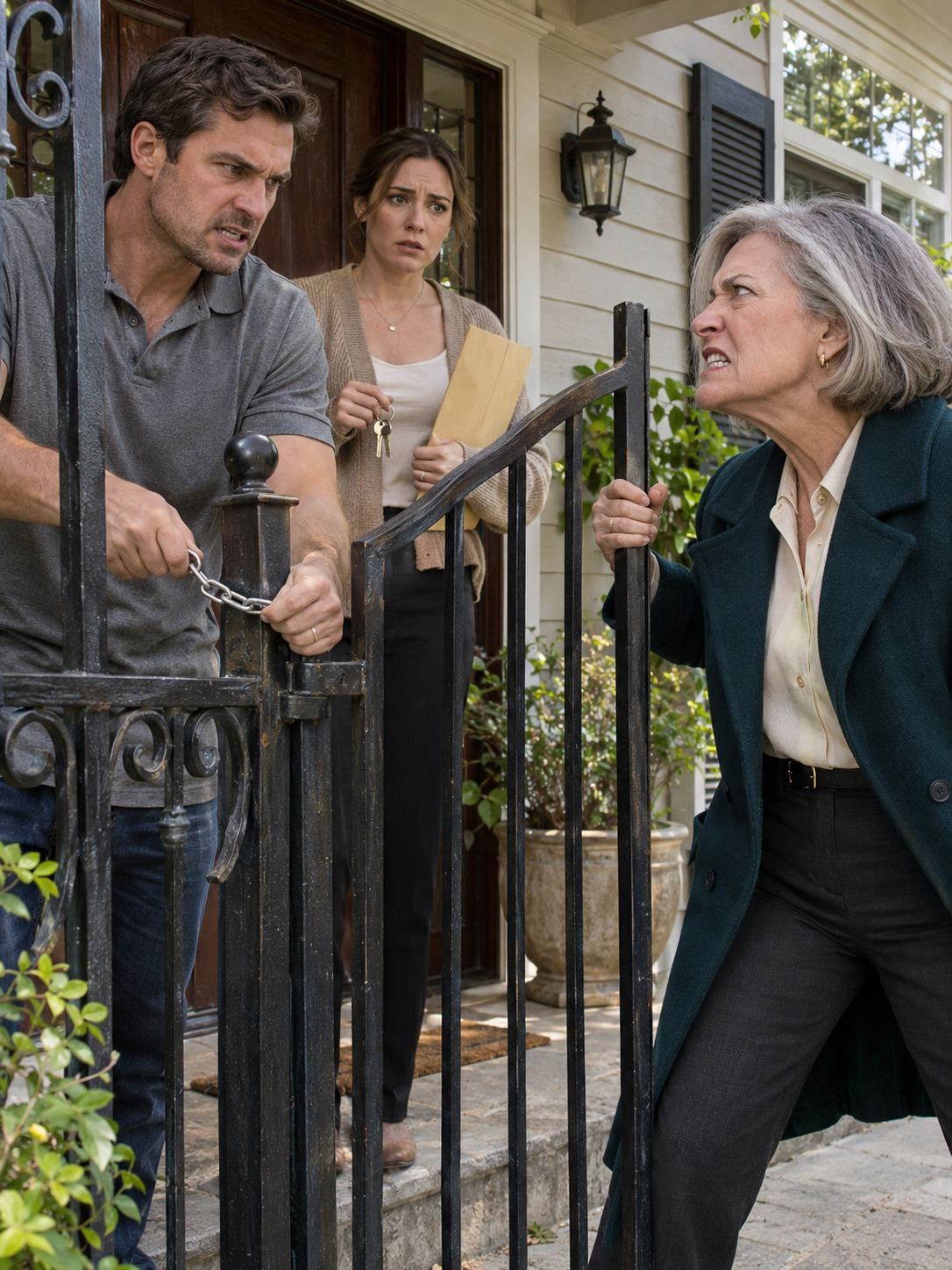
My son was pulling a heavy chain through my front gate when I caught the iron bars and stopped him.
"Mom, let go. You're not supposed to be here anymore."
Owen looked down at me.
Then I noticed the envelope in his wife's hands.
Something was terribly wrong.
I had been home for less than three minutes.
My suitcase still stood beside the stone steps. My shoulders ached from the long flight, and my phone was nearly dead. I had spent eighteen days away, traveling between financial meetings and visiting an old business associate who had retired to Florida.
I had expected to return to my own bed, make coffee in my kitchen, and spend the evening sorting through the mail.
Instead, my thirty-nine-year-old son was standing inside my front gate, trying to lock me out.
"Move your hand," Owen said.
I tightened my grip on the iron bar.
"Why are you putting a chain on my gate?"
He exhaled sharply, as though I were deliberately making an ordinary situation difficult.
"We talked about this."
"No, we didn't."
Behind him, Beth appeared in the doorway.
My daughter-in-law was holding a large manila envelope against her chest. Her copper-red hair was tied into a loose braid, and she wore the familiar expression she used whenever she wanted to make something unpleasant sound reasonable.
"Ruth," she said carefully. "You're home earlier than we expected."
I looked at her.
"My flight arrived at the time I told you."
She glanced at Owen.
That small movement told me more than either of them intended.
"What's in the envelope?" I asked.
Beth lowered it slightly.
"Just some information."
"About what?"
"A place we've found for you."
I stared at her.
Then I looked at Owen.
He had stopped pulling the chain.
"You're moving," he said.
For a moment, I thought I had misunderstood him.
"Excuse me?"
"We found somewhere beautiful. It's designed for people your age. You won't have to worry about maintaining this place anymore."
Beth stepped forward, apparently encouraged by his explanation.
"Your room has a garden view. There's a dining room, housekeeping, medical assistance if you ever need it. It's really lovely."
I didn't take the envelope.
"I have a house."
Owen's jaw tightened.
"Mom, please don't start."
"Start what?"
"Making everything difficult."
I looked beyond him.
My porch chairs had been stacked together beside the front window. A hired moving van stood near the garden, its rear doors open.
The decorative planter I had bought after selling my company was sitting beside a pile of cardboard boxes.
I could see two unfamiliar men moving something through the doorway.
Then I noticed the labels.
KEEP.
STORE.
DONATE.
My eyes settled on a small wooden cabinet near the entrance.
My grandmother had given it to me when I graduated from college.
Someone had attached a DONATE label to its front.
I felt something tighten in my chest.
"Who gave them permission to touch my belongings?"
Owen rubbed his forehead.
"We've been handling things while you were away."
"That wasn't my question."
Beth stepped closer.
"We were trying to make this easier for you."
"By packing my house?"
"By helping you transition."
I almost laughed.
Not because anything was funny, but because the words were so carefully chosen.
Transition.
It was a word people used when they wanted to avoid saying what they were actually doing.
They were removing me from my own home.
And they had apparently decided that I would cooperate once I returned.
"Owen," I said quietly. "Open the gate."
He shook his head.
"Not until we finish talking."
"Then we'll talk inside."
"You're not staying here tonight."
I looked at the chain again.
"Who changed my locks?"
He didn't answer immediately.
Beth did.
"We thought it would be better to have everything organized before you came back."
"Who changed my locks?"
"Owen arranged it."
I turned toward my son.
He looked irritated rather than ashamed.
"You've been forgetting things," he said. "You leave lights on. You don't always answer your phone. This house is too much responsibility."
I studied his face.
I was sixty-two years old.
Not ninety-two.
I had no difficulty remembering appointments, managing my finances, or understanding a complicated business contract.
I had managed an engineering company for nearly three decades.
I had negotiated with suppliers, handled payroll, settled disputes, and made decisions involving millions of dollars.
I had also raised Owen.
I remembered the first time he had broken a window with a baseball.
I remembered the hospital visits, the school meetings, the college tuition payments, and the nights I had stayed awake worrying about his future.
Apparently, none of those memories mattered now.
"Do you remember the first office I rented?" I asked.
He frowned.
"What?"
"The engineering company. The first office. It was smaller than your garage."
"Mom, this isn't relevant."
"I built that business before you finished elementary school."
He gave an impatient sigh.
"And you sold it. Good for you. But that doesn't change the fact that you can't maintain this property forever."
I looked at him for several seconds.
Then I asked, "What makes you think I can't?"
He opened his mouth.
Before he could answer, a man's voice came from beside the parked car.
"Owen?"
All three of us turned.
A middle-aged Asian man in a dark business suit was standing near a black sedan. He held a leather folder under one arm.
I recognized him.
David Chen.
He was the financial adviser I had spoken with twice before leaving town.
He had helped coordinate some of the documentation connected to the investment portfolio I had established after selling my company.
I hadn't expected to see him at my house.
Especially not with Owen.
David approached the gate, looking from my son to me.
His expression changed.
"Owen, why is the woman you paid to relocate still standing outside?"
The world seemed to become unusually quiet.
I looked at David.
Then I looked at my son.
"Paid?"
Owen immediately pulled the chain away from the gate.
"Not here, Mom."
I felt my stomach tighten.
"Where would you prefer? This is my house."
Beth lowered the envelope.
David opened his folder.
"Perhaps we should stop for a moment."
Owen shook his head.
"David, there's no need to make this complicated. My mother knows about the move."
I turned toward him.
"Do I?"
"We discussed it."
"We discussed whether I wanted help cleaning the gutters."
Beth made a small, uncomfortable sound.
"Ruth, this isn't funny."
"No," I replied. "It isn't."
David looked down at his paperwork.
"You told me she had approved the relocation."
Owen's face reddened.
"She did."
"When?"
"Several weeks ago."
"Which conversation?"
My son stared at him.
David continued.
"You specifically said she had agreed to transfer her residential arrangements and that the property would be prepared for sale after the move."
I felt the blood drain from my face.
Sale?
I had never agreed to sell my home.
I had never discussed selling my home.
I hadn't even considered moving.
"What sale?" I asked.
David stopped speaking.
Beth looked at Owen.
Owen looked at David.
For the first time since I had arrived, nobody seemed to know what to say.
I slowly released the gate.
"David, I think you should explain exactly what you believe is happening."
He glanced at Owen.
"I don't think we should discuss confidential financial arrangements in front of—"
"In front of whom?" I interrupted. "The owner of the property?"
His expression changed.
Then he nodded.
"You're right."
Owen stepped forward.
"Mom, please. You're misunderstanding the situation."
I looked at him.
"Then explain it."
He gestured toward the house.
"We've been trying to protect you. That's all."
"From what?"
"From the costs. The maintenance. Everything."
"I've paid every property tax bill on time."
"That's not the point."
"I've maintained this house for twenty-six years."
"Things are different now."
"How?"
He didn't answer.
David closed his folder halfway.
"Mr. Owen, I need to be certain that you understand something. The arrangement I was asked to facilitate was based on your representation that your mother had authorized the move."
Owen's expression hardened.
"You said this would be handled."
"I said it could be handled if the owner consented."
Beth stepped between them.
"Can we please stop talking about money in the driveway?"
I turned toward her.
"Why? Is there something about the money I shouldn't hear?"
She went silent.
I looked at the moving van.
One of the workers had come out carrying a cardboard box.
On its side, someone had written RUTH — DONATE.
I recognized the contents through the partially open top.
My old engineering notebooks.
The original sketches I had made when I was developing the first prototype that eventually became the foundation of my company.
I walked toward the box.
"Put that down," I told the worker.
He looked at Owen.
"Put it down," I repeated.
This time, he obeyed.
I removed the DONATE label.
My hands were steady, although my heart was beating faster than it had in years.
I turned back toward my son.
"Who authorized this?"
Owen crossed his arms.
"I did."
The answer landed harder than I expected.
Not because he had moved my furniture.
Because he had said it without hesitation.
He genuinely believed he had the right.
I looked at the front door, at the people moving through my hallway, at the stranger holding a folder, and finally at the son I had spent thirty-nine years protecting.
Four years earlier, I had sold my interest in the engineering company I had built.
I had received considerably more money than my family knew.
I had deliberately kept my finances private.
I told Owen I was comfortable.
He had interpreted that as modest savings and a small retirement income.
He had never asked what the company was worth.
He had never asked what I had done with the proceeds.
And I had never volunteered the information.
I preferred being treated like his mother rather than being treated like an investment opportunity.
Apparently, I had made a mistake.
"David," I said.
He looked up.
"Yes, Ruth?"
"Tell me exactly what you paid my son for."
Owen's face went pale.
Beth tightened her grip on the envelope.
David slowly opened the leather folder again.
He removed a document and looked at the signature near the bottom.
Then he glanced at my son.
"Before I answer that, I need to show you something."
He turned the document toward me.
I looked at the first page.
My name appeared near the top.
My address was underneath it.
And beside a line marked PROPERTY OWNER AUTHORIZATION was a signature that looked remarkably like mine.
But I had never signed it.
David placed his finger beside the date.
"Ruth, this document was submitted eighteen days ago."
I stared at the signature.
Then I looked at Owen.
He took one step backward.
And David quietly turned to the second page...
Hết Chapter 1. Các chương tiếp theo sẽ tiếp tục từ chính tình tiết tài liệu giả mạo này, giữ nguyên mạch truyện, nhân vật và hướng kết thúc có hậu.






Comments 0