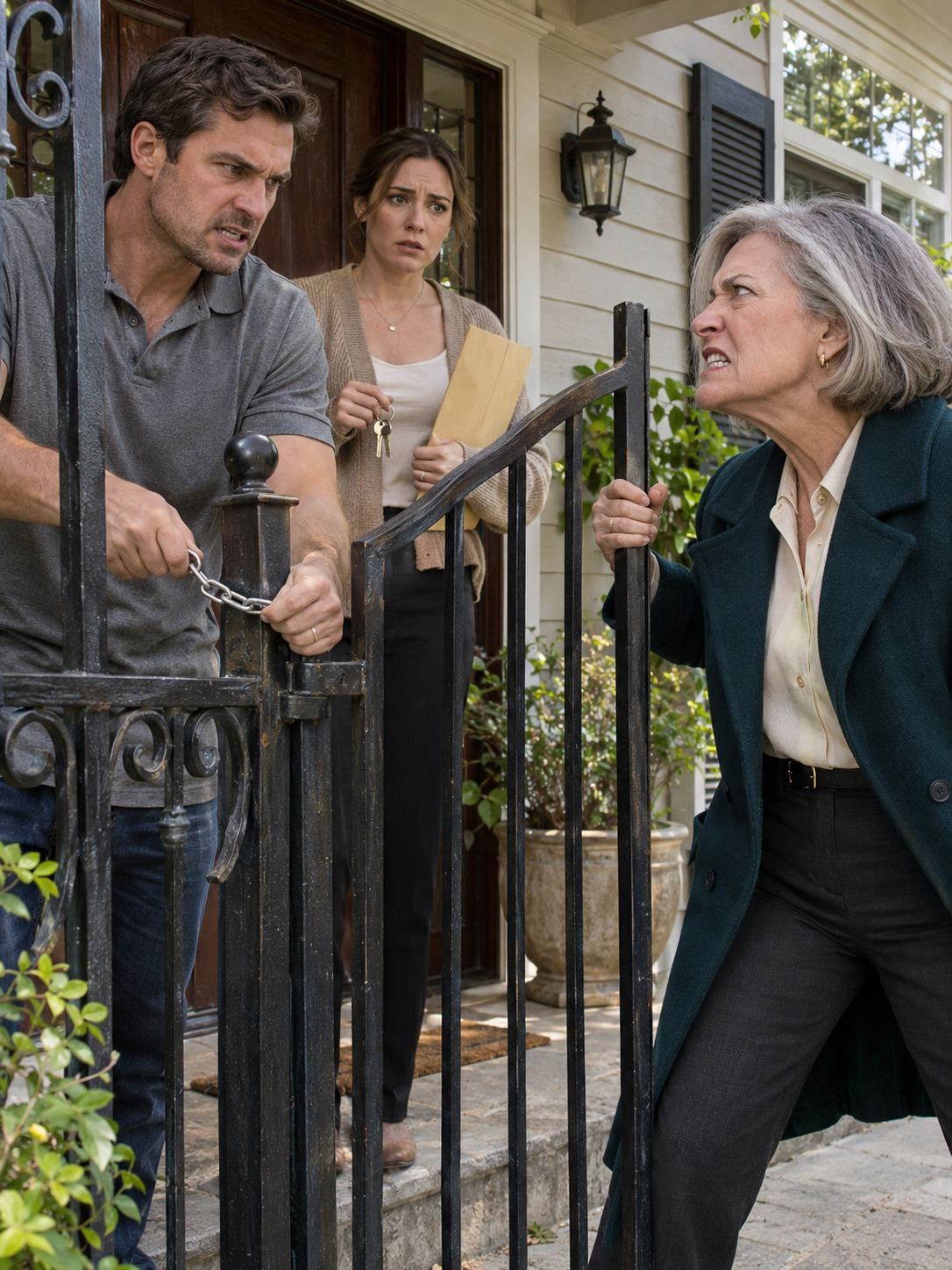
"Ruth? It's me. Please open the door."
I stood in the hallway, holding the photograph in one hand and my phone in the other.
The woman outside my gate was Margaret Ellis.
She had been my husband's closest friend in business for more than twenty years. She had attended our family celebrations, sat beside me at Thomas's funeral, and helped me organize his affairs after his death.
She was also the woman who had kept the metal case containing his final instructions.
I approached the front door but didn't unlock it.
"Margaret, why are you here?"
Her voice trembled.
"Because I should have come seven years ago."
I looked through the glass.
She was crying.
I remembered Thomas's handwriting on the photograph.
She knows what happened.
I unlocked the door but left the security chain attached.
"Start talking."
Margaret looked at the photograph in my hand.
"Thomas knew I would eventually have to tell you."
"Then why didn't you?"
She closed her eyes.
"Because Harold threatened me."
I felt my stomach tighten.
"Come inside. Evelyn is on her way, and everything you say will be documented."
Margaret nodded.
She entered slowly, carrying a leather handbag.
We sat at the kitchen table.
For several seconds, she simply looked around the room.
Then her eyes settled on Thomas's photograph beside the window.
"He loved this house," she whispered.
"So did I."
She nodded.
"That's why he fought so hard to protect it."
I placed the photograph on the table.
"Explain."
Margaret opened her handbag and removed a thick envelope.
"Seven years ago, Thomas discovered that Daniel Mercer had been using Owen's original investment debt to create additional financial obligations."
"David told me."
Margaret nodded.
"David was involved in the accounting review. But he didn't have all the records."
She opened the envelope.
Inside were bank statements, correspondence, and copies of old agreements.
"Thomas discovered that most of Owen's original debt had already been repaid. Daniel continued charging fees and interest, then used the inflated balance to pressure Owen into signing additional agreements."
I examined the documents.
"And Harold?"
"Harold helped him."
My jaw tightened.
"Why?"
"Because Harold had a financial interest in one of the companies receiving the payments."
I stared at her.
"So the family attorney was making money from the transactions he was supposed to review."
Margaret nodded.
"Thomas found evidence of it."
She removed another document.
"This was the original accounting summary."
I leaned forward.
The numbers matched David's explanation.
The original loan had been substantially repaid.
The remaining amount was far smaller than Daniel claimed.
And several subsequent charges had no supporting invoices.
I looked at Margaret.
"Why did Thomas keep this?"
"He wanted to challenge the debt formally. He also wanted to protect Owen from being pursued for money he didn't actually owe."
I felt tears gathering.
"Thomas was trying to protect our son."
"Yes."
I looked down at the documents.
"And what happened at the hospital?"
Margaret took a slow breath.
"Thomas called me that evening. He told me he was afraid Harold and Daniel were preparing to use a new agreement against him."
"Did he tell you he was sick?"
"Yes. He said his chest hurt."
I closed my eyes.
"He should have called me."
Margaret's voice softened.
"He wanted to. He asked Owen to contact you, but Harold told everyone you were unavailable."
I opened my eyes.
"That wasn't true."
"I know."
She looked down.
"Harold told Owen that contacting you would only create unnecessary panic. Owen was young, frightened, and already ashamed of the debt."
I looked toward the hallway.
My son had been manipulated.
But he had also made decisions.
Both things could be true.
Margaret continued.
"At the hospital, Thomas refused to sign the new agreement. He also refused to leave with Daniel. He specifically asked that you be contacted."
"Why did Harold sign the discharge paperwork?"
"Because he told the hospital staff that Thomas had authorized him to handle the arrangements."
"But Thomas had written that he didn't consent to leaving with Daniel."
"Yes."
I felt anger rise.
"Did Margaret—did you know they had altered the paperwork?"
She shook her head.
"Not immediately. I discovered the discrepancy when Thomas's estate records were being assembled."
I stared at her.
"Then why didn't you report it?"
"Because Harold told me the hospital had made an administrative correction. He showed me the altered version and said the original note was a temporary entry."
"And you believed him?"
"I wanted to."
She wiped her eyes.
"Then I learned that the original document had been preserved."
I stared at her.
"How?"
"A nurse contacted me privately several weeks after Thomas died. She remembered him asking for you. She had also noticed that the copy in the legal file did not match the original."
My heart tightened.
"Why didn't she contact the authorities?"
"She was frightened of losing her job. She eventually provided a statement through an attorney."
I sat back.
For seven years, I had believed my husband's final hours were simply an unfortunate medical event.
Now I understood that people had hidden information from me because revealing it would expose their own wrongdoing.
"Did Daniel cause Thomas's death?"
Margaret looked directly at me.
"No. I have never seen evidence proving that. Thomas suffered a serious cardiac event, and we cannot honestly say what would have happened if he had remained in the hospital."
I nodded slowly.
I appreciated her honesty.
I didn't want a convenient villain responsible for every tragedy.
I wanted the truth.
"Then what did happen after Thomas died?"
Margaret removed another folder.
"Harold prepared the false guaranty agreement. He used the hospital paperwork to support the claim that Thomas had acknowledged the debt shortly before his death."
I stared at the signature.
The same forged signature that had appeared in Owen's email.
"Who created it?"
"Harold prepared the documents. Daniel supplied the financial figures."
"And my house?"
"They intended to use the supposed agreement to establish leverage over the property."
I looked at the paperwork.
The plan had been simple.
Make Owen believe his father owed money.
Make him believe the debt could destroy his future.
Persuade him to sign documents.
Then arrange the sale of my house.
And if I refused, use a guardianship petition to undermine my ability to object.
I looked at Margaret.
"Was the guardianship petition part of the original plan?"
"No. That came later."
"Who suggested it?"
"Harold. Daniel wanted to use your refusal to sell as evidence that you were becoming unreasonable."
I felt my hands tighten.
"Then they invented a medical evaluation."
Margaret nodded.
"They used an outdated form from another case. Harold believed it would make the petition appear more convincing."
I stared at her.
"Have they done this to other people?"
Margaret hesitated.
"I know of at least two other property owners whose situations deserve investigation."
I looked at Evelyn's empty chair.
"Caroline needs all of this."
Margaret pushed the documents toward me.
"She can have everything."
The doorbell rang.
Evelyn had arrived.
I let her in and introduced Margaret.
For the next hour, Margaret gave a detailed statement.
She identified the financial companies, the people involved, the original transactions, and the documents Thomas had preserved.
She also handed over copies of emails and correspondence that connected Harold and Daniel to the disputed agreements.
Evelyn photographed everything.
Then she called Caroline.
Within minutes, Caroline confirmed that the new evidence would be added to the existing investigation.
There was another important development.
The court had not granted the guardianship petition.
Caroline had filed an objection, and the false medical evaluation was now being challenged with confirmation from the clinic.
My independence remained legally intact.
I felt my shoulders relax for the first time that evening.
Then Evelyn looked at Margaret.
"Do you have anything that directly connects Harold to the altered documents?"
Margaret nodded.
She reached into her handbag and removed a small digital recorder.
"I kept this."
I stared at it.
"What is it?"
"A recording of a conversation between Harold and Daniel. It was made during a business meeting shortly after Thomas died."
Evelyn looked at her carefully.
"Is it an original recording?"
"Yes. I made it because I suspected they were preparing to blame the accounting discrepancies on me."
She placed it on the table.
Evelyn explained that Caroline would need to review its authenticity and the circumstances in which it was made before relying on it.
I nodded.
Margaret looked at me.
"Ruth, I should have given you this years ago."
"Yes."
She lowered her head.
"I know."
I studied her.
"Why did you finally come tonight?"
She looked at the photograph.
"Because I heard Harold had filed the guardianship petition. I knew he was trying to finish what he and Daniel started. And I couldn't watch another person lose their home because I was too frightened to speak."
I nodded slowly.
"Then make sure you tell the whole truth this time."
"I will."
The following weeks changed everything.
Caroline's legal team examined the documents, the hospital records, the financial audit, and the materials recovered from Thomas's desk.
David cooperated fully.
He provided the original accounting files from his former firm and helped identify the transactions that had been misrepresented.
The independent examination of Thomas's signature found significant inconsistencies between the disputed guaranty and verified examples of his handwriting.
The hospital confirmed that its original records had been altered in the copy supplied to Harold's office.
The false medical evaluation submitted with the guardianship petition was also challenged.
The clinic confirmed that I had never been examined by the doctor whose name appeared on the document.
The court rejected the emergency guardianship request.
Caroline also helped establish that I had never authorized the sale of my home.
The attempted transaction was stopped.
My property remained mine.
Then the investigation expanded.
Daniel's financial records revealed that he had continued collecting payments based on disputed balances.
Harold's records showed that he had prepared and circulated documents containing statements that could not be supported by the original files.
Their involvement in the hospital paperwork and the financial agreements became part of a formal investigation.
Eventually, both men faced serious legal consequences.
The false financial claims were withdrawn.
The disputed guaranty was ruled unenforceable.
The remaining legitimate business debt was independently reviewed and settled according to the actual records.
The proposed sale of my house disappeared.
The guardianship petition was dismissed.
For the first time in years, nobody was trying to decide what should happen to my life without asking me.
But the most difficult conversation was still waiting.
Owen came to see me one Sunday afternoon.
He arrived alone.
No Beth.
No Daniel.
No folder.
He stood on the porch holding a small paper bag.
I opened the door.
"Hello, Mom."
"Hello, Owen."
He looked nervous.
"I brought something."
He handed me the bag.
Inside was an old photograph.
Thomas was standing beside Owen when he was about ten years old.
They were in the backyard, building a wooden birdhouse.
Both were laughing.
I smiled faintly.
"I remember this."
"Dad kept a copy in his office."
I looked at him.
"Why are you giving it to me?"
"Because I found it among my things. And because I thought you should have it."
I stepped aside.
"Come in."
We sat at the kitchen table.
For several minutes, Owen said nothing.
Then he looked at me.
"I've started working with a financial counselor."
I nodded.
"That's good."
"I'm selling the car I bought with the money Daniel gave me."
I looked at him.
"Why?"
"Because I need to repay what I took from your account."
I studied his face.
"That money will be handled through Caroline's settlement arrangements."
"I know. I still want to make it right."
He looked down.
"I also told Beth everything."
I waited.
"She knows I signed the guardianship petition. She knows about the documents and the money."
"How did she respond?"
"She was furious."
I nodded.
"She had reason to be."
Owen swallowed.
"She's agreed to work on our marriage, but only if I stop hiding things."
I looked at him.
"That's a reasonable condition."
He nodded.
Then his eyes filled.
"Mom, I don't expect you to forgive me."
I remained quiet.
He continued.
"I believed Daniel because I was ashamed. I believed Harold because he sounded like someone who knew what he was doing. And when I realized things weren't right, I was too afraid to admit how far I'd gone."
He wiped his eyes.
"I helped them hurt you."
I looked at my son.
For years, I had imagined what I would say if he ever truly understood what he had done.
I had prepared speeches in my mind.
Angry speeches.
Painful speeches.
But sitting across from him, I found that I didn't need them.
"I loved you before you made those mistakes," I said.
He looked up.
"And I love you now. But trust has to be rebuilt."
He nodded.
"I understand."
"You won't have access to my accounts."
"Of course."
"You won't make decisions about my property."
"I know."
"And you will never sign another legal document without understanding exactly what it says."
He gave a small, sad smile.
"I promise."
I looked at him.
"Don't promise. Practice."
He nodded.
"I will."
I reached across the table and placed my hand over his.
It wasn't a complete reconciliation.
It wasn't supposed to be.
But it was a beginning.
Six months later, my house looked like itself again.
The movers had taken away the unwanted boxes.
My furniture was back where it belonged.
The porch chairs had been returned to their usual places.
I had the iron gate repaired and removed the chain Owen had installed.
I kept the new keys on a small brass hook beside the front door.
The old wooden desk remained in my study.
I had the hidden compartment professionally restored, but I kept Thomas's original notes and the small memory card in a secure place.
The evidence had done what Thomas intended.
It had protected our home.
The financial investigation had also uncovered enough irregularities to help other people whose property and savings had been targeted through similar arrangements.
Margaret testified.
David provided the records.
Harrison Vale cooperated with the investigation and admitted that he had failed to report concerns when he first discovered the questionable transactions.
He later provided additional evidence about the companies involved.
None of them escaped responsibility for their choices.
But I was grateful that they finally stopped hiding.
Beth and Owen began counseling.
Their marriage survived, though they had to rebuild it honestly.
Owen found work in a different industry and began paying back the money he had taken.
He stopped asking me to solve his financial problems.
That mattered more to me than any apology.
On the first anniversary of my return, I invited him and Beth for dinner.
We ate at the same kitchen table where the documents had once covered every inch of space.
This time, there were flowers in the middle.
Beth brought dessert.
Owen brought an old photograph of his father.
After dinner, he helped me carry the dishes into the kitchen.
Then he stopped beside the desk.
"Mom?"
"Yes?"
"I found something in Dad's old files."
He handed me a small envelope.
My name was written across the front.
I recognized the handwriting immediately.
Thomas's.
My hands trembled as I opened it.
Inside was a short letter.
My dearest Ruth,
If you are reading this, I hope it means you found the strength to ask questions when other people wanted you to remain silent.
I know you. You have never needed anyone to tell you how to run your life.
I also know I haven't always told you everything. I thought protecting you meant carrying some burdens alone. Perhaps I was wrong about that.
Whatever happens, remember that the house is yours because it is your home, not because of its value.
And please remind Owen that making a mistake does not mean his life is over. He must learn to take responsibility, but he must never believe that money matters more than the people who love him.
I love you. Always.
Thomas.
I pressed the letter against my chest.
For a moment, I couldn't speak.
Owen stood beside me.
"He really loved you, Mom."
I smiled through my tears.
"Yes. He did."
I folded the letter carefully and placed it inside the envelope.
Then I looked at my son.
"Your father would have wanted you to become a better man."
Owen nodded.
"I'm trying."
"I can see that."
We stood together in the quiet study.
Later that evening, after Owen and Beth had gone home, I walked onto the porch.
The city lights shimmered in the distance.
The iron gate stood open.
I thought about the day I had returned from Florida.
The chain.
The envelope from the senior residence.
The labels on my furniture.
The stranger asking why I was still standing outside my own home.
I remembered how small I had felt for one terrible moment.
Then I remembered what Thomas had left behind.
Not simply a key.
Not merely a collection of documents.
He had left me the truth.
And the truth had given me the power to defend myself.
I was sixty-three now.
I had no intention of moving into a room chosen by someone else.
I had no intention of surrendering my independence because another person found it inconvenient.
I would continue living in the home Thomas and I had built together.
I would continue managing my finances, making my decisions, and enjoying the life I had worked so hard to create.
And I would love my son without allowing him to control me.
I walked back inside and locked the front door.
The key turned smoothly.
For the first time in months, the sound didn't remind me of something being taken away.
It reminded me that I was home.
My home.
My life.
My choice.
And nobody would ever make those decisions for me again.






Comments 0