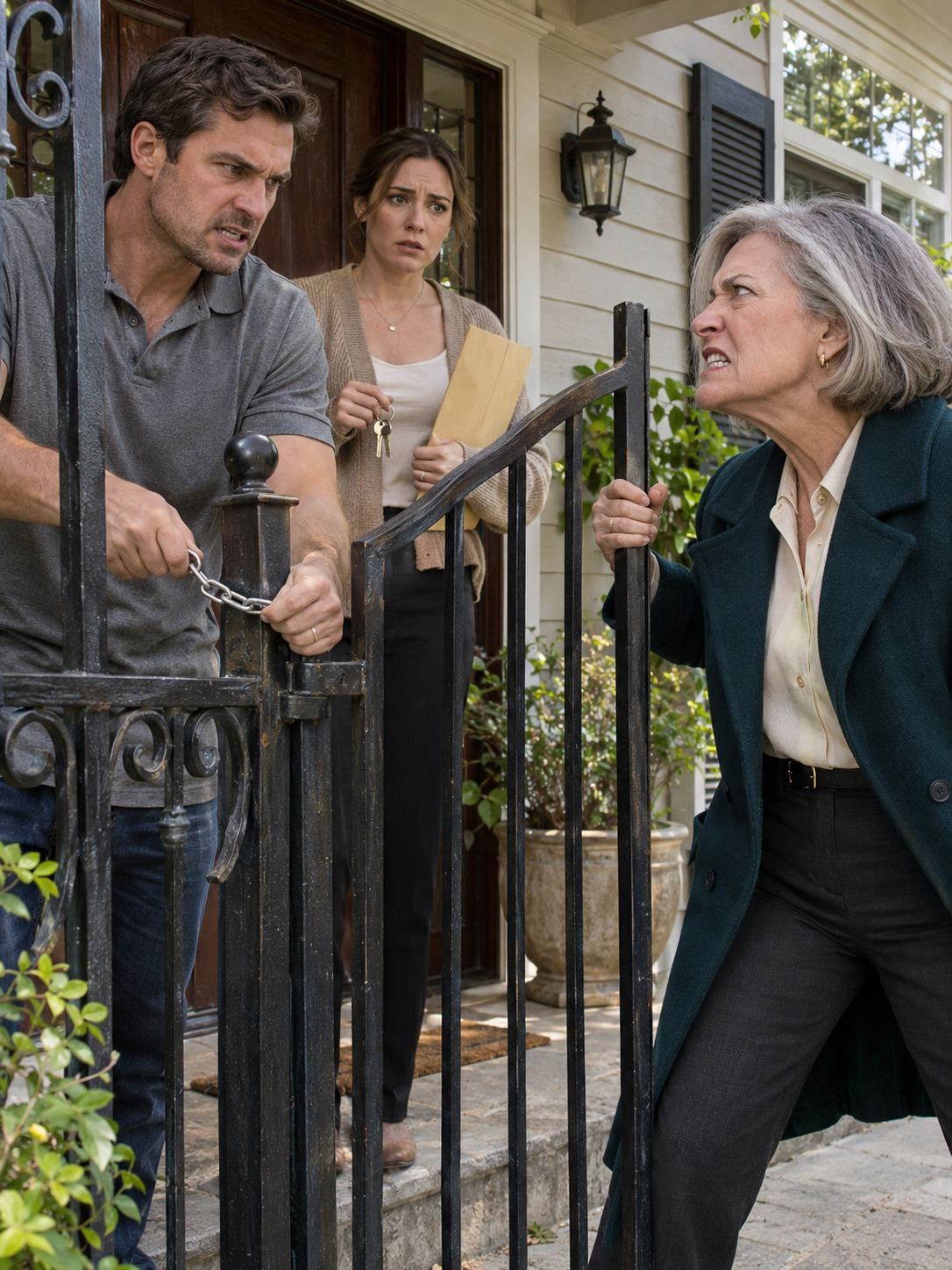
My phone kept ringing while my son stared at the screen.
"Don't answer that," Owen said.
His voice was so sharp that Beth flinched.
I looked at him.
"Why?"
"Because you don't know who's calling."
"Neither do you, apparently."
He reached toward my phone.
I moved it away.
"Owen, don't."
He stopped, but his eyes remained fixed on the screen.
David stood beside my old desk, holding the folder containing the relocation documents. He had been quiet since the message arrived, but I noticed the way he watched my son.
He had noticed the change, too.
A few minutes earlier, Owen had been angry, impatient, and convinced that everyone should listen to him.
Now he looked frightened.
Not embarrassed.
Not frustrated.
Frightened.
I answered the call.
"Hello?"
For a moment, nobody spoke.
Then a woman's voice said, "Mrs. Bennett?"
"Speaking."
"Are you alone?"
I looked around my living room.
"My son, his wife, and a financial adviser are here."
The woman hesitated.
"Is your son Owen Bennett?"
"Yes."
Another pause.
"Then please don't tell him where you're going."
I felt a cold sensation move through my chest.
"Who is this?"
"My name is Margaret Ellis. I worked with your husband."
I gripped the phone more tightly.
"My husband died seven years ago."
"I know."
"Then why are you calling me now?"
"Because someone came looking for something he left behind."
I glanced at Owen.
He was standing completely still.
"What something?"
"I can't explain everything over the phone."
"Try."
The woman lowered her voice.
"Your husband gave me an envelope before he died. He told me to keep it until you needed it."
I stared at the floor.
My husband, Thomas, had been a careful man.
He was the kind of person who kept receipts for appliances long after the warranties expired. He labeled every spare key, organized our insurance documents, and never threw away a letter without reading it twice.
But he had never told me about an envelope.
"Why didn't you give it to me after his funeral?"
"Because he specifically instructed me not to."
I closed my eyes.
That sounded like Thomas.
He had always believed there was a right time for difficult conversations.
Sometimes I loved that about him.
Sometimes it drove me crazy.
"What changed?" I asked.
Margaret took a breath.
"Your son contacted me yesterday."
My eyes opened.
"Owen?"
"Yes."
"What did he want?"
"He asked whether your husband had left any private documents concerning the house."
I slowly turned toward my son.
He was watching me.
"Did you give him anything?"
"No."
"Did you tell him about the envelope?"
"I told him I couldn't discuss your husband's affairs with him."
I heard a faint sound on the other end of the line.
A door closing.
Then Margaret spoke again.
"Mrs. Bennett, I need to ask you something. Has anyone tried to make you leave your home?"
I looked at the boxes scattered across my living room.
"Yes."
Her breathing changed.
"Then you need to see what your husband left."
"Where are you?"
"I'll send you the address."
"Margaret, what is in that envelope?"
She didn't answer immediately.
Then she said something that made my knees feel weak.
"Your husband was worried this might happen."
The call ended.
I remained standing in the middle of my living room, staring at the dark screen.
Seven years.
Thomas had been gone for seven years.
And somehow, a decision he had made before his death was reaching into my life at the exact moment my son was trying to take my home.
"Who was that?" Owen demanded.
I slipped the phone into my coat pocket.
"Someone who knew your father."
His expression tightened.
"Who?"
"Margaret Ellis."
The reaction was immediate.
Beth looked at Owen.
Owen looked away.
I noticed.
"You know her."
"No."
"Then why did you just look at Beth?"
"I didn't."
"You did."
He gave an irritated laugh.
"Mom, you're seeing things."
I walked toward him.
"Did you contact Margaret yesterday?"
He stared at me.
"Who told you that?"
"Answer the question."
He looked toward David.
"This is a family matter."
David didn't move.
"Your mother asked you a direct question."
Owen's face reddened.
"I called her because I was trying to locate some old paperwork."
"What paperwork?"
"Documents related to Dad's estate."
"Your father's estate was settled years ago."
"Not everything."
I felt my heart beat harder.
"What does that mean?"
Owen hesitated.
Beth stepped forward.
"Ruth, maybe everyone should calm down."
I turned toward her.
"I am calm."
She lowered her eyes.
I looked back at Owen.
"What did you want from Margaret?"
He rubbed his forehead.
"I was trying to find out whether Dad had left any restrictions on the property."
I stared at him.
"Restrictions?"
"Yes."
"Why?"
"Because the buyer wanted to know."
There it was.
The buyer.
The person or company my son had been negotiating with behind my back.
I walked to the kitchen and pulled out a chair.
"Sit down, Owen."
He looked surprised.
"What?"
"Sit."
For a moment, I saw the little boy who used to freeze when I caught him lying about his homework.
Then his expression hardened again.
"I'm not a child."
"Then stop behaving like one."
David quietly followed us into the kitchen.
Beth remained near the doorway.
Owen finally sat across from me.
I placed the forged authorization document on the table.
"Let's begin with this."
He looked at it.
"I already explained."
"No. You avoided explaining."
I pointed to the signature.
"This isn't mine."
He said nothing.
"I was in Florida on the date this document was supposedly signed."
"You could have signed electronically."
"I didn't."
"Maybe you forgot."
I stared at him.
For a moment, I couldn't believe he had said it.
Then I understood.
That was the story he had been building.
I was getting older.
I forgot things.
I didn't understand money.
I couldn't manage my house.
Every accusation served the same purpose.
If people believed I was confused, they might stop asking whether I had agreed to anything.
"Owen," I said quietly, "have you been telling people I'm losing my memory?"
He looked away.
Beth shifted uncomfortably.
I turned toward her.
"Beth?"
She swallowed.
"We may have mentioned that you've seemed overwhelmed."
"To whom?"
"Just people helping with the transition."
"Names."
She looked at Owen.
I waited.
Finally, she said, "The residence coordinator. The moving company. And the property representative."
I nodded.
"Anyone else?"
Neither answered.
David placed his folder on the table.
"Ruth, I think you should consult an attorney immediately."
"I intend to."
Owen pushed back his chair.
"This is unbelievable. We're trying to make sure you're taken care of, and you're acting like we've committed some terrible crime."
I looked at the forged signature.
"Someone signed my name."
"That doesn't mean—"
"Someone changed my locks."
"Because—"
"Someone accepted twenty-five thousand dollars to arrange my relocation."
He stopped speaking.
I leaned forward.
"And someone began preparing my house for sale without asking me."
The silence stretched.
Finally, Owen said, "You don't understand the situation."
"Then explain it."
He looked toward the window.
I followed his gaze.
The moving van was still parked outside.
The workers had stopped carrying boxes.
One stood beside the open rear doors, looking at his phone.
I realized they were waiting to be told whether to continue.
"David," I said, "please tell them the move is canceled."
He nodded and stepped outside.
Beth followed him.
For the first time since arriving home, I was alone with my son.
Owen stared at the table.
I looked at his hands.
They were trembling slightly.
I remembered those hands when they were small enough to fit inside mine.
I remembered teaching him to tie his shoes.
I remembered holding him after he fell off his bicycle.
I remembered the night he called from college because he had failed an exam and thought his future was over.
I had told him one mistake didn't define a person.
I still believed that.
But this wasn't one mistake.
This was a series of decisions.
He had changed my locks.
He had packed my belongings.
He had arranged a senior residence.
He had accepted money.
And he had allowed someone to submit a document bearing my forged signature.
"Owen," I said softly, "are you in trouble?"
He looked up.
For one brief second, his expression changed.
The anger disappeared.
I saw exhaustion.
Fear.
Something almost like shame.
Then he looked away.
"No."
"Are you in debt?"
His jaw tightened.
"Why would you ask that?"
"Because people don't usually sell their mother's house unless they believe they need something."
He stood abruptly.
"I'm not selling your house."
I pointed to the acquisition agreement.
"Then what is that?"
He looked at the document.
"I was trying to arrange a solution."
"For whom?"
He didn't answer.
I waited.
Finally, he whispered, "You wouldn't understand."
I felt a sharp ache in my chest.
"Try me."
He shook his head.
"You've always thought you knew everything."
"No. I've spent most of my life learning how much I don't know."
"You never trusted me."
I stared at him.
"Is that what this is about?"
"You kept everything from me."
"What did I keep from you?"
"Your money. The company. All of it."
I sat back.
So there it was.
Not concern about my health.
Not the maintenance of the property.
Money.
"You knew I sold the company."
"I didn't know how much you got."
"You never asked."
He laughed bitterly.
"Because every time I brought up finances, you changed the subject."
"I changed the subject because my finances are private."
"I'm your son."
"That doesn't make you my accountant."
His face hardened.
"You have no idea what it's like trying to build something when everyone assumes your mother can bail you out."
I stared at him.
"Have you asked me to bail you out?"
He looked away.
"No."
"Then why would anyone assume that?"
He didn't answer.
I thought about the last several years.
Owen had changed jobs twice.
He had talked about starting a consulting business.
He and Beth had purchased a larger house than I thought they could comfortably afford.
When I asked whether the mortgage was manageable, he told me not to worry.
I had respected that boundary.
Now I wondered whether respecting it had been a mistake.
"How much do you owe?" I asked.
He looked at me sharply.
"Nothing."
"Owen."
"I said nothing."
I didn't believe him.
But I also knew that pushing harder would only make him retreat.
So I changed the question.
"Who introduced you to the buyer?"
He stared at the floor.
"Someone from work."
"Name?"
He hesitated.
"Daniel Mercer."
I repeated the name silently.
Daniel Mercer.
It meant nothing to me.
"What does he do?"
"Property investment."
"How did you meet him?"
"Through a business contact."
"What business?"
Owen stood again.
"I'm done with this."
He walked toward the hallway.
I didn't follow.
"Your father would be ashamed of what you've done."
He stopped.
I regretted the words almost immediately.
Not because they were necessarily untrue.
Because I knew how deeply they would hurt him.
He turned slowly.
"You don't get to use Dad against me."
"I'm not trying to."
"Yes, you are."
His eyes were wet.
For a moment, I thought he might cry.
Instead, he said, "You have no idea what Dad kept from you."
Then he walked out.
I remained seated.
My husband had been gone for seven years.
I had spent those years believing that I understood our marriage.
We had disagreed about ordinary things.
Money.
Work.
How much time I spent at the office.
Whether Owen needed more independence.
But we had trusted each other.
At least, I believed we had.
Now two people had suggested that Thomas had left something unresolved.
Margaret Ellis.
And my son.
I took out my phone.
A new message had arrived.
It contained an address.
A small office building on the other side of town.
Below it, Margaret had written:
Please come alone. Bring proof of identity. Do not bring Owen.
I read the message several times.
Then I called my attorney.
Her name was Caroline Hayes.
She had handled the sale of my engineering company and several personal legal matters over the years.
When she answered, I told her everything.
The chain.
The changed locks.
The senior residence.
The forged signature.
The twenty-five-thousand-dollar payment.
The proposed sale.
She listened without interrupting.
When I finished, she was silent for several seconds.
"Ruth," she said, "do not sign anything."
"I won't."
"Do not allow anyone to remove more property."
"I've already stopped the movers."
"Good. Preserve every document. Take photographs. Keep copies of the messages."
"I will."
"And Ruth?"
"Yes?"
"Please tell me your son doesn't have access to your financial accounts."
"He doesn't."
"Are you certain?"
I hesitated.
"He has never been authorized to manage them."
"That's not quite what I asked."
I looked toward the hallway.
I could hear Owen and Beth arguing quietly near the front door.
"I'll verify everything."
"Do it today."
After we ended the call, I sat alone for several minutes.
Then I opened my banking application.
My primary accounts appeared normal.
I checked the balances.
No unexpected withdrawals.
No unfamiliar transfers.
I checked the investment account associated with the sale of my company.
Everything appeared intact.
Then I opened an older account.
It was a joint household account Thomas and I had used years earlier.
After his death, I had kept it open for a few automatic payments and occasional household expenses.
The balance was usually modest.
But when I opened the transaction history, I noticed something strange.
Three transfers.
All made within the past month.
Each one was smaller than the twenty-five-thousand-dollar payment David had described.
Each one had gone to the same unfamiliar recipient.
MERCER PROPERTY SERVICES.
I stared at the screen.
Daniel Mercer.
The name Owen had just given me.
I opened the first transaction.
Then the second.
Then the third.
The total was eighteen thousand dollars.
I felt my pulse quicken.
I hadn't authorized those payments.
I hadn't even opened that account during my trip.
I immediately called the bank.
After verifying my identity, I asked to speak with someone about unauthorized transactions.
The representative placed me on hold.
While I waited, David returned to the kitchen.
"The movers have stopped," he said. "They're waiting for written confirmation from the company that hired them."
"Who hired them?"
"Owen."
"Using whose money?"
David hesitated.
"I don't know."
I turned my phone toward him.
"Do you recognize this company?"
He leaned closer.
His expression changed.
"Mercer Property Services."
"Yes."
He looked at me.
"Ruth, where did you get that?"
"From my bank account."
David sat down.
For the first time, he looked genuinely alarmed.
"That company was listed as a third-party service provider in the relocation documents."
I felt my stomach tighten.
"Who approved those payments?"
He shook his head.
"I don't know."
The bank representative returned to the line.
"Mrs. Bennett, thank you for waiting. I've reviewed the transactions."
"Good."
"These transfers were initiated through an authorized online banking profile."
I sat very still.
"Whose profile?"
There was a pause.
"Mrs. Bennett, I need to verify one additional detail before I can disclose that information."
I answered her questions.
My date of birth.
The last four digits of my identification number.
A security question I had established years earlier.
Then she said, "Thank you. The profile used to initiate these transfers was added to the account approximately six weeks ago."
"Added by whom?"
Another pause.
"The profile was registered under the name Owen Bennett."
I closed my eyes.
David said nothing.
The representative continued.
"Mrs. Bennett, would you like me to suspend that profile and initiate a fraud review?"
"Yes."
"Immediately?"
"Immediately."
She began explaining the process.
I barely heard her.
My son had not only tried to move me out of my house.
He had apparently gained access to an account I had never authorized him to use.
I looked toward the hallway.
Owen was no longer there.
Beth stood near the front door, speaking quietly into her phone.
When she saw me watching, she ended the call.
I stood.
"David, I need you to stay here for a few minutes."
"Of course."
I walked toward Beth.
"Where's Owen?"
She looked surprised.
"He went outside."
"Where?"
"To make a call."
I moved toward the front door.
The driveway was empty except for the moving van.
Owen's car was gone.
I looked back at Beth.
"When did he leave?"
She swallowed.
"Just now."
I took out my phone.
There was another message from Margaret Ellis.
This one contained only six words.
He knows you're coming. Hurry.
I stared at it.
Then another message appeared.
A photograph.
It showed the entrance to Margaret's office building.
A dark blue car was parked outside.
I recognized the license plate.
It belonged to my son.
Before I could call Margaret, my phone rang.
Her name appeared on the screen.
I answered immediately.
"Margaret?"
Her voice was barely a whisper.
"Mrs. Bennett, listen carefully."
"What's happening?"
"Your son is here."
I gripped the phone.
"Don't give him anything."
"I haven't."
"Then lock your door."
A sharp noise sounded in the background.
Margaret gasped.
"Mrs. Bennett, there's someone else with him."
"Who?"
She didn't answer.
I heard footsteps.
Then a man's voice.
Low.
Impatient.
Unfamiliar.
"Margaret, open the cabinet."
The line went silent.
For three seconds, I heard nothing but faint movement.
Then Margaret whispered one final sentence.
"Ruth, the man standing beside your son is the same man who visited your husband the night before he died."
A door slammed.
Someone shouted.
And the call disconnected.






Comments 0