David turned the second page toward me.
I didn't reach for it immediately.
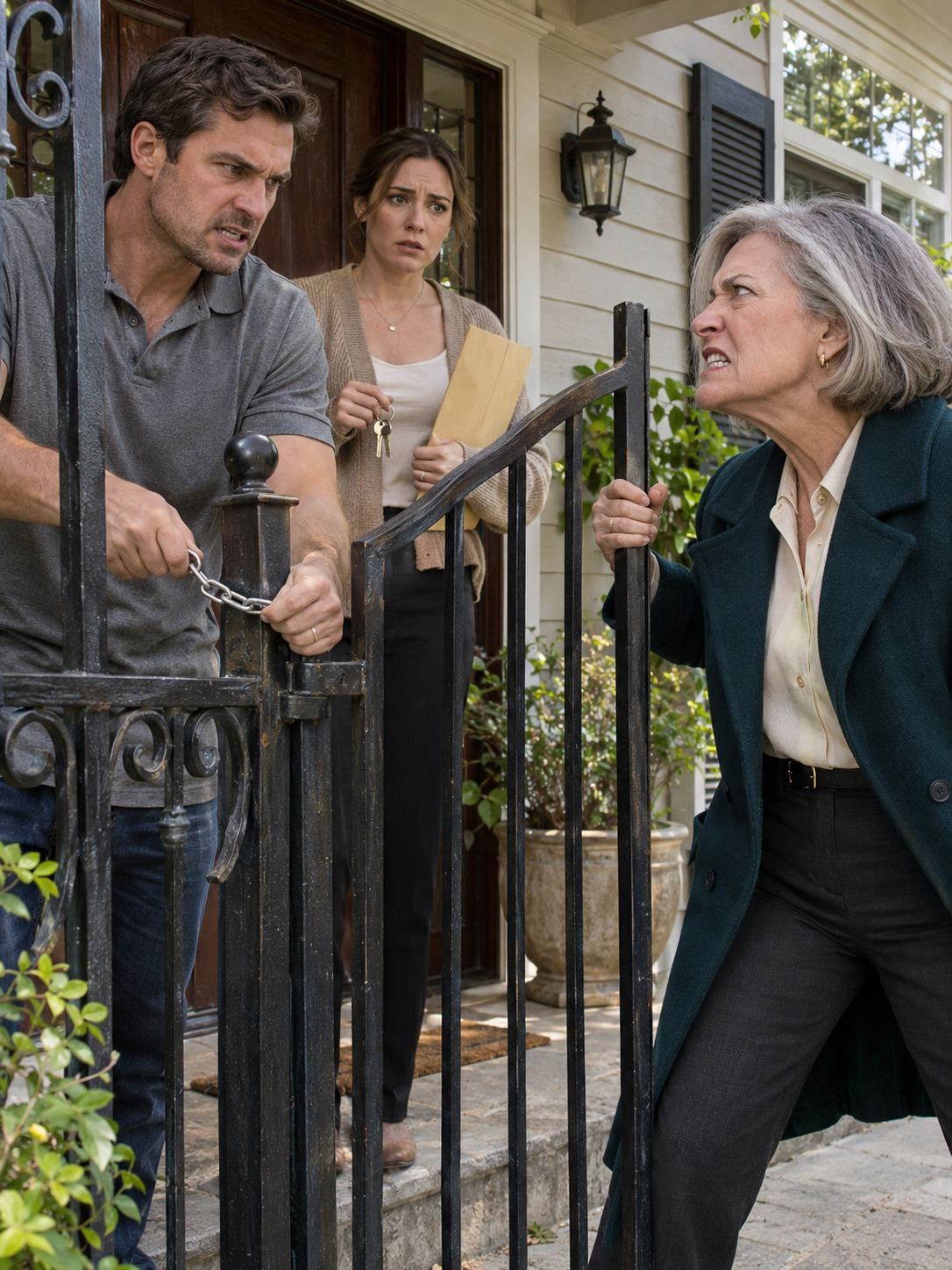
Owen was standing on the other side of the iron gate, his fingers wrapped around the loose chain. Beth remained behind him, clutching the senior residence envelope as though it could somehow protect her from what was happening.
"Mom, don't do this," Owen said.
I looked at him.
"Do what?"
"Turn a misunderstanding into something ugly."
I finally took the document from David.
At the top was a heading I recognized from the business world: PROPERTY TRANSITION AND RELOCATION AUTHORIZATION.
Below it were several paragraphs describing an agreement involving my house, my personal belongings, and the transfer of my residential arrangements to a senior living facility.
My full legal name appeared in the first section.
My home address appeared beneath it.
Then I reached the signature.
It was supposed to be mine.
The signature was convincing at first glance. Whoever had written it knew how I signed my name. The capital R was slightly oversized, the final stroke extended beneath the last name, and the letters leaned forward.
But something was wrong.
I had signed thousands of documents during my career. Contracts, purchase orders, employment agreements, banking instructions, and corporate filings.
I knew my own signature.
This one was an imitation.
"Who signed this?" I asked.
Owen shifted his weight.
"I told you. We discussed everything."
"Who signed this document?"
"Mom, you signed it."
I looked at the date.
Eighteen days earlier.
I had been in Florida.
I had not been anywhere near my house.
"David, did you witness this signature?"
He shook his head.
"No. The document was submitted electronically through an intermediary. I was informed that the authorization had already been obtained."
"Who submitted it?"
David glanced toward Owen.
"My understanding is that your son handled the submission."
I turned another page.
There were financial figures, estimated relocation costs, property preparation expenses, and a section describing compensation for coordinating the move.
I read that section twice.
Then a third time.
"What's this payment?"
David leaned closer.
"That is the amount transferred to Owen under the relocation coordination agreement."
I looked at the number.
Twenty-five thousand dollars.
For several seconds, I couldn't speak.
My son had received twenty-five thousand dollars to arrange my removal from my own house.
Beth immediately stepped forward.
"That isn't what it sounds like."
I kept my eyes on the paper.
"Then tell me what it sounds like."
"It was a family arrangement. Owen was going to use the money for expenses."
"What expenses?"
She looked at her husband.
Owen answered for her.
"Packing. Transportation. The deposit at the residence. There were a lot of things to organize."
I nodded slowly.
"Did you tell David that I had agreed to this?"
"Yes."
"Did you tell him I had agreed to sell my house?"
Owen's eyes narrowed.
"Nobody said you were selling it tomorrow."
"That's not what I asked."
David closed the folder.
"Ruth, there is something else you should know."
Owen immediately turned toward him.
"David, stop."
David didn't respond.
He removed a third document.
"This agreement includes an additional provision concerning the property."
I held out my hand.
He gave it to me.
The document was titled CONDITIONAL PROPERTY ACQUISITION.
My address appeared again.
This time, beneath the address was an estimated purchase price.
I stared at the figure.
It was substantially below the property's current market value.
The proposed buyer was a limited liability company I had never heard of.
"Who owns this company?"
David adjusted his glasses.
"I haven't independently verified its beneficial ownership."
I looked at Owen.
"Do you know?"
He rubbed the back of his neck.
"It's a development company."
"Whose development company?"
"Mom, this is getting ridiculous."
"Whose company?"
He didn't answer.
Beth looked toward the moving van.
One of the hired workers had returned to the porch. He was holding a framed photograph, waiting for instructions.
I recognized it immediately.
It was a picture of Owen at eight years old, sitting on my shoulders at a county fair.
The frame had a small crack near the bottom.
I had repaired it myself years ago.
"Put that inside," I told the worker.
He looked at Owen.
"She said put it inside," David repeated.
The worker carried the photograph through the doorway.
I watched him disappear.
Then I turned back to the papers.
"David, why did you transfer money to my son?"
David took a breath.
"I didn't personally transfer it. The payment was issued through an account connected to the relocation arrangement. My role was to coordinate the financial documentation."
"But you approved it."
"I processed the instruction based on the representations supplied to me."
"And those representations came from Owen?"
"Yes."
My son threw his hands up.
"Because somebody had to do something! You weren't here. You don't understand how much this place costs."
I looked at him.
"Do you know how much I pay in property taxes?"
He didn't answer.
"Do you know what my insurance costs?"
Nothing.
"Do you know how much is in my retirement account?"
"Mom, that's not the point."
"Do you know what I earned when I sold my company?"
His expression changed.
For the first time, I saw something other than irritation.
It was curiosity.
I had spent years keeping my finances separate from family conversations.
When I sold my ownership interest four years earlier, I had received enough to ensure that I would never need to depend on anyone for housing, medical care, or ordinary living expenses.
I had told Owen I was comfortable.
I had not told him the actual figure.
He had never asked.
Now, standing behind my own locked gate, he seemed suddenly interested.
"You have money," he said.
I studied his face.
"Of course I have money."
"Then why didn't you tell us?"
I almost smiled, but stopped myself.
"Why would I need to tell you?"
Beth intervened.
"Ruth, we're not trying to take anything from you."
I raised the document.
"Then why is my house listed for sale?"
She looked at Owen.
He looked away.
That was when I noticed something else.
The relocation agreement had a date near the bottom.
But the property acquisition document had a different date.
It was dated six days earlier.
I placed the pages side by side.
"David, why were these signed on different dates?"
He leaned over the documents.
"The relocation authorization was submitted first. The acquisition proposal followed after the initial approval."
"Initial approval from whom?"
"Your son."
I stared at him.
"Not from me?"
David hesitated.
"No."
I handed him the papers.
"Then you don't have my approval."
"That's becoming clear."
Owen stepped toward the gate.
"Mom, can we please go inside and talk like a normal family?"
I looked at the chain.
"You changed the locks."
"I can get you a new key."
"You packed my furniture."
"We can unpack it."
"You put my desk under a DONATE label."
He looked briefly embarrassed.
"That was a mistake."
"My desk?"
"Yes."
"The desk where I designed the first machine that built my company?"
He lowered his eyes.
I had bought that desk secondhand when I was twenty-nine. Its surface was scarred, and one drawer never closed properly. But it was where I had drawn the first working design of a machine that eventually became the foundation of our engineering business.
I had spent countless nights there.
Owen had grown up watching me work at it.
He knew exactly what it meant.
Yet somebody had decided it belonged in a donation pile.
I took another breath.
"Open the gate."
He looked toward David.
David's voice became firm.
"Mr. Owen, I strongly recommend that you stop interfering with your mother's access to her property."
"You're not a lawyer."
"No. But I am a financial adviser, and I know what happens when a transaction is based on authorization that may not exist."
Owen stepped back.
He pulled the chain away from the bars.
The gate opened with a metallic groan.
I picked up my suitcase and walked through.
Beth moved aside.
For a moment, I thought she might apologize.
Instead, she said, "You really should have told us you were coming home today."
I stopped.
I turned slowly.
"Why?"
She opened her mouth, then closed it.
I waited.
"Because we weren't finished preparing," she finally said.
"Preparing what?"
Her eyes moved toward the front door.
I followed her gaze.
A large cardboard box sat beside the hallway.
Another was underneath the stairs.
My name appeared on both.
I walked inside.
The house smelled of cardboard, furniture polish, and unfamiliar cleaning products.
My hallway rug was rolled tightly and secured with plastic straps.
The small table where I kept my keys had been emptied.
Even the ceramic bowl my late husband had bought during our anniversary trip was missing.
I walked into the living room.
Half the bookshelves were empty.
The photographs had been removed from the walls.
I found a small stack of framed pictures on the floor.
One showed Owen holding his high school diploma.
Another showed him at his wedding.
I picked up the wedding photograph.
Beth had been beautiful that day.
She had cried during the ceremony, and Owen had held her hand throughout the reception.
I remembered being happy for them.
I remembered telling my son that I hoped he would always protect the people he loved.
Now I wondered what he thought protection meant.
David entered behind me.
"Ruth, I suggest we stop the relocation immediately."
"Agreed."
"I'll contact the appropriate parties and notify them that the authorization is disputed."
"Do that."
Owen appeared in the doorway.
"You're overreacting."
I placed the wedding photograph carefully on the mantel.
"No. I'm asking questions."
"You always do this. You take one thing and turn it into a huge problem."
"Then answer one question."
He folded his arms.
"What?"
"Who is buying my house?"
He looked at the floor.
Beth turned away.
David watched him.
Finally, Owen said, "It's a company connected to someone I know."
"Who?"
"I don't know every detail."
"Then how did you negotiate the arrangement?"
"I was handling the practical side."
"Who introduced you?"
He remained silent.
I moved toward my desk.
The DONATE label was still attached.
I peeled it away and ran my fingers across the old wooden surface.
A faint pencil mark remained near the back corner.
It was from the first time Owen had tried to draw a picture of a car when he was six.
I had never removed it.
"David," I said without turning around.
"Yes?"
"Please take photographs of every document, every label, and every item that has been moved."
Owen gave a short, disbelieving laugh.
"You're seriously treating your own son like a criminal?"
I looked at him.
"I'm treating an unauthorized transaction like an unauthorized transaction."
His expression hardened.
Beth finally spoke.
"Maybe we should leave."
Owen didn't move.
"Beth."
She looked at him.
"Let's go."
But David wasn't finished.
He had been examining the acquisition document again.
"Ruth, there's one more thing."
I turned.
He held the paper closer to the light.
"Look at the company name here."
I read it.
The name was unfamiliar.
Then he pointed to the registered mailing address.
My eyes moved across the line.
It was a commercial office building downtown.
I knew that building.
My former engineering company had maintained an office there for years.
"Why is the buyer registered at that address?" I asked.
David frowned.
"I don't know."
I studied the company name again.
Something about it bothered me.
It sounded familiar, but I couldn't place it.
Then my phone vibrated.
An unknown number.
I almost ignored it.
But the message contained a photograph.
It showed the front of my house.
The same black iron gate.
The same porch.
The same moving van.
Below the photograph were eleven words:
Ruth, don't let Owen sign anything else. Your husband left something here.
I read it twice.
My husband had been dead for seven years.
I slowly looked up.
"Owen."
He was already watching me.
"Who sent this?"
He took one look at my phone.
And the color disappeared from his face.
Then the unknown number began calling...






Comments 0