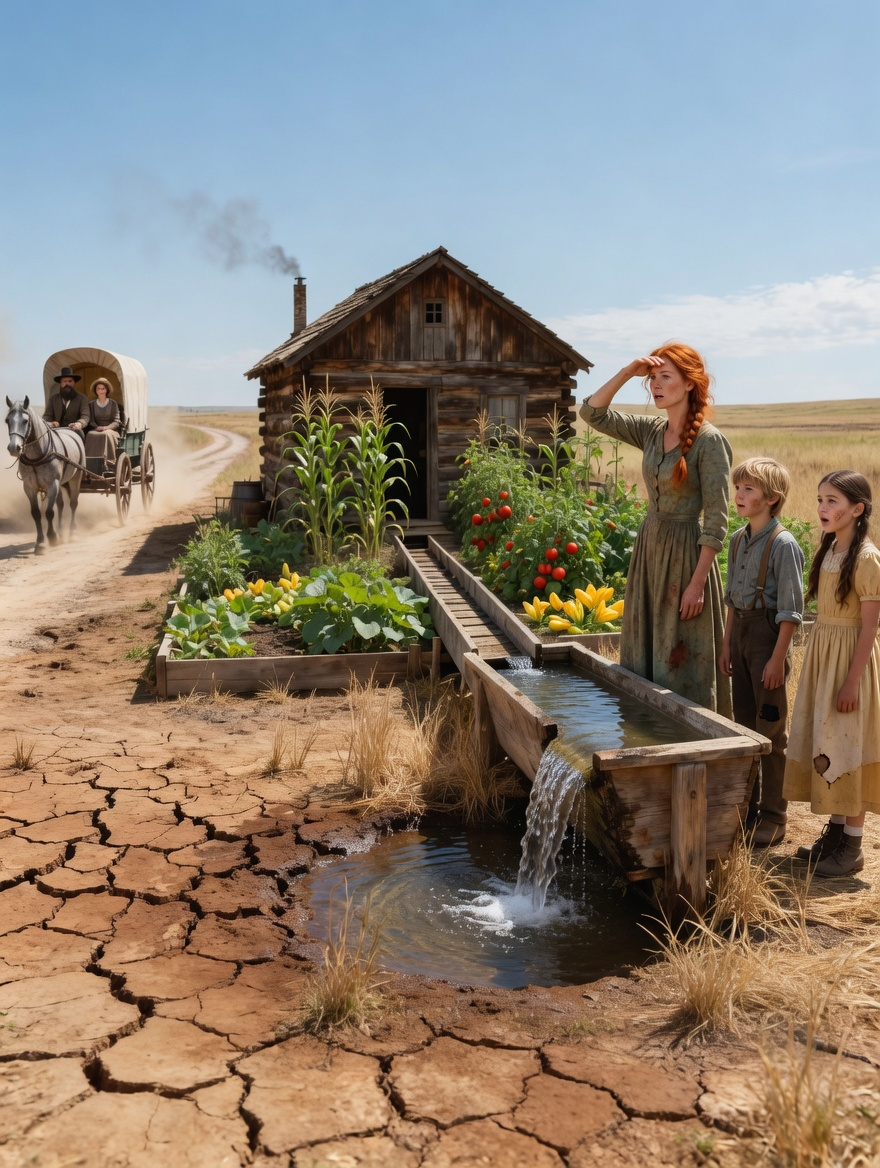
"Take your children and get out!" Constance Hargrove shouted, forcing a folded bill into Clara's hand.
Her husband, Theodore Hargrove, stood beside the parlor desk holding a leather-bound property ledger.
A small notation appeared beneath Erik Reinhold's name.
Widow's allowance: $5.00.
Clara understood that her husband's family had already decided her future.
And they had made their decision before she entered the room.
For several seconds, nobody moved.
The grandfather clock against the wall ticked so loudly that Clara could hear each individual movement of its brass mechanism.
Five dollars.
That was the amount Constance Hargrove had decided her daughter-in-law was worth.
Not five dollars a week.
Not five dollars until Clara found work.
Five dollars in total.
The money rested against Clara's palm, soft from years of passing between strangers, its corners bent and its green ink faded.
Constance stood opposite her in a dark silk dress, her silver hair arranged beneath a lace cap. Her expression contained no embarrassment, no regret, and certainly no compassion.
"This conversation is finished," she said.
Clara looked down at the bill.
Then she looked at the portrait above the fireplace.
Erik.
Her husband had been dead for four months, yet sometimes she still expected to hear his boots crossing the hallway.
He had possessed an easy laugh and a habit of brushing his thumb across her knuckles whenever he sensed she was worried.
When their son Nils was born, Erik had wept openly, astonishing the midwife.
When their daughter Maja arrived three years later, he had lifted the baby toward the window and promised her she would never have to be afraid of the world.
He had meant it.
That was the cruelest part.
Erik had meant every promise he made.
But promises could not stop a falling tree.
And a dead man could not defend his wife.
"Are you listening?" Constance demanded.
Clara turned toward her.
"Yes."
"Then I suggest you begin packing."
Theodore shifted beside the desk.
He was a broad-shouldered man whose beard had gone almost entirely white. His logging business had made him one of the wealthiest landowners in Millbrook County.
Men stood when he entered a room.
Bankers shook his hand with both of theirs.
At church, people waited for him to take his seat before choosing their own.
Yet now, standing only a few feet from his widowed daughter-in-law, Theodore seemed unable to meet her eyes.
"Constance," he said quietly, "perhaps we might give her until the end of the week."
His wife turned.
"The end of the week?"
"She has the children to consider."
"Exactly. And the sooner she learns to provide for them, the better."
Clara watched Theodore's shoulders settle.
He would not argue.
He never did.
During seven years of marriage, Clara had learned that Theodore Hargrove could command forty lumbermen without raising his voice, but could not contradict his wife across a dinner table.
Constance looked back at Clara.
"You have been living under this roof at our expense since Erik's death."
Clara felt something tighten beneath her ribs.
"At your expense?"
"Do not begin."
"I kept the accounts for the eastern logging operation."
"Erik kept those accounts."
"Erik could barely remember where he put his spectacles."
Theodore glanced up.
For one brief moment, Clara thought he might smile.
He did not.
She continued.
"I balanced the wages. I recorded the timber shipments. I wrote the letters to the suppliers when the river froze and deliveries stopped. When the men were sick, I brought them food. When your kitchen maid left, I baked bread before sunrise."
Constance's lips narrowed.
"All perfectly ordinary duties for a wife."
"And after Erik died?"
"Clara."
"I continued the accounts for six weeks after his funeral."
"Enough."
"I did it because Theodore asked me."
Theodore looked at the ledger.
Constance stepped closer.
"You have mistaken usefulness for importance."
The words struck harder than Clara expected.
Not because they were new.
Constance had spent seven years reminding her that she had married above her station.
Clara's father had been a schoolteacher. Her mother had taken in sewing. There had never been much money in their home, but there had always been books, music, and supper enough for anyone who arrived hungry.
Constance considered such a childhood evidence of poor breeding.
Erik had laughed at that.
"My mother thinks money is inherited in the blood," he once told Clara. "If that were true, she'd have gold coins instead of a heart."
Clara had laughed until he kissed her.
Now the memory felt like a hand closing around her throat.
From the doorway came a small voice.
"Mama?"
Clara turned.
Nils stood in the hall.
He was ten years old, thin from a recent growth spurt, with sandy-brown hair that refused to lie flat. His faded rust-red shirt hung loosely beneath a gray vest.
His sister Maja stood behind him.
At six, Maja still carried the cloth doll Clara had made from scraps of an old apron. Its stitched face had faded, and one arm was shorter than the other.
Both children were watching the adults.
Nils looked at the money in Clara's hand.
"Why is Grandmother giving you that?"
Constance answered before Clara could speak.
"Your mother is leaving."
Maja tightened her grip on the doll.
"Leaving where?"
"She will find somewhere suitable."
Nils looked from his grandmother to his mother.
"Are we going too?"
Constance folded her hands.
"That depends."
Clara felt a warning stir inside her.
"Depends on what?"
"On whether you are prepared to be sensible."
Constance approached the children.
"Nils, Maja, you know your grandfather and I love you very much."
Neither child answered.
"You have always had warm beds here. Good food. Proper clothing. Lessons. A respectable home."
Maja edged toward her brother.
Constance continued.
"Your mother has decided she wants to live independently."
"That is not what happened," Clara said.
Constance ignored her.
"Unfortunately, independence can be difficult for a woman without property."
Nils looked at Clara.
"Mama?"
Clara crossed the room and placed herself between Constance and the children.
"What are you proposing?"
Constance's face softened into an expression Clara distrusted more than her anger.
"The children may stay."
Silence.
Theodore closed the ledger.
Clara stared at her mother-in-law.
"What?"
"The children may remain here. We will see that they receive a proper upbringing. You may visit when circumstances permit."
Maja grabbed Clara's skirt.
Nils stood very still.
Clara felt her heartbeat in her ears.
"You want me to leave them."
"I want to spare them unnecessary suffering."
"You want to take my children."
"I want to protect my grandchildren."
"From their mother?"
"From poverty."
Clara looked at Theodore.
He remained silent.
She understood then that the five dollars had never been the entire punishment.
The money was bait.
Constance expected Clara to walk out, fail, return humiliated, and surrender her children in exchange for a roof.
It was not enough to remove her from the family.
Constance wanted Clara to acknowledge that she had never belonged there.
Clara knelt in front of Nils and Maja.
She took one of their hands in each of hers.
"We're going on an adventure," she said.
Maja blinked.
"Like the stories Papa told?"
Clara swallowed.
"Something like that."
Nils searched her face.
"Will we come back?"
Clara looked toward the portrait.
Erik's painted eyes seemed to follow her.
"No," she said quietly. "Not to live here."
Maja's mouth trembled.
"But my bed—"
"We'll find another bed."
"And my books?"
"We'll take your favorites."
Nils looked past her at Constance.
"Grandmother says we can stay."
Clara gently squeezed his hand.
"I know."
"Would it be easier?"
The question nearly broke her.
He was ten years old.
He should have been thinking about fishing, school lessons, and whether the first snowfall would be deep enough for sledding.
Instead, he was asking his mother whether leaving him behind would make her life easier.
Clara leaned forward until her forehead touched his.
"Listen to me carefully," she whispered. "You and your sister are not burdens. You are my family. Wherever we go, we go together."
Nils nodded.
Maja pressed against her shoulder.
Behind them, Constance gave an impatient sigh.
"Sentiment will not feed children."
Clara stood.
"Neither will cruelty."
Theodore lifted his head.
Constance's expression hardened.
"Be very careful."
Clara folded the five-dollar bill once and placed it inside the pocket of her apron.
"I will."
Then she took her children upstairs.
Their belongings fit into two traveling bags.
That fact hurt more than Clara expected.
Seven years in the Hargrove house.
Seven years of marriage.
Two births.
A thousand ordinary mornings.
And everything she was permitted to take could be carried by one woman and two children.
She packed Nils's arithmetic book, his father's old pocket compass, two shirts, and a pair of wool stockings.
For Maja, she packed her favorite picture book, a second dress, a ribbon, and the cloth doll.
Clara took her mother's sewing needles, a small tin of buttons, Erik's pocketknife, and a photograph from their wedding.
She hesitated over the photograph.
Erik stood beside her beneath the apple tree behind the church. He was smiling at something outside the frame.
Clara remembered what it was.
A goat had escaped from the neighboring farm and begun eating the flowers arranged for the wedding.
Erik had laughed so hard that the photographer had threatened to leave.
Clara slipped the picture between the pages of her Bible.
She changed into her faded navy-blue traveling dress, fastened the worn leather belt around her waist, and tied her dark chestnut hair into a low braided bun.
Then she took one last look around the bedroom.
On the bed lay Erik's old wool scarf.
She picked it up.
For a moment, she pressed it against her face.
It no longer smelled like him.
That was when she understood how thoroughly death could steal a person.
Not all at once.
A little every day.
First the voice.
Then the warmth of their clothes.
Then the sound of their footsteps.
Until the things they left behind became ordinary objects again.
Clara folded the scarf and placed it in her bag.
Downstairs, Theodore waited beside the front door.
Constance was nowhere to be seen.
He held a small envelope.
"Clara."
She stopped.
The children stood close beside her.
Theodore looked at the envelope, then at Nils.
"I thought perhaps—"
A door opened behind him.
Constance appeared at the end of the hallway.
"Theodore."
His hand lowered.
Clara watched him slide the envelope back into his coat.
The movement was small.
It told her everything.
"Goodbye, Father," she said.
He flinched at the word.
She had called him Father since her wedding day.
Now it sounded like a farewell to something that had never truly existed.
Outside, the air carried the smell of damp leaves and wood smoke.
Clara took Maja's hand.
Nils carried one bag.
She carried the other.
They walked down the long gravel drive without looking back.
At the gate, Maja asked whether Grandmother would come after them.
"No, sweetheart."
"Will Grandfather?"
Clara hesitated.
"I don't think so."
Nils looked up at the house.
"Papa wouldn't have let them do this."
Clara stopped.
For a moment, she could not speak.
Then she knelt and straightened his vest.
"No," she said. "He wouldn't."
They continued toward Millbrook.
By the time they reached the boardinghouse, the sun had slipped behind the trees.
Mrs. Bellamy, who ran the establishment, opened the door with flour on her hands.
She had known Clara for years.
Her expression changed when she saw the children and the bags.
"Oh, Mrs. Reinhold."
"Good evening. I wondered whether you had a room."
Mrs. Bellamy glanced over her shoulder.
"For how long?"
"Just until I find work."
The woman hesitated.
"I heard about Erik. Such a terrible thing."
"Thank you."
"And your husband's family?"
Clara held her gaze.
"We are no longer staying with them."
Mrs. Bellamy understood immediately.
Her expression became uncomfortable.
"I wish I could help."
Clara glanced toward the staircase.
"Even a small room would do."
"It's not that."
"Then what is it?"
Mrs. Bellamy lowered her voice.
"Mrs. Hargrove came by this afternoon."
Clara felt the blood drain from her face.
"Constance?"
"She said there might be trouble if I took you in."
"What kind of trouble?"
"She didn't say."
The boardinghouse owner looked toward the street.
"My husband supplies linens to the Hargrove camps. We can't afford to lose that business."
Clara nodded.
"Of course."
Mrs. Bellamy's eyes filled with embarrassment.
"I am sorry."
Clara took Maja's hand.
"So am I."
The next boardinghouse refused them.
Then the third.
At the church, Reverend Whitcomb explained that the spare room was being repaired.
At the general store, the owner suggested she speak to the banker.
The banker listened while Clara explained that she could keep accounts, teach children, sew, bake, and manage household expenses.
He folded his hands over his stomach.
"A widow with two dependents is not a sound financial risk."
"I am asking for employment, not charity."
"And I am telling you that respectable households do not hire women who are involved in family disputes."
Clara stared at him.
"Who told you there was a dispute?"
The banker did not answer.
By dusk, Clara understood.
Constance had not merely thrown her out.
She had made certain there would be nowhere for her to go.
They bought a small loaf of bread with the few coins Clara still had in her purse.
She divided it into three pieces.
Nils noticed hers was the smallest.
"You can have some of mine."
"I'm not very hungry."
He looked at her.
They both knew she was lying.
He tore his bread in half and placed one piece in her hand anyway.
Clara nearly cried.
She did not.
Instead, she ate it.
Night fell.
The church woodshed stood behind the building, sheltered from the worst of the wind.
Clara found an unlocked side door.
Inside were stacked logs, old tools, and a narrow space beneath a wooden bench.
She spread a borrowed blanket across the floor.
Maja lay down first.
Nils curled beside her.
Clara wrapped her arms around both children and listened to the wind moving through the cracks.
For a long time, nobody spoke.
Then Nils whispered, "Mama?"
"Yes?"
"Are we poor now?"
Clara looked into the darkness.
She could have lied.
She could have promised that everything would be fine.
She could have told him that his grandmother would change her mind.
But the boy had already seen too many adults disguise cruelty as kindness.
He deserved the truth.
"Yes," she whispered. "We are poor now."
Nils was silent.
Then he asked, "Are we going to stay poor?"
Clara looked toward the narrow strip of moonlight beneath the door.
"I don't know."
Maja stirred in her sleep.
Clara pulled the blanket higher around her.
"But I know something else."
"What?"
"We are still together."
Nils reached for her hand.
His fingers were cold.
Clara held them until his breathing grew slow and steady.
Only then did she allow herself to think about the morning.
She had five dollars.
Two children.
No home.
No work.
No friends willing to challenge the Hargroves.
And somewhere beyond the town limits, there had to be a place where Constance's influence ended.
The next morning, Clara walked into the county land office.
A young clerk sat behind a high wooden counter, sorting papers.
He barely glanced up.
"Can I help you?"
"I want to buy land."
He looked at her clothing, then at the two children standing beside her.
"Land?"
"Yes."
"How much acreage?"
"As much as I can afford."
"And what is your budget?"
Clara placed the folded bill on the counter.
"Five dollars."
The clerk laughed.
Then he saw that she was not smiling.
His laughter faded.
"Ma'am, five dollars won't buy a decent horse."
"I'm not looking for a horse."
"It won't buy a building lot in town."
"Then show me something outside town."
He shook his head.
"There isn't anything."
Clara left the money on the counter.
"Please check."
The clerk sighed and reached for a large leather ledger.
He turned several pages.
Stopped.
Turned another.
Then frowned.
"Well."
Clara waited.
"There is one property."
"Where?"
"Forty acres past Miller's Creek."
"Is there a house?"
"A cabin. If you want to call it that."
"What's wrong with it?"
The clerk looked up.
"Everything."
Clara said nothing.
"The structure is old. The ground is bad. The road is barely passable. Nobody has lived there for three years."
"Why?"
The clerk hesitated.
"Water."
Clara frowned.
"Water?"
"Comes up through the floorboards. Doesn't matter how dry the weather gets. The place stays wet."
"Is the roof sound?"
"Somewhat."
"Are the walls standing?"
"Last time anyone checked."
"Is the deed clear?"
The clerk studied her.
"Yes."
"Any outstanding taxes?"
"Settled under the county abandonment sale."
"Any claims against the land?"
"None recorded."
Clara looked at the bill.
"Then I'll take it."
The clerk stared at her.
"You haven't even seen it."
"Will someone else buy it before tomorrow?"
He gave a short laugh.
"Nobody's buying that place."
"Then I would like the deed."
He leaned back.
"Mrs. Reinhold, I feel obligated to warn you. The Lindquist cabin has ruined every family that tried to live there."
Clara looked directly at him.
"Has anyone tried to understand where the water comes from?"
The clerk blinked.
"What's to understand? The place floods."
"Is it river water?"
"I don't know."
"Rainwater?"
"Nobody knows."
"Does it smell?"
He frowned.
"What?"
"The water. Does it smell rotten?"
"I've never been there."
"Then how do you know the land is worthless?"
The clerk opened his mouth.
Closed it.
Finally, he pulled a yellowed document from beneath the ledger.
"Because everyone says it is."
Clara looked at the deed.
At the bottom was a description of the property.
Forty acres.
One log dwelling.
Unimproved land.
Permanent water intrusion.
She reached for the pen.
The clerk stopped her.
"There's one more thing."
Clara looked up.
"What?"
He turned the deed over.
On the back, beneath an old surveyor's stamp, someone had written a note in faded ink.
The clerk stared at it for a moment.
"That's strange."
"What is?"
He brought the paper closer to the window.
The words were faint, but still legible.
Northwest foundation. Do not seal.
Clara leaned forward.
"Who wrote that?"
The clerk shook his head.
"I have no idea."
He examined the old survey date.
Then his expression changed.
"Wait."
He reached beneath the counter and pulled out another ledger.
Its binding cracked when he opened it.
He turned to a page near the back.
There, beside the original Lindquist property record, was a name Clara recognized.
Her grandmother's maiden name.
And directly beneath it was a second entry that made the clerk go silent.
He looked from the ledger to Clara.
"Mrs. Reinhold," he said slowly, "there is something about this land you need to see."
He turned the book toward her.
And pointed to a single line.






Comments 0